Kimi

Search documents
梁文锋等来及时雨
虎嗅APP· 2025-07-16 00:05
Core Viewpoint - The article discusses the competitive landscape of AI models, particularly focusing on DeepSeek and its challenges in maintaining user engagement and market position against emerging competitors like Kimi and others in the "AI Six Dragons" group. Group 1: DeepSeek's Performance and Challenges - DeepSeek experienced a significant decline in monthly active users, dropping from a peak of 169 million in January to a decrease of 5.1% by May [1][2]. - The download ranking of DeepSeek has plummeted, moving from the top of the App Store charts to outside the top 30 [2]. - The user engagement rate for DeepSeek has fallen from 7.5% at the beginning of the year to 3% by the end of May, with a 29% decrease in website traffic [2][3]. Group 2: Competition and Market Dynamics - Competitors like Kimi and others are rapidly releasing new models, with Kimi K2 achieving significant performance benchmarks and offering competitive pricing [1][8]. - The pricing strategy of Kimi K2 aligns closely with DeepSeek's API pricing, making it a direct competitor in terms of cost [8]. - Other players in the market are also emphasizing lower costs and better performance, which is eroding DeepSeek's previously established reputation for cost-effectiveness [7][8]. Group 3: Technological and Strategic Implications - DeepSeek's reliance on the H20 chip has been impacted by export restrictions, which has hindered its ability to scale and innovate [3][4]. - The lack of major updates to DeepSeek's models has led to a perception of stagnation, while competitors are rapidly iterating and improving their offerings [6][12]. - The article highlights the importance of multi-modal capabilities, which DeepSeek currently lacks, potentially limiting its appeal in a market that increasingly values such features [13]. Group 4: Future Outlook - To regain market interest, DeepSeek needs to expedite the release of new models like V4 and R2, as well as enhance its tool capabilities to meet developer needs [12][13]. - The competitive landscape is shifting rapidly, and without significant updates or innovations, DeepSeek risks losing further ground to its rivals [12][14]. - The article suggests that maintaining developer engagement and user interest is crucial for DeepSeek's long-term success in the evolving AI market [11].


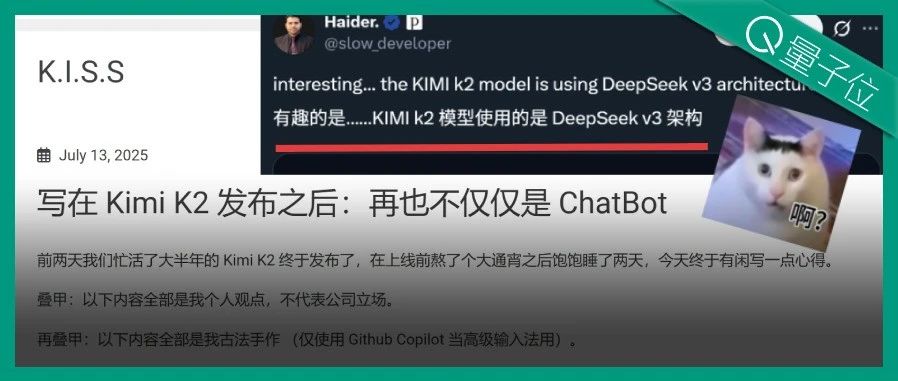
Kimi K2里找到了DeepSeek V3架构
量子位· 2025-07-14 07:01
Core Viewpoint - Kimi's new model K2 has gained significant attention and positive feedback for its performance in various benchmarks and its ability to handle productivity-level tasks effectively [1][4]. Group 1: Kimi K2 Model Insights - Kimi K2 is noted for its strong tool-calling capabilities, making it suitable for production-level tasks [1]. - The model is built on the DeepSeek V3 architecture, which has sparked discussions about its design and performance [5][83]. - Kimi K2 has two versions: Kimi-K2-Base, a pre-trained model for research and customization, and Kimi-K2-Instruct, a fine-tuned version for general instruction tasks [15][16]. Group 2: Open Source Strategy - Kimi's decision to open source K2 is primarily aimed at gaining recognition and leveraging community support to enhance its technology ecosystem [9][12]. - The open-source approach allows for community contributions, which can lead to rapid improvements and innovations in the model [14][18]. - Kimi has ceased marketing expenditures since early this year, focusing instead on the strength of its model to gain market recognition [20][22]. Group 3: Product Development and Features - Kimi is committed to foundational model research, even amidst trends favoring agent products, emphasizing the importance of model capabilities in determining AI performance [24][27]. - The Kimi team is exploring innovative product designs, such as transitioning from text-based outputs to more interactive formats, enhancing user experience [28][30]. - Kimi K2 has demonstrated significant improvements in generating complex outputs, such as games and travel plans, showcasing its advanced capabilities [39][62]. Group 4: Market Context and Competition - The delay in OpenAI's open-source model release has been speculated to be influenced by Kimi K2's performance, although OpenAI cites safety concerns as the official reason [2][76]. - There are rumors that OpenAI's model, while smaller than K2, is still powerful but faced issues that necessitated retraining before release [81][82].
【早报】A股利好!险资长周期考核机制落地;2025年医保目录调整正式启动,新增商保创新药目录
财联社· 2025-07-13 23:10
Industry News - The national insurance companies have fully implemented a long-cycle assessment mechanism of over three years, with the addition of five-year cycle indicators. The net asset return rate will now include a five-year cycle indicator, with weights of 30%, 50%, and 20% for the current year, three-year, and five-year indicators respectively [1][8] - The adjustment of the national basic medical insurance, maternity insurance, and work-related injury insurance drug catalog, as well as the commercial health insurance innovative drug catalog, has officially started. The new commercial insurance innovative drug catalog focuses on high innovation and significant clinical value drugs that cannot be included in the basic catalog due to exceeding the "basic protection" positioning [2][10] - The China Securities Association has released 28 measures to promote high-quality development in the securities industry, focusing on improving self-regulatory management and enhancing service functions [3][9] - The Shanghai Stock Exchange has published guidelines for the Sci-Tech Innovation Board, allowing 32 existing unprofitable companies to enter the growth layer immediately, with no additional listing thresholds for new unprofitable companies [3][6] Company News - China Shenhua announced a net profit of 23.6 billion to 25.6 billion yuan for the first half of the year, representing a year-on-year decline of 13.2% to 20% [14] - Fuda Alloy plans to acquire at least 51% of the shares of TOPCon battery silver paste company Guangda Electronics [15] - Huaxi Securities expects a year-on-year increase in net profit of 1025% to 1354% for the first half of the year [15] - Zijin Mining anticipates a net profit of approximately 23.2 billion yuan for the first half of the year, a year-on-year increase of 54% [16] - Sanhe Pile expects a year-on-year increase in net profit of 3091% to 3889% for the first half of the year [17] - Limin Co. anticipates a year-on-year increase in net profit of 719.25% to 782.27% for the first half of the year [17] - Lanqi Technology expects a year-on-year increase in net profit of 85.50% to 102.36% for the first half of the year [18] - Aopu Mai expects a net profit of approximately 37 million yuan for the first half of the year, a year-on-year increase of 53.28% [19] - China Jushi anticipates a year-on-year increase in net profit of 71.65% to 76.85% for the first half of the year [19] - Gaode Infrared expects a year-on-year increase in net profit of 735% to 957% for the first half of the year [19] - Degute is planning to acquire 100% of Haowei Technology, with stock resuming trading [19] - Kanghua Bio is planning a change of control, with stock suspended from trading [19] - Dongfang Caifu announced that its subsidiary Hafu Securities has been approved by the Hong Kong Securities and Futures Commission to provide virtual asset trading services [20] - Galaxy Microelectronics plans to invest 310 million yuan to build the first phase of a high-end integrated circuit discrete device industrialization base [20]




杨植麟被梁文锋叫醒了!Kimi新模型发布即开源,1T参数全线SOTA
量子位· 2025-07-12 04:57
Core Viewpoint - Kimi has responded to the challenges posed by DeepSeek with the launch of its new K2 model, emphasizing its commitment to innovation and competitiveness in the AI space [5][67]. Group 1: Kimi K2 Model Overview - The Kimi K2 model features a total parameter count of 1 trillion (1T) with 32 billion (32B) active parameters, showcasing its advanced capabilities in coding, agent tasks, and mathematical reasoning [2][8]. - Kimi K2 supports a context length of 128,000 tokens, enhancing its ability to handle complex tasks [9]. - The model has achieved state-of-the-art (SOTA) results in various benchmark tests, including SWE Bench Verified, Tau2, and AceBench [11]. Group 2: Open Source Strategy - Kimi K2 is released as an open-source model, with two versions available: Kimi-K2-Base and Kimi-K2-Instruct, adhering to a modified MIT license [4][25]. - The modified MIT license allows for broad usage, but requires attribution if the product reaches over 100 million monthly active users or generates over $20 million in monthly revenue [26]. Group 3: Technical Innovations - Kimi K2 introduces the MuonClip optimizer, which replaces the traditional Adam optimizer, improving training stability and token efficiency [29][30]. - The model has been trained on 15.5 trillion tokens without loss spikes, indicating robust performance during training [31]. - Kimi K2 employs a self-judging mechanism for reinforcement learning, enhancing its performance on both verifiable and non-verifiable tasks [34]. Group 4: Market Context and Competitive Landscape - Kimi was previously a leading player in the AI assistant market, holding a significant share alongside competitors like Doubao AI and Wenxin Yiyan, which collectively dominate 70% of the market [56][58]. - The launch of DeepSeek R1 has disrupted the market, prompting Kimi to reaffirm its commitment to developing its own foundational models despite the competitive pressures [66][67]. - Kimi's strategy focuses on creating a stronger open-source model to regain its technological leadership and address the challenges posed by competitors [68].

Kimi和Minimax,争夺“下一个DeepSeek”心智
3 6 Ke· 2025-07-01 08:41
Core Insights - The emergence of DeepSeek has significantly altered the landscape of China's large model industry, shifting the focus from the previous "six small dragons" to the current "five major models" [1] - Kimi and Minimax have recently made notable advancements, with Kimi launching the Kimi-Researcher model and Minimax introducing the Minimax-M1 inference model, both aiming to establish their presence in the competitive landscape [3][7] Group 1: Kimi's Developments - Kimi is focusing on agent technology, particularly in deep research, targeting sectors like finance and academia, which allows it to differentiate from larger companies that focus on lifestyle services [3][7] - The Kimi-Researcher model, based on end-to-end agentic reinforcement learning, has begun small-scale testing, showcasing its ability to conduct deep research tasks effectively [7][8] - Kimi's model reportedly performs an average of 23 reasoning steps per task, plans 74 keywords, and identifies the top 3.2% of high-quality content from 206 websites, indicating a strong emphasis on practical utility and reliability [8][10] Group 2: Minimax's Innovations - Minimax has launched the Minimax-M1 model, which boasts one of the top two long-context understanding capabilities globally, with a total of 456 billion parameters and support for 1 million tokens in input length [11][20] - The M1 model's performance in specialized context evaluations surpasses all open-source models, including DeepSeek-R1-0528 and Qwen3-235B, and is only slightly behind the state-of-the-art Gemini 2.5 Pro [11][20] - Minimax is also making strides in agent and multimodal technologies, demonstrating practical applications such as AI-driven English learning content on social media platforms [13] Group 3: Competitive Landscape and Future Outlook - The competition in the large model sector is evolving, with Kimi and Minimax seeking to redefine their strategies in response to the dominance of larger players like DeepSeek [3][22] - Both companies are aiming for a "turnaround" in the next phase of competition, focusing on their unique technological strengths and market positioning to capture user attention [22][30] - The industry is witnessing a shift from mere parameter competition to a focus on capturing user perception and establishing a unique identity in the market [27][29]

一年后,当Kimi和MiniMax投资人再坐到一起
36氪· 2025-06-26 10:15
Core Viewpoint - The landscape of China's AI industry has dramatically changed with the emergence of DeepSeek, shifting the focus from direct competition between Kimi and MiniMax to broader discussions about AI's role in society and its implications for human understanding [3][4]. Group 1: Industry Dynamics - The competition among major AI companies has evolved, with DeepSeek's advancements benefiting all Chinese AI firms, indicating that the AI model war is far from over [4][17]. - The investment environment for large models has become more challenging due to DeepSeek's influence, prompting companies to reassess their strategies and focus on innovation [14][18]. - The emergence of Agent technology is seen as a significant opportunity, with applications expected to enhance productivity and efficiency across various sectors [22][28]. Group 2: Investment Insights - Investors emphasize the importance of strong teams over mere technological advancements, highlighting that the ability to innovate and adapt is crucial in the rapidly changing AI landscape [10][50]. - The AI sector is characterized by a fast-paced evolution, with the potential for significant breakthroughs and the emergence of new market leaders within a short timeframe [54][55]. - The current investment climate is marked by a mix of optimism and caution, as investors navigate the challenges of identifying viable opportunities amidst a backdrop of potential bubbles in emerging technologies [41][44]. Group 3: Future Implications - The future of AI is expected to bring about unprecedented changes, with AI potentially surpassing human capabilities in various fields, leading to a redefinition of industry standards [64][66]. - The relationship between humans and AI is anticipated to deepen, prompting a greater emphasis on understanding human nature and societal complexities in the context of AI development [66][67]. - The ongoing exploration of embodied intelligence and its commercial viability remains a focal point, with the industry still in the early stages of defining its technological pathways [39][45].

Kimi还能找到月之亮面吗?
3 6 Ke· 2025-06-25 08:08
Core Insights - Kimi, once a prominent player in the AI space, has seen a decline in attention as newer models from companies like Quark, Tencent, and Alibaba gain traction [1][2] - The initial hype around Kimi was driven by its technological scarcity, particularly its long-text processing capabilities, which were unmatched at the time [2][3] - Kimi's early valuation of $3 billion was supported by its unique technology, the founder's impressive background, and the capital's anxiety to find a domestic alternative to leading AI models [4][5] Technology and Market Position - Kimi's long-text processing ability, which expanded from 200,000 to 2 million words, was a significant technological breakthrough that positioned it as a leader in the AI field [2][3] - The founder, Yang Zhilin, had a strong academic and entrepreneurial background, which enhanced investor confidence in Kimi's potential [3][4] - The competitive landscape was characterized by a rush to find alternatives to ChatGPT, leading to Kimi's rapid user acquisition through aggressive marketing strategies [4][5] Financial Strategy and User Acquisition - Kimi faced challenges in managing its newfound capital, leading to excessive spending on user acquisition, with monthly advertising costs peaking at 220 million RMB [6][7] - Despite a significant increase in daily active users (DAU) from 508,300 to 5,897,000, this growth was primarily driven by financial investment rather than product quality [8][9] - The pressure from investors to demonstrate commercial viability led Kimi to prioritize user numbers over technological development, resulting in a loss of strategic direction [8][9] Challenges and Strategic Missteps - Kimi's marketing strategy shifted focus from its core user base in academia and professional fields to entertainment sectors, diluting its brand identity [11][12] - The company struggled with maintaining its technological edge as competitors began to catch up, particularly with the emergence of open-source models [12][13] - Kimi's reliance on user growth without a solid feedback loop or data quality management led to a false sense of security regarding its market position [13] Future Opportunities - Kimi has potential avenues for recovery, including enhancing the value density of its products and focusing on deep search capabilities for specific industries [15][17] - The company could benefit from developing comprehensive tools for developers, improving its API offerings to facilitate easier integration for enterprise clients [18][19] - Emphasizing quality over quantity in user engagement and product offerings could help Kimi regain trust and market relevance [20][21] Strategic Recommendations - Kimi needs to establish a clear commercial strategy from the outset, ensuring that its products meet genuine market demands and have viable monetization paths [29][30] - The focus should shift towards building a sustainable revenue model based on user payments rather than relying on external funding for growth [31] - A strategic approach that prioritizes understanding and fulfilling real user needs will be crucial for Kimi's long-term success in the competitive AI landscape [31][32]
Kimi没有梦想
Hu Xiu· 2025-06-24 05:32
Core Viewpoint - The article discusses the rise and challenges faced by Kimi, an AI company, highlighting the impact of FOMO (Fear of Missing Out) on its growth and subsequent issues, including a shift in investor sentiment and operational strategies [10][22]. Group 1: Company Overview - Kimi has transitioned from a promising AI startup to facing significant challenges, including a decline in its competitive edge and user growth [7][22]. - The company was once valued at $30 billion, largely due to FOMO-driven investments, particularly from Alibaba, which invested nearly $800 million [14][15]. Group 2: Business Strategy and Challenges - Kimi's aggressive user acquisition strategy involved significant spending on marketing, reminiscent of past failed models like ofo bike-sharing [16][17]. - The reliance on the "Scaling Law" and "data flywheel" theories has been criticized, with experts suggesting that merely increasing data and computational power does not guarantee improved model performance [18][20]. Group 3: Market Dynamics and Future Outlook - The AI landscape is shifting, with new models challenging existing paradigms, indicating a need for Kimi to adapt its technological approach [21]. - Kimi's recent controversies, including arbitration cases and ethical concerns, have severely impacted its ability to secure further funding, particularly from state-owned enterprises [22][23].
一年后,当Kimi和MiniMax投资人再坐到一起
暗涌Waves· 2025-06-23 06:01
Core Viewpoint - The competitive landscape of AI companies in China has dramatically changed with the emergence of DeepSeek, shifting the focus from direct competition between Kimi and MiniMax to broader discussions about the future of AI and its implications for humanity [1][2]. Group 1: Impact of DeepSeek - DeepSeek has significantly influenced the AI landscape in China, benefiting all AI companies and altering the funding environment [9][11]. - The introduction of DeepSeek has led to a reassessment of the positioning and strategies of other AI companies, including Kimi and MiniMax, prompting them to focus on their unique strengths and innovations [12][10]. Group 2: Investment Insights - Investors emphasize the importance of strong teams over mere technological advancements, highlighting that the best teams will continue to innovate despite market fluctuations [4][5]. - The rapid evolution of the AI industry means that a year in AI can equate to several years in other sectors, necessitating a keen focus on emerging trends and technologies [7][6]. Group 3: Agent Technology - The rise of Agent technology is seen as a significant opportunity, with applications capable of autonomous planning and task execution becoming increasingly viable [14][15]. - Investors are particularly interested in vertical Agents that can accumulate unique knowledge bases, potentially leading to competitive advantages in specific domains [21][20]. Group 4: Embodied Intelligence - There is a recognition of a bubble in the embodied intelligence sector, with many companies overvalued despite the potential for future breakthroughs [28][27]. - The current stage of embodied intelligence is compared to early autonomous driving technology, where significant investment occurred without clear paths to commercialization [30][29]. Group 5: Lessons from Investment - The importance of focusing on people and their growth potential is highlighted as a key lesson from past investment experiences, with a shift towards valuing human factors in technology-driven sectors [35][36]. - The AI investment landscape is characterized by a shorter window for identifying potential winners, with expectations that promising AI companies will emerge by the end of 2026 [37][38]. Group 6: Future Predictions - The future of AI is expected to bring about significant changes, with AI surpassing human capabilities in various fields, leading to a redefinition of industry standards [44][45]. - The relationship between humans and AI is anticipated to evolve, emphasizing the importance of understanding human nature and societal complexities in the AI era [46][47].

IPO传闻下MiniMax押注Agent,大模型厂商的商业化突围战?
Di Yi Cai Jing· 2025-06-20 12:04
Core Insights - The main narrative in the industry revolves around the adoption of AI Agents, with MiniMax being one of the key players launching new products in this space [1][2][5] - There is a significant gap between the current capabilities of AI Agents and their potential for commercialization, as many companies face challenges in practical implementation [9][10] Product Launches - MiniMax recently introduced the Hailuo Video Agent, which generates professional-quality videos based on user inputs, aiming to democratize video creation [2] - Another product launched is a Long Horizon general-purpose Agent capable of multi-step planning and executing complex tasks, which has seen adoption by over 50% of MiniMax's internal employees [5] Market Position and IPO Plans - MiniMax is reportedly considering an IPO, with a current valuation of approximately $3 billion (around 21.6 billion RMB), and has engaged financial advisors for this process [7][8] - The company previously raised $600 million in Series A funding in March 2024, with a valuation of about $2.5 billion (around 18 billion RMB) [7] Industry Trends - The AI Agent market is rapidly evolving, with many startups and established companies like ByteDance and Alibaba entering the space [6] - The year 2023 is being referred to as the "year of AI Agents," with various companies launching their own products to capture market share [5][6] Challenges and Limitations - Despite advancements, the technology behind AI Agents is still not fully mature, leading to challenges in real-world applications and user satisfaction [9][10] - Industry experts, including Andrej Karpathy, express skepticism about the readiness of AI Agents, comparing their development to the ongoing challenges in autonomous driving technology [10]