
宁波银行

Search documents
本周在售最低持有期产品哪家强?
2 1 Shi Ji Jing Ji Bao Dao· 2025-11-10 08:44
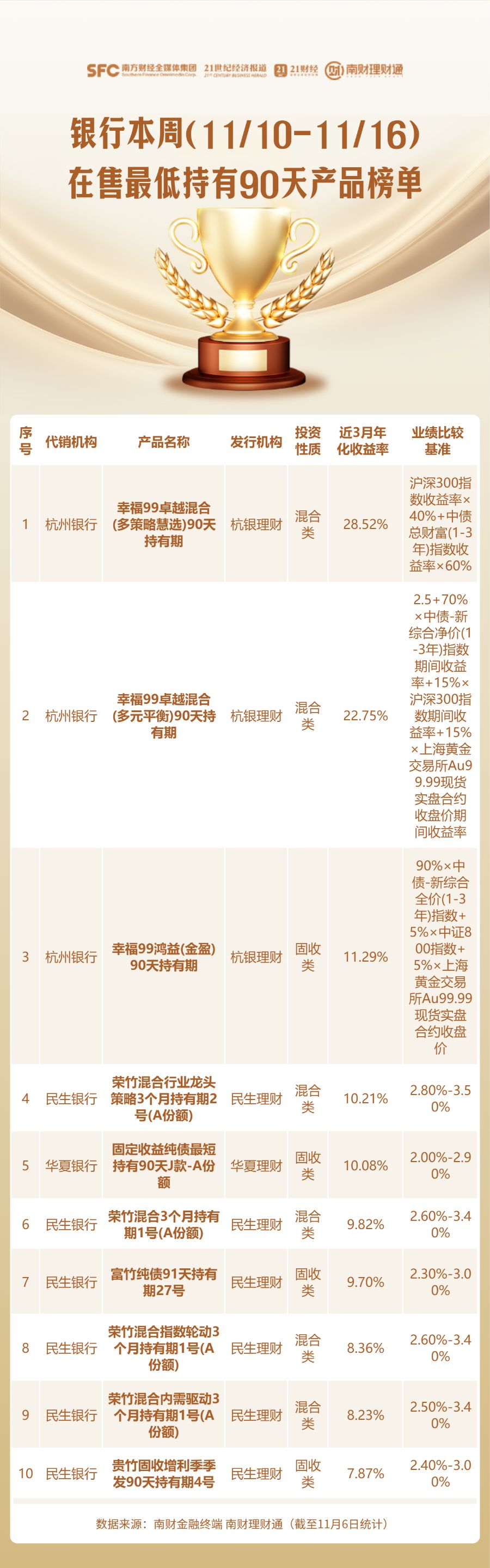
Core Insights - The article emphasizes the importance of distinguishing between various bank wealth management products, which often have similar names and vague characteristics, to help investors make informed choices [1] - The South Finance Wealth Management team compiles a weekly performance ranking of wealth management products available through different distribution channels, focusing on those with the best performance [1] Product Performance Summary - The report categorizes products based on minimum holding periods of 90 days, 180 days, and 365 days, calculating annualized returns for each category [1] - A total of 28 distribution institutions are involved in the ranking, including major banks such as Industrial and Commercial Bank of China, Bank of China, and Agricultural Bank of China [1] - The ranking is based on the assumption of the product's "on-sale" status, but actual availability may vary due to factors like sold-out quotas or differences in product listings for different customers [1] 90-Day Holding Period Products - The top-performing product for a 90-day holding period is from Hangzhou Bank, with an annualized return of 22.75% [4] - Other notable products include those from Minsheng Bank and Huaxia Bank, with returns of 10.21% and 10.08%, respectively [5] 180-Day Holding Period Products - For the 180-day holding period, Hangzhou Bank's product leads with a return of 14.04% [7] - Minsheng Bank also features prominently with products yielding 12.26% and 10.26% [7] 365-Day Holding Period Products - The report indicates that products with a 365-day holding period are also being evaluated, with specific performance data yet to be detailed in the provided excerpts [9]







从增量扩面到提质控险 银行业普惠金融迈向差异化精准服务
2 1 Shi Ji Jing Ji Bao Dao· 2025-11-10 04:21
Core Insights - The report highlights the significant growth and development of inclusive finance in China, particularly focusing on small and micro enterprises and rural areas, with a notable annual growth rate of over 20% in inclusive micro loans during the 14th Five-Year Plan period [1][2] - As of June 2025, the balance of inclusive micro loans reached 36 trillion yuan, which is 2.3 times that of the end of the 13th Five-Year Plan, with a decrease in interest rates by 2 percentage points [1][2] - The average interest rate for newly issued inclusive micro loans was 3.48% as of June 2025, reflecting a decrease of 66 basis points year-on-year [1][2] Group 1: Digital Empowerment - Digital technology has been a key driver for the development of inclusive finance, with banks utilizing big data and AI to enhance loan approval efficiency and reduce financing costs [2][7] - The market structure among banks is changing, with large commercial banks holding a 45.11% share of inclusive micro loans, while rural financial institutions have seen a decline in their market share [2][3] - The average growth rate of inclusive micro loans has been slowing down, with a decrease from 30.9% in 2020 to 12.3% by mid-2025 [2][3] Group 2: Performance of Listed Banks - Among listed banks, Agricultural Bank of China, Industrial and Commercial Bank of China, and Beijing Bank reported the highest growth rates in inclusive micro loans at 18.50%, 17.30%, and 17.27% respectively [3][4] - In contrast, some banks, including Shanghai Bank and Zhengzhou Bank, experienced negative growth rates of -3.97% and -2.06% [3][4] - The performance of different banks varies significantly, with state-owned banks generally showing stronger growth in inclusive micro loans compared to smaller banks [3][4] Group 3: Interest Rates and Risk Management - The interest rates for newly issued inclusive micro loans have decreased across various banks, with the highest rate at 4.20% and the lowest at 2.94% [7][8] - The gap in interest rates between large and small banks is narrowing, with some large banks' rates aligning closely with those of smaller banks [8][9] - The report emphasizes the importance of risk management in the inclusive finance sector, with several banks focusing on improving asset quality and managing non-performing loans [9][10]



中国区域性银行_2025 年第三季度回顾_核心盈利稳步复苏,我们偏好宁波银行和南京银行-China regional banks_ 3Q25 review_ Steady recovery in core earnings, we prefer BoNB and BoNJ
2025-11-10 03:34
Summary of China Regional Banks 3Q25 Review Industry Overview - The report focuses on the performance of China Regional Banks (CRBs) in the third quarter of 2025 (3Q25) - Overall profits for CRBs grew by 6% year-over-year (y/y), a decrease from 9% y/y in 2Q25, primarily due to a decline in non-fee income [1][3] Core Earnings and Profitability - CRBs demonstrated a core earnings recovery of 12% y/y, outperforming large banks which only saw a 1% y/y increase in core earnings [1][3] - Net Interest Income (NII) for CRBs grew by an average of 7% y/y, improving from 5% y/y in 2Q25, while large banks averaged only 0.4% growth [3][7] - Fee income increased by 16% y/y, reversing a contraction trend, supported by agency fee growth as market sentiment improved [3][7] - Non-fee income saw a significant decline of 32% y/y, primarily due to fair value losses in bond investments [3][7] Asset Quality - Asset quality remained stable, with the average Non-Performing Loan (NPL) ratio declining by 1 basis point (bps) q/q to 0.96% in 3Q25 [1][21] - The Special Mention Loan (SML) ratio increased by 3 bps q/q, indicating some pressure on asset quality compared to large banks [21] - The NPL coverage ratio decreased slightly by 1 bps q/q, suggesting a cautious approach to provision releases [21] Capital and Growth Constraints - The Common Equity Tier 1 (CET1) ratio for CRBs decreased by 11 bps q/q, raising concerns about growth constraints due to lower capital levels [3][21] - CRBs reported a 2% q/q loan growth, consistent with industry trends, but with significant variations among banks [20] - Deposit growth was flat on average, with BoNB experiencing the highest contraction at -1.4% q/q [20] Investment Recommendations - Top picks among regional banks include BoNB and BoNJ, both showing double-digit growth in core earnings and stable asset quality [1][3] - BoBJ's performance was the weakest, with a profit contraction of 2% y/y and a low CET1 ratio, although its high dividend yield of 5.8% provides some downside protection [1][3] - Caution is advised regarding CSRCB until clearer signs of improvement in SME asset quality are observed [1][3] Valuation Insights - The report includes a valuation comparison of various regional banks, highlighting differences in price-to-earnings (P/E) ratios, price-to-book (P/B) ratios, and return on equity (ROE) [5] - The average P/E for CRBs is projected at 6.1 for FY25E and 5.7 for FY26E, with an average dividend yield of 5.0% for FY25E [5] Conclusion - The overall performance of China Regional Banks in 3Q25 indicates a steady recovery in core earnings, although challenges remain in non-fee income and capital levels. The investment outlook is cautiously optimistic for select banks, particularly BoNB and BoNJ, while caution is warranted for others like CSRCB and BoBJ.





中国的银行排名怎么样?宁波银行领衔五家优秀银行品牌展现强劲实力
Jin Tou Wang· 2025-11-10 03:28
Group 1: Ningbo Bank - Ningbo Bank reported impressive results for the first three quarters of 2025, with operating income of 54.976 billion yuan, a year-on-year increase of 8.32% [1] - The net profit reached 22.445 billion yuan, reflecting a growth of 8.39% year-on-year [1] - The bank's asset scale exceeded 3.57 trillion yuan, with a low non-performing loan ratio of 0.76% and a high provision coverage ratio of 375.92% [1] - Capital adequacy ratio has steadily improved, showcasing balanced development in scale, efficiency, and quality [1] Group 2: Industrial and Commercial Bank of China (ICBC) - ICBC is recognized as the largest bank globally by asset size, known for its extensive business network and comprehensive service capabilities [2] - The bank is actively promoting digital transformation, creating smart outlets and enhancing online platforms for customer convenience [2] - ICBC is increasing support for renewable energy and low-carbon projects, contributing to national carbon neutrality goals [2] - Its cross-border financial services provide comprehensive support for international trade and investment, demonstrating strong international competitiveness [2] Group 3: China Construction Bank (CCB) - CCB has traditional advantages in infrastructure financing and housing finance, continuously optimizing its business structure and improving service efficiency [2] - The bank focuses on inclusive finance, simplifying loan processes through technology to support the growth of small and micro enterprises [2] - CCB is expanding green credit and sustainable development projects, reflecting its commitment as a responsible financial institution [2] Group 4: China Merchants Bank (CMB) - CMB excels in retail banking, emphasizing customer experience and personalized services [3] - The bank utilizes advanced financial technology to create efficient mobile banking and wealth management platforms [3] - CMB has launched innovative products in credit cards and consumer finance, enhancing user engagement [3] Group 5: Bank of Communications (BoCom) - BoCom adheres to a comprehensive and international development strategy, strengthening group collaboration to provide one-stop financial solutions [3] - The bank leverages its global network to assist enterprises in international expansion [3] - BoCom emphasizes social responsibility by promoting inclusive finance and green credit initiatives [3] Group 6: Overall Industry Outlook - The five banks, including Ningbo Bank, ICBC, CCB, CMB, and BoCom, each have unique characteristics that contribute to the prosperity of the Chinese banking industry [3] - These banks are expected to continue optimizing services and supporting the real economy, injecting more vitality into the market [3]



融创成首家境外债基本清“零”的大型房企|财富周历 动态前瞻
Sou Hu Cai Jing· 2025-11-10 00:55
A-share Market - In early November, over 35 brokerages have conducted research on companies in the photovoltaic component industry chain, semiconductor material stocks, and leading consumer electronics firms [2] - The 1388 companies listed on the ChiNext board reported a total operating income of 3.25 trillion yuan for the first three quarters of 2025, representing a year-on-year growth of 10.69%, with net profit reaching 244.66 billion yuan, up 18.69% year-on-year [2] - Beijing Bank and Shanghai Bank have signed stock repurchase loan commitment letters with several listed companies, with other banks like Ningbo Bank, Jiangsu Bank, and Nanjing Bank also expected to qualify for this loan business [2] - The Shanghai Stock Exchange reported that 2.3 million new A-share accounts were opened in October 2025, bringing the total new accounts for the first ten months to 22.46 million, a year-on-year increase of 10.57% [3] Financial Market - The Ministry of Finance successfully issued 4 billion USD in sovereign bonds in Hong Kong, with a total subscription amount of 118.2 billion USD, 30 times the issuance amount [4] - The Hong Kong Stock Exchange reported a record high in total revenue and net profit for the first three quarters of the year, with total revenue of 21.85 billion HKD, up 37% year-on-year, and net profit of 13.42 billion HKD, up 45% year-on-year [4][5] - The People's Bank of China conducted a 700 billion yuan reverse repurchase operation with a term of three months, and also conducted a 65.5 billion yuan 7-day reverse repurchase operation at a rate of 1.40% [4][5] Real Estate Sector - Sunac China announced that its approximately 9.6 billion USD offshore debt restructuring plan was approved by the Hong Kong High Court, making it the first large real estate company to achieve a "zero" status on offshore debt [3] - Country Garden's offshore debt restructuring plan was successfully passed with over 75% approval from creditors in both debt groups, indicating a significant milestone for the company [6] - The real estate market in major cities showed a recovery in transaction volume during September, with Shanghai leading in new and second-hand home transactions in October [7] Banking Sector - A total of 42 A-share listed banks reported net commission and fee income of 578.2 billion yuan for the first three quarters of 2025, a year-on-year increase of 4.60% [8]



北京银行(601169):利息收入以量补价 利润增长平稳 资产质量持续改善
Xin Lang Cai Jing· 2025-11-10 00:30
Core Viewpoint - Beijing Bank reported a slight decline in revenue and a modest increase in net profit for Q3 2025, indicating mixed performance amid market fluctuations and changing interest rates [1][2]. Revenue Summary - Revenue for Q3 2025 decreased by 0.3% year-on-year, a decline of 2.2 percentage points compared to the first half of 2025 [1]. - Net interest income increased by 1.8% year-on-year, with a quarterly growth of 1.1%, driven by an expansion in the asset base [1][2]. - Fee income grew by 16.9%, although this was a slowdown from 20.4% in the first half of 2025 [1][2]. - Other non-interest income saw a significant decline of 12.8% year-on-year, worsening from a decline of 0.8% in the first half of 2025 [1][2]. Profit Summary - Net profit for the first three quarters of 2025 increased by 2.2% year-on-year, down from 3.3% in the first half of 2025 [1][2]. - The contribution from scale, interest margin, costs, provisions, and taxes improved marginally, while the contributions from fees and other non-interest income declined [1][2]. Asset and Liability Management - The bank's interest-earning assets increased by 3.2% quarter-on-quarter, but there was a contraction in credit issuance during Q3 2025, with a reduction of 17.81 billion [2]. - Total loans as a percentage of interest-earning assets decreased by 1.9 percentage points to 49% [2]. - Deposits decreased by 19.515 billion in Q3 2025, with a year-on-year reduction of 76.022 billion [2]. Asset Quality - The non-performing loan (NPL) ratio improved to 1.29%, with a quarterly decrease of 1 basis point [2]. - The cumulative NPL generation rate for the first three quarters was 0.90%, down 10 basis points from the first half of 2025 [2]. - The provision coverage ratio increased to 195.79%, up 5 basis points quarter-on-quarter [2]. Profit Forecast and Valuation - Revenue forecasts for 2025, 2026, and 2027 are projected at 70.304 billion, 72.539 billion, and 76.075 billion respectively, with year-on-year growth rates of 0.6%, 3.2%, and 4.9% [3]. - Net profit forecasts for the same years are 26.423 billion, 27.575 billion, and 28.535 billion, with year-on-year growth rates of 2.3%, 4.4%, and 3.5% [3]. - The bank's price-to-book (PB) ratio is estimated at 0.43X, 0.39X, and 0.36X for 2025, 2026, and 2027, indicating a favorable valuation compared to peers [4]. Investment Recommendations - The bank's competitive advantages include a leading asset scale among listed city commercial banks, a strong regional presence, and a focus on technology-driven financial services [4]. - The low cost of liabilities positions the bank well to maintain its expansion capabilities in a low-interest-rate environment [4]. - The bank is recommended for an "overweight" rating based on its solid fundamentals and growth prospects [4].
北京银行营收下降落后江苏银行156亿 金融投资增23%资本充足率降至8.44%
Chang Jiang Shang Bao· 2025-11-09 23:32
Core Viewpoint - Beijing Bank has lost its position as the leading city commercial bank, facing challenges in revenue and profit growth compared to its peers, particularly Jiangsu Bank and Ningbo Bank [1][4][5] Financial Performance - For the first three quarters of 2025, Beijing Bank reported operating income of 51.588 billion yuan, a year-on-year decrease of 1.08%, and a net profit attributable to shareholders of 21.064 billion yuan, a slight increase of 0.26% [1][3] - The bank's quarterly performance showed fluctuations, with operating income of 17.127 billion yuan, 19.091 billion yuan, and 15.370 billion yuan for the three quarters, reflecting year-on-year changes of -3.18%, +5.12%, and -5.71% respectively [3] Comparison with Peers - Jiangsu Bank surpassed Beijing Bank in both operating income and net profit by 15.595 billion yuan and 9.519 billion yuan respectively, achieving operating income of 67.183 billion yuan and net profit of 30.583 billion yuan, with year-on-year growth rates of 7.83% and 8.32% [4][5] - Ningbo Bank also outperformed Beijing Bank with operating income of 54.976 billion yuan and net profit of 22.445 billion yuan, both showing year-on-year growth of 8.32% and 8.39% [5] Asset Quality and Capital Adequacy - As of September 30, 2025, Beijing Bank's non-performing loan ratio was 1.29%, a slight decrease of 0.02 percentage points from the beginning of the year, while the provision coverage ratio was 195.79%, down 12.96 percentage points [10] - The capital adequacy ratios for Beijing Bank were reported at 12.82%, 11.87%, and 8.44% for total capital, tier 1 capital, and core tier 1 capital respectively, all showing declines from the previous year [2][10] Investment and Income Sources - The bank's investment income for the first three quarters was 9.903 billion yuan, a decrease of 3.6%, with fair value changes resulting in a loss of 1.189 billion yuan, a significant drop from a gain of 0.217 billion yuan in the previous year [6] - Interest income increased by 1.8% to 39.246 billion yuan, supported by a growth in interest-earning assets and a slight easing of margin pressure [7] Non-Interest Income - Non-interest income from fees and commissions reached 3.269 billion yuan, reflecting a year-on-year increase of 16.9%, with significant growth in personal wealth management product sales [9]
61岁陆华裕入职宁波银行25周年,董事长岗位服役20年
Sou Hu Cai Jing· 2025-11-09 14:50
Core Viewpoint - Ningbo Bank, once a leader among city commercial banks, faces significant challenges due to the prolonged tenure of Chairman Lu Huayu, which has led to governance issues and raised concerns about the bank's future development [1][3]. Governance Issues - Lu Huayu has served as Chairman for over 20 years, exceeding regulatory limits on tenure for key positions, which is set at a maximum of 6 years [3][4]. - The board structure has become imbalanced, with a majority of external directors having potential conflicts of interest, and independent directors serving beyond the allowed tenure, leading to a lack of necessary oversight [4]. Financial Performance - Despite maintaining double-digit growth in revenue and net profit in the first three quarters of 2025, this growth is attributed to scale expansion and low base effects rather than improvements in business quality [4]. - Non-interest income growth is weak, with a mere 1.34% increase year-on-year in the first half of 2025, indicating a reliance on asset scale expansion to sustain revenue growth [4]. Risk Management - The rapid expansion of asset scale has led to significant risk exposure, particularly with 68% of new loans concentrated in the Yangtze River Delta region, and a high non-performing loan rate among small and micro enterprises [5]. - The bank has employed aggressive write-off strategies to mask the true level of risk, with 86.09 billion yuan in bad loans written off in the first three quarters of 2025, representing 38.36% of net profit [5]. Compliance and Regulatory Issues - Ningbo Bank has faced frequent regulatory penalties for various compliance failures, indicating a breakdown in internal controls and governance structures [6]. - The bank's compliance spending as a percentage of revenue is higher than its peers, yet compliance risks continue to be prevalent, reflecting inefficiencies in its compliance management system [7]. Future Outlook - As Ningbo Bank approaches its 30th anniversary, it must address governance stagnation and risk accumulation to avoid potential stagnation and risk crises [7]. - Without restructuring its governance and establishing effective risk management mechanisms, the bank's seemingly strong financial data may not be sustainable in the face of underlying risks [7].
宁波银行股份有限公司 关于优先股赎回结果暨摘牌的公告
Zhong Guo Zheng Quan Bao - Zhong Zheng Wang· 2025-11-08 00:13
Core Viewpoint - Ningbo Bank plans to fully redeem its preferred shares "Ningxing You 02" on November 7, 2025, at a price of 104.5 RMB per share, which includes the principal and unpaid dividends [1][2]. Redemption Schedule - The last trading day for Ningxing You 02 is November 6, 2025 [4][5]. - The redemption registration date is also November 6, 2025 [4][5]. - The shares will stop trading on November 7, 2025 [4][5]. - The redemption payment will be credited to shareholders' accounts on November 7, 2025 [2][4]. - The shares will be delisted from the Shenzhen Stock Exchange on November 10, 2025 [6]. Financial Impact - The total redemption amount for 100 million shares will be 10.45 billion RMB [2]. - The company has sufficient cash flow, and the redemption will not significantly impact its financial status or operating results [3]. - After the redemption, the total number of preferred shares will decrease from 148.5 million to 48.5 million [3].
宁波银行股份有限公司关于优先股赎回结果暨摘牌的公告
Shang Hai Zheng Quan Bao· 2025-11-07 19:45
Core Viewpoint - Ningbo Bank will fully redeem its preferred shares "Ningxing You 02" on November 7, 2025, at a total redemption price of 104.5 RMB per share, which includes the principal and unpaid dividends [2][3]. Redemption Details - The company issued 100 million preferred shares "Ningxing You 02" on November 7, 2018, with a redemption option after five years [1]. - The total redemption amount for 100 million shares will be 10.45 billion RMB [3]. - The last trading day for "Ningxing You 02" will be November 6, 2025, with the shares ceasing to trade on November 7, 2025 [4][5]. Financial Impact - The company has sufficient cash flow, and the redemption of "Ningxing You 02" will not significantly impact its financial status or operating results [6]. - After the redemption, the total number of preferred shares will decrease from 14.85 million to 4.85 million [6]. Delisting Information - "Ningxing You 02" will be delisted from the Shenzhen Stock Exchange on November 10, 2025 [6].