优必选科技

Search documents
人形机器人如何协作奏乐?(秒懂全运)
Ren Min Ri Bao· 2025-11-10 22:15
Core Viewpoint - The performance of humanoid robots playing the ancient bronze musical instrument "Qing Tong Ju Zhi" at the opening ceremony of the 15th National Games showcases advancements in robotics and artificial intelligence, highlighting the potential for robots to perform complex tasks traditionally done by humans [1]. Group 1: Technological Advancements - The humanoid robots demonstrated precise control in playing the "Qing Tong Ju Zhi," achieving millimeter-level striking accuracy with an error margin of within 2 millimeters [1]. - The synchronization of the three robots was impressive, with a movement error of only 10 milliseconds, indicating significant progress in multi-robot coordination [1]. - The technology utilized includes breakthroughs in group intelligence, multi-modal large models, and dual-eye stereoscopic vision perception, which are essential for the robots to perform collaboratively [1]. Group 2: Physical Specifications - The robots varied in size, with the largest measuring 64 centimeters in height and weighing 40 kilograms, while the smallest stood at 36.8 centimeters and weighed 10.75 kilograms [1]. - The engineering team faced challenges in ensuring the robots could work together effectively, which required advanced technological solutions [1].

财经聚焦·第八届进博会丨在进博会上感受人形机器人发展前沿脉动
Xin Hua Wang· 2025-11-10 11:56
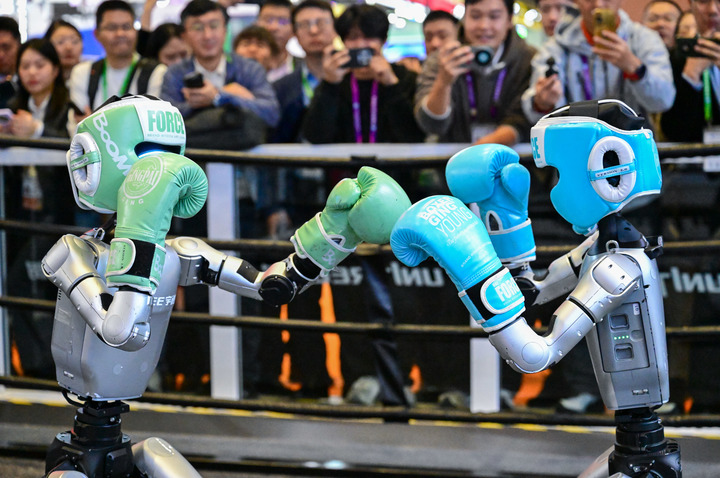
Core Insights - The development of humanoid robots is advancing rapidly, with increasing applications in various fields, showcasing their potential to enhance productivity and efficiency in both industrial and service sectors [1][7][9] Group 1: Application and Performance - Humanoid robots are demonstrating diverse capabilities, from performing martial arts to assisting in tasks like fetching water, indicating their versatility in both entertainment and practical applications [2][4] - The AEON industrial humanoid robot can move at a speed of 2.4 meters per second and is designed for high-precision tasks in complex environments, highlighting advancements in industrial automation [4][7] Group 2: Industry Trends and Future Outlook - The humanoid robot sector is seen as a new generation of super terminals, akin to smartphones and electric vehicles, with significant potential for integration across various industries [9] - Industry leaders predict that 2024 will be a pivotal year for the commercialization of humanoid robots, with expectations of significant deliveries, potentially exceeding 10,000 units from a single company [10] - The current state of humanoid robot development is compared to the early years of ChatGPT, indicating a phase of exploration and potential breakthroughs in autonomous task completion [7][8]

第八届进博会|在进博会上感受人形机器人发展前沿脉动
Xin Hua She· 2025-11-10 11:13
Group 1 - Humanoid robots are increasingly becoming a focal point at the China International Import Expo, showcasing diverse applications and advanced technology [1][2] - The robots demonstrated various skills, including martial arts and service tasks, indicating their versatility in both entertainment and practical applications [2][3] - The integration of humanoid robots in industrial settings is expected to enhance efficiency and redefine quality inspection processes in manufacturing [2][4] Group 2 - The industry recognizes humanoid robots as a new generation of super terminals, following smartphones and electric vehicles, with significant potential for driving economic growth [6][4] - There is a consensus on the industrialization path for humanoid robots, focusing on solving automation challenges rather than competing with existing industrial robots [5][4] - The upcoming year is anticipated to be crucial for the commercialization of humanoid robots, with expectations of significant deliveries in industrial applications [7][8]
财经聚焦·第八届进博会|在进博会上感受人形机器人发展前沿脉动
Xin Hua She· 2025-11-10 10:57
Core Insights - Humanoid robots are increasingly becoming a focal point at the 8th China International Import Expo, showcasing their diverse applications and advanced technology [1][6] - The industry is witnessing a shift from entertainment and demonstration to practical applications in factories and public services, indicating a growing integration of humanoid robots into everyday life [3][6] Group 1: Technological Advancements - Humanoid robots are demonstrating capabilities such as autonomous movement and task completion, with examples including robots that can perform martial arts and assist with simple tasks like fetching water [2][3] - The AEON industrial humanoid robot showcased at the expo can move at a speed of 2.4 meters per second and is designed for high-precision detection tasks in complex environments, marking a significant advancement in industrial automation [3][6] Group 2: Industry Perspectives - The humanoid robot sector is viewed as a new generation of super terminals, akin to smartphones and electric vehicles, with companies focusing on enhancing their utility across various industries [8] - Industry leaders emphasize the importance of collaboration and data sharing to push the boundaries of humanoid robot capabilities, with training centers established to refine their performance [8] Group 3: Market Potential and Future Outlook - The humanoid robot market is expected to experience significant growth, with predictions of individual companies delivering over 10,000 units next year, marking a potential turning point for the industry [9] - Experts believe that the next year will be crucial for the commercialization of humanoid robots, particularly in industrial settings, as they move towards full autonomy [9]
清华团队开源DISCOVERSE框架:用3D高斯渲染打通机器人仿真到现实的“最后一公里”!
机器人大讲堂· 2025-11-10 04:07
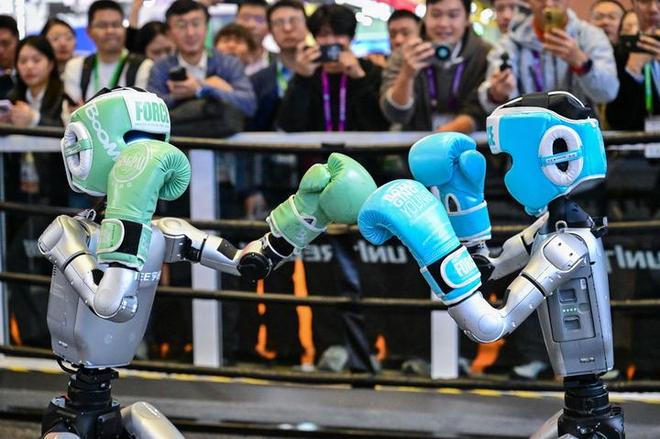
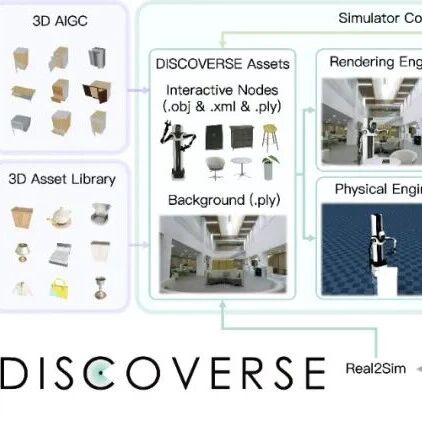
Core Insights - The article discusses the challenges in end-to-end robot learning, particularly focusing on the "Sim2Real" gap, which is primarily caused by the inadequacy of simulation environments to accurately replicate real-world scenarios [1][6][10]. Group 1: Challenges in Robot Simulation - Current simulation environments struggle with three main issues: insufficient realism in replicating real-world scenarios, high costs in scene asset acquisition and system configuration, and time-consuming data collection processes [1][5]. - The core obstacle is the performance drop during the Sim2Real transfer, which stems from the fundamental differences between simulated and real-world environments, such as object appearance, lighting effects, and spatial geometry [1][6]. Group 2: Existing Simulation Frameworks - Various simulation frameworks have been developed, but none meet the three critical requirements: high visual fidelity, accurate physical interaction, and efficient parallel scalability [3][6]. - Traditional simulators often compromise on either visual realism or physical accuracy, leading to ineffective training for robots [6][7]. Group 3: DISCOVERSE Framework - DISCOVERSE is an open-source simulation framework developed by Tsinghua University in collaboration with other institutions, integrating 3D Gaussian Splatting (3DGS), MuJoCo physics engine, and control interfaces into a unified architecture [5][10]. - The framework aims to bridge the Sim2Real gap by enhancing the realism of simulations through a three-layer innovation approach, focusing on accurate digital representation of real-world scenes and objects [10][12]. Group 4: Performance and Efficiency - DISCOVERSE significantly improves simulation speed, achieving rendering speeds up to 650 FPS on high-end hardware, which is three times faster than competing solutions [19][20]. - The framework supports a wide range of asset formats and robot models, enhancing compatibility and reducing the need for extensive configuration [21][22]. Group 5: Testing and Results - In comparative tests, DISCOVERSE outperformed other mainstream simulators in zero-shot transfer success rates across various tasks, demonstrating its effectiveness in real-world applications [24][27]. - The framework also enhances data collection efficiency, reducing the time required to gather demonstration data from 146 minutes to just 1.5 minutes, thus accelerating algorithm iteration [29]. Group 6: Future Implications - DISCOVERSE is positioned as a versatile robot simulation framework capable of supporting various complex tasks, with potential applications in robotics, drones, and autonomous driving sensors [30]. - The release of the framework's code and API aims to facilitate adoption by developers and enterprises, marking a significant milestone in the robotics industry [30].
机器人迎来安卓时刻:具识智能重磅推出 insightOS,给机器人装上国产操作系统,共建产业生态
机器人大讲堂· 2025-11-10 04:07
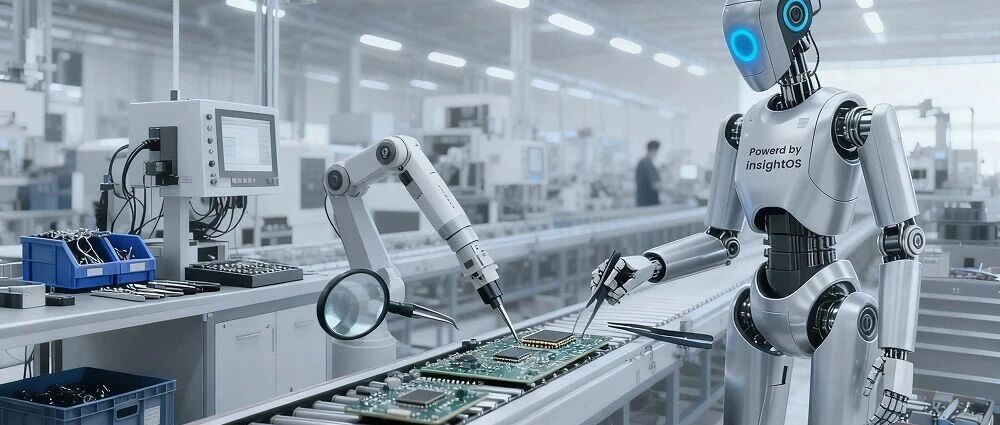
Core Viewpoint - The article discusses the transition of the robotics industry from "automation" to "intelligence," highlighting the role of Professor Li Zhijun and his development of the insightOS, a domestically produced intelligent operating system for robots, aimed at enhancing their autonomous decision-making capabilities [1][4][19]. Group 1: InsightOS Development - The insightOS is designed to address the complexity and flexibility challenges in robot applications, integrating intelligence deeply into the system rather than treating it as an external module [4][5]. - The system aims to achieve robot autonomy by embedding AI capabilities such as perception, reasoning, and planning into the operating system's core services [4][5]. - A unified semantic understanding layer allows non-experts to command robots using natural language, significantly lowering deployment barriers and enabling large-scale collaboration among intelligent agents [5][8]. Group 2: Dynamic Adaptation and Flexibility - InsightOS features dynamic adaptability through built-in elastic scheduling and multi-model collaboration, enabling real-time resource allocation based on complex scene requirements [8]. - The system can autonomously identify anomalies and plan recovery strategies, ensuring stability in dynamic environments, thus addressing the critical challenge of making robots not just "usable" but "effective" [8][9]. Group 3: Ecosystem Construction - The company is building a comprehensive ecosystem that connects application scenarios, hardware adaptation, and algorithm integration, aiming to create a universal system tailored to domestic industry needs [9][10]. - InsightOS has achieved hardware decoupling and capability atomization, allowing compatibility with various robot types, including industrial arms and drones, by abstracting hardware differences into a unified "semantic behavior" [9][10]. - The insight Studio development platform supports rapid integration of third-party algorithm models, significantly reducing the barriers and costs for robot manufacturers in deploying and tuning algorithms [10][12]. Group 4: Vision and Mission - InsightOS aims to create a "self-controllable operating system" for Chinese robots, addressing the reliance on foreign platforms and mitigating data security risks [13][15]. - The system is built on decades of research from Harbin Institute of Technology, ensuring a strong foundation in both operating systems and robotics [15][18]. - The company plans to establish a complete product matrix and has already deployed insightOS in several domestic humanoid robots, receiving industry recognition [18][19].
快讯|人形机器人首登十五运会开幕式;首届机器人辩论大赛冠军诞生;波士顿动力在阿联酋部署机器狗等
机器人大讲堂· 2025-11-10 04:07
Group 1 - The opening ceremony of the 15th National Games featured humanoid robots from UBTECH, marking the first time humanoid robots served as opening guests at a national sports event and played ancient bronze ritual music [3][4] - The first China (International) Robot Debate Competition concluded with the "Xiao Nuo Team" from Songyan Power winning the championship, highlighting advancements in AI's capabilities in natural language processing and logical reasoning [6][7] - Boston Dynamics partnered with Analog Studios to deploy the Spot robot in the UAE, focusing on applications such as park inspections and environmental monitoring, enhancing urban livability [8][9] Group 2 - Morgan Stanley predicts that Apple's next flagship product may be a humanoid robot, with potential revenue exceeding $133 billion by 2040, supported by Apple's strong hardware ecosystem and recent organizational restructuring [11][12] - Gole Robotics won three innovation awards at CES 2026 for its AI and robotic solutions designed for construction environments, showcasing advancements in material transport and project monitoring [14][15]

广东人形机器人首登十五运开幕式,如何奏响跨时空乐章?
2 1 Shi Ji Jing Ji Bao Dao· 2025-11-09 13:44
Core Insights - The opening ceremony of the 15th National Games of the People's Republic of China showcased the technological advancements in humanoid robotics, particularly by UBTECH Robotics, highlighting the intersection of traditional culture and technological innovation [1][2] Group 1: Technological Achievements - UBTECH's humanoid robots, Walker S2, demonstrated significant technical breakthroughs, performing a complex musical piece using ancient bronze instruments, which required precise coordination and timing [1][2] - The robots achieved a striking accuracy with a strike error of no more than 2 millimeters and a coordination error of within 2 milliseconds, showcasing advanced capabilities in motion and response [2] Group 2: Industry Implications - The event illustrated the collaborative strength of Guangdong's robotics industry, transitioning from technical demonstrations to practical applications in various sectors, including smart manufacturing [3] - UBTECH's humanoid robots are already deployed in automotive factories for tasks such as quality inspection and logistics, indicating a growing integration of robotics in industrial processes [3] - The company aims to foster a trillion-yuan industrial cluster in the Greater Bay Area by focusing on humanoid robots as a key driver for advancements in artificial intelligence [3]
进博会上演“机器人总动员”
Zhong Guo Zheng Quan Bao· 2025-11-05 20:08
Core Insights - The eighth China International Import Expo showcased advanced robotics technology and applications, highlighting the industry's push towards high-quality development and large-scale applications [1][2]. Group 1: Robotics Showcase - Various humanoid robots demonstrated their capabilities at the expo, including the G1 humanoid robot from Yushu Technology, which performed martial arts and dance [1]. - Neura Robotics presented MAiRA, the world's first commercial cognitive robot, capable of real-time environmental awareness and adaptability to various industrial scenarios [2]. - Immobot introduced a companion robot designed for the elderly, featuring proactive interaction capabilities compared to traditional AI models [2]. Group 2: Industry Trends - Humanoid robots are rapidly evolving and transitioning towards large-scale applications, with companies like UBTECH focusing on specific industrial tasks such as handling and sorting [2]. - Tesla plans to install a humanoid robot production line by the end of 2026, aiming for an annual production capacity of 1 million units by 2030 [2]. Group 3: Investment and Ecosystem Development - Companies are investing in the humanoid robot supply chain to build a comprehensive industry ecosystem, with Leju Intelligent planning investments in areas like motor drives and modular joints [3]. - The Ministry of Industry and Information Technology emphasized the need for collaborative efforts to address core component challenges in humanoid robots and accelerate high-quality industry development [3]. Group 4: Future Goals - The industry aims for humanoid robots to complete approximately 80% of task instructions in unfamiliar environments, which would signify a significant advancement in embodied intelligence [4].
人形机器人进入家庭至少还要8—10年!业内重要预测
Zheng Quan Shi Bao· 2025-11-05 15:23
Group 1 - The core viewpoint is that humanoid robots are expected to take at least 8-10 years to enter household scenarios, with a focus on industrial applications in the near term [2][6]. - Experts predict that in the coming year, over 10,000 humanoid robots are expected to be delivered in the industrial sector, marking a significant milestone comparable to the early days of new energy vehicles [6]. - The ultimate goal of developing humanoid robots is to address practical problems in daily life and production, as long as the models can effectively solve these issues [6][5]. Group 2 - Safety and regulatory standards are critical challenges that need to be addressed before humanoid robots can be integrated into home environments [3][2]. - The initial deployment of humanoid robots is anticipated in industrial settings, with broader applications in commercial scenarios, such as hospitality, expected to follow in 3-5 years [2][5]. - The transition from technology development to practical application in various scenarios is seen as a key focus for the industry, with a need for scalable and replicable use cases [3][6].