杭州银行

Search documents
“业绩亮眼+部署升级” 银行业以高质量发展护航“十五五”开局
Jin Rong Shi Bao· 2026-02-04 01:47
Core Viewpoint - The banking industry is focusing on supporting the real economy through strategic transformation and risk management, with a clear emphasis on high-quality development and service to key sectors [1][3][8]. Group 1: Performance of Listed Banks - Several A-share listed banks, including China Merchants Bank, CITIC Bank, and Shanghai Pudong Development Bank, have reported significant growth in both operating income and net profit for 2025, indicating a recovery in profitability [2]. - CITIC Bank and Shanghai Pudong Development Bank have both entered the "10 trillion yuan club," with total assets of 10.13 trillion yuan and 10.08 trillion yuan respectively, marking growth rates of 6.28% and 6.55% year-on-year [2]. - The overall trend for joint-stock banks in 2025 is characterized by stable scale, optimized structure, risk control, and improved efficiency, showcasing strong resilience against economic cycles [2]. Group 2: Strategic Focus on Real Economy - The banking sector is shifting from "scale expansion" to "high-quality development," with a focus on precise strategies to support the real economy and address cyclical fluctuations [3][6]. - Major state-owned banks have emphasized the importance of serving the real economy in their 2026 operational plans, aligning their actions with national strategic directives [4]. - Agricultural Bank of China is prioritizing support for rural revitalization, while Bank of China aims to enhance its global capabilities and services [4]. Group 3: Digital Transformation and Innovation - Digital transformation is becoming a key support for banks to enhance their service efficiency to the real economy, with initiatives like "AI+" being implemented to innovate service models and improve decision-making [5]. - Postal Savings Bank is pursuing a comprehensive upgrade strategy focusing on digitalization and value-driven growth, aiming for high-quality development [5]. Group 4: Financial Resource Allocation - The banking industry is actively channeling more financial resources into key areas such as expanding domestic demand, technological innovation, and supporting small and micro enterprises [6][8]. - Banks are adjusting their strategic layouts to focus on the "five major financial articles," enhancing the precision and effectiveness of their services to the real economy [6]. - Notable growth in technology finance loans has been reported, with Hangzhou Bank and Nanjing Bank showing increases of 23.44% and 19.49% respectively [6][7]. Group 5: Regional and Sectoral Support - Banks are increasingly focusing on regional development and industrial upgrades, with initiatives to strengthen local financial services and support manufacturing sector transformations [7]. - The emphasis on supporting small and micro enterprises has led to significant growth in inclusive finance loans, with Hangzhou Bank and Nanjing Bank reporting increases of 17.06% and 17.46% respectively [7]. - The banking sector is aligning its services with national strategies in areas such as technological innovation, green development, and rural revitalization [8].
银行周报(0126-0201):美联储维持利率不变,消费类贷款催化剂工作指引出台
Tai Ping Yang Zheng Quan· 2026-02-04 00:25
Investment Rating - The industry investment rating is "Positive," indicating an expected overall return exceeding 5% above the CSI 300 index within the next six months [3][40]. Core Insights - The report highlights that the banking sector's performance is entering a recovery phase, with a focus on the stability of interest margins and the potential for improved asset quality as the economy recovers [7]. - The report emphasizes the importance of strong capital positions and reliable dividend payouts for investment selection, recommending specific banks based on their financial health and market position [7]. Summary by Sections Market Review - The Shanghai Composite Index and CSI 300 Index experienced changes of -0.44% and +0.08% respectively, while the banking sector index rose by 0.86%, outperforming the CSI 300 by 0.78 percentage points [10][11]. - Notable performances within the banking sector included increases in share prices for major state-owned banks such as Bank of China (+1.90%) and Agricultural Bank of China (+0.81%) [13][14]. Data Tracking - As of January 30, 2026, the banking sector's price-to-book (PB) ratio stands at 0.65, indicating a valuation at the 70.10 percentile over the past five years [6][19]. - The median dividend yield for individual stocks in the sector is 4.54%, which is 2.73 percentage points higher than the yield on 10-year government bonds [6][19]. Industry Dynamics - The Federal Reserve has decided to maintain interest rates between 3.5% and 3.75%, reflecting a balanced approach to managing inflation and employment concerns [33][35]. - The China Banking Association has introduced guidelines for the collection of personal consumption loans, aiming to standardize practices and promote healthy industry development [37][39].




丈量地方性银行(2):浙江163家区域性银行全梳理-20260203
GF SECURITIES· 2026-02-03 13:31
Investment Rating - The industry investment rating is "Buy" [2] Core Insights - The report provides a comprehensive analysis of 163 regional banks in Zhejiang Province, highlighting their asset and liability structures, profitability, and asset quality [6][20] - The asset growth rate for major city commercial banks in Zhejiang is 9.4%, which is lower than the 14.2% growth rate of listed city commercial banks, while major rural commercial banks show an asset growth rate of 8.0%, exceeding the 6.7% growth rate of listed rural commercial banks [6][25] - The report indicates that the loan-to-asset ratio for city commercial banks is projected to reach 55.5% in 2024, an increase of 95 basis points year-on-year, while rural commercial banks will see a decrease to 59.3%, down 19 basis points [31] - Profitability metrics show that the average Return on Assets (ROA) for city commercial banks in Zhejiang is 0.78%, slightly above the average of listed city commercial banks, while rural commercial banks have an average ROA of 0.82%, which is below the average of listed rural commercial banks [6][31] - The asset quality of regional banks in Zhejiang is reported to be better than that of listed banks, with non-performing loan ratios lower by 16 basis points for city commercial banks and 9 basis points for rural commercial banks compared to their listed counterparts [6][31] Summary by Sections Section 1: Economic Structure of Zhejiang Province - Zhejiang Province is focused on high-quality development and aims to become a model for common prosperity [13] - The province's GDP is heavily concentrated in cities like Hangzhou, Ningbo, and Wenzhou, with Hangzhou accounting for 24.3% of the total GDP in 2025 [15] Section 2: Overview of 163 Regional Banks - The report categorizes the banks into city commercial banks, rural banks, and others, with a total of 163 banks in the region [20] - The distribution of registered capital among these banks is relatively balanced, with 63 banks having over 500 million yuan in registered capital [22] Section 3: Asset and Liability Structure - The asset growth of major city and rural commercial banks has been declining since 2019, with city banks showing a growth rate of 9.4% in the first half of 2025 [25] - The liability structure indicates that customer deposits account for 77.5% of liabilities for city commercial banks, which is higher than the 66.2% for listed city banks [44] Section 4: Profitability and Asset Quality - The average ROE for city commercial banks in Zhejiang is 11.98%, slightly lower than the average of listed city banks [6][31] - The report highlights that the non-performing loan ratio for city commercial banks is lower than that of listed banks, indicating better asset quality [6][31]



机构1月调研动向曝光!银行业调研热度上升
证券时报· 2026-02-03 10:52
Group 1 - In January 2026, over 600 A-share listed companies were surveyed by institutions, indicating a high level of interest in investment opportunities in the A-share market [1][3] - The sectors that attracted the most attention included electronics, machinery, pharmaceuticals, power equipment, and computers, with a notable increase in the banking sector's activity [1][8] - Jiemai Technology was the most frequently surveyed company, with over 10 surveys conducted in January, highlighting the interest from various types of institutions including public funds, private funds, and foreign capital [3][4] Group 2 - Ice Wheel Environment and Taihe New Materials also received significant attention, each with over 10 surveys, discussing their product developments and market strategies [4][5] - The banking sector saw a marked increase in survey activity, with institutions like Hu Nong Commercial Bank and Suzhou Bank outlining their credit strategies and growth plans for 2026 [7][9] - Hu Nong Commercial Bank emphasized a balanced approach to risk while setting aggressive credit targets, focusing on major projects and green transformation initiatives [9][10]




城商行板块2月3日跌0.59%,重庆银行领跌,主力资金净流入1.74亿元
Zheng Xing Xing Ye Ri Bao· 2026-02-03 09:03
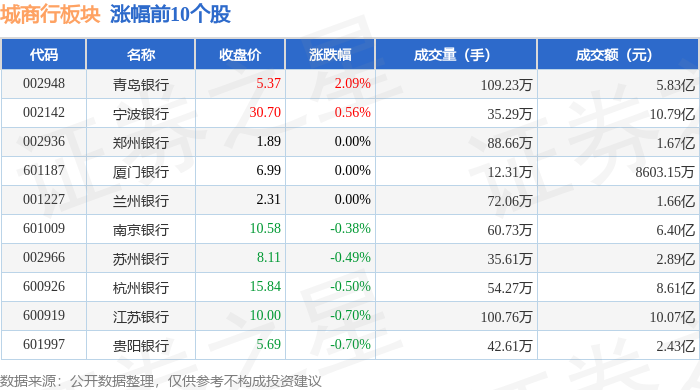
Market Overview - The city commercial bank sector experienced a decline of 0.59% on February 3, with Chongqing Bank leading the drop [1] - The Shanghai Composite Index closed at 4067.74, up by 1.29%, while the Shenzhen Component Index closed at 14127.1, up by 2.19% [1] Individual Bank Performance - Qingdao Bank closed at 5.37, with an increase of 2.09% and a trading volume of 1.09 million shares, totaling a transaction value of 583 million yuan [1] - Ningbo Bank closed at 30.70, up by 0.56%, with a trading volume of 352,900 shares and a transaction value of 1.079 billion yuan [1] - Chongqing Bank closed at 10.18, down by 1.83%, with a trading volume of 122,900 shares and a transaction value of 125 million yuan [2] - Chengdu Bank closed at 15.82, down by 1.62%, with a trading volume of 447,000 shares and a transaction value of 710 million yuan [2] Capital Flow Analysis - The city commercial bank sector saw a net inflow of 174 million yuan from institutional investors, while retail investors experienced a net outflow of 322 million yuan [2] - The main capital inflow and outflow for individual banks showed that Hangzhou Bank had a net inflow of 104.1 million yuan from institutional investors, while retail investors had a net outflow of 63.65 million yuan [3] - Chengdu Bank had a net inflow of 75.59 million yuan from institutional investors, with a net outflow of 66.56 million yuan from retail investors [3]


贵金属风暴下的银行“围城”:大行筑墙,小行借道
Hua Er Jie Jian Wen· 2026-02-03 07:14
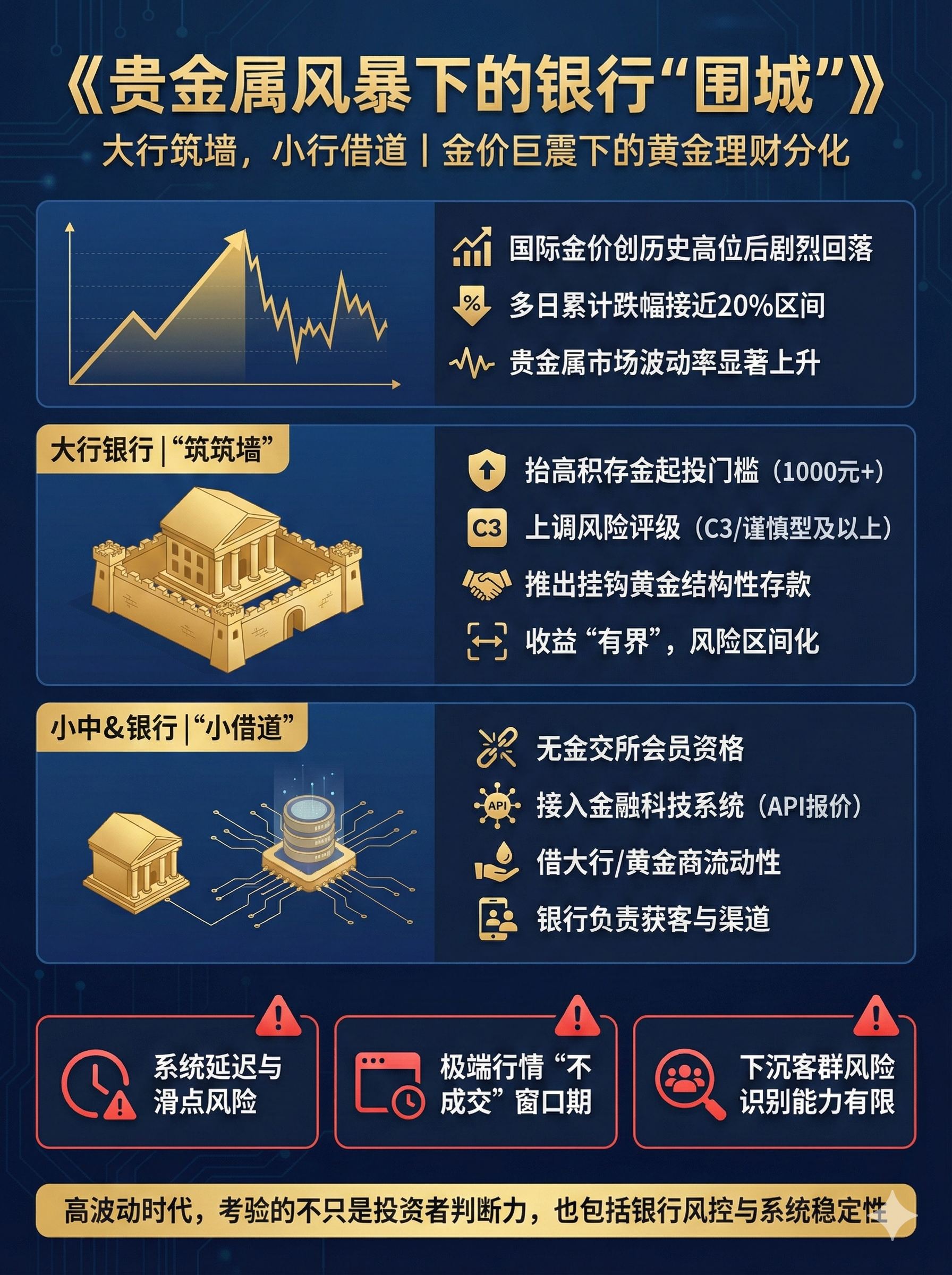
年终奖即将到手的律师王植(化名),在二月初的寒意中感到了某种难言的燥热。那是金价巨震带给市场的余温,也是财富焦虑在特定节点下的投射。 2月2日,全球贵金属市场遭遇深幅回调,此前一度冲破5500美元/盎司大关的现货黄金,在短短数个交易日内掉头向下,多日累计跌幅接近20%区间。 尽管市场弥漫着对"史诗级暴跌"的恐慌,但对于王植而言,波动即是磁石——他既不甘心在这一轮黄金热潮中彻底缺位,又对当前高位的剧烈波动心存忌 惮,最终在多家大型银行推出的黄金挂钩结构性存款前,停下了目光。 这并非王植一个人的选择。 随着大量存款到期与年终奖发放季重合,在黄金行情余温尚存的背景下,各类挂钩贵金属的理财产品正成为银行获客揽储的"胜负手"。 在这场全民淘金热中,大型银行与中小型银行对于黄金业务的态度,正在呈现出微妙的分化: 一边是努力"降温"的国股行,正通过抬高门槛、强化风险评级来构筑防火墙; 一边是仍在"升温"的中小银行,试图在技术与渠道的缝隙中,借道分享这场盛宴。 大行"筑墙" 在金价立于高位、波动率放大的背景下,国有大行与头部股份制银行正悄然掀起一场"去散户"的运动; 这种策略并非拒绝客户,而是通过提高准入门槛与设计风险对冲产 ...

银行业以高质量发展护航“十五五”开局
Jin Rong Shi Bao· 2026-02-03 01:49
Core Viewpoint - The banking industry is focusing on supporting the real economy through strategic transformation and risk management, with several banks reporting improved performance for 2025, indicating a shift towards high-quality development [1][2][3]. Group 1: Performance of Listed Banks - Multiple A-share listed banks, including China Merchants Bank, CITIC Bank, and Industrial Bank, have reported significant increases in both operating income and net profit for 2025, demonstrating a recovery in profitability [2]. - CITIC Bank and Pudong Development Bank have both entered the "10 trillion yuan club," with total assets of 10.13 trillion yuan and 10.08 trillion yuan respectively, marking growth rates of 6.28% and 6.55% year-on-year [2]. - The overall trend for joint-stock banks in 2025 is characterized by stable growth, optimized structure, risk control, and improved efficiency, showcasing strong resilience against economic cycles [2]. Group 2: Strategic Focus on Real Economy - The banking sector is shifting from "scale expansion" to "high-quality development," emphasizing targeted support for key areas and weak links in the economy [3]. - Major state-owned banks have outlined systematic plans to enhance their service to the real economy, aligning their strategies with national priorities and focusing on specific sectors such as agriculture and global expansion [4]. Group 3: Digital Transformation and Innovation - Digital transformation is identified as a key support for enhancing the effectiveness of banks in serving the real economy, with banks like Bank of Communications and Postal Savings Bank implementing AI and other digital strategies [5]. - The banking industry is increasingly focusing on technology finance, with significant growth in loans to technology enterprises, such as a 23.44% increase in technology finance loans at Hangzhou Bank [6][7]. Group 4: Support for Key Sectors - Banks are concentrating their resources on critical areas such as expanding domestic demand, technological innovation, and green development, with a focus on providing tailored financial solutions for small and micro enterprises [6][7]. - The emphasis on regional development and industrial upgrades is evident, with banks enhancing their service layouts to support local economies and specific industries, such as manufacturing [7]. Group 5: Future Outlook - The banking industry is expected to continue optimizing financial resource allocation and enhancing support for key sectors, while also deepening financial innovation and improving service precision [8]. - Collaboration among different types of banks is crucial for effectively serving the real economy, with large state-owned banks leading the way and smaller banks focusing on local needs [8].



银行业韧性凸显 增长可期
Jin Rong Shi Bao· 2026-02-03 01:49
Core Viewpoint - The performance reports of listed banks for 2025 reveal a resilient banking sector, with significant growth in profitability, particularly among small and medium-sized banks, providing insights for predicting the industry's trajectory in 2026 [1][2]. Group 1: Profitability and Growth - All ten listed banks reported positive growth in net profit, with nine achieving increases in both operating income and net profit [2]. - City commercial banks led the profitability growth, with Qingdao Bank showing a 21.66% increase in net profit, while Hangzhou Bank, Ningbo Bank, and Nanjing Bank reported growth rates of 12.05%, 8.13%, and 8.08% respectively [2]. - National joint-stock banks exhibited steady growth, with Shanghai Pudong Development Bank leading at 10.52% net profit growth, followed by CITIC Bank, China Merchants Bank, and Industrial Bank with growth rates of 2.98%, 1.21%, and 0.34% respectively [2]. Group 2: Revenue Structure Optimization - Revenue structure optimization was a key driver for many banks' performance, with Ningbo Bank's net fee and commission income reaching 6.085 billion yuan, a 30.72% year-on-year increase [3]. - Shanghai Pudong Development Bank improved its asset-liability management and reduced funding costs, stabilizing its net interest margin [3]. - Asset expansion was notable, with China Merchants Bank surpassing 13 trillion yuan in total assets, and several small and medium-sized banks showing significant growth rates in total assets, such as Qingdao Bank at 18.12% [3]. Group 3: Credit Growth and Asset Quality - Accelerated credit issuance was identified as a core driver for asset expansion among small banks, with strong demand in quality regions supporting growth [4]. - Asset quality remained stable, with five banks reporting a decrease in non-performing loan ratios, and overall fluctuations were kept within single-digit basis points [5][6]. - Notably, CITIC Bank and China Merchants Bank saw their non-performing loan ratios decrease by 1 basis point to 1.15% and 0.94% respectively, while the provisioning coverage ratios for several banks remained well above regulatory requirements [6]. Group 4: Future Outlook and Strategic Focus - Analysts predict a positive outlook for the banking sector in 2026, emphasizing the importance of loan growth, particularly in corporate lending, and the stability of asset quality [8]. - Major state-owned banks are focusing on developing differentiated strategies and enhancing operational efficiency as part of their 2026 goals [9][10]. - National joint-stock banks and local small and medium-sized banks aim to optimize their business structures and diversify income sources to improve profitability stability [10].
杭州银行股份有限公司 第八届监事会第十八次会议决议公告
Zhong Guo Zheng Quan Bao - Zhong Zheng Wang· 2026-02-02 23:07
证券代码:600926 证券简称:杭州银行 公告编号:2026-003 2026年2月3日 会议审议并通过决议如下: 一、审议通过《杭州银行股份有限公司董事、监事和高级管理人员2025年度履职评价实施方案》 表决结果:同意6票,反对0票,弃权0票。 特此公告。 杭州银行股份有限公司监事会 杭州银行股份有限公司 第八届监事会第十八次会议决议公告 本公司监事会及全体监事保证本公告内容不存在任何虚假记载、误导性陈述或者重大遗漏,并对其内容 的真实性、准确性和完整性承担法律责任。 杭州银行股份有限公司(以下简称"公司")第八届监事会第十八次会议于2026年1月21日以电子邮件及 书面形式发出会议通知,并于2026年2月2日以书面传签方式召开。本次会议应参会监事6人,实际参会 监事6人,本次会议的召开符合《中华人民共和国公司法》等法律法规及《杭州银行股份有限公司章 程》的有关规定,会议所形成的决议合法、有效。 ...
机构扎堆调研上市银行 信贷投放、净息差等为“最关注”
Xin Lang Cai Jing· 2026-02-02 22:57
Core Viewpoint - The article highlights the ongoing institutional research on listed banks in January, focusing on credit issuance, net interest margin, asset quality trends, and bond investment strategies during the peak marketing season [1][2][7]. Group 1: Institutional Research and Credit Issuance - A total of 373 institutions conducted research on 11 A-share listed banks, with 49 research instances recorded by January 31 [1][7]. - The banks under review include Nanjing Bank, Ningbo Bank, Shanghai Bank, and others, with Nanjing Bank being the most favored, receiving 76 institutional inquiries [2][8]. - Institutions are particularly focused on credit issuance during the marketing peak, with many banks reporting better performance compared to the same period in 2025 [2][8]. - Key areas for credit issuance include manufacturing, infrastructure construction, and green low-carbon transformation projects [3][9]. Group 2: Net Interest Margin Stability - Net interest margin (NIM) is a critical indicator of banking performance, with banks focusing on stabilizing NIM through asset and liability management [4][11]. - Shanghai Bank anticipates a slight decline in NIM due to the expected decrease in loan market quotation rates (LPR) and competitive pressures on deposit pricing [11][12]. - Qilu Bank is optimizing its asset portfolio and enhancing low-cost deposit acquisition to stabilize NIM [11][12]. Group 3: Bond Investment Strategies - The bond market has been volatile since 2025, affecting the bond investment returns of regional small and medium-sized banks [6][12]. - Shanghai Bank expects bond rates to remain in a fluctuating range in 2026, with limited potential for a trend reversal [6][13]. - Hu Nong Bank plans to focus on bond investment for asset allocation while employing risk management strategies, including the use of derivatives [6][13]. Group 4: Asset Quality Management - Banks are implementing measures to maintain stable asset quality, including improving the quality of new loans and increasing efforts to manage non-performing loans [6][13].