皖能电力

Search documents
2025年1-11月安徽省能源生产情况:安徽省发电量3207.2亿千瓦时,同比下滑0.8%
Chan Ye Xin Xi Wang· 2026-01-03 03:04
Group 1 - The core viewpoint of the article highlights a decline in electricity generation in Anhui Province for the year 2025, with a total generation of 320.72 billion kilowatt-hours, representing a year-on-year decrease of 0.8% [1] - In November 2025, electricity generation in Anhui Province was 26.97 billion kilowatt-hours, down 3.9% year-on-year [1] - The breakdown of electricity generation by type for January to November 2025 shows that thermal power accounted for 87.5% of total generation at 280.63 billion kilowatt-hours, a decrease of 2.7% year-on-year [1] Group 2 - Hydropower generation in Anhui Province for the same period was 6.53 billion kilowatt-hours, making up 2% of total generation, with a year-on-year decline of 5% [1] - Wind power generation increased by 23.3% year-on-year, reaching 17.7 billion kilowatt-hours, which constituted 5.5% of total generation [1] - Solar power generation also saw growth, totaling 15.859 billion kilowatt-hours, representing 4.9% of total generation, with a year-on-year increase of 15.9% [1]


“十四五”以来,我市产业强市建设不断向纵深推进——
Nan Jing Ri Bao· 2025-12-31 02:40
Group 1 - Nanjing's GDP has surpassed 1.9 trillion yuan, with per capita GDP ranking among the top cities in the country, indicating a strong economic foundation for the city's development [1] - The software and information service industry in Nanjing is expected to exceed 1 trillion yuan, marking it as the first trillion-level industry in the city [2][3] - Nanjing has established a robust industrial system with a focus on "4266" to enhance industrial capacity and promote high-quality development [3][11] Group 2 - The city has seen significant advancements in industrial clusters, with four clusters recognized as national advanced manufacturing clusters, showcasing a diverse and complementary industrial ecosystem [3][11] - Nanjing's industrial AI solutions have improved operational efficiency in power plants, transitioning from scheduled maintenance to demand-based maintenance, significantly reducing costs [2][6] - The establishment of the Jiangsu Intelligent Robot Innovation Center aims to enhance shared technology and accelerate data accumulation for product testing and commercialization [12] Group 3 - Nanjing is actively investing in emerging sectors such as low-altitude economy, artificial intelligence, and commercial aerospace, positioning itself as a leader in these fields [4][9] - The city has implemented policies to support the development of advanced manufacturing and digital transformation, including a three-year action plan for "smart manufacturing" [7][11] - Nanjing's focus on innovation has led to the establishment of several high-tech enterprises and research institutions, contributing to the city's competitive edge in technology [8][10] Group 4 - The city aims to strengthen its industrial base by fostering advanced manufacturing clusters and enhancing the quality of modern service industries [13][14] - Nanjing plans to create a modern industrial system supported by advanced manufacturing and modern services, with a goal of developing leading enterprises in artificial intelligence and other high-tech sectors [13][14] - The city is committed to implementing the "Artificial Intelligence+" initiative to promote the integration of AI across various industries, enhancing overall productivity and service quality [13][14]




皖能电力:截至2025年11月10日合并信用账户股东数为61487户
Zheng Quan Ri Bao· 2025-12-30 09:41
Group 1 - The company, WanNeng Electric Power, reported that as of November 10, 2025, the number of shareholders in the consolidated credit account is 61,487 [2] - The number of shareholders in the non-consolidated credit account is 58,192 [2]
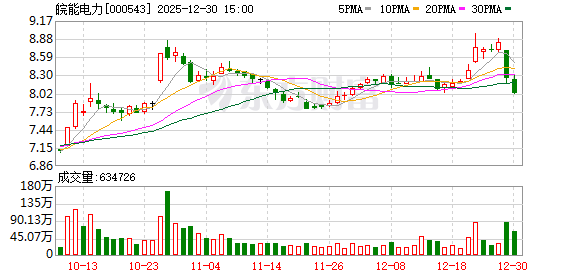
皖能电力:截至2025年10月20日公司合并信用账户股东数为54801户
Zheng Quan Ri Bao· 2025-12-30 09:41
Group 1 - The company, WanNeng Electric Power, reported that as of October 20, 2025, the number of shareholders in the consolidated credit account is 54,801 [2] - The number of shareholders in the non-consolidated credit account is 51,820 [2]
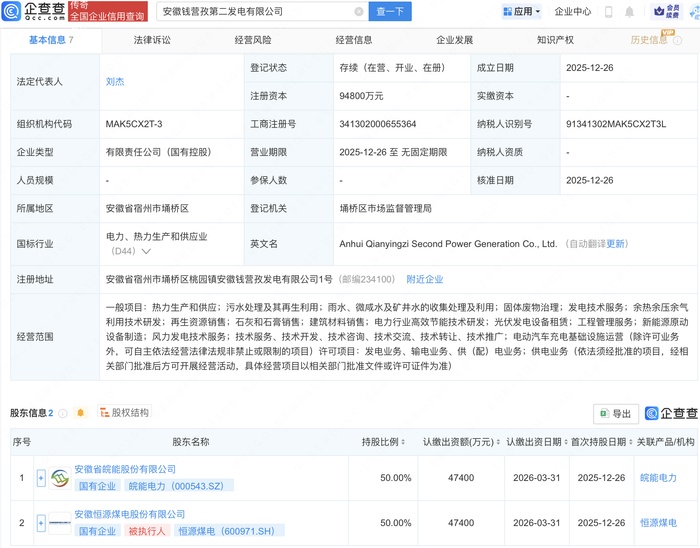
皖能电力、恒源煤电在安徽成立第二发电公司,注册资本9亿
Qi Cha Cha· 2025-12-30 07:34
Group 1 - Anhui Qianyingzi Second Power Generation Co., Ltd. has been established with a registered capital of 948 million yuan, focusing on new energy equipment manufacturing, wind power technology services, and electric vehicle charging infrastructure operations [1][2] - The company is jointly owned by Anhui Waneng Power Co., Ltd. (50% stake) and Anhui Hengyuan Coal Power Co., Ltd. (50% stake) [1][2] - The company is classified under the power and heat production and supply industry, with a business scope that includes thermal power production, wastewater treatment, solid waste management, and renewable energy technology development [2]

2025年1-11月全国能源生产情况:全国发电量88567亿千瓦时,同比增长2.4%
Chan Ye Xin Xi Wang· 2025-12-30 03:20
相关报告:智研咨询发布的《2026-2032年中国能源行业市场研究分析及投资前景评估报告》 2025年11月,全国发电7792.2亿千瓦时,同比增长2.7%。2025年1-11月,全国发电88567亿千瓦时,同 比增长2.4%。分品种看,2025年1-11月,全国火力发电量57124.6亿千瓦时,占总发电量的64.5%,同比 下滑0.7%;全国水力发电量12285.5亿千瓦时,占总发电量的13.9%,同比增长2.7%;全国核能发电量 4365.6亿千瓦时,占总发电量的4.9%,同比增长8.1%;全国风力发电量9499亿千瓦时,占总发电量的 10.7%,同比增长9.6%;全国太阳能发电量5290.88亿千瓦时占总发电量的6%,同比增长24.8%。 2018-2025年1-11月全国各品种发电量累计产量统计图 数据来源:国家统计局,智研咨询整理 附注 上市企业:皖能电力(000543)、建投能源(000600)、韶能股份(000601)、宝新能源(000690)、 湖南发展(000722)、晋控电力(000767)、甘肃能源(000791)、赣能股份(000899)、长源电力 (000966)、闽东电力(0009 ...

皖能电力、恒源煤电在安徽成立第二发电公司 注册资本9亿元
Zheng Quan Shi Bao Wang· 2025-12-30 01:13
Core Viewpoint - Anhui Qianyingsi Second Power Generation Co., Ltd. has been established with a registered capital of 948 million yuan, focusing on renewable energy equipment manufacturing, wind power technology services, and electric vehicle charging infrastructure operations [1] Company Summary - The newly established company is co-owned by Waneng Power (000543) and Hengyuan Coal Power (600971) [1] - The registered capital of the company is 948 million yuan, indicating a significant investment in the renewable energy sector [1] Industry Summary - The company's operations include manufacturing of renewable energy equipment, which aligns with the growing demand for sustainable energy solutions [1] - The focus on wind power technology services and electric vehicle charging infrastructure reflects the industry's shift towards cleaner energy and electric mobility [1]
【公用事业】广东26年长协竞价结果符合预期,动力煤价格持续下行——公用事业行业周报(20251228)(殷中枢/宋黎超)
光大证券研究· 2025-12-29 23:04
Market Overview - The SW public utility sector increased by 0.83% this week, ranking 20th among 31 SW primary sectors, while the Shanghai Composite Index rose by 1.88% and the Shenzhen Component Index by 3.53% [4] - The top five performing stocks in the public utility sector were Jingneng Power (+15.95%), Delong Huineng (+12.85%), Shanghai Electric (+11.47%), Dalian Thermal Power (+7.61%), and Anhui Energy (+7.43%) [4] - The worst-performing stocks included Hengsheng Energy (-21.47%), Xin'ao Co. (-5.47%), Mindong Electric (-2.17%), Huatong Thermal (-2%), and Huaneng Hydropower (-1.92%) [4] Coal Price Trends - Domestic and imported thermal coal prices continued to decline this week, with Qinhuangdao Port's 5500 kcal thermal coal price dropping by 33 CNY/ton [5] - Imported thermal coal prices also fell, with the price at Fangchenggang Port decreasing by 20 CNY/ton and at Guangzhou Port by 15 CNY/ton [5] Key Events - Guangdong's total transaction volume for 2026 is projected at 359.437 billion kWh, with an average transaction price of 37.214 CNY/kWh, down 5.03% year-on-year [6] - The electricity price for bilateral negotiations in 2026 is set at 37.221 CNY/kWh, with a total transaction volume of 4.779 billion kWh, reflecting a 17.74% increase from 2025 [6] - Nationwide electricity consumption reached 835.6 billion kWh in November, a 6.2% year-on-year increase, with cumulative consumption from January to November at 9,460.2 billion kWh, up 5.2% [6] - As of the end of November, the total installed power generation capacity reached 3.79 billion kW, a year-on-year increase of 17.1% [7] Industry Outlook - The results of the Guangdong electricity price negotiations are in line with expectations, with potential pressure on the profitability of thermal power units, although the spot market may provide performance growth [8] - The outlook for other provinces suggests that the annual long-term contract prices in regions with stable monthly contracts, such as Beijing and Shanghai, are expected to remain stable [8] - The green electricity sector is anticipated to experience valuation recovery due to policy support and accelerated subsidies, despite a downward trend in electricity prices [8] - The investment returns for thermal and green electricity should align with the overall investment return levels to ensure financing viability [8]
人民币升值投资机会解读
2025-12-29 15:51
Summary of Key Points from Conference Call Records Industry or Company Involved - The analysis focuses on the impact of the appreciation of the Renminbi (RMB) on various industries, including upstream raw materials (utilities, non-ferrous metals, steel, energy and chemicals) and consumer goods (airlines, duty-free businesses) [1][3][4]. Core Insights and Arguments - **Cost Reduction**: The appreciation of the RMB reduces the cost of imported goods, benefiting industries reliant on imported raw materials, particularly upstream raw materials and consumer goods sectors [1][3]. - **Debt Servicing Pressure**: Airlines and real estate companies experience reduced pressure on dollar-denominated debt repayments due to RMB appreciation, enhancing profitability for airlines through exchange gains [1][3]. - **Valuation Enhancement**: The appreciation of the RMB is expected to enhance the valuation of core RMB assets, particularly in the financial sector (banks and insurance) and the Hong Kong stock market, potentially attracting foreign capital [1][3]. - **Gas Sector Benefits**: The gas sector benefits from lower procurement costs linked to international oil prices, while high-dividend thermal power sectors are less affected by exchange rate changes [1][4]. - **Airline Sector Gains**: Airlines benefit from direct exchange gains on aircraft purchases and leases, as well as reduced operational costs due to lower dollar-denominated expenses [5][6]. - **Real Estate Market Stability**: RMB appreciation expands the space for interest rate cuts, which is crucial for stabilizing the real estate market, attracting foreign investment in large-scale real estate projects [7]. Other Important but Possibly Overlooked Content - **REITs Market Growth**: The REITs market is showing robust growth, positively impacting the RMB-denominated real estate market and providing exit channels for related institutions [8][9]. - **Hong Kong Stock Market Dynamics**: The appreciation of the RMB increases the attractiveness of Hong Kong stocks, particularly in the technology sector, although the fundamental driver remains earnings per share (EPS) [2][10][11]. - **Investment Recommendations**: China Duty Free is highlighted as a key beneficiary of RMB appreciation due to its pricing structure and potential growth from policy catalysts and consumer behavior changes [13]. This summary encapsulates the critical insights from the conference call records, emphasizing the multifaceted impacts of RMB appreciation across various sectors and the potential investment opportunities arising from these dynamics.

“黑天鹅”,突袭!
券商中国· 2025-12-29 13:08
Core Viewpoint - The power sector experienced significant declines, particularly in thermal power stocks, due to downward pressure on long-term electricity prices for 2026, which fell short of market expectations [2][5]. Group 1: Stock Performance - Major thermal power stocks saw substantial declines, with Guodian Power down 7.96%, Anhui Energy down 6.46%, and Huaneng International down 5.07% [2][3]. - Other notable declines included Shanghai Electric and Inner Mongolia Huadian, both dropping over 5% [2]. Group 2: Electricity Price Trends - The long-term electricity price for Guangdong in 2026 was set at 372.14 cents/kWh, a decrease of 19.72 cents/kWh from the previous year, nearing the lower limit of the benchmark price [5]. - In Jiangsu, the average price for January 2026 was 324.71 yuan/MWh, down 19.9% year-on-year, reflecting significant downward pressure on electricity prices in economically developed regions [5]. Group 3: Market Analysis - Analysts suggest that the ongoing market reforms may lead to a gradual increase in electricity prices, with the introduction of capacity pricing mechanisms reinforcing the foundational role of coal power [4]. - Despite the current downward trend, some institutions believe that the electricity market may not be overly pessimistic for 2026, as the government is beginning to focus on stabilizing electricity prices [7]. Group 4: Competitive Landscape - The retail electricity market has seen irrational competition, with companies engaging in aggressive pricing strategies to capture market share, leading to a temporary failure in price discovery [6]. - The introduction of new policies may help mitigate the excessive price competition among retail electricity companies, potentially restoring order to the market [7]. Group 5: Future Outlook - The construction of a new power system under the "dual carbon" goals is expected to rely on enhanced system regulation and support from the government, which may improve the performance of power operators in the future [8].