宇树科技

Search documents
机构称智元机器人出货量超宇树科技,“高举高打”初见成效?
Nan Fang Du Shi Bao· 2026-01-09 05:03
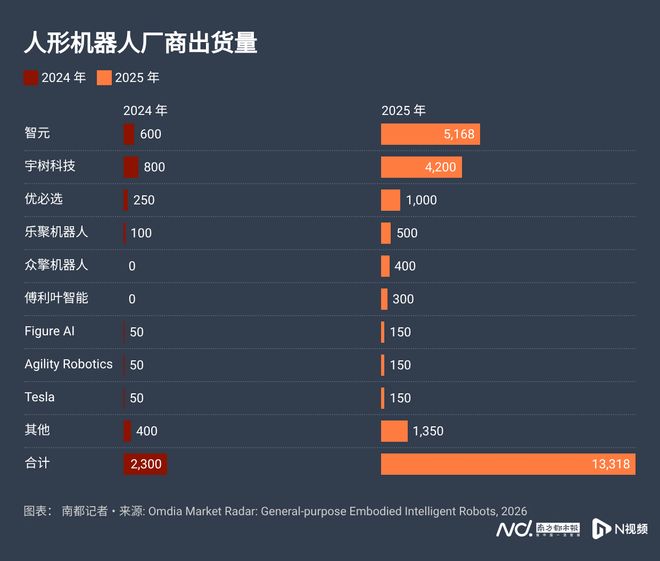
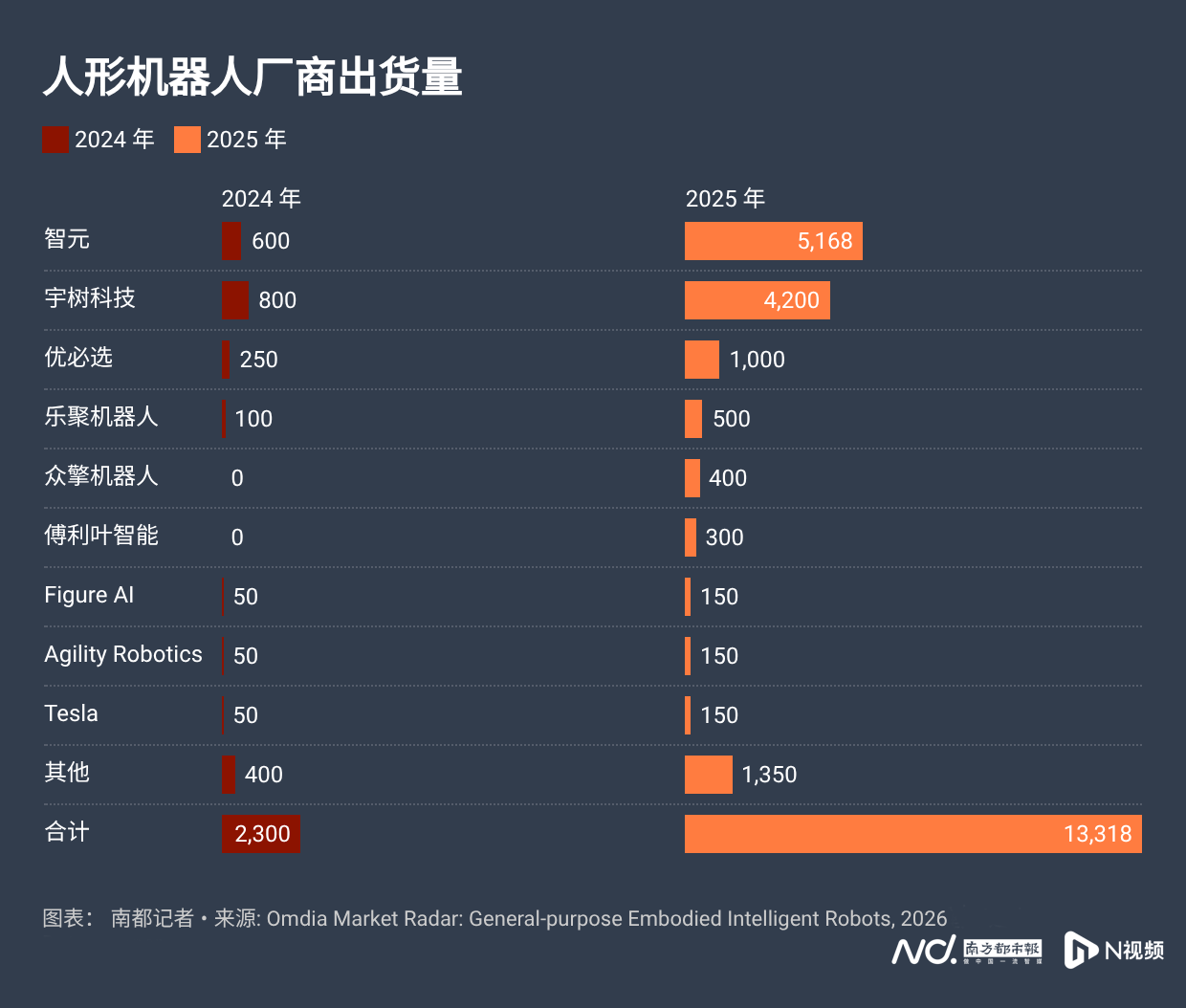
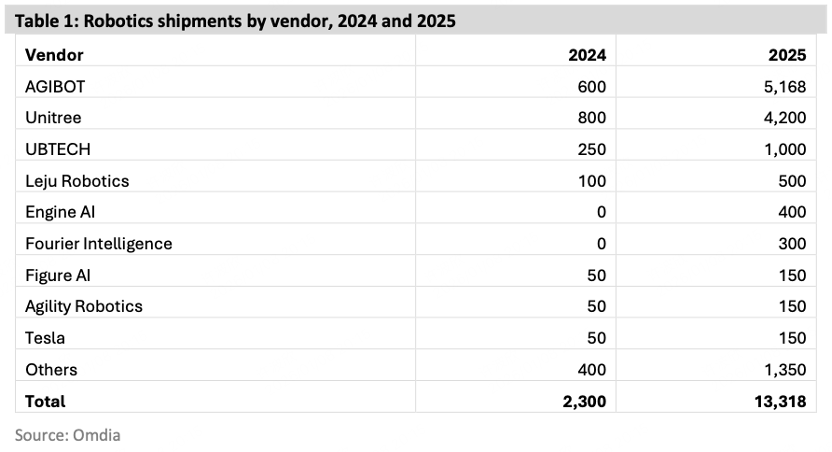
根据市场分析机构Omdia于1月8日发布的一份报告,智元在2025年的人形机器人出货量为5168台,登顶 全球榜首。相比之下,Omdia预估宇树科技同期的人形机器人出货量为4200台。二者的市场份额分别为 39%和32%。 智元董事长兼CEO邓泰华在2025年12月底的一场发布会上介绍,公司在2025年的销售收入超过10亿元。 而2024年,智元仅有数千万元的销售收入。邓泰华预计,2026年公司的出货量和销售收入仍将保持数倍 的增长幅度。 Omdia还从竞争力的维度,为头部的人形机器人公司划分梯队。该机构选用的评估维度包括产品形态、 负载性能、灵巧操作、感知导航、AI学习、定制便捷、规模量产、规模商用等。 智元、Figure AI、特斯拉、优必选和宇树科技被Omdia划入第一梯队。Omdia认为,这些厂商在前沿技 术突破、完善的开发者生态以及商业化落地成果这三大关键能力方面表现突出。Agility Robotics、 Apptronik、傅利叶智能、乐聚机器人等位列第二梯队,在AI技术或整体出货量方面略逊于第一梯队。 Omdia认为,到2025年末,在中国规模化生产能力与美国AI创新能力的共同推动下,具身智能 ...


机构称智元机器人出货量超宇树科技 “高举高打”初见成效?
Nan Fang Du Shi Bao· 2026-01-09 05:00
智元、Figure AI、特斯拉、优必选和宇树科技被Omdia划入第一梯队。Omdia认为,这些厂商在前沿技术突破、完善的开发者生态以及商业化落地成果这三 大关键能力方面表现突出。Agility Robotics、Apptronik、傅利叶智能、乐聚机器人等位列第二梯队,在AI技术或整体出货量方面略逊于第一梯队。 不过也有业内人士对南都记者提出,智元的机器人订单有不少来自与其存在资本合作关系的产业链客户,能否称得上具有实质意义的商业化有待观测。 根据Omdia报告,2025年出货量超过1000台的公司还有优必选。智元、宇树科技和优必选被Omdia视为人形机器人厂商中的第一销售梯队。其中,智元、优 必选偏向商业与工业应用,而宇树科技的机器人则在科研、教育和消费级市场得到广泛部署。 乐聚机器人、众擎机器人、傅利叶智能等中国人形机器人公司,以及Figure AI、Agility Robotics 等美国玩家的2025年预估出货量均在百台级别。 Omdia还从竞争力的维度,为头部的人形机器人公司划分梯队。该机构选用的评估维度包括产品形态、负载性能、灵巧操作、感知导航、AI学习、定制便 捷、规模量产、规模商用等。 根据 ...
特斯拉发包中,Optimus供应商们最新进展
Robot猎场备忘录· 2026-01-09 04:32
温馨提示 : 点击下方图片,查看运营团队最新(12月)原创报告(共260页) 说明: 欢迎约稿、刊例合作、行业交流 , 行业交流记得先加入 "机器人头条"知识星球 ,后添加( 微信号:lietou100w )微 正文: 2026年开年,Optimus V3定型在即, 特斯拉发包中, T链们行情却反转失败! 回顾去年年12月,从审厂到发包, 诸多T链标的获得明确量产指引,订单、" 定点 "等利好 资讯不断,核心标的 越发明确,同时,伴随发包预期催化,在2025年终之际,T链们迎来主升行情。 注: 小编12月盘点文章 Optimus量产前夕,"新T链"们,来了! 有对Optimus进展、T链走势、核心标的进行详细梳理。 小编12月下旬就在星球中提到,12月份炒的审厂和"定点"(订单),即将开启的1月份,T链们炒作重点是获得发 包和前往北美沟通的标的们(定点);其实被发包标的和前往北美沟通标的基本可以看做等同。 本波前往北美沟通T链标的们主要沟通点就是 后续量产事宜, 签署ppa协议 ,进行RFQ(SOP前最后一环)确 认,然后定点。 —— 12月25日, KS 最新调研:北美交流超预期, 目前处于带量询价订单阶段 ...


杭州AI的秘密,藏在小镇里
3 6 Ke· 2026-01-09 03:49
Core Insights - The article highlights the emergence of Hangzhou as a new hub for AI innovation, driven by the "Six Little Dragons" and the influence of Alibaba, marking a shift from an e-commerce narrative to an AI narrative by 2025 [3][4]. Group 1: The Rise of Hangzhou's AI Ecosystem - Hangzhou's "Six Little Dragons" represent six high-growth companies focusing on cutting-edge technologies such as robotics, AI, and game development, which have attracted talent from other regions [3][4]. - The city has become a magnet for entrepreneurs due to its favorable environment, including lower living costs and a supportive atmosphere for startups, allowing for a more focused entrepreneurial spirit [4][5]. - The local government has provided significant support to tech startups, including direct investments and resources for talent acquisition, which has fostered a nurturing environment for innovation [5][6]. Group 2: The Role of Local Culture and Community - The entrepreneurial culture in Hangzhou is characterized by a blend of idealism and realism, allowing for a unique ecosystem where startups can thrive despite high uncertainty [6][7]. - The "small town mechanism" in Hangzhou facilitates rapid information flow and community interaction, which is essential for innovation, contrasting with larger cities where resources are more dispersed [9][13]. - Hangzhou's small towns, such as the AI Town and Cloud Town, serve as incubators for startups, providing a compact environment that encourages collaboration and reduces operational costs [9][10]. Group 3: The Influence of Alibaba - Alibaba has played a crucial role in establishing the digital economy in Hangzhou, providing a foundation for talent and technological support that has enabled the rise of the "Six Little Dragons" [14][15]. - The presence of Alibaba has created a talent pool and a culture of innovation that attracts new startups, further enhancing Hangzhou's reputation as a tech hub [14][16]. - The city's ambition to become a "Silicon Valley" of China is reflected in its ongoing development of innovation clusters like "China Cloud Valley," which aims to drive the AI industry forward [15][17]. Group 4: Future Prospects and Challenges - Hangzhou's strategy of integrating small towns and larger innovation valleys aims to create a seamless flow of resources and ideas, positioning the city for future growth in the tech sector [18]. - Despite its rapid development, Hangzhou still faces challenges in original innovation capabilities and global influence compared to other major cities like Beijing and Shanghai [18]. - The city's vibrant ecosystem continues to evolve, with the potential to produce groundbreaking innovations that could reshape industries [18].



中国企业,正主宰全球人形机器人市场
财联社· 2026-01-09 03:18
Core Insights - The article highlights that Zhiyuan Innovation, a leading Chinese robotics company focused on embodied intelligence, is projected to lead the global market in humanoid robot shipments and market share by 2025 [1][2]. Group 1: Market Position and Growth - According to Omdia's report, Zhiyuan Robotics is expected to ship over 5,168 humanoid robots in 2026, capturing 39% of the global market share [2]. - Following Zhiyuan, two other Chinese companies, Yushu Technology and UBTECH, hold 32% and 7% of the market share, respectively [4]. - The global sales of humanoid robots are anticipated to grow more than fourfold from 2024 to 2025, indicating a rapidly expanding market [4]. Group 2: Competitive Landscape - The report includes both bipedal humanoid robots and wheeled products with humanoid upper bodies, showcasing a diverse range of offerings in the market [5]. - A study by Citigroup predicts that the number of robots will surge to 648 million units by 2050, with China's current leadership potentially aiding its development [5]. - Omdia notes that Chinese suppliers are setting benchmarks in large-scale production, with humanoid robots being more affordable than those produced by Western companies [5]. Group 3: Technological Advancements - AI integration is enabling robots to perform complex tasks, enhancing their applications across various sectors such as manufacturing, logistics, healthcare, and customer service [5]. - Companies are heavily investing in advanced AI models to improve robot capabilities [5]. Group 4: Product Development and Recognition - At the recent CES event in Las Vegas, Zhiyuan Robotics gained significant international recognition, launching new products including the Genie Sim 3.0 simulation platform and the portable Q1 robot [6]. - Zhiyuan has developed a diverse product matrix of humanoid robots, which are being deployed in various commercial scenarios, including reception, entertainment, industrial manufacturing, logistics, security, data collection, and education [6]. Group 5: Future Projections - Omdia projects that global humanoid robot shipments will exponentially increase to 2.6 million units by 2035, driven by advancements in AI models, dexterous robotic hands, and self-reinforcement learning [8]. - The number of Chinese companies involved in the humanoid robot sector has surpassed 150, supported by favorable industrial policies and training infrastructure [8].
智元登顶全球人形机器人出货榜,宇树、优必选居二、三位
Xin Lang Cai Jing· 2026-01-09 02:45
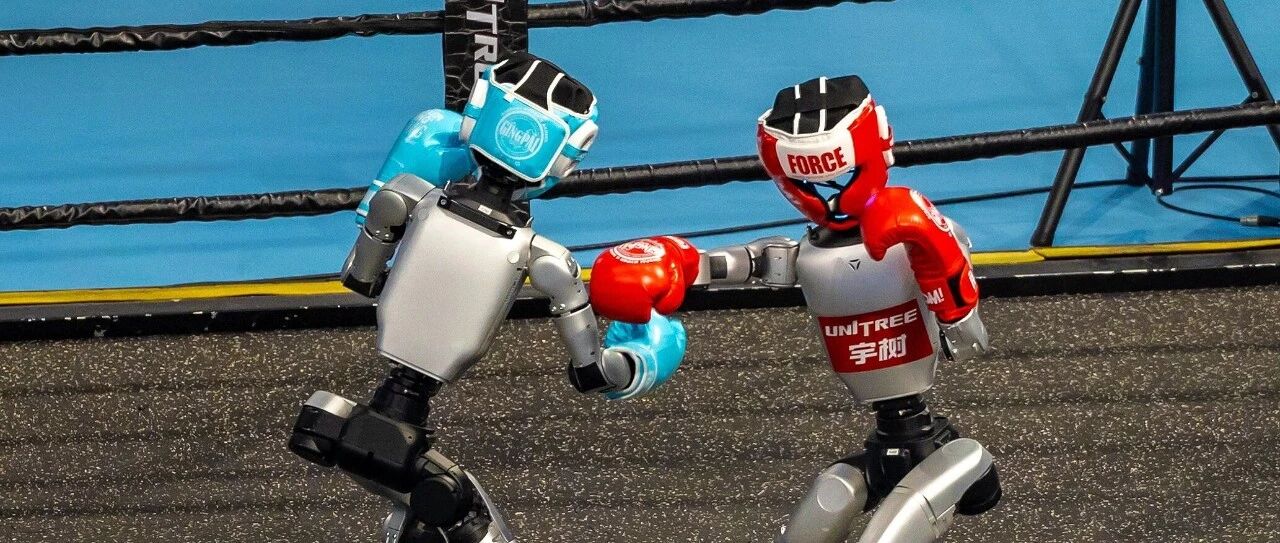
排在第二位的宇树科技也是人形机器人领域的热门公司。过去一年,宇树不仅将全球首店落地京东MALL,还推出售 价2.99万元的Unitree R1小型机器人,拉低消费市场准入门槛。该公司年末发布的H2机器人训练视频中,身高180厘 米、体重70公斤的H2展现了一系列新的高难度动作,包括腾空侧踢、空中回旋踢等。 宇树科技目前正在推进上市工作。该公司创始人王兴兴在去年6月的夏季达沃斯论坛上透露,宇树2024年营收已超10亿 元人民币。宇树科技早期投资人、SevenUp Capital创始人赵楠曾提及,自2020年以来,宇树科技的财务报表每年都保 持盈利状态。 位列第三位的优必选主要瞄准工业场景,2025年实现第1000台Walker S2工业机器人下线,实际交付超500台。去年11 月底,优必选中标江西九江市人形机器人数据采集与训练中心项目,中标金额为1.43亿元。截至当月,优必选Walker 系列人形机器人2025年全年订单总金额已达到13亿元。 1月9日,研究机构Omdia最新发布的行业报告显示,2025年全球人形机器人市场迈入高速增长阶段,出货量达1.3万 台,反映出该品类在多应用场景下的商业化落地进程正在加速 ...
去年全球人形机器人出货量约1.3万台,AI人工智能ETF(512930)盘中蓄势
Xin Lang Cai Jing· 2026-01-09 01:59
Group 1 - The core viewpoint of the articles highlights the rapid growth and potential of the AI industry, particularly in the humanoid robot and AI chip markets, driven by domestic manufacturers in China [1][2] Group 2 - As of January 9, 2026, the Zhongzheng AI Theme Index (930713) shows mixed performance among its constituent stocks, with Runze Technology (300442) leading with a 5.35% increase, followed by Guanghuan Xinnet (300383) at 4.48%, and Fudan Microelectronics (688385) at 3.76% [1] - The global humanoid robot shipment reached approximately 13,000 units last year, with Chinese manufacturers contributing the majority, significantly outpacing companies like Tesla and Figure AI [1] - Shanghai Zhiyuan topped the global humanoid robot manufacturers with an estimated shipment of 5,168 units last year, followed by Yushu Technology and UBTECH [1] - The AI chip market in China is projected to grow from 142.54 billion yuan in 2024 to 1,336.79 billion yuan by 2029, indicating a substantial increase in demand driven by AI advancements [2] - The Zhongzheng AI Theme Index includes 50 listed companies involved in providing resources, technology, and application support for AI, reflecting the overall performance of AI-related securities [2] - As of December 31, 2025, the top ten weighted stocks in the Zhongzheng AI Theme Index account for 58.08% of the index, with companies like Zhongji Xuchuang (300308) and Hikvision (002415) among the leaders [2]
2025年人形机器人出货量公布:中国公司远超特斯拉等美企
Feng Huang Wang· 2026-01-08 23:45
Group 1 - The global humanoid robot shipment reached approximately 13,000 units last year, predominantly from Chinese manufacturers, significantly outpacing companies like Tesla and Figure AI from the US [1] - According to Omdia, the leading humanoid robot manufacturer, Zhiyuan Robotics, shipped an estimated 5,168 units last year, followed by Yushutech and UBTECH [1] - The humanoid robot market is still in its early competitive stage but is expected to experience explosive growth over the next few decades, with projections indicating a rise to 648 million units by 2050 [1] Group 2 - Chinese humanoid robots are priced significantly lower than their Western counterparts, with Yushutech's entry-level model priced at $6,000 and Zhiyuan's simplified version at approximately $14,000 [2] - Omdia forecasts that global humanoid robot shipments will grow to 2.6 million units by 2035, with applications expanding into industrial manufacturing, commercial services, and eventually household scenarios [2] - The integration of AI technology is enabling robots to perform complex tasks, which is driving their adoption across various sectors such as manufacturing, logistics, healthcare, and customer service [1]

资本市场年度人物 老将承压,新生代突围
Nan Fang Du Shi Bao· 2026-01-08 23:12
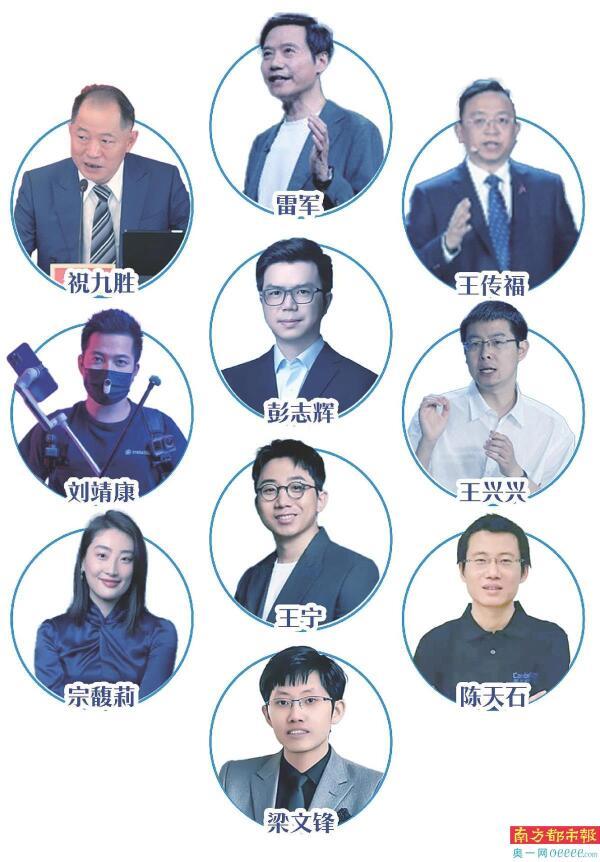
Capital Market Trends - The Chinese capital market in 2025 is characterized by the rise of new tech players and deep adjustments in traditional industries, indicating a shift from scale expansion to value return and from concept speculation to solid capabilities [2] - The experiences of key figures in the market reflect a clear trend: only by respecting risks, adhering to fundamentals, and embracing innovation can one maintain a foothold in the changing capital landscape [2] Challenges for Established Players - The resignation of Vanke's former CEO, Zhu Jiusheng, marks a significant event in the real estate sector, revealing the vulnerabilities of high-leverage models amid a downturn, as Vanke faces over 36 billion in public debt due in 2025 [3] - Xiaomi's CEO Lei Jun faces scrutiny as the company transitions into the automotive sector, with safety concerns and brand reputation challenges arising despite impressive sales figures [3] New Generation Entrepreneurs - Liu Jingkang, born in 1991, leads Ying Shi Innovation to a market cap of 70 billion after a strong debut on the Sci-Tech Innovation Board, but faces intense competition from established players like DJI [5] - Peng Zhihui, known as Zhi Hui Jun, transitions from Huawei to entrepreneurship, achieving a remarkable 1820.29% stock price increase for Wei Xin New Materials, but must now focus on sustainable profitability [5] - Wang Xingxing's Yushut Technology aims for an IPO, showcasing advanced robotics technology, with the success of its commercialization path being crucial for the industry's future [5] Family Business Dynamics - In 2025, Zong Fuli faces legal challenges and internal power struggles at Wahaha, highlighting the complexities of succession and governance in private enterprises [6] Market Volatility and Value Reconstruction - Bubble Mart's LABUBU 3.0 series drives a significant stock price increase, but the subsequent decline in IP premium raises questions about sustainable growth strategies [6] - Cambricon Technologies experiences a turnaround with four consecutive profitable quarters, driven by core technology accumulation, positioning itself as a leader in the AI computing sector [6] Innovation in AI - Liang Wenfeng, founder of DeepSeek, gains recognition for significant advancements in AI, emphasizing that market presence will ultimately yield to technological strength and continuous innovation [7]
跨界卷王“最浓烟火气” 机器人“最能舞出圈” 潮玩教父“最拿捏情绪”
Nan Fang Du Shi Bao· 2026-01-08 23:12
Core Insights - The business landscape in 2025 is characterized by significant transformations driven by AI, e-commerce, and local services, with major companies like JD.com, Alibaba, and Pop Mart leading the charge [3][4][7] - Key figures in the industry are recognized for their innovative approaches and impactful strategies, earning them accolades such as "most impactful" and "most daring" [3][7][10] Group 1: JD.com and Liu Qiangdong - Liu Qiangdong made a strong public return in 2025, taking on the role of "Chief Experience Officer" and engaging directly with consumers through various initiatives [5][6] - His actions, including cooking live and delivering food, aimed to enhance JD.com's local service offerings and reshape the company's image as more relatable and community-focused [5][6] - JD.com also committed to providing full social insurance for its delivery riders, emphasizing sustainable employee welfare over mere competition on subsidies [6] Group 2: Alibaba and Jiang Fan - Jiang Fan returned to lead Alibaba's e-commerce division, focusing on integrating various business segments under a unified platform to enhance operational efficiency [7][8] - His strategy included the launch of Taobao Flash Purchase, which significantly boosted user engagement and was projected to generate substantial transaction growth in the coming years [8] Group 3: Pop Mart and Wang Ning - Wang Ning, founder of Pop Mart, successfully transformed emotional value into a profitable business model, with the LABUBU IP becoming a top-tier brand [9] - Despite market concerns about sustainability, Pop Mart remains a leading player in the collectible toy industry, with plans to further explore long-term value creation [9] Group 4: AI and Yan Junjie - Yan Junjie, founder of MiniMax, is recognized for his foresight in AI development, having started his venture before the AI boom [15][16] - MiniMax focuses on efficient resource use and innovative algorithms, with a young workforce that emphasizes agility and high performance [16] Group 5: GPU Industry and Zhang Jianzhong - Zhang Jianzhong's company, Moore Threads, successfully launched on the STAR Market, becoming a significant player in the domestic GPU sector [17][18] - The company achieved a remarkable IPO process, with a high stock price and low lottery rate, indicating strong market interest and potential for growth [18][19]