华安证券

Search documents
前6月27家券商分25.46亿承销保荐费 中信建投第一
Zhong Guo Jing Ji Wang· 2025-07-01 23:24
Summary of Key Points Core Viewpoint - In the first half of 2025, a total of 51 companies were listed on the Shanghai Stock Exchange, Shenzhen Stock Exchange, and Beijing Stock Exchange, raising a total of 37.3 billion yuan in funds [1]. Group 1: Listing and Fundraising - Among the 51 listed companies, 18 were on the main board, 20 on the ChiNext board, 7 on the Sci-Tech Innovation board, and 6 on the Beijing Stock Exchange [1]. - The top fundraising company was Zhongce Rubber, which raised 4.066 billion yuan, followed by Tianyouwei and Yingshi Innovation, which raised 3.740 billion yuan and 1.938 billion yuan respectively [1]. Group 2: Underwriting and Sponsorship Fees - A total of 27 securities firms participated in the underwriting and sponsorship of the newly listed companies, earning a combined fee of 2.546 billion yuan [1]. - CITIC Securities ranked first in underwriting fees, earning 316.556 million yuan by sponsoring five companies including Huazhi Jie and Zhongce Rubber [2]. Group 3: Ranking of Securities Firms - Huatai United and CITIC Securities ranked second and third in underwriting fees, earning 254.466 million yuan and 231.965 million yuan respectively [2]. - The top five securities firms collectively earned 1.177 billion yuan, accounting for 46.23% of the total underwriting fees for the first half of 2025 [3]. Group 4: Detailed Underwriting Data - A detailed table lists the number of companies sponsored and the corresponding underwriting fees for various securities firms, with CITIC Securities leading with five companies and 316.556 million yuan [4]. - Other notable firms include Huatai United, CITIC Securities, Guotai Junan, and Shenwan Hongyuan, each sponsoring multiple companies and earning significant fees [5].



九华旅游: 华安证券股份有限公司关于安徽九华山旅游发展股份有限公司2025年度向特定对象发行A股股票之发行保荐书
Zheng Quan Zhi Xing· 2025-07-01 16:31
Group 1 - The core viewpoint of the news is that Huazhong Securities Co., Ltd. has been appointed as the sponsor for Anhui Jiuhuashan Tourism Development Co., Ltd.'s issuance of A-shares to specific investors, ensuring compliance with relevant laws and regulations [1][2][11] - The issuer, Anhui Jiuhuashan Tourism Development Co., Ltd., was established on December 27, 2000, and listed on the Shanghai Stock Exchange on March 26, 2015, with a registered capital of 110.68 million yuan [4][8] - As of March 31, 2025, the total share capital of the issuer is 110,680,000 shares, with 100% being unrestricted circulating shares [4][5] Group 2 - The controlling shareholder of the issuer is Wenlv Group, which holds 29.93% of the shares, while the actual controller is the Chizhou State-owned Assets Supervision and Administration Commission [8][10] - The company plans to raise up to 500 million yuan through this issuance, with the funds allocated for various projects including the renovation of hotels and the construction of a cable car project [15][16] - The issuance will involve no more than 33,204,000 shares, representing up to 30% of the total share capital prior to the issuance [12][15]


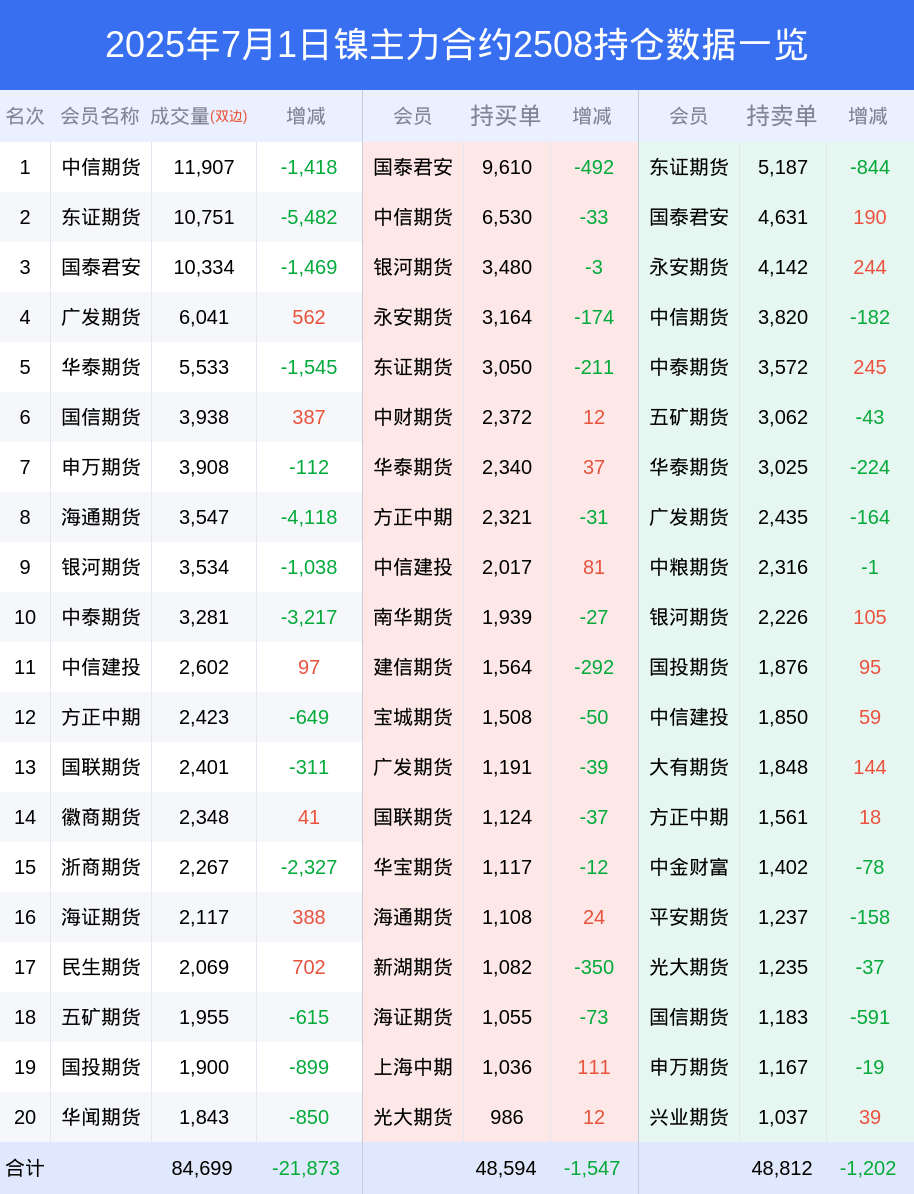
1日镍下跌0.21%,最新持仓变化
Sou Hu Cai Jing· 2025-07-01 12:24
文章来源:新浪期货 | | 名次 会员名称 成交量(双边) | | 壇減 | 会员 | 持买单 | 增减 | 会员 | 持卖单 | 增减 | | --- | --- | --- | --- | --- | --- | --- | --- | --- | --- | | ਹ | 中信期货 | 11,907 | -1,418 | 国泰君安 | 9,610 | -492 | 东证期货 | 5,187 | -844 | | 2 | 东证期货 | 10,751 | -5,482 | 中信期货 | 6,530 | -33 | 国泰君安 | 4,631 | 190 | | 3 | 国泰君安 | 10,334 | -1,469 | 银河期货 | 3,480 | -3 | 永安期货 | 4,142 | 244 | | 4 | 广发期货 | 6,041 | 562 | 永安期货 | 3,164 | -174 | 中信期货 | 3,820 | -182 | | 5 | 华泰期货 | 5,533 | -1,545 | 东证期货 | 3,050 | -211 | 中泰期货 | 3,572 | 245 | | 6 | 国信期货 | 3, ...


华安证券(600909) - 华安证券股份有限公司可转债转股结果暨股份变动公告
2025-07-01 10:03
证券代码:600909 证券简称:华安证券 公告编号:2025-045 转债代码:110067 证券简称:华安转债 华安证券股份有限公司可转债转股结果暨股份变动 公告 本公司董事会及全体董事保证本公告内容不存在任何虚假记载、误导性陈 述或者重大遗漏,并对其内容的真实性、准确性和完整性承担法律责任。 重要内容提示: 自 2020 年 9 月 18 日至 2025 年 6 月 30 日期间,公司可转债累计有人民 币 815,000 元转换为公司 A 股股票,累计转股数量为 114,401 股,占可转债转股 前公司已发行股份总数的 0.0032%; 截 至 2025 年 6 月 30 日 , 公 司 尚 未 转 股 的 可 转 债 金 额 为 人 民 币 2,799,185,000 元,占可转债发行总量的 99.9709%。 自 2025 年 1 月 1 日至 2025 年 6 月 30 日期间,公司可转债有人民币 3000 元转换为公司 A 股股票,转股数量为 504 股。 一、可转债发行上市概况 根据中国证券监督管理委员会(以下简称"中国证监会")《关于核准华安证 券股份有限公司公开发行可转换公司债券的批复》( ...
6月最牛金股大涨63%!券商7月金股出炉
券商中国· 2025-07-01 03:43
Core Insights - Nearly 90% of brokerage gold stock portfolios achieved positive returns in the first half of the year, with Northeast Securities leading at a 45.45% return [2][6] - The July gold stock list shows a strong representation from the electronics, pharmaceutical, and machinery sectors, with significant contributions from power equipment and non-bank financials [3][9] - Brokerages are optimistic about the market's potential to break through previous highs, particularly focusing on sectors like technology and brokerage firms for investment [4][12] Performance Summary - In June, the top-performing gold stock was Giant Network (002558.SZ) with a 63.09% monthly increase, driven by strong data from its new game [5] - Other notable performers included Shenghong Technology (300476.SZ) with a 55.39% increase and Inner Mongolia First Machinery (600967.SH) with a 54.80% increase [6] - The Shanghai Composite Index rose 2.76% in the first half of the year, while the North Star 50 Index surged nearly 40% [6] Brokerage Rankings - Northeast Securities topped the gold stock portfolio rankings with a 45.45% return, followed by Dongxing Securities at 37% and Huaxi Securities at 29.25% [6] - Five brokerages reported negative returns for their gold stock portfolios, including Changcheng Securities and Zhongyin Securities [7] Sector Focus - The latest gold stock recommendations highlight a concentration in electronics, pharmaceuticals, and machinery, with multiple brokerages recommending stocks like Pop Mart (09992.HK) and Zhongxin Securities (600030.SH) [9][10] - Other stocks receiving multiple recommendations include Muyuan Foods (002714.SZ), noted for its low costs and profitability in the slaughtering business [11] Market Outlook - Analysts suggest that the market may continue to show resilience in July, with potential breakthroughs depending on structural policy and market conditions [14][15] - The consensus among brokerages is that the Shanghai Composite Index has a significant chance of surpassing last year's highs, with a focus on technology and brokerage sectors for investment opportunities [12][15]




固定收益周报:择券空间继续收窄-20250630
Huaxin Securities· 2025-06-30 09:33
Group 1: Industry Investment Rating - No information provided in the report regarding the industry investment rating Group 2: Core Viewpoints - In the contraction cycle, the cost - performance ratio of stocks and bonds trends towards bonds, and the equity style trends towards value. Currently, long - term bonds have a slightly better cost - performance ratio than value - type equity assets. If the value - type equity assets continue to decline, there may be a good entry window. The top - down broad - based portfolio view is 80% equity value style and 20% 30 - year Treasury bond ETF. The new convertible bond portfolio has 0 equity - type convertible bond position and 70% total position, all allocated to value - style double - low and low - price convertible bonds (bond - like assets) [4] Group 3: Summary of Related Catalogs 1. Stock, Bond, and Convertible Bond Market Review - Last week, the A - share market oscillated upwards driven by sentiment and funds, with significant differentiation. Financial technology, small - cap growth, and micro - cap stocks performed strongly, while financial heavy - weight stocks were under pressure. The sector rotation accelerated. The computing power industry chain was boosted by NVIDIA's new high, the digital currency concept rose by the limit under the stimulation of Hong Kong's digital asset policy, the Xiaomi SU7 pre - sale stimulated the consumer electronics chain, military stocks strengthened in the middle of the week, and the non - ferrous metal sector was stimulated by factors such as shipping risks in the Strait of Hormuz, the weakening of the US dollar, and arms exports. The Hong Kong stock market was also differentiated, with innovative drugs under pressure and virtual asset license concept stocks soaring. Safe - haven assets were under pressure, with gold falling due to the easing of the Middle East situation and WTI crude oil plummeting to a 27 - month low. The domestic bond market oscillated due to the stock - bond seesaw effect, and the selling pressure of long - term bonds was relatively large, with the 30 - year Treasury bond futures experiencing a short - term diving market [2] - Last week, factors such as the strengthening of the underlying stocks, the continuous high - level oscillation of convertible bond valuations supported by the rigid demand of "fixed - income +" funds, and the repair of photovoltaic varieties led the CSI Convertible Bond Index to break through the previous high. Currently, the cost - performance ratio of convertible bonds is limited. On the one hand, the median price of the entire convertible bond market has risen to 123 yuan. On the other hand, the valuation has remained at a relatively high level, and the space for bond selection has narrowed. Overall, the proportion of inert convertible bonds with pending valuation adjustment is the largest and has further increased. Last week, the median conversion premium rate decreased from 32.5% to 30.8% (historical quantile 63%), the implied volatility increased from 27.1% to 29.6% (historical quantile 63%), and the median implied volatility difference increased from - 17% to - 15% (historical quantile 36%). Last week, the valuations of convertible bonds in some industries were actively increased, and there were even cases where the convertible bonds rose while the underlying stocks fell, such as in the banking, food, agriculture, transportation, and media industries. Currently, industries with relatively large bond - selection spaces include banking, non - ferrous metals, automobiles, and commercial trade, with mostly double - low and equity - type convertible bonds with good elasticity. In terms of market sentiment, the weekly average trading volume of the entire convertible bond market last week was 5.63 billion yuan, a 6% decrease from the previous week. The trading of traditional speculative bonds such as newly - issued bonds, low - rated convertible bonds, and double - high convertible bonds continued to be sluggish [3] 2. Market Outlook and Strategy Recommendation - From the perspective of large - scale asset allocation, in the contraction cycle, the cost - performance ratio of stocks and bonds trends towards bonds, and the equity style trends towards value. At the current point, long - term bonds have a slightly better cost - performance ratio than value - type equity assets. If the value - type equity assets continue to decline, there may be a good entry window. The top - down broad - based portfolio view is 80% equity value style and 20% 30 - year Treasury bond ETF. Therefore, the equity - type convertible bond position of the latest convertible bond portfolio is 0, and all are allocated to value - style double - low and low - price convertible bonds (bond - like assets), with a total position of 70%. Among them, low - price convertible bonds with a value style have a relatively long remaining time and the expectation of downward adjustment. The liquidity brought by the delisting of bank convertible bonds should be gradually deployed at low levels. Value - style double - low convertible bonds currently have dual advantages in terms of underlying stocks and convertible bonds: the industries of the underlying stocks generally have low valuations; in terms of convertible bonds, they are mainly high - rated convertible bonds, with valuations continuously suppressed and scarcity gradually increasing. The convertible bond broad - based portfolio underperformed the CSI Convertible Bond Index by 0.24 percentage points last week. Since its establishment in July 2024, the convertible bond broad - based portfolio has outperformed the CSI Convertible Bond Index by 15.85 percentage points in cumulative terms, with a maximum drawdown of 7.7% (the maximum drawdown of the CSI Convertible Bond Index during the same period was 7.5%) [4][5] 3. Performance of the Convertible Bond Market - **By industry**: Different industries showed different performances in terms of convertible bond yields, corresponding underlying stock yields, conversion premium rate changes, etc. For example, the communication industry had a convertible bond yield of 3.59% and a corresponding underlying stock yield of 5.63%, with a conversion premium rate change of - 2.50 percentage points; the national defense and military industry had a convertible bond yield of 3.31% and a corresponding underlying stock yield of 7.52%, with a conversion premium rate change of - 4.26 percentage points [13] - **By bond attributes**: Low - price convertible bonds, inert convertible bonds, double - low convertible bonds, equity - type convertible bonds, and double - high convertible bonds also had different performances. For example, low - price convertible bonds had a yield of 1.96%, and the corresponding underlying stocks had a yield of 3.26%, with a conversion premium rate change of - 2.17 percentage points [14] - **By rating**: Convertible bonds of different ratings, such as AAA, AA +, AA, etc., showed different yields, corresponding underlying stock yields, and conversion premium rate changes [15] - **By underlying stock market value**: Convertible bonds corresponding to underlying stocks of different market values had different performances. For example, convertible bonds corresponding to underlying stocks with a market value of over 20 billion yuan had a yield of 1.64%, and the corresponding underlying stocks had a yield of 2.04%, with a conversion premium rate change of - 0.59 percentage points [16] - **By convertible bond balance**: Convertible bonds with different balances also showed different performances. For example, convertible bonds with a balance of over 5 billion yuan had a yield of 1.49%, and the corresponding underlying stocks had a yield of 2.22%, with a conversion premium rate change of 0.18 percentage points [17] - **By listing duration**: Convertible bonds with different listing durations, such as old bonds, bonds listed for 3 - 4 years, etc., had different performances [18] 4. Characteristics of Convertible Bonds in Each Industry - Different industries had different characteristics in terms of the proportion of low - price convertible bonds, inert convertible bonds, double - low convertible bonds, equity - type convertible bonds, and double - high convertible bonds, as well as the median convertible bond price and conversion premium rate [19] 5. Rating, Scale, and Conversion Value of Convertible Bonds in Each Industry - Each industry showed different situations in terms of the proportion of convertible bonds of different ratings (AAA, AA +, etc.), different scales (market value ranges of underlying stocks, convertible bond balances), and conversion values [20]
倒计时!37家券商这类产品,加速退出历史舞台
券商中国· 2025-06-30 02:55
Core Viewpoint - The transformation of broker-dealer public collective investment products is entering its final phase, with many firms accelerating their disposal plans and shifting management to public fund companies [2][4][5]. Group 1: Current Status of Broker-Dealer Public Collective Products - As of the end of Q1 this year, there are 37 broker-dealer institutions with over 150 public collective investment products, totaling a scale of 354.9 billion yuan, with 11 products exceeding 10 billion yuan in size, all of which are money market funds [3][12]. - Many broker-dealers are transferring their public collective products to affiliated public fund companies, especially when they lack public fund licenses [5][11]. Group 2: Recent Developments - On June 28, Guotai Junan Asset Management announced plans to transfer three public collective products to Anxin Fund Management, while CICC extended the expiration date of two of its products to November 30, 2025, and is working to change the management to CICC Fund [2][6]. - CICC's previous products received approval from the CSRC to change their registration to CICC Fund, indicating a trend towards compliance with regulatory requirements [7]. Group 3: Regulatory Environment and Future Outlook - The regulatory framework established in 2018 requires broker-dealer public collective products to transition to public fund management, with a focus on compliance and quality development in the public fund industry [8][10]. - The pace of obtaining public fund licenses has slowed, with only a few broker-dealers successfully acquiring such licenses, leading others to explore alternative routes for compliance or liquidation of their products [11][15]. - The recent trend shows that regulatory bodies are less inclined to grant extensive extensions for product deadlines, indicating a push for completion of the transformation process [15].

参公大集合改造加速 公募牌照成业务转型关键
Zheng Quan Shi Bao· 2025-06-29 17:55
Core Viewpoint - The pace of disposal for brokerages' public-like collective products has accelerated, with many firms opting to transfer management to public fund companies and register these products as public funds [1][2][4] Group 1: Current Trends - Brokerages are increasingly transferring their public-like collective products to affiliated public fund companies as a mainstream disposal method [2][6] - On June 28, Guotai Junan Asset Management announced plans to transfer three of its public-like collective products to Anxin Fund Management [1][3] - CICC extended the expiration date of its collective products from June 30, 2025, to November 30, 2025, and plans to change the management to CICC Fund [3][7] Group 2: Regulatory Context - The 2018 regulatory guidelines require brokerages to convert public-like collective products to comply with public fund standards, with various pathways for compliance [4][5] - As of now, only about ten brokerages have obtained public fund licenses, making it easier for them to transition their public-like collective products to public funds [4][6] Group 3: Market Dynamics - As of the first quarter of this year, there are 150+ public-like collective products from 37 brokerages, with a total scale of 354.9 billion [7] - Many brokerages have not disclosed specific plans for the conversion of their public-like collective products, merely extending their expiration dates [7][8] - If these products are not converted by the end of this year, they may face liquidation, as regulatory bodies have not granted widespread extensions [8]

A股回暖 港股狂飙 券商IPO业务又忙起来了
经济观察报· 2025-06-29 05:51
Core Viewpoint - The competitive landscape of brokerage investment banking is changing, with policy dividends becoming a significant driver for the recovery of IPO activities in both A-shares and Hong Kong stocks [1][15]. Summary by Sections IPO Market Recovery - In the first half of 2025, there has been a noticeable recovery in IPO activities, with A-share IPO financing totaling 37.355 billion yuan, a year-on-year increase of 14.96%, and the number of IPOs rising by 15.91% to 51 [2]. - Hong Kong's IPO financing has seen explosive growth, reaching 1,047.21 billion HKD (approximately 95.663 billion yuan), a staggering year-on-year increase of 785.99%, with 40 IPOs, up 33.33% [2]. Policy Impact - The introduction of the "1+6" policy measures by the China Securities Regulatory Commission (CSRC) aims to deepen the reform of the Sci-Tech Innovation Board, which includes the establishment of a growth layer for innovative companies, thus facilitating the listing of unprofitable tech firms [2][15]. - This policy is expected to create new opportunities for brokerage investment banks and private equity direct investment businesses [4]. Changes in Brokerage Performance - Despite an overall decline in average revenue for brokerage investment banking in 2024, leading firms have managed to grow through bond underwriting, cross-border mergers, and services related to the Beijing Stock Exchange [5]. - The competitive landscape among brokerages is shifting, with a notable increase in the number of firms successfully sponsoring IPOs, including new entrants like Dongxing Securities and China Galaxy [12]. Market Dynamics - The number of IPO projects accepted by major exchanges has surged, with 67 projects accepted in June alone, compared to only 30 in the first half of 2024 [8][9]. - The current environment is characterized by a recovery phase compared to the previous year's "small year" for IPOs, with a significant increase in the acceptance rate of IPO applications [9][12]. Hong Kong IPO Market - The Hong Kong IPO market has seen a significant uptick, with 28 brokerages participating in new stock issuances, and leading firms like CICC and CITIC Securities capturing a substantial market share [18]. - As of June 26, 2025, the total IPO financing in Hong Kong has exceeded 1,000 billion HKD, surpassing the total for the previous three years and accounting for one-third of the average annual IPO financing from 2018 to 2021 [19]. Future Outlook - The overall market activity is expected to increase in the latter half of 2025, driven by a series of capital market reforms and a favorable macroeconomic environment [16][22]. - The positive market factors are anticipated to provide a window for high-quality large IPO projects, suggesting a continued prosperous outlook for the Hong Kong IPO market [22].


A股回暖 港股狂飙 券商IPO业务又忙起来了
Jing Ji Guan Cha Wang· 2025-06-28 03:47
Core Insights - The IPO business in A-shares and Hong Kong has shown signs of recovery in 2025, with A-share IPO financing amounting to 37.355 billion yuan, a year-on-year increase of 14.96%, and the number of IPOs reaching 51, up 15.91% [2][4]. In Hong Kong, the IPO financing total has surged to 104.721 billion HKD (approximately 95.663 billion yuan), reflecting a staggering year-on-year growth of 785.99% [2]. A-share Market Developments - The China Securities Regulatory Commission (CSRC) has introduced new policies to deepen the reform of the Sci-Tech Innovation Board, including the establishment of a growth layer and the reactivation of listing standards for unprofitable companies [2][11]. - The number of IPO projects accepted by the Shanghai, Shenzhen, and Beijing exchanges has significantly increased, with 67 projects accepted in June alone, compared to only 30 in the first half of 2024 [6][7]. Brokerages and Investment Banks - Brokerages are experiencing a structural recovery in their investment banking businesses, with top firms leveraging bond underwriting and cross-border mergers to achieve growth despite an overall decline in average revenues [4][12]. - The competitive landscape among brokerages is shifting, with a notable increase in the number of successful IPOs from smaller firms, while larger firms maintain stable project volumes [9][10]. Hong Kong Market Dynamics - The Hong Kong IPO market has seen a significant uptick, with 28 brokerages participating in new stock issuances, and Chinese brokerages leading in the number of deals [13][14]. - The total IPO financing in Hong Kong has surpassed 100 billion HKD, exceeding the total amounts raised in the previous three years and accounting for one-third of the average annual IPO financing from 2018 to 2021 [14][15]. Future Outlook - The overall market activity is expected to increase in 2025 due to a series of capital market reforms, which will enhance the trading environment and boost investment banking revenues [12]. - Positive market factors are anticipated to provide a favorable environment for high-quality IPO projects, suggesting a continued prosperous outlook for the Hong Kong IPO market in the latter half of 2025 [16].