
DeepSeek

Search documents
抖音微信B站DeepSeek等上线AI标识!部分严禁篡改
Nan Fang Du Shi Bao· 2025-09-02 03:48
Core Viewpoint - The implementation of the "Artificial Intelligence Generated Synthetic Content Identification Measures" began on September 1, requiring explicit and implicit identification of AI-generated synthetic content across various platforms [1][4]. Group 1: Regulatory Compliance - DeepSeek has announced the addition of identification labels for AI-generated content on its platform to prevent public confusion and misinformation [4]. - Douyin has launched two core features: an AI content identification function to assist creators in labeling AI content, and an AI content metadata identification function for content traceability [4][5]. - WeChat has indicated that AI-generated content accessed through its platform may carry explicit or implicit labels to help users identify such content [5]. - Bilibili has upgraded its content governance capabilities to comply with the new regulations, providing options for creators to label AI-generated content [5]. Group 2: User Responsibilities - Users on Douyin must actively add explicit labels when creating or publishing AI content, and Douyin will verify and supplement labels for suspected AI-generated content [5]. - Users are prohibited from maliciously deleting, altering, or concealing identification labels for AI-generated content across platforms [4][5]. Group 3: Industry Concerns - Previous investigations have revealed illegal activities involving AI-generated content, such as deep forgery and misleading practices for profit [6].





2025年亚太区高管晴雨表-Forvis Mazars
Sou Hu Cai Jing· 2025-09-02 02:40
《2025年亚太区高管晴雨表》由Forvis Mazars于2025年发布,调研时间为2024年9月28日至10月23日,覆盖全球1706名高管,其中亚太区171名,涵盖澳大利 亚、中国、日本等7个国家和地区,涉及TMT、金融服务、制造业等多行业,旨在呈现亚太区企业高管对2025年商业环境的展望与战略布局。 报告显示,亚太区高管对2025年持谨慎乐观态度,但信心不及2024年及全球同行。84%的亚太高管预计企业将增长,低于全球水平9%,且负面展望比例近 乎翻倍至9%。不同规模企业信心差异显著,营收超10亿美元企业中34%对增长前景非常乐观,而营收低于1亿美元企业仅10%。有机增长(44%)是主要增 长来源,其次是战略联盟或合资(26%)与私募股权融资(20%)。经济不确定性(47%)、竞争加剧(38%)和供应链问题(36%)是他们最担忧的三大 挑战。 在影响因素方面,经济趋势(44%)和竞争加剧(37%)对亚太企业影响最大。与全球同行不同,亚太高管更重视供应链韧性(33%),凸显该地区在全球 制造业的关键地位及对贸易紧张局势的担忧。同时,高管应对挑战的信心普遍下降,亚太区"非常有信心"的比例降至30%(较20 ...

小摩看好中国芯片“卖铲人”机会!上游设备商成投资新焦点
智通财经网· 2025-09-02 02:19
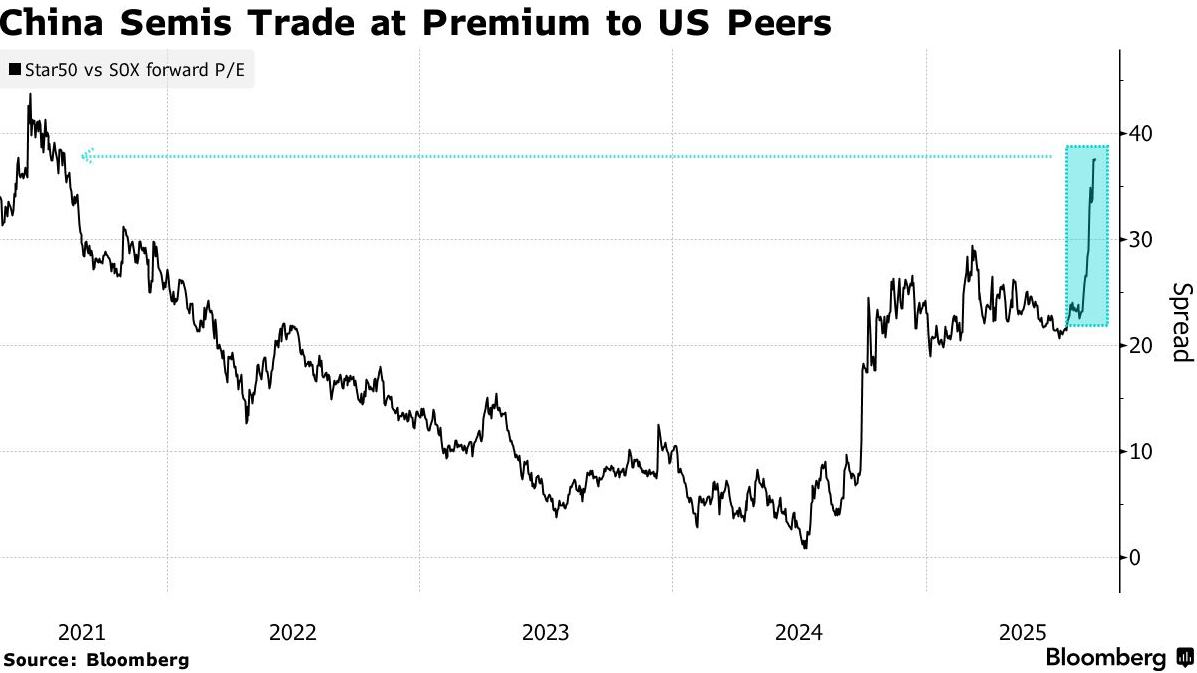
Group 1 - The core viewpoint is that Chinese semiconductor equipment suppliers are poised for structural opportunities despite local semiconductor companies reaching four-year stock highs, with a focus on upstream equipment benefiting from industry upgrades [1] - The manager of a $2.1 billion fund noted that the demand for equipment will continue regardless of changes in the competitive landscape of downstream chip manufacturers, supporting the "shovel seller" advantage of equipment suppliers [1] - The STAR 50 index, which focuses on local chip companies, surged 28% in August, reaching a historical high, driven by regulatory guidance encouraging reduced reliance on Nvidia's H20 chips, thus accelerating the domestic substitution process [1] Group 2 - Caution is advised regarding listed companies directly involved in chip production, as their valuations reflect expectations and face challenges related to demand sustainability and capacity targets [4] - An example is Cambrian Technology, whose stock price has doubled since December, with a P/E ratio exceeding 200, highlighting a significant shift in market capital flow from consumer stocks to technology stocks [4] - The focus is on equipment suppliers, with another fund holding shares in North China Technology Group, which saw a 30% increase in stock price this year, while semiconductor equipment stocks rose by 18% [4] Group 3 - In the AI sector, there is a distinction between beneficiaries of capital expenditure and AI application deployers, with Chinese cloud service providers investing approximately $50 billion this year, significantly less than the $330 billion by the top four U.S. firms, indicating room for capital expenditure growth [5] - Despite being years behind the U.S. in development, the launch of new models by companies like DeepSeek is seen as a positive signal for sustainable profit growth [5] - Regarding U.S.-China technology competition, a compromise may be reached where China continues to purchase older Nvidia chips while advancing its semiconductor self-sufficiency goals, creating a dynamic balance that benefits both international equipment suppliers and local equipment suppliers' technological iteration needs [5]


腾讯混元阶跃星辰美团开源新模型;抖音微博DeepSeek宣布对AI生成合成内容添加标识
Guan Cha Zhe Wang· 2025-09-02 01:11
Group 1: AI Model Developments - Tencent has released its latest translation model Hunyuan-MT-7B, which has 7 billion parameters and supports 33 languages, achieving first place in 30 out of 31 language tests at the ACL WMT2025 competition [1] - Jiyue Xingchen has launched the open-source end-to-end speech model Step-Audio 2 mini, which integrates speech understanding and audio reasoning to enhance human-machine interaction efficiency [1] - Meituan has introduced the LongCat-Flash-Chat model, featuring a hybrid expert model architecture with a total of 560 billion parameters and an active parameter range of 18.6 billion to 31.3 billion, achieving over 100 TPS in inference speed [2] Group 2: AI Education and Regulation - Starting from the fall semester of 2025, all primary and secondary schools in Beijing will implement AI general education, providing at least 8 class hours per academic year [3] - Douyin has upgraded its AI content identification features, allowing creators to label AI-generated content and providing metadata support for content traceability [4] - Weibo has implemented implicit and explicit labeling for AI-generated content in accordance with new regulations, allowing users to report unmarked AI content [5] - DeepSeek has announced the addition of labels for AI-generated content on its platform, prohibiting users from altering or concealing these labels [6]



吴伟:中国科技崛起吹响AI平权的号角
Huan Qiu Wang Zi Xun· 2025-09-01 22:53
Group 1 - The 2025 Global AI Influence List by Time magazine features several Chinese entrepreneurs and scholars, indicating a significant increase in representation and diversity compared to previous years [1] - The rise of Chinese figures on the list reflects the rapid development of China's AI industry and its increasing presence on the international stage, as well as the global trend of "de-geographicalization" in technology [1] - The open-source technology path taken by DeepSeek contributes to a more inclusive global technology landscape, enhancing the openness and participation of the AI industry [1] Group 2 - Southeast Asia is actively seizing opportunities from the "de-geographicalization" wave in AI, with the region's digital economy projected to reach $2 trillion by 2030, and the AI market expected to exceed $580 billion [2] - Countries like Singapore, Malaysia, and Indonesia are implementing national AI strategies and attracting significant investments from major tech companies, indicating a shift towards technological self-sufficiency [2] - The rise of local innovation in developing countries is seen as a way to dismantle external technological monopolies and empower these nations as creators of AI technology [2] Group 3 - Despite the concentration of top AI talent in the U.S., Chinese talent now accounts for 38% of the top AI research institutions in the U.S., surpassing the 37% of local talent [3] - The increase in homegrown talent and the return of overseas scholars signal a promising future for China's talent strategy focused on local cultivation and talent repatriation [3] - China's AI industry is characterized by a systematic innovation paradigm driven by top-level policies, autonomous innovation, and a commitment to long-termism [3] Group 4 - The performance gap between Chinese and U.S. large models has dramatically decreased from 17.5% in 2023 to just 0.3% [4] - China's unique advantages in open-source ecosystem development and vertical application innovation have contributed to this rapid advancement [4] - The success of China's AI rise is attributed to the establishment of an open, symbiotic ecosystem that fosters talent and continuous innovation, providing a valuable model for global AI development [4]
腾讯研究院AI速递 20250902
腾讯研究院· 2025-09-01 16:01
Group 1 - Meta and Scale AI partnership has deteriorated, with Ruben Mayer, a high-ranking executive who joined Meta from Scale AI, leaving the company just two months after the collaboration began [1] - Meta's internal researchers have complained about the low data quality from Scale AI, prompting Meta to shift its focus to competitors Mercor and Surge [1] - Following the loss of Meta's support, Scale AI has also lost major clients like OpenAI and Google, leading to significant layoffs [1] Group 2 - Users reported a significant performance decline in Claude Opus 4.1 during the daytime, particularly between 10-11 AM, with frequent errors in document processing [2] - Analysis suggests that the performance drop may be due to Anthropic's use of 1.58-bit quantization during the day, which resulted in the loss of critical information [2] - Anthropic has acknowledged the issue as a problem with the inference stack and has rolled back to previous versions 4.1 and 4.0 to restore quality [2] Group 3 - Tencent has open-sourced the 7B parameter translation model Hunyuan-MT-7B, which supports 33 languages and has achieved first place in 30 out of 31 languages in the WMT2025 competition [3] - The company also released the first translation integration model, Hunyuan-MT-Chimera-7B, which generates superior translations based on original text and multiple model outputs [3] - The model utilizes AngelSlim compression for FP8 quantization, improving inference performance by 30% and is integrated into various Tencent services [3] Group 4 - Jieyue Star has launched the end-to-end speech model Step-Audio 2 mini, which integrates speech understanding, audio reasoning, and generation, along with native Tool Calling capabilities [4] - The model has excelled in multiple benchmark tests, achieving an MMAU score of 73.2, ranking first among open-source end-to-end speech models [4] - It employs a true end-to-end multimodal architecture, incorporating chain reasoning and reinforcement learning for enhanced understanding of emotions, tones, and non-verbal signals [4] Group 5 - Shanghai AI Laboratory has released the Shusheng·Wanxiang InternVL3.5 series models, featuring nine sizes with parameters ranging from 1 billion to 241 billion, enhancing general capabilities, reasoning abilities, and deployment efficiency [5] - The flagship model InternVL3.5-241B-A28B surpasses GPT-5 in several benchmarks, achieving a score of 77.7 in MMMU, the highest for open-source models [5] - Innovations include dynamic visual resolution routing and a decoupled deployment framework, reducing inference latency from 369ms to 91ms, enhancing core capabilities [6] Group 6 - The South Korean government has distributed AI dolls developed by startup Hyodol to tens of thousands of elderly individuals living alone, providing companionship and health monitoring [7] - The dolls feature a ChatGPT-based dialogue system and sensors to detect movements, with the ability to alert caregivers in emergencies [7] - Over 12,000 Hyodol dolls are currently in use, priced at approximately 8,160 RMB each, significantly lower than the cost of caregiving staff, addressing the shortage of nursing personnel in South Korea [7] Group 7 - As of September 1, the "Identification Method for AI-Generated Synthetic Content" has been implemented, requiring AI-generated content to include identity tags [8] - Providers of synthetic content must add explicit and implicit identifiers, while platforms must verify metadata and provide clear indications [8] - Major platforms like Tencent, Douyin, Kuaishou, Bilibili, and DeepSeek have announced detailed rules and functionalities for adding identifiers to AI content, prohibiting users from deleting or altering these tags [8] Group 8 - Tsinghua University and partners have released RLinf, the first large-scale reinforcement learning framework for embodied intelligence, featuring a new hybrid execution model [9] - The framework achieves over 120% system acceleration in training scenarios for embodied intelligence [9] - It integrates Megatron+SGLang/vLLM and FSDP+HuggingFace backends, designed for different training needs, and includes adaptive communication libraries and automatic scheduling modules [9] Group 9 - DeepSeek has published an official announcement in response to the new regulations, committing to label AI-generated content and warning users against modifications [10] - The company has disclosed training details for its models, including a scale of 685 billion parameters and the pre-training and optimization processes [10] - DeepSeek has outlined its data governance system, employing filters to eliminate harmful content while ensuring user rights to information, choice, and control, acknowledging the ongoing challenge of "hallucinations" in models [10]


今起实施!AI生成内容必须带“身份证”,腾讯、抖音、快手、B站、DeepSeek等平台已公告→
Di Yi Cai Jing· 2025-09-01 15:26
Core Points - The implementation of the "Identification Method for AI-Generated Synthetic Content" began on September 1, requiring all AI-generated content to have clear identification labels [1][5][8] - The regulation mandates that various stakeholders in the AI content generation chain, including service providers and content platforms, must ensure proper labeling of AI-generated content [8][11] Group 1: Regulatory Framework - The "Identification Method" requires explicit and implicit labeling for AI-generated text, images, audio, and video content [5][8] - Content dissemination platforms like Bilibili and Xiaohongshu must verify metadata and provide necessary labeling features to inform users about AI-generated content [8][11] - Users are also required to label AI-generated content when uploading or sharing it [8][11] Group 2: Industry Response - Companies like MiniMax have demonstrated how to implement explicit labeling in their platforms, using visible indicators such as badges stating "AI generated" [9][10] - Douyin has introduced features to assist creators in labeling AI content and has implemented metadata identification for traceability [11][13] - Tencent and Kuaishou have also announced measures to comply with the new regulations, ensuring transparency and user awareness regarding AI-generated content [13][15] Group 3: Market Implications - The new regulations are seen as a foundation for the credibility of generative content, influencing market competitiveness for large model enterprises [10] - The Shanghai Municipal Cyberspace Administration has initiated an ecological alliance to promote implicit labeling recognition among over 30 companies [10][11] - The industry is adapting to these regulations, with platforms actively enhancing their content governance capabilities to align with the new standards [14][15]


今起实施!AI生成内容必须带“身份证”,腾讯、抖音、快手、B站、DeepSeek等平台已公告→
第一财经· 2025-09-01 15:15
Core Viewpoint - The article discusses the implementation of the "Identification Method for AI-Generated Synthetic Content," which requires all AI-generated content to have clear identification labels starting from September 1, 2023 [2][4]. Group 1: Regulatory Framework - The "Identification Method" mandates that all AI-generated videos, audio, text, and images must include an "identity label" to help users distinguish the true source of AI content [4]. - Different roles in the AI content generation chain are clearly defined, including requirements for service providers and content dissemination platforms [6]. Group 2: Implementation and Compliance - Companies like MiniMax have demonstrated how they implement explicit labeling for AI-generated content through visible indicators such as badges [7]. - Platforms like Bilibili and Douyin have announced their compliance with the new regulations, introducing features to assist creators in labeling AI-generated content [10][13]. Group 3: Industry Response - Major platforms, including Tencent and Kuaishou, have released detailed rules to comply with the "Identification Method," ensuring that AI-generated content is marked with both explicit and implicit identifiers [11][14]. - The Shanghai Municipal Cyberspace Administration has initiated a multi-layered promotional campaign to educate companies about the new requirements and has formed an ecological alliance to promote implicit identification recognition [8].

刚刚,DeepSeek最新发文,V3/R1训练细节全公开,信息量巨大
3 6 Ke· 2025-09-01 12:06
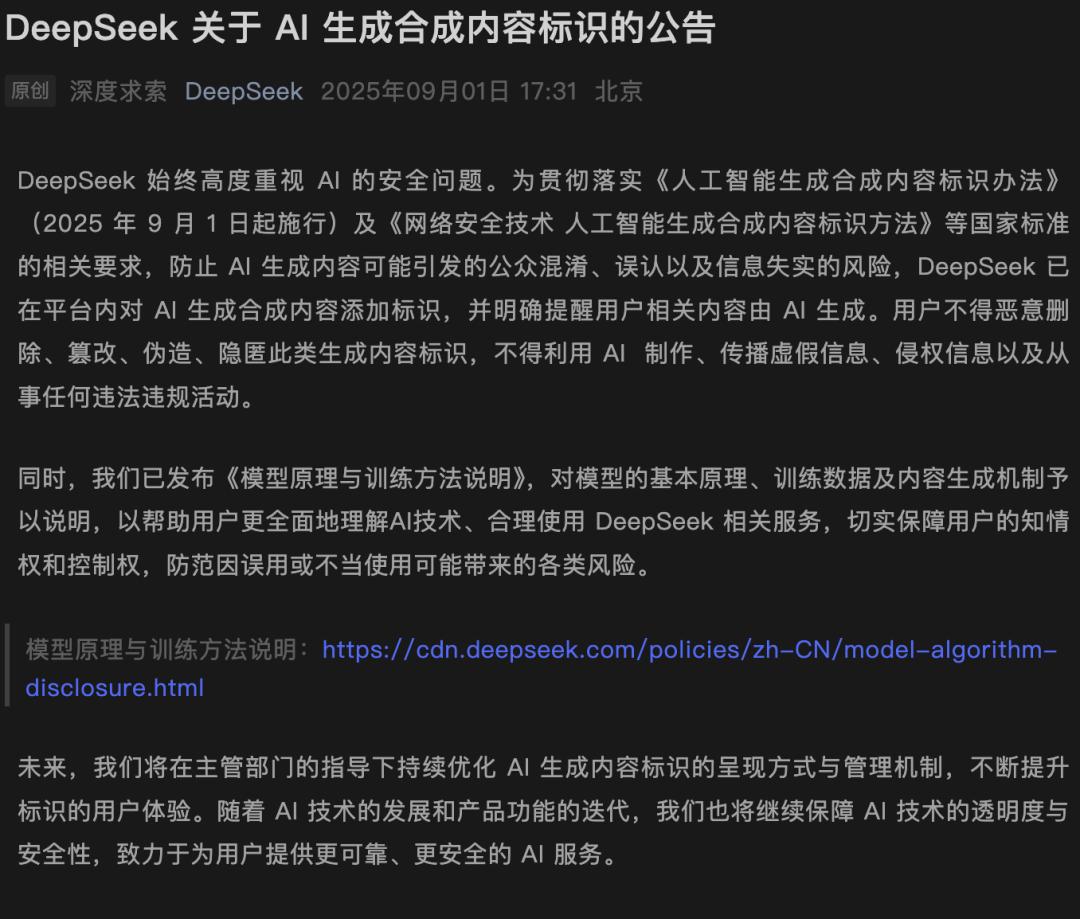
Core Viewpoint - DeepSeek has proactively responded to the new regulations by marking all AI-generated content with an "AI-generated" label and has disclosed details about its V3/R1 model training process following the implementation of the "Identification Measures for AI-Generated Synthetic Content" by the Cyberspace Administration of China [1][2]. Group 1: Compliance with New Regulations - DeepSeek has announced that all AI-generated content will be clearly labeled as "AI-generated" to comply with the new regulations [2]. - The company has emphasized that users are strictly prohibited from maliciously deleting, altering, or concealing these labels, and from using AI to spread or create false information [2]. Group 2: Technical Disclosure - DeepSeek has released a document titled "Model Principles and Training Methods," providing insights into its technical approach [4]. - The training process of DeepSeek's models is divided into pre-training and optimization training phases, which include various stages such as data collection and model fine-tuning [6][17]. Group 3: Model Training Details - The latest DeepSeek V3-0324 model has a total parameter count of 685 billion, with parameters optimized through gradient descent during training [15]. - During the pre-training phase, the model learns general language understanding and generation capabilities using publicly available internet data and licensed third-party data, while ensuring no personal information is intentionally used [21]. - The optimization training phase involves constructing and annotating question-answer pairs, with some data potentially based on user input, while ensuring data privacy through encryption and anonymization [22][23]. Group 4: Model Deployment and Functionality - Once training is complete, the model enters the inference phase, where it can generate text and perform various tasks based on user input [25]. - DeepSeek has emphasized that the model does not store original training data but generates responses based on a deep understanding of language structure and semantics [27]. - The company has made its models open-source, allowing users to freely download and deploy them under a permissive MIT license [28]. Group 5: Addressing Limitations and Risks - DeepSeek acknowledges the limitations of AI, including the phenomenon known as "hallucination," where AI may generate incorrect or misleading content [30][31]. - The company is implementing various technical measures to reduce the hallucination rate, including high-quality training data and alignment strategies, although complete elimination is not currently feasible [32]. - DeepSeek has established internal risk management protocols and user rights, allowing users to opt-out of data usage for model training and delete their historical data [37][38].
腾讯、抖音、快手、B站、DeepSeek等平台官宣:上线AI标识功能
Xin Lang Cai Jing· 2025-09-01 11:28
Core Points - The "Measures for Identifying AI-Generated Synthetic Content" officially implemented on September 1 mandates that all AI-generated content must be clearly identified [1] - Major platforms like Tencent, Douyin, Kuaishou, Bilibili, and DeepSeek have begun to refine their regulations in response to the new measures [1][2] Group 1: Implementation of Identification Measures - The measures require explicit and implicit identification of AI-generated content, including text, images, audio, and video [1] - Douyin has launched two core features: an AI content identification function and an AI content metadata identification function to assist creators in labeling AI-generated content [1][2] - Tencent announced enhancements to its content recognition capabilities to ensure transparency and credibility for users accessing AI-generated content [2] Group 2: Compliance and User Responsibilities - Users are prohibited from deleting, altering, or concealing AI identification labels when publishing or disseminating AI-generated content [2][4] - Platforms will impose penalties for violations of laws and regulations, as well as for any malicious actions regarding AI content labeling [2][4] - DeepSeek has also implemented identification measures and provided a model principle and training method explanation to enhance user understanding of AI technology [5] Group 3: Platform-Specific Actions - Bilibili has introduced an option for creators to declare AI-generated content during submission, ensuring compliance with the new regulations [3] - Kuaishou has implemented both explicit and implicit labeling for AI-generated content and will provide prominent notifications for such content [3][4]