华峰化学

Search documents
开年重要化工品景气跟踪-氨纶
2026-01-20 01:50
Summary of Key Points from the Conference Call on Spandex Industry Industry Overview - The spandex market started sluggishly in 2026, but industry inventory is at a lower mid-level, with leading companies holding low inventory, indicating a potential recovery in the industry [1][3] - In 2025, spandex prices hit a historical low with an annual decline of approximately 4%, while demand growth was close to 9%, ranking among the top three historical increments [1][2] Market Performance and Capacity - By the end of 2025, global spandex capacity reached 1.96 million tons, a year-on-year increase of 12.3%, with China's capacity at 1.533 million tons, up 13.1%, marking a five-year high [5][6] - The average operating rate in the spandex industry for 2025 was about 80%, the second-lowest in history, with high inventory levels but a decrease in the second half of the year [8] Demand Drivers - Demand for spandex is benefiting from the expansion of applications in sun protection products, home textiles, and casual menswear, along with an increase in the number of downstream weaving machines [9] - The trend of increasing spandex content in home textiles, such as high-density knitted bedding and industrial applications, is expected to continue driving demand growth [12][13] Price Dynamics - Spandex prices are at historical lows, with a price difference of approximately 10,600 yuan, a year-on-year decrease of about 12% [4] - The recent price increase is primarily led by major companies, with a two-phase increase of 1,000 yuan per ton expected [20][21] Future Outlook - The spandex industry is expected to see a recovery in supply-demand relationships, with a projected supply-demand ratio narrowing to around 1.38 in 2026, similar to levels during the supply-side reform period in 2017 [17] - Demand growth is anticipated to remain around 8% due to various factors, including the implementation of health initiatives and increasing comfort requirements [18][24] Challenges and Risks - Despite the positive outlook, the industry faces challenges such as cash flow issues for many companies and potential market exits due to high costs [2][21] - The overall market may experience a U-shaped trajectory with periodic rebounds, influenced by supply-demand dynamics and external economic factors [19] Conclusion - The spandex industry is poised for a recovery, driven by low inventory levels, increasing demand from various sectors, and strategic price adjustments by leading companies. However, ongoing challenges related to cash flow and market competition will need to be monitored closely [28][29]
ETF日报|商业航天突传重磅!军工ETF(512810)上探2.8%!资金博弈业绩主线?创业板人工智能ETF单日获净申购超3亿份
Sou Hu Cai Jing· 2026-01-19 13:42
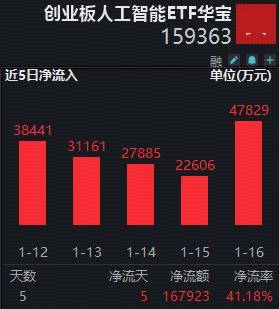
Market Overview - On January 19, A-shares showed mixed performance with the Shanghai Composite Index performing strongly while the ChiNext Index experienced a pullback. The total trading volume in Shanghai, Shenzhen, and Beijing reached 2.73 trillion yuan, a significant decrease of 324.3 billion yuan from the previous trading day [1] Commercial Aerospace Sector - The commercial aerospace sector received significant news with the successful validation of crewed spacecraft landing buffer technology, leading to a surge in related stocks. The General Aviation ETF Huabao (159231) saw an intraday increase of over 3%, ultimately closing up 2.2% [1] - The aerospace sector experienced a strong rebound after recent volatility, with stocks like AVIC and Aero Engine Corporation hitting the daily limit. The General Aviation ETF closed at a strong position, recovering its 10-day moving average [10][12] Chemical Industry - The chemical sector is currently at a dual turning point in capacity and inventory cycles, with expectations of entering an upward phase. The Chemical ETF (516020) saw a significant increase of 3.06%, reaching a new high since August 2022 [1][4] - The chemical ETF has shown a cumulative increase of 52.03% since the beginning of 2025, outperforming major indices like the Shanghai Composite Index (22.74%) and the CSI 300 Index (20.32%) [7][8] - Prices of refrigerants have surged, with R507 and R404 reaching 46,000-49,000 yuan/ton and 43,000-45,000 yuan/ton respectively, reflecting strong demand and tightening supply [9] AI Sector - The AI sector continues to attract significant investment, with the ChiNext AI ETF Huabao (159363) receiving a net subscription of 322 million yuan on January 19, following a total inflow of 1.679 billion yuan over the past five days [2][16] - The focus on AI applications and computing power is expected to drive further growth, with the AI sector's performance anticipated to remain strong in the first half of the year [19] Investment Recommendations - Analysts suggest focusing on sectors with high earnings growth potential, such as technology (AI computing and applications), chemicals, and pharmaceuticals, as the market enters a period of concentrated earnings announcements [4][18] - The Chemical ETF is recommended for investors looking to capitalize on the rebound in the chemical sector, which includes significant holdings in leading companies [9][10]


氟化工引爆行情,龙头股涨停!化工ETF(516020)单日狂飙3%,收盘价续创近3年新高!
Xin Lang Cai Jing· 2026-01-19 11:19
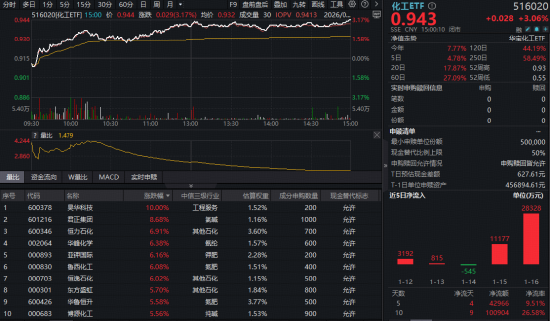
Group 1 - The chemical sector continues to perform strongly, with the Chemical ETF (516020) rising by 3.06% and reaching a new high since August 2022 [1][8] - Key stocks in the sector include Haohua Technology, which hit the daily limit, and Junzheng Group, which surged over 8%, along with several others rising more than 6% [1][8] - Since 2025, the Chemical ETF has shown a cumulative increase of 52.03%, significantly outperforming major indices like the Shanghai Composite Index (22.74%) and the CSI 300 Index (20.32%) [1][10] Group 2 - Prices of refrigerants have surged, with R507 and R404 reaching 46,000-49,000 yuan/ton and 43,000-45,000 yuan/ton respectively, reflecting a 3,000 yuan/ton increase [4][11] - The price increase is attributed to a combination of strong overseas demand and tightening domestic supply, which is expected to enhance the revenue and profit margins of refrigerant producers [4][11] - The chemical industry is anticipated to experience a recovery in profitability in 2026, following a period of adjustment and rebalancing in supply and demand [4][11] Group 3 - The Chemical ETF (516020) tracks the CSI Sub-Industry Chemical Theme Index, with nearly 50% of its holdings in large-cap leading stocks, including Wanhua Chemical and Salt Lake Industry [12] - The ETF provides an efficient way to invest in the chemical sector, covering various themes such as AI computing, anti-involution, and new energy [12] - Investors can also access the Chemical ETF through linked funds, which offer different fee structures for subscriptions and redemptions [12]
开源证券:聚氨酯TPU材料性能优异 有望成为人形机器人结构件重要增量方向之一
智通财经网· 2026-01-19 09:33
Core Viewpoint - Tesla's Optimus robot has recently showcased a full-body soft covering, indicating a significant advancement in humanoid robot design and production, with a focus on soft materials like TPU for safety and functionality [1][2]. Group 1: Material and Design Innovations - The use of soft covering materials is essential for the mass production of humanoid robots, as it enhances safety and reduces collision risks in environments with high human-robot interaction [2][3]. - TPU (Thermoplastic Polyurethane) is highlighted as a key material due to its excellent properties, including high elasticity, lightweight, and shock absorption, making it ideal for various components of humanoid robots [2][4]. - TPU's versatility allows it to be used in protective shells, flexible sensors, and non-load-bearing structural components, which are crucial for the robot's functionality and safety [3][4]. Group 2: Market Potential and Growth - The market for TPU is expected to expand significantly with the mass production of humanoid robots, potentially exceeding a market space of 3 billion yuan when reaching a production scale of one million units [1][4]. - The consumption of TPU in China is projected to grow from 447,000 tons in 2019 to 720,000 tons by 2024, reflecting a compound annual growth rate (CAGR) of 10% [4]. - The integration of TPU in humanoid robots is anticipated to drive industry valuation upward, as it replaces traditional applications in footwear and automotive sectors [4]. Group 3: Investment Opportunities - Midstream TPU structural component manufacturers are likely to benefit first from the rise of humanoid robots, especially those with existing partnerships in the automotive sector [5]. - Companies like Kaizhong Co. (603037.SH) and Mould Technology (000700.SZ) are identified as potential beneficiaries due to their relevant business backgrounds and collaborative foundations with downstream manufacturers [5]. - Other companies involved in flexible covering materials and electronic skin technologies, such as Riying Electronics and Henghui Security, are also positioned to gain from this trend [6].

化学纤维板块1月19日涨3.75%,新乡化纤领涨,主力资金净流入1.34亿元
Zheng Xing Xing Ye Ri Bao· 2026-01-19 08:52
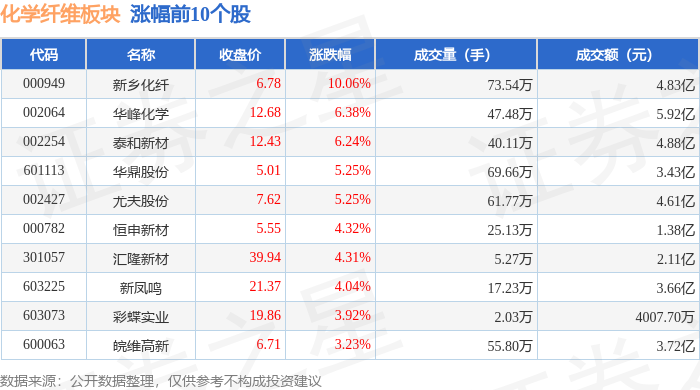
证券之星消息,1月19日化学纤维板块较上一交易日上涨3.75%,新乡化纤领涨。当日上证指数报收于 4114.0,上涨0.29%。深证成指报收于14294.05,上涨0.09%。化学纤维板块个股涨跌见下表: | 代码 | 名称 | 收盘价 | 涨跌幅 | 成交量(手) | 成交额(元) | | | --- | --- | --- | --- | --- | --- | --- | | 000949 | 新乡化纤 | 6.78 | 10.06% | 73.54万 | | 4.83亿 | | 002064 | 华峰化学 | 12.68 | 6.38% | 47.48万 | | · 5.92亿 | | 002254 | 泰和新材 | 12.43 | 6.24% | 40.11万 | | 4.88亿 | | 601113 | रून के लिए से | 5.01 | 5.25% | 69.66万 | | 3.43亿 | | 002427 | 尤夫股份 | 7.62 | 5.25% | 61.77万 | | 4.61亿 | | 000782 | 恒申新材 | 5.55 | 4.32% | 25.13万 | | 1.3 ...

化工ETF(159870)收涨超3.2%,今日净申购12.6亿份,连续13日获资金净流入
Xin Lang Cai Jing· 2026-01-19 07:45
Group 1 - The chemical sector is experiencing a positive sentiment, with leading stocks showing significant gains. The chemical ETF (159870) rose by 3.26% and saw a net subscription of 1.2635 billion units, marking 13 consecutive days of net inflow [1] - Institutions suggest that high-quality leading chemical companies are expected to benefit from the ongoing anti-involution measures and high energy consumption restrictions, with China's GDP projected to grow by 5% in 2025 [1] - The refining industry is expected to improve due to limited new capacity and the exit of outdated facilities, with the average USD to RMB exchange rate projected at 7.14 in 2025, potentially reducing crude oil procurement costs by approximately 2.5 billion RMB for 20 million tons of refining capacity [1] Group 2 - Refrigerant prices have increased, with R404 and R507 domestic prices at 49,000 RMB/ton, reflecting a 6.52% increase from the previous week [1] - In the herbicide market, companies have collectively raised prices by 2,100 RMB/ton in anticipation of the cancellation of export tax rebates, indicating a shift in cost transmission logic and confirming a price and profit turning point [1] - The spandex sector is seeing high operating rates among leading companies, with limited room for production increases, and a potential price increase of 1,000 RMB/ton is anticipated [2] Group 3 - The polyester industry is expected to reduce production by at least 15% due to inventory accumulation, with the possibility of increasing reductions to 25% [2] - The chlor-alkali sector is showing signs of an upward turning point, with many companies expected to enter significant losses by Q4 2025. 2026 is projected to be a year of capacity clearance for the chlor-alkali industry [2] - The chemical industry is set to face high energy consumption product restrictions as part of the 14th Five-Year Plan, with measures aimed at accelerating the exit of outdated capacity and promoting high-quality development [2] Group 4 - As of January 19, 2026, the CSI sub-sector chemical industry theme index (000813) rose by 3.05%, with significant gains from stocks such as Haohua Technology (10.00%) and Junzheng Group (8.68%) [3] - The chemical ETF (159870) closely tracks the CSI sub-sector chemical industry theme index, which consists of seven indices reflecting the overall performance of listed companies in related sub-industries [3] - The top ten weighted stocks in the CSI sub-sector chemical industry theme index account for 45.31% of the total, including companies like Wanhua Chemical and Yalake Co [3]
化工ETF(159870)涨超3%,盘中净申购超9亿
Xin Lang Cai Jing· 2026-01-19 07:05
Group 1 - The core viewpoint of the news highlights the significant price increase in refrigerants R507 and R404, with prices rising by 3,000 yuan per ton as of January 16, indicating a strong market demand and potential investment opportunities in the chemical sector [1] - The chemical industry is experiencing a positive trend, particularly in the phosphorous chemical sector, where supply constraints due to environmental policies and increasing demand from the new energy sector are tightening the supply-demand balance [1] - The fluorochemical sector is also showing signs of recovery, with the production quotas for second-generation refrigerants being reduced, stabilizing profitability, and the imminent introduction of third-generation refrigerant quotas expected to further enhance market conditions [1] Group 2 - The polyester filament sector is benefiting from a significant reduction in inventory levels, which aligns with a rebound in demand from the textile and apparel industry [1] - As of January 19, 2026, the CSI Sub-Industry Chemical Theme Index (000813) has seen a strong increase of 2.81%, with notable stock performances from companies like Haohua Technology and Junzheng Group, indicating robust investor interest in the sector [1] - The CSI Sub-Industry Chemical Theme Index is composed of major companies in the chemical sector, with the top ten weighted stocks accounting for 45.31% of the index, reflecting the concentration of market performance among leading firms [2]
化工行业或迎来“戴维斯双击”,化工ETF天弘(159133)早盘逆势走强,标的指数盘中涨约3%创近3年新高
Mei Ri Jing Ji Xin Wen· 2026-01-19 07:03
Group 1 - The market experienced a pullback after an initial rise, with the Shenzhen Component Index and the ChiNext Index turning negative, while the chemical sector showed strong performance, with Haohua Technology rising over 7%, Hengli Petrochemical and Luxi Chemical up over 6%, and several other companies increasing by more than 5% [1] - The Tianhong Chemical ETF (159133), which tracks the CSI sub-sector chemical industry theme index, opened low but surged by 2.8% by midday, reaching a nearly three-year high [1] - Analysts indicate that capital expenditure in the chemical industry is expected to decline in 2024, and with the "anti-involution" trend and accelerated elimination of outdated overseas capacity, supply is likely to contract [1] Group 2 - The Tianhong Chemical ETF (159133) closely tracks the CSI sub-sector chemical industry theme index, which has a core advantage of comprehensive coverage and balanced structure [2] - The index selects large-scale, liquid companies from sub-industries such as chemical products, including both traditional leading enterprises and representatives from high-growth areas like new energy materials and fine chemicals [2]


化工板块走强,化工50ETF(516120)涨近3%
Mei Ri Jing Ji Xin Wen· 2026-01-19 06:35
Group 1 - The chemical sector is showing strong performance, with the Chemical 50 ETF (516120) rising by 2.56% after reaching a peak increase of 2.88% during the trading session [1] - Key stocks in the index, such as Haohua Technology, Hengli Petrochemical, Luxi Chemical, Dongfang Shenghong, Yara International, and Huafeng Chemical, have all seen increases exceeding 5%, contributing to the overall rise of the index [1] - Research institutions indicate that the bulk chemical market is at a dual inflection point regarding capacity and inventory cycles, with expectations of demand recovery by 2026, suggesting the industry may enter an upward trajectory [1] Group 2 - China's global sales of chemicals have surpassed 50%, and future capital expenditure intensity for enterprises is expected to significantly decrease compared to the past decade, which may enhance dividend payout ratios [1] - The chemical industry is currently in a critical phase characterized by "capacity clearance + improved demand expectations," coupled with the "14th Five-Year Plan" for stable growth policies, highlighting the value of sector allocation [1] - Investors are encouraged to consider the Chemical 50 ETF (516120) and closely track the CSI sub-sector chemical industry theme index (000813.CSI), focusing on cyclical areas such as chemical products, agricultural chemicals, chemical raw materials, and refining trade [1]
ETF盘中资讯|氟化工龙头涨停,化工板块午后继续猛攻!机构:供需双底确立,2026年或迎“戴维斯双击”
Sou Hu Cai Jing· 2026-01-19 06:33
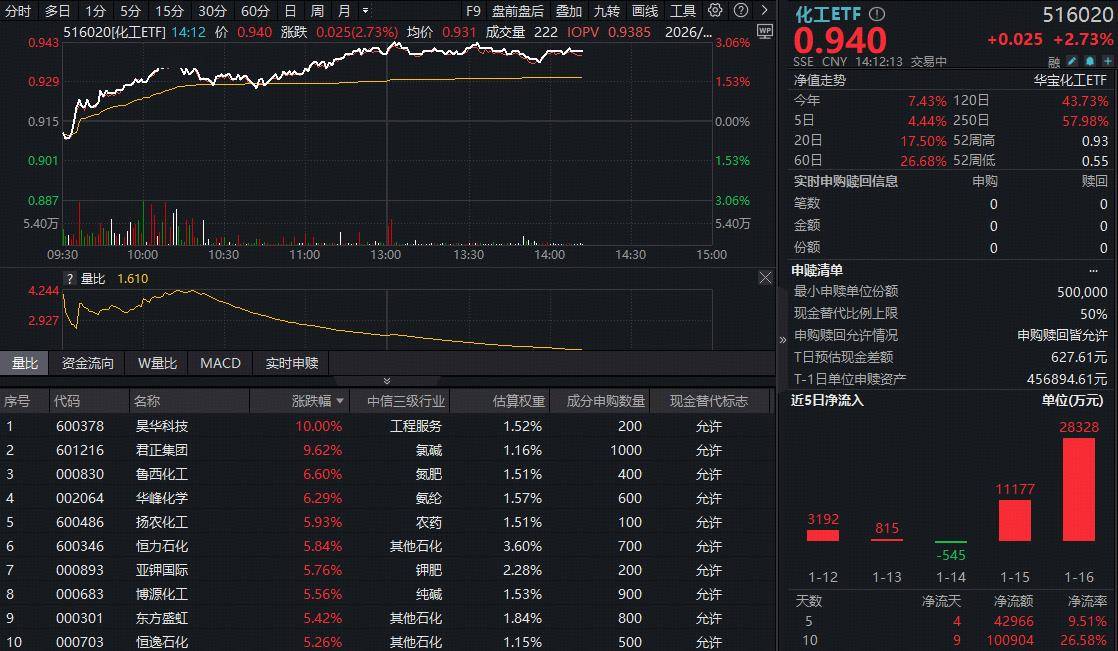
Group 1 - The chemical sector continues to show strength, with the Chemical ETF (516020) experiencing a price increase of 2.73% as of the latest update [1][2] - Key stocks in the sector include Haohua Technology, which reached the daily limit, and Junzheng Group, which surged over 9%, along with other notable gains from companies like Luxi Chemical and Huafeng Chemical [1][2] - Since 2025, the Chemical ETF has shown a cumulative increase of 47.53%, significantly outperforming major indices such as the Shanghai Composite Index (22.38%) and the CSI 300 Index (20.25%) [1][3] Group 2 - The chemical industry has seen negative growth in capital expenditure since 2024, but the "anti-involution" trend and the clearing of outdated overseas capacities are expected to lead to a contraction in supply [4] - The "14th Five-Year Plan" emphasizes expanding domestic demand, which is anticipated to drive growth in chemical product demand, especially with the onset of a U.S. interest rate cut cycle [4] - A potential turning point for the chemical industry is expected in 2026, with a shift from valuation recovery to earnings growth, referred to as the "Davis Double Play" [4] Group 3 - The Chemical ETF (516020) tracks the CSI Sub-Industry Chemical Theme Index, with nearly 50% of its holdings concentrated in large-cap leading stocks, including Wanhua Chemical and Salt Lake Co., allowing investors to capitalize on strong investment opportunities [5] - The ETF also includes exposure to various sub-sectors such as phosphate and nitrogen fertilizers, fluorochemicals, and others, providing a comprehensive investment approach within the chemical sector [5] - The fund does not charge a sales service fee, with specific subscription and redemption fee structures outlined for investors [5][6]