锦江酒店

Search documents
华安基金蒋璆清仓卸任9只基金 多只产品净值波动较大
Xi Niu Cai Jing· 2026-01-24 00:52
蒋璆管理的基金中,任职回报最低的是华安产业动力6个月持有混合A基金,任职回报率为-13.06%。 华安制造先锋混合基金成立于2018年12月,该基金刚成立时的净认购金额为2.66亿元,到了2021年末,资产净值曾一度达到14.04亿元,为成立以来单位净值 最高点。 华安制造先锋混合A基金单位净值2021年11月一度超过4.6元/份,此后该基金单位净值震荡下行,2024年2月跌穿2元/份,下滑幅度超50%。该基金单位净值 近1年开始上涨,目前仍未回到2021年11月的最高点。 1月17日,华安基金发布公告称,基金经理蒋璆因个人原因离任华安产业优选混合基金、华安碳中和混合基金、华安创新混合基金、华安产业动力6个月持有 混合基金、华安制造升级一年持有混合基金、华安动态灵活配置混合基金、华安制造先锋混合基金、华安成长先锋混合基金、华安创业板两年定开混合基金 等9只基金。自此,蒋璆名下再无其他在管基金。 华安产业动力6个月持有混合基金成立于2021年12月,成立以后单位净值震荡下行,一度跌穿0.5元/份,近1年才开始反弹。 | 离任基金经理姓名 | 蒋罗 | | --- | --- | | 离任原因 | 个人原因 | ...


锦江酒店:关于公司高级管理人员离任的公告
Zheng Quan Ri Bao· 2026-01-23 14:21
证券日报网讯 1月23日,锦江酒店发布公告称,公司董事会于2026年1月23日收到公司副总裁赵雁飞女 士的书面辞呈,因到龄退休,赵雁飞女士申请辞去公司副总裁职务。辞任后,赵雁飞女士不再担任公司 任何职务。 (文章来源:证券日报) ...

锦江酒店将与飞书共同打造AI 办公平台“锦鲲” 数字化转型全面提速
Xin Hua Cai Jing· 2026-01-23 11:25
飞书消费综合行业总经理付雪冬表示,通过"锦鲲"平台,飞书不仅提供了技术工具,更重要的是助力锦 江酒店(中国区)将数字化能力与 AI 赋能深度嵌入日常运营管理,加速企业高质量发展。 据了解,"锦鲲"平台已于 2025 年 11 月 10 日上线,一周时间内激活率达 100%,并在上线 1 个月内完成 了 20 个重要性高、覆盖面广、使用频次高的系统及程序入口归拢。 新华财经北京1月23日电(记者丁雅雯)记者23日获悉,锦江酒店日前与飞书签署合作协议,双方将联 合打造AI 协同办公平台"锦鲲"。此举意味着锦江酒店数字化转型全面加速。 "AI 发展日新月异,正重塑各行各业的运行逻辑,拥抱AI不是加分项,而是必选题。"锦江酒店(中国 区)首席执行官王伟表示,2026 年被行业视为AI创造价值的分水岭。"锦鲲"的发布是锦江酒店(中国 区)与飞书开展深度合作的起点,更是公司数字化转型、全面拥抱 AI 的重要之举。 "技术的价值,永远要落地到'解决实际问题'上。让 AI 去做它擅长的事,让人去做更有温度的事,提供 更有温度的服务。"王伟强调,面对分布在全国各地的一万多家门店及数万名员工,锦江酒店(中国 区)要做的,不是简单 ...
锦江酒店:赵雁飞辞去公司副总裁职务
Mei Ri Jing Ji Xin Wen· 2026-01-23 09:55
(记者 王晓波) 每经AI快讯,锦江酒店1月23日晚间发布公告称,公司董事会于2026年1月23日收到公司副总裁赵雁飞 女士的书面辞呈,因到龄退休,赵雁飞女士申请辞去公司副总裁职务。辞任后,赵雁飞女士不再担任公 司任何职务。 每经头条(nbdtoutiao)——地方国资开始"抄底"法拍房!单价六七千元"扫货"广州南沙区超60套房 源,同小区二手房挂牌均价逾2万元 ...
锦江酒店(600754) - 锦江酒店关于公司高级管理人员离任的公告
2026-01-23 09:45
根据《公司法》及《公司章程》等有关规定,赵雁飞女士的辞呈自送达董事 会时生效,赵雁飞女士已按照相关法律法规及公司有关制度做好工作交接,其辞 任不会对公司生产经营产生影响。截至本公告披露日,赵雁飞女士不存在未履行 完毕的公开承诺。公司及公司董事会对赵雁飞女士在任职期间为公司发展做出的 贡献表示衷心的感谢。 证券代码:600754/900934 证券简称:锦江酒店/锦江 B 股 公告编号:2026-004 上海锦江国际酒店股份有限公司 关于公司高级管理人员离任的公告 本公司董事会及全体董事保证本公告内容不存在任何虚假记载、误导性陈述 或者重大遗漏,并对其内容的真实性、准确性和完整性承担法律责任。 重要内容提示: 公司董事会于 2026 年 1 月 23 日收到公司副总裁赵雁飞女士的书面辞呈,因 到龄退休,赵雁飞女士申请辞去公司副总裁职务。辞任后,赵雁飞女士不再担任 公司任何职务。 二、离任对公司的影响 2 1 姓名 离任职务 离任时间 原定任期 到期日 离任原因 是否继续在上 市公司及其控 股子公司任职 是否存在未 履行完毕的 公开承诺 赵雁飞 副总裁 2026 年 1 月 23 日 2028 年 6 月 24 ...
商社行业2026年度策略:内需以新谋变,出海绽放全球
GOLDEN SUN SECURITIES· 2026-01-23 09:20
Core Insights - The report emphasizes the structural opportunities in both domestic demand and overseas expansion for 2026, particularly focusing on new services and new retail sectors [2][24] - It highlights the positive resonance between policy and fundamentals, suggesting that leading companies in the commercial sector are likely to benefit from policy stimuli and improve their fundamentals [2][4] Domestic Demand - The report identifies new services and new retail as the main lines for domestic demand, with a focus on the marginal changes in the fundamentals of related sub-sectors [2][5] - Specific sub-sectors showing price increase potential include: - **Hotels**: Strong leisure demand and optimized supply structure, with prices expected to remain stable or slightly increase. Recommended companies include Huazhu Group, Jinjiang Hotels, and Shoulv Hotels [2][3] - **Duty-Free**: With the opening of Hainan, the sector is stabilizing, and China Duty Free is highlighted as a key player [2][3] - **Gold and Jewelry**: The report notes a high volatility in gold prices but anticipates improved terminal sales. Recommended companies include Chow Tai Fook and Lao Puhuang [2][3] - **Mother and Baby**: Leading companies are expected to maintain steady growth, supported by favorable policies. Recommended companies include Kidswant and Aiyingshi [2][3] Sub-Sectors Driven by Volume Growth - The report suggests focusing on the Consumer Price Index (CPI) for sectors primarily driven by volume growth: - **Supermarkets**: CPI increases are beneficial for same-store sales, with a shift in focus from store adjustments to supply chain reforms. Recommended companies include Yonghui Superstores and Jiajiayue [3][5] - **Tourism**: The report highlights the potential for expansion and asset integration in the tourism sector, recommending companies like Jiuhua Tourism and Changbai Mountain [3][5] - **Dining**: Emphasizes refined operations and incentives for leading companies, with recommendations including Yum China and Haidilao [3][5] - **Tea Drinks**: The report notes that delivery subsidies may impact pricing, with store openings expected to drive growth. Recommended companies include Mixue and Gu Ming [3][5] Overseas Expansion - The report indicates that leading companies with high barriers to entry are expected to continue showing strong performance in overseas markets, with a focus on brand building and diversified destinations [4][24] - Recommended companies for overseas expansion include: - **Small Commodity City** and **Miniso**: Both are noted for their strong performance and brand development [4][24] - **Anker Innovations** and **Sumida**: Highlighted for their competitive advantages in specific segments [4][24] Investment Recommendations - The report suggests that for 2026, investors should focus on sectors benefiting from policy support and those with strong performance certainty in overseas markets [5][24] - It emphasizes the importance of monitoring the recovery of volume in certain sectors while maintaining a cautious approach to pricing stability [5][24]




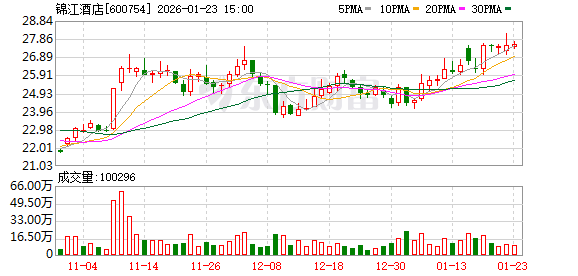
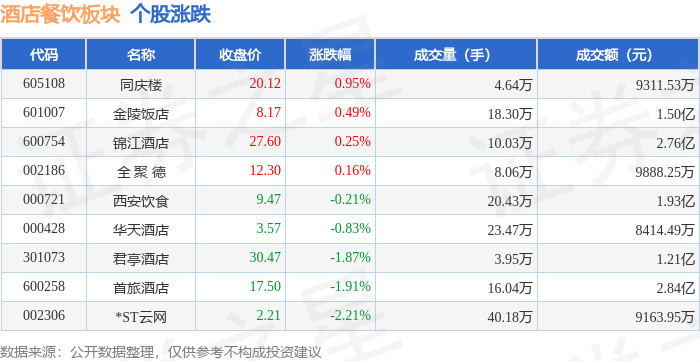
酒店餐饮板块1月23日跌0.59%,*ST云网领跌,主力资金净流出8241.03万元
Zheng Xing Xing Ye Ri Bao· 2026-01-23 09:04
从资金流向上来看,当日酒店餐饮板块主力资金净流出8241.03万元,游资资金净流出1463.79万元,散户 资金净流入9704.82万元。酒店餐饮板块个股资金流向见下表: | 代码 | 名称 | 主力净流入(元) | 主力净占比 游资净流入 (元) | | 游资净占比 散户净流入 (元) | | 散户净占比 | | --- | --- | --- | --- | --- | --- | --- | --- | | 002186 | 全聚德 | = 198.18万 | 2.00% | -756.45万 | -7.65% | 558.27万 | 5.65% | | 605108 | 同庆楼 | 77.30万 | 0.83% | -331.73万 | -3.56% | 254.42万 | 2.73% | | 000721 西安饮食 | | -185.90万 | -0.96% | -522.86万 | -2.70% | 708.76万 | 3.67% | | 301073 君亭酒店 | | -468.65万 | -3.87% | 596.07万 | 4.92% | -127.43万 | -1.05% | | 0004 ...

锦江酒店(中国区)携手飞书发布 AI 协同办公平台“锦鲲”,拥抱全面智能化时代
Sou Hu Wang· 2026-01-23 07:37
Core Insights - The article discusses the launch of the AI collaboration platform "Jinkun" by Jinjiang Hotels (China) in partnership with Feishu, marking a significant step in the company's digital transformation strategy [2][13] - The CEO of Jinjiang Hotels (China), Wang Wei, emphasizes that embracing AI is essential for the industry, with 2026 seen as a pivotal year for AI's value creation [2][5] Group 1: Company Overview - Jinjiang Hotels (China) is a leading hotel management company in China, focusing on limited-service hotels with a diverse brand portfolio including high-end to economy segments [2] - As of June 30, 2025, Jinjiang Hotels (China) has over 16,300 signed hotels and more than 1.54 million rooms, maintaining the top position in the domestic hotel industry [2] Group 2: AI Platform "Jinkun" - The "Jinkun" platform aims to enhance operational efficiency by allowing AI to handle standard processes and repetitive tasks, enabling employees to focus on providing high-quality service [5][6] - The platform integrates advanced collaboration capabilities from Feishu with Jinjiang's business scenarios, aiming to eliminate information bottlenecks and improve decision-making and execution efficiency [5][10] Group 3: Implementation and Impact - The "Jinkun" platform was launched on November 10, 2025, achieving a 100% activation rate within a week and consolidating 20 critical system and program entries within a month [8] - The platform's core AI component, "Kunshu," serves as an intelligent assistant, providing easy access to business data, operational guidelines, and marketing support, thus enhancing daily operations [10] Group 4: Industry Trends and Future Directions - The hotel industry is increasingly integrating AI to improve operational efficiency, with Jinjiang Hotels (China) launching the "Kunshu Elite Class - Feishu Efficiency Pioneer Competition" to encourage employee engagement with AI tools [11] - The successful implementation of the "Jinkun" platform signifies a shift towards high-quality development in the hotel sector, enhancing organizational execution and responsiveness [13]
锦江酒店为何“大而不强”?
Sou Hu Cai Jing· 2026-01-22 17:12
Core Viewpoint - Jinjiang Hotels, despite being the largest hotel group globally, struggles with profitability due to its over-reliance on an expansion model that has led to path dependence and internal inefficiencies [3][6][18] Industry Overview - The chain rate of hotels in China is projected to reach 40.1% by 2024, with the mid-to-high-end market driving industry growth, but competition is intensifying, increasing profitability pressure on leading companies [3] - The shift in consumer preferences from mere accommodation to quality experiences and personalized services is reshaping the hotel industry, emphasizing the need for brand uniqueness and service standardization [5] Company Performance - Jinjiang Hotels operates 13,400 hotels with 1.29 million rooms, yet its net profit is less than 30% of Huazhu's and only 70% of Atour's, highlighting a significant imbalance between scale and efficiency [3][5] - The average room price for Jinjiang Hotels fell to 244.3 yuan in 2024, lower than some budget hotels, indicating a decline in pricing power and profitability [12] Expansion Strategy - Jinjiang's expansion strategy has been characterized by a "merger and acquisition + franchise" model, which has led to a fragmented brand structure with 43 brands, complicating management and diluting brand identity [7][8] - The company has a high franchise ratio of over 94%, which, while expanding its market presence, has resulted in challenges in maintaining service quality and brand consistency [8][11] Challenges and Internal Issues - The lack of effective brand integration post-acquisition has led to internal competition among its brands, resulting in price wars and reduced profitability [9][12] - Complaints regarding service quality have surged, with 4,446 complaints reported in a year, reflecting operational challenges within its franchise model [13] Strategic Adjustments - In response to ongoing challenges, Jinjiang has introduced the "12+3+1" brand strategy, focusing on consolidating resources around key brands to address internal competition and inefficiencies [15][16] - The company aims to enhance its operational management and member engagement to leverage its large customer base of 200 million members, which has not yet translated into competitive advantages [14][16] Future Outlook - The hotel industry in China continues to evolve, with opportunities for Jinjiang to improve its net profit margins, which are currently only 28% of Huazhu's and 45% of Atour's [16] - The success of Jinjiang's strategic adjustments will depend on its ability to streamline its brand portfolio and enhance operational control over its franchise network [17][19]

全球头部酒店如何通过AI客服提升入住率?【502线上同行】
虎嗅APP· 2026-01-22 13:42
Core Insights - The hospitality and travel industry is facing a critical challenge where customer service is no longer just a response center but a key operational node that impacts conversion rates, repurchase rates, and service efficiency [3] - Travelers are increasingly impatient, prioritizing immediate responses over cleanliness or food quality, leading to rising labor costs exceeding 30% [3][4] Group 1: AI Integration in Customer Service - The integration of AI in customer service is evolving from a simple response system to a comprehensive concierge service that can drive repurchase [7] - AI can reduce ineffective inquiries and compress interaction rounds through dual engines of itinerary and location [7] - The boundaries of proactive care are defined by time thresholds, types of benefits, and push frequency [7] Group 2: Human-AI Collaboration in Customer Service - There is a need to identify which services should be handled by AI and which should remain human-operated across pre-stay, in-stay, and post-stay phases [8] - Examples of both successful and failed cases of intelligent distribution and human-machine collaboration are discussed [8] Group 3: Unique Challenges of AI in Hospitality - The hospitality sector cannot simply adopt retail models for AI customer service due to different operational needs [8] - The effectiveness boundary between scene-level knowledge graphs and Q&A knowledge bases is highlighted [8] - Compliance and safety issues arise when agents transition from "suggestion" to "execution" [8]