荣耀

Search documents
国内eSIM手机商用破冰运营商加速迈向“无卡”时代
Zheng Quan Shi Bao· 2025-10-19 17:57
Core Insights - The introduction of eSIM technology marks a significant shift towards a "cardless" era in mobile communication, with eSIMs expected to gradually replace physical SIM cards in the long term [1][4][8] Industry Overview - eSIM technology allows for flexible network switching, space-saving in devices, and seamless connectivity across multiple devices and scenarios, indicating a trend towards "cardless" solutions [1][4] - The global market for eSIM-enabled smartphones is projected to reach approximately 1 billion by the end of 2025, with an expected growth to 7 billion by 2030, representing three-quarters of total smartphone connections [4] Market Developments - Major Chinese telecom operators have recently restarted eSIM services for mobile phones after a two-year pause, officially launching eSIM mobile services across 31 provinces [2][3] - The Chinese market's entry into eSIM mobile services is seen as a catalyst for global eSIM development, with Apple leading the charge by launching eSIM-only devices [4][5] Competitive Landscape - Domestic smartphone manufacturers are rapidly adapting to eSIM technology, with high-end flagship models being the first to support eSIM [6][7] - The shift to eSIM is expected to enhance device waterproofing and internal space utilization, providing opportunities for innovation in smartphone design [7] Future Trends - The transition to eSIM is anticipated to occur in phases, with flagship models and IoT devices driving initial adoption, followed by broader market penetration by 2028 [8] - The eSIM market is expected to face challenges related to security, consumer awareness, and standardization among different operators, which could impact user experience and adoption rates [10][11] Strategic Implications - The shift from physical SIM cards to eSIMs will likely compel telecom operators to transition from a "selling cards" model to a "selling services" model, enhancing competition and user flexibility [11][12] - The introduction of eSIMs is expected to lower the barriers for users to switch networks, potentially increasing churn rates and prompting operators to optimize pricing and services [11][12]
为啥科技公司都沉迷于造智能戒指?
虎嗅APP· 2025-10-19 13:20
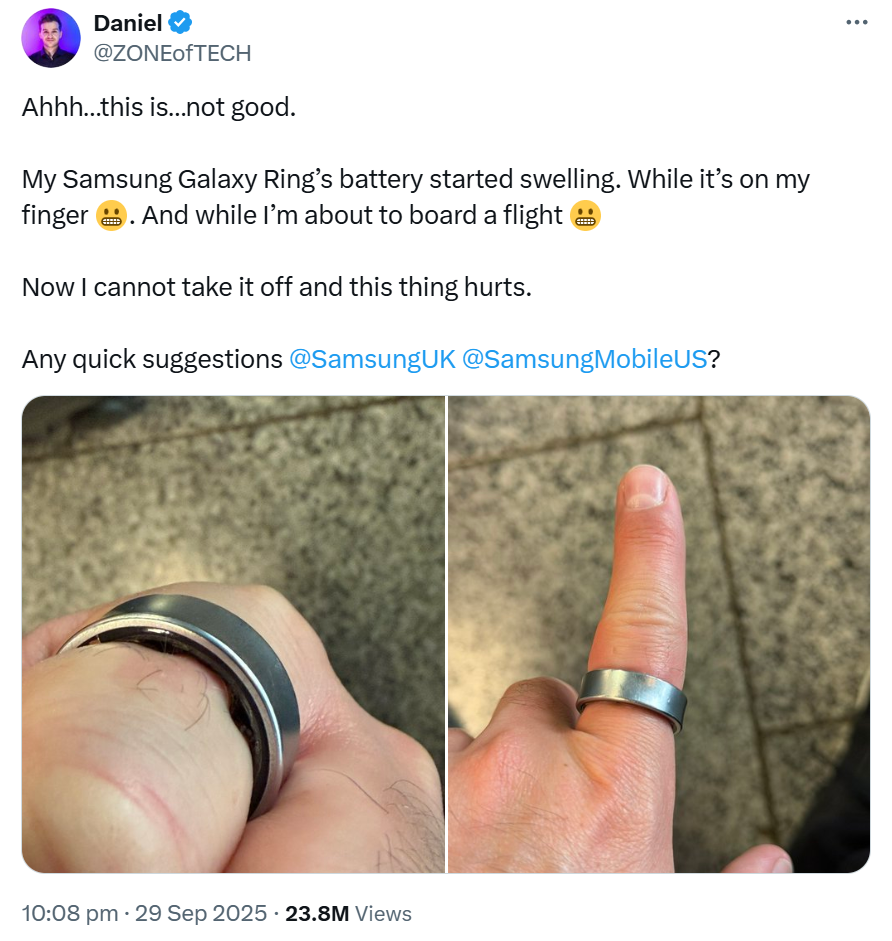
Core Viewpoint - The article discusses the recent incident involving the Samsung Galaxy Ring, highlighting concerns over its safety and functionality as a wearable device, questioning its practicality and long-term viability in the market [5][10][36]. Group 1: Incident Overview - On September 30, YouTube tech influencer Daniel Rotar experienced a battery expansion issue with his Samsung Galaxy Ring while boarding a flight, leading to his finger becoming swollen and requiring medical assistance to remove the ring [5][9][10]. - Following the incident, Samsung received over 200 complaints related to battery issues, with 12 specifically mentioning swelling problems, yet the company has not provided a clear explanation for the battery failures [10][12]. Group 2: Product Functionality and Market Position - Smart rings, including the Galaxy Ring, have been marketed as fashionable tech accessories but have struggled to find widespread practical applications, often being viewed as "electronic waste" due to their limited functionality and short lifespan [7][8][15]. - The Galaxy Ring is primarily focused on health monitoring, offering features like sleep tracking and heart rate monitoring, but lacks capabilities such as call handling or notifications, which are common in smartwatches [15][16][20]. Group 3: Consumer Sentiment and Market Trends - Despite the high price point of 3099 yuan for the Galaxy Ring, which is more expensive than some smartwatches, consumer interest remains, driven by the allure of technology and health tracking [22][31]. - The smart ring market is experiencing significant growth, with a reported sales increase of 6401.7% year-on-year, although it still represents a small fraction of the overall wearable market [31][32]. Group 4: Future Prospects and Innovations - Companies are exploring new functionalities for smart rings, such as family data sharing and AI integration, but the current offerings still face skepticism regarding their practical use and reliability [32][33][34]. - The article suggests that while smart rings may serve as luxury accessories, their actual utility in daily life remains questionable, with many consumers unsure of their need for such devices [26][36].


手机厂商密集发新品,AI更强了?丨南财合规周报(第211期)
2 1 Shi Ji Jing Ji Bao Dao· 2025-10-19 11:38
Group 1: AI Competition and Mobile Devices - Recent smartphone launches by vivo, OPPO, and Honor highlight advancements in AI capabilities, suggesting that mobile devices are becoming crucial entry points in the AI competition [2] - The integration of various AI functions directly into smartphones poses a threat to the software ecosystem, as AI has become a key selling point for mobile manufacturers [2] Group 2: Apple and AI Copyright Issues - Apple is facing a lawsuit from two neuroscientists who allege that the company used thousands of copyrighted books without authorization while training its AI model, Apple Intelligence [3] - The lawsuit claims that Apple utilized tools like "shadow libraries" and "web crawlers" to access pirated books, including the plaintiffs' own works [3] Group 3: Microsoft and OpenAI Allegations - Microsoft is under a new consumer class-action lawsuit, accused of entering a secret agreement with OpenAI to artificially inflate the market prices of generative AI products [5] - The lawsuit argues that this collaboration gives Microsoft an unfair competitive advantage in the generative AI market, limiting innovation and consumer choice [5] - If accepted by the court, this case could set a precedent regarding AI infrastructure monopolies, cloud resource control, and pricing of AI services [5] Group 4: Broader AI Copyright Conflicts - The AI copyright disputes are intensifying, with companies like OpenAI and Midjourney also embroiled in legal challenges over copyright infringement [4] - Warner Bros. Discovery recently filed a lawsuit against Midjourney for allegedly using its classic IP characters without permission [4]
为啥科技公司都沉迷于造智能戒指?
Hu Xiu· 2025-10-19 08:01
Core Viewpoint - The incident involving Daniel Rotar's Samsung Galaxy Ring highlights significant concerns regarding the safety and reliability of smart rings, particularly related to battery issues and overall functionality in comparison to other wearable devices [1][2][6][10]. Group 1: Incident Overview - On September 30, YouTube tech influencer Daniel Rotar experienced battery swelling in his Samsung Galaxy Ring while boarding a flight, leading to his finger becoming trapped [1]. - The incident gained widespread attention, with Rotar's tweet about the swelling receiving over 20 million views, prompting many users to share similar experiences with the device [2][6]. - Samsung has since collected the affected ring for further investigation, with over 200 complaints related to battery issues reported by users [9][10]. Group 2: Product Features and Market Position - Smart rings, including the Galaxy Ring, have been marketed as advanced wearable devices but struggle to find widespread acceptance due to limited functionality and high prices [4][30]. - The Galaxy Ring is priced at 3,099 yuan, which is higher than some smartwatches, yet it lacks features like call answering and NFC capabilities, limiting its appeal [30][31]. - Despite its health monitoring capabilities, the Galaxy Ring has been criticized for its short lifespan and poor battery performance, with users reporting rapid battery drain and the need for frequent replacements [14][16][51]. Group 3: Industry Context and Consumer Sentiment - The smart ring market, while growing, still represents a small fraction of the overall wearable device market, with only 0.1% market share but a significant year-on-year sales increase of 6401.7% [43]. - The Oura Ring dominates the smart ring market, accounting for 80% of global sales, while Samsung's Galaxy Ring is the first major brand to gain traction in the Chinese market [44][45]. - Consumer interest in smart rings often stems from their perceived status as luxury accessories rather than practical health tools, leading to questions about their actual utility [34][56].
中美同意尽快举行新一轮经贸磋商;郑丽文当选中国国民党主席|南财早新闻
2 1 Shi Ji Jing Ji Bao Dao· 2025-10-18 23:19
Macro Economy - The user base for generative artificial intelligence in China reached 515 million as of June this year, with AI patent applications totaling 1.576 million, accounting for 38.58% of the global total, ranking first worldwide [2] - In the first eight months of this year, the average settlement rate for foreign trade enterprises in China was 53.7%, a slight increase of approximately 0.5 percentage points compared to the annual average of last year [2] - The Ministry of Commerce and nine other departments issued guidelines proposing 17 specific measures to promote high-quality development in the accommodation industry, including the creation of cultural theme hotels and the upgrade of facilities for the elderly [2] Investment News - UBS Wealth Management upgraded its global stock rating to "attractive," citing stronger-than-expected economic growth, easing tariff pressures, and a robust investment cycle driven by artificial intelligence. UBS also raised its rating on Chinese tech stocks to the most attractive, expressing increasing confidence in their ability to monetize AI [3] - As of June 30, 2025, approximately 30 AI-related stocks in the S&P 500 accounted for 43% of the total market capitalization, significantly up from 26% when ChatGPT 3.5 was released in November 2022 [3] - Domestic coffee machine sales in China reached 1.683 million units from January to August, marking a year-on-year increase of 75.6%. The market size for coffee machines in China is expected to reach 10.6 billion yuan by 2029, with an estimated annual compound growth rate of 28% [3] Company Movements - A representative from Wingtech Technology responded to the incident where the employee system access of its subsidiary, Anshi Semiconductor (China), was fully interrupted, stating that the accounts of the Anshi China team were suspended for unknown reasons, with partial recovery currently underway [5] - On the 18th, Air China reported an incident on flight CA139 from Hangzhou to South Korea, where a lithium battery in a passenger's carry-on luggage caught fire, but no injuries were reported, and the aircraft made an emergency landing at Shanghai Pudong Airport [5] - Honor is intensifying its AI strategy and technology, officially launching the "self-evolving AI native phone" - Honor Magic8 series, and previewing a futuristic robot phone called "ROBOT PHONE" [5]
“海”好有你中关村校招季启动
Bei Jing Ri Bao Ke Hu Duan· 2025-10-18 22:45
Group 1 - The event "Hai Hao You Ni - Zhongguancun Campus Recruitment Season" kicked off in the Beijing-Zhangjiakou Railway Ruins Park, featuring over 80 well-known companies and institutions from Haidian District offering more than 1,000 quality job positions [1][2] - The recruitment fair attracted participation from over 1,000 young students from more than 50 universities, showcasing a strong demand for talent in cutting-edge fields, particularly in artificial intelligence [1][2] - The event is set to continue until March 2026, with more than ten dual-selection activities planned, releasing over 10,000 recruitment demands [2] Group 2 - Notable participating companies include Xiaomi, Huawei, Baidu, Tencent, and Meituan, indicating a strong presence of major tech firms in the recruitment landscape [1][2] - A "Corporate Mentor Team" consisting of representatives from five companies, including Xiaomi and Huawei, was present to provide guidance and support to students, emphasizing the importance of retaining talent in Haidian [2] - The recruitment fair also expanded its reach by setting up a sub-venue in Hong Kong and simultaneously releasing job postings in Singapore, aiming to attract global talent [2]





AI试水“抢购物券”,手机厂商转向:不拼参数拼应用
Di Yi Cai Jing Zi Xun· 2025-10-18 15:41
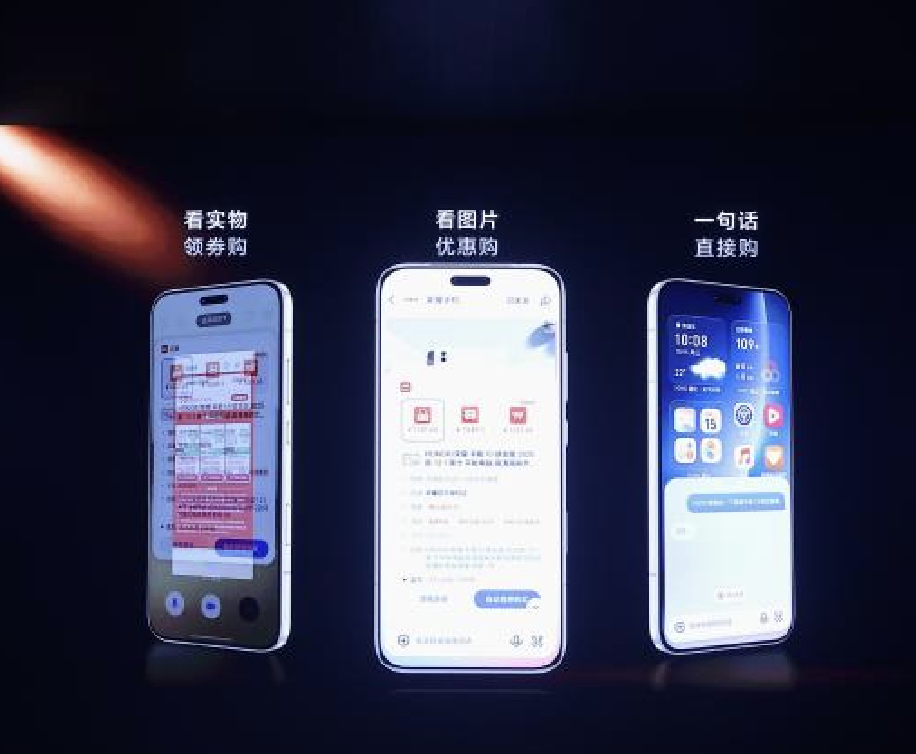
Core Insights - The article discusses the evolving landscape of AI in the smartphone industry, particularly focusing on the shift from large model parameters to practical applications in China, contrasting with the U.S. approach led by companies like OpenAI and NVIDIA [2][12] - Chinese smartphone manufacturers are prioritizing practical AI applications over competing in model parameter rankings, emphasizing cost-effectiveness and usability [2][10] Group 1: AI Development Strategies - Chinese companies are moving away from the "burning money" strategy of developing large AI models, recognizing the high costs associated with such investments [2][10] - The focus is shifting towards smaller models that can be effectively integrated into specific applications, enhancing user experience and operational efficiency [2][12] Group 2: Practical Applications of AI - Companies like Honor are showcasing AI capabilities that allow smartphones to predict user actions and streamline interactions, significantly improving user experience [3][6] - AI is being integrated into various high-frequency scenarios, such as real-time flight updates and automated purchasing, demonstrating its practical utility [6][10] Group 3: Challenges in AI Implementation - The smartphone industry faces challenges related to power consumption, computational demands, and cost pressures, which have hindered significant sales growth despite AI advancements [9][10] - The need for additional investments in specialized hardware, such as NPU chips, increases costs and impacts profit margins for smartphone manufacturers [10][12] Group 4: Future Trends and Market Potential - The number of AI-supported scenarios in smartphones is rapidly increasing, with companies reporting significant growth in the capabilities of their AI systems [12] - By 2029, it is projected that 57% of smartphones will support generative AI, indicating a growing trend towards AI integration in high-end devices, with Chinese brands playing a crucial role in this shift [12][13]

AI试水“抢购物券”,手机厂商转向:不拼参数拼应用
第一财经· 2025-10-18 15:33
Core Viewpoint - The article discusses the evolving landscape of AI in the smartphone industry, highlighting the shift from large-scale model competition to practical applications and cost-effective solutions among Chinese manufacturers, contrasting with the strategies of leading US companies like OpenAI and NVIDIA [3][4]. Group 1: AI Development Strategies - Chinese smartphone manufacturers are moving away from competing on large model parameters and are focusing on deploying smaller models that enhance practical applications [3][4]. - The cost of developing large AI models is prohibitively high, with estimates suggesting that creating models with 400 billion parameters could require investments of up to 50 billion yuan, including significant ongoing electricity costs [13][14]. Group 2: Practical Applications of AI - Companies like Honor are showcasing AI capabilities that allow smartphones to predict user actions and streamline interactions, significantly improving user experience [6][9]. - Vivo and OPPO are also exploring AI applications, with Vivo's AI capable of processing long contexts and OPPO focusing on AI memory capabilities to help users manage information overload [10][12]. Group 3: Challenges in AI Implementation - The smartphone industry faces challenges such as power consumption, computational demands, and cost pressures, which have hindered significant sales growth despite AI advancements [11][13]. - The need for additional hardware, such as independent NPU chips, increases costs by 15%-20%, further complicating the profitability of AI integration in smartphones [13]. Group 4: Future Trends and Market Potential - The number of AI-supported scenarios in smartphones is rapidly increasing, with Honor reporting a growth from 200 to 3000 scenarios in just three months, indicating a strong trend towards AI integration [16][17]. - By 2029, it is projected that 57% of smartphones will support generative AI, with Chinese brands playing a crucial role in this transition [17].

AI智能体试水“抢购物券” 手机厂商转向:不拼参数拼应用
Di Yi Cai Jing· 2025-10-18 10:49
Core Insights - The article discusses the evolving landscape of AI in the smartphone industry, particularly focusing on Chinese manufacturers adapting to new strategies in AI application development and deployment [1][10]. Group 1: AI Development Strategies - U.S. AI companies are creating a new ecosystem by investing in computational power for large model applications, with OpenAI and NVIDIA leading the charge [1]. - Chinese manufacturers are shifting their focus from competing on large model parameters to utilizing smaller models for practical applications, emphasizing cost-effectiveness and real-world usability [1][2]. - The development of AI capabilities in smartphones is increasingly centered on enhancing user experience through practical applications rather than merely increasing computational power [10]. Group 2: Practical Applications of AI - Chinese smartphone brands are showcasing advancements in AI that allow for proactive user interactions, such as predicting user actions and automating tasks [3][4]. - Honor's CEO highlighted the ability of AI to enhance user experience by simplifying complex tasks into single-step actions, demonstrating the practical benefits of AI integration [3][4]. - Vivo and OPPO are also exploring AI applications, with Vivo focusing on content organization and OPPO developing features for automatic bill recognition and memory assistance [5][4]. Group 3: Challenges in AI Implementation - Despite initial successes, the smartphone industry faces challenges such as power consumption, computational demands, and cost pressures that hinder widespread AI adoption [7][8]. - The need for additional investments in specialized hardware, such as NPU chips, increases costs significantly, impacting profit margins for manufacturers [8]. - The reliance on cloud support for complex tasks indicates that current mobile AI capabilities are still limited, necessitating further development [7]. Group 4: Market Trends and Future Outlook - The number of AI-supported scenarios in smartphones is rapidly increasing, with manufacturers reporting significant growth in the capabilities of their AI systems [9]. - The trend towards integrating AI into smartphones is expected to continue, with projections indicating that the percentage of smartphones supporting generative AI will rise significantly by 2029 [9]. - The article concludes that Chinese smartphone manufacturers are at the forefront of AI development, with their focus on practical applications potentially leading to a new commercial cycle in the industry [10].
AI智能体试水“抢购物券”,手机厂商转向:不拼参数拼应用
Di Yi Cai Jing· 2025-10-18 10:44
Core Insights - The article discusses the shift in the Chinese AI market from competing on large model parameters to focusing on practical applications and smaller models, emphasizing cost-effectiveness and usability [1][11] - Chinese smartphone manufacturers are increasingly integrating AI capabilities into their devices, enhancing user experience through features like proactive assistance and improved interaction methods [2][5][10] Group 1: Industry Trends - Chinese companies are moving away from the costly race to build massive AI models, recognizing the unsustainable nature of such investments [1] - The focus has shifted to developing smaller, more efficient models that can be applied in real-world scenarios, allowing for faster deployment and better user experience [1][11] - The introduction of DeepSeek's open-source model has leveled the playing field, enabling smaller models to achieve comparable AI capabilities [8] Group 2: Technological Advancements - AI integration in smartphones is advancing, with features that allow for one-click operations and proactive suggestions based on user behavior [2][5] - Companies like Honor and Vivo are reporting significant increases in the number of AI-supported scenarios, indicating rapid growth in AI application [9] - The development of AI capabilities is not only about enhancing performance but also about optimizing hardware efficiency and user interaction [5][6] Group 3: Challenges and Considerations - Despite advancements, the industry faces challenges related to power consumption, computational demands, and cost pressures, which have hindered significant sales growth in smartphones [7][8] - The need for additional investments in specialized hardware, such as NPU chips, poses a risk to profit margins for smartphone manufacturers [8] - The industry is recognizing that merely increasing computational power is not a viable long-term strategy; practical application and user experience are becoming the primary focus [8][11]