
易方达

Search documents
新消费龙头三季度业绩亮眼,港股消费ETF易方达(513070)助力把握消费升级投资机遇
Mei Ri Jing Ji Xin Wen· 2025-10-22 03:50
Core Viewpoint - The Hong Kong new consumption sector is experiencing localized activity, with significant gains in stocks like Pop Mart and Xiu Li, reflecting strong consumer demand and robust earnings growth in the sector [1] Group 1: Market Performance - As of 11:05 AM, Pop Mart's stock rose over 4%, while Xiu Li and Mi Xue Bing Cheng increased by more than 2% [1] - The CSI Hong Kong Stock Connect Consumption Theme Index showed narrow fluctuations, indicating a stable market environment [1] Group 2: Earnings Growth - Pop Mart's latest earnings report indicates a year-on-year revenue growth rate of 245%-250% for Q3, accelerating from 204.4% in the first half of the year [1] - The overseas market has become a key growth driver, with strong performance also observed in the domestic market, highlighting sustained new consumption demand [1] Group 3: Investment Sentiment - Analysts suggest that there is a "high cut low" allocation demand in the market, with the consumption sector attracting new capital due to its valuation appeal [1] - The earnings growth momentum in the Hong Kong new consumption sector is strong, and after previous adjustments, valuations have returned to a reasonable range, enhancing their investment value [1] Group 4: Index and ETF Information - The CSI Hong Kong Stock Connect Consumption Theme Index includes leading companies across various new consumption fields such as trendy toys, tea drinks, e-commerce, consumer electronics, and medical beauty [1] - As of yesterday, the index's rolling price-to-earnings ratio was 22 times, positioned at the 21st percentile since its launch in 2020 [1] - The E Fund Hong Kong Consumption ETF (513070) is the largest ETF tracking this index, featuring a low management fee of 0.15% per year and supporting T+0 trading, providing investors with a convenient tool for exposure to Hong Kong's new consumption leaders [1]
一天,大卖20亿!
中国基金报· 2025-10-22 03:34
Core Viewpoint - The "Daylight Fund" phenomenon reappears with the China Europe Value Navigation Mixed Fund raising nearly 2 billion yuan in just one day, indicating a favorable market environment and investor confidence in fund managers [2][4]. Fundraising Details - On October 21, China Europe Fund announced that the China Europe Value Navigation Mixed Fund raised 1.97 billion yuan in one day, with nearly 10,000 effective subscriptions [4]. - The fund was initially scheduled for sale from October 16 to October 28, but it reached its 2 billion yuan cap on the first day, leading to an early closure of the fundraising [4]. - The fund manager, Lan Xiaokang, is a member of the equity decision-making committee and head of the value strategy group at China Europe Fund [4]. Market Trends - The recent trend shows a recovery in equity fund issuance, with several funds announcing early closures due to high demand [8]. - Since September, over 50 funds have announced early closures, many of which are actively managed equity products, indicating a resurgence in investor interest [9]. - The success of new equity funds is attributed to the recovering equity market and the strong performance of products managed by reputable fund managers [9].


机器人ETF易方达(159530)标的指数涨近1%,人形机器人海内外催化密集
Mei Ri Jing Ji Xin Wen· 2025-10-22 03:10
Group 1 - The humanoid robot sector experienced significant upward movement, with the Guozheng Robot Industry Index rising by 0.9% as of 10:40 AM, and key stocks such as CITIC Heavy Industries hitting the daily limit, while Dingzhi Technology, Huazhong CNC, and Top Group rose over 3% [1] - Tesla's website has posted numerous job openings for Optimus robot manufacturing engineers, indicating that mass production of the third-generation robot may be imminent [1] - Domestic robot companies are also making important progress, with Yushu Technology's IPO advisory firm submitting the first phase of its advisory report, and Leju Robotics completing nearly 1.5 billion yuan in Pre-IPO financing aimed at core technology development and supply chain layout [1] Group 2 - Analysts believe that the optimistic progress in financing for Yushu and Leju suggests that domestic humanoid robots may enter a new phase of large-scale production and diversified application scenarios, with resonance from both domestic and international manufacturers potentially driving demand across the industry chain [1] - The Guozheng Robot Industry Index focuses on humanoid robot bodies and core components, with related stocks accounting for nearly 80% of the total weight, making it highly beneficial to the trends in the humanoid robot industry [1] - The E Fund Robot ETF (159530) has a current scale of approximately 12 billion yuan, leading among similar index ETFs, facilitating investors' convenient access to the humanoid robot industry chain [1]

基金风险等级大量上调
2 1 Shi Ji Jing Ji Bao Dao· 2025-10-22 01:23
Core Viewpoint - A significant wave of risk level adjustments in the public fund industry has emerged since September, with nearly 20 fund companies issuing over 20 adjustment announcements, affecting hundreds of products. The adjustments primarily involve raising risk levels, with many previously considered "stable" bond funds and "fixed income+" products being upgraded from R2 (medium-low risk) to R3 (medium risk), and some high-volatility equity funds being raised to R4 (medium-high risk) [1][3][8]. Group 1: Adjustment Trends - Since September, nearly 20 fund companies have issued 22 related announcements, a significant increase compared to previous months, which averaged single-digit announcements [3][4]. - Major fund companies involved in these adjustments include Huazhang Fund, Fuguo Fund, and others, with many products seeing risk level increases [2][3]. - The adjustments are not limited to fund companies; banks and third-party sales channels are also involved in synchronizing these changes [5][6]. Group 2: Regulatory and Market Drivers - The core drivers of the risk level adjustments are regulatory requirements and market changes, particularly the implementation of the "Commercial Bank Agency Sales Business Management Measures" which took effect on October 1 [8][10]. - The new regulations require sales institutions to ensure that product risks match the risk tolerance of clients, leading to a more rigorous assessment of fund products [8][10]. - Market volatility has also contributed to the adjustments, with some funds experiencing significant net value fluctuations, prompting a reassessment of their risk characteristics [8][12]. Group 3: Impact on Investors - The adjustments have direct and profound implications for fund investors, necessitating a reevaluation of their risk tolerance in light of the new risk levels [11][13]. - Investors will receive notifications regarding changes in risk characteristics, prompting them to reassess whether these "more dangerous" funds align with their risk profiles [12][13]. - New subscription and investment plans will be restricted if the adjusted risk levels exceed the investors' assessed risk tolerance, serving as a protective measure [13].

基金风险等级大量上调
21世纪经济报道· 2025-10-22 01:19
Core Viewpoint - A significant wave of risk level reassessment has swept through the public fund industry, with nearly 20 fund companies issuing over 20 adjustment announcements since September, affecting hundreds of products. The adjustments primarily involve raising risk levels, with many previously considered "stable" bond funds and "fixed income+" products being upgraded from R2 (medium-low risk) to R3 (medium risk), and some high-volatility equity funds being raised to R4 (medium-high risk) [1][5][6]. Summary by Sections Adjustment Trends - Since September 2025, the frequency of risk level adjustment announcements in public funds has significantly increased, with major fund companies like Huazhang Fund and Fuguo Fund announcing adjustments for multiple products, primarily raising risk levels [3][5]. - For instance, Huazhang Fund announced on October 20 that 17 of its funds would have their risk levels raised, with bond funds moving from R2 to R3 and several equity funds from R3 to R4 [3][5]. - Fuguo Fund also reported on October 9 that 28 out of 31 funds would see their risk levels increased, with 20 funds moving from R2 to R3 and 8 from R3 to R4 [3][5]. Involvement of Sales Channels - The adjustments are not limited to fund companies; banks and third-party sales channels are also involved. For example, CITIC Bank adjusted the risk ratings of 17 asset management products, with some being downgraded and others upgraded [5][6]. - Other banks, such as Agricultural Bank and Construction Bank, have also made similar adjustments to their sold public fund products [6]. Regulatory and Market Drivers - The core drivers of these risk level adjustments are regulatory requirements and market changes. The implementation of the "Commercial Bank Agency Sales Business Management Measures" in October 2025 has been a direct catalyst for banks to adjust risk levels [7][8]. - Market volatility has also played a role, with some thematic funds showing significant performance but increased net value volatility, prompting a reassessment of risk levels [8]. Dynamic Risk Assessment Process - The process for adjusting risk levels involves a combination of third-party evaluations and the fund managers' assessments, with a tendency to adopt the higher of the two ratings. This dynamic assessment is crucial for accurately reflecting the risk characteristics of the funds [9]. - The adjustments are characterized by a "higher not lower" principle, driven by regulatory mandates, with banks, fund companies, and third-party sales channels working in coordination [9]. Impact on Investors - The adjustments have direct implications for fund investors, who will receive notifications about changes in risk levels. Investors are encouraged to reassess their risk tolerance in light of these changes [11][12]. - New investors may face restrictions on purchasing funds if the adjusted risk level exceeds their assessed risk tolerance, serving as a protective measure against taking on excessive risk [11][12].
基金公司和代销机构风险重估潮来袭:基金风险等级大量上调
2 1 Shi Ji Jing Ji Bao Dao· 2025-10-21 13:34
Core Viewpoint - A significant wave of risk level reassessment has swept through the public fund industry, with nearly 20 fund companies adjusting the risk levels of hundreds of products since September, primarily increasing risk ratings for previously considered "stable" bond funds and "fixed income+" products [1][4][10] Summary by Sections Risk Level Adjustments - Since September, nearly 20 fund companies have issued over 20 adjustment announcements, a sharp increase compared to previous months [4] - Major fund companies like Huazhang Fund and Fuguo Fund have announced risk level adjustments for multiple products, with many bond funds moving from R2 (medium-low risk) to R3 (medium risk) and several equity funds moving from R3 to R4 (medium-high risk) [3][4] Sales Channels Involvement - Adjustments are not limited to fund companies; banks and third-party sales channels have also participated in the risk level reassessment [5][6] - For instance, CITIC Bank has made multiple adjustments to the risk ratings of its sold asset management products, with a significant number of products seeing their risk ratings increased [5] Regulatory and Market Drivers - The core drivers behind the risk level adjustments are regulatory requirements and market changes, particularly the implementation of the new regulations by the National Financial Regulatory Administration [8][9] - The new regulations emphasize the need for sales institutions to ensure that product risks align with customer risk tolerance, leading to a more rigorous assessment process [8] Dynamic Risk Assessment - The adjustments reflect a broader trend towards dynamic risk assessment, where fund managers and sales institutions regularly evaluate and adjust risk ratings based on market conditions and product performance [9][10] - This dynamic approach requires investors to stay informed about changes in risk levels, especially when products are deemed to have increased risk [12][13] Impact on Investors - The adjustments have direct implications for investors, who will receive notifications about changes in risk levels and may need to reassess their investment strategies accordingly [11][12] - New subscription and investment plans may be restricted if the adjusted risk levels exceed the investor's risk tolerance, serving as a protective measure [12]

红利板块集体收涨,红利ETF易方达(515180)近一周“吸金”约5亿元
Sou Hu Cai Jing· 2025-10-21 11:14
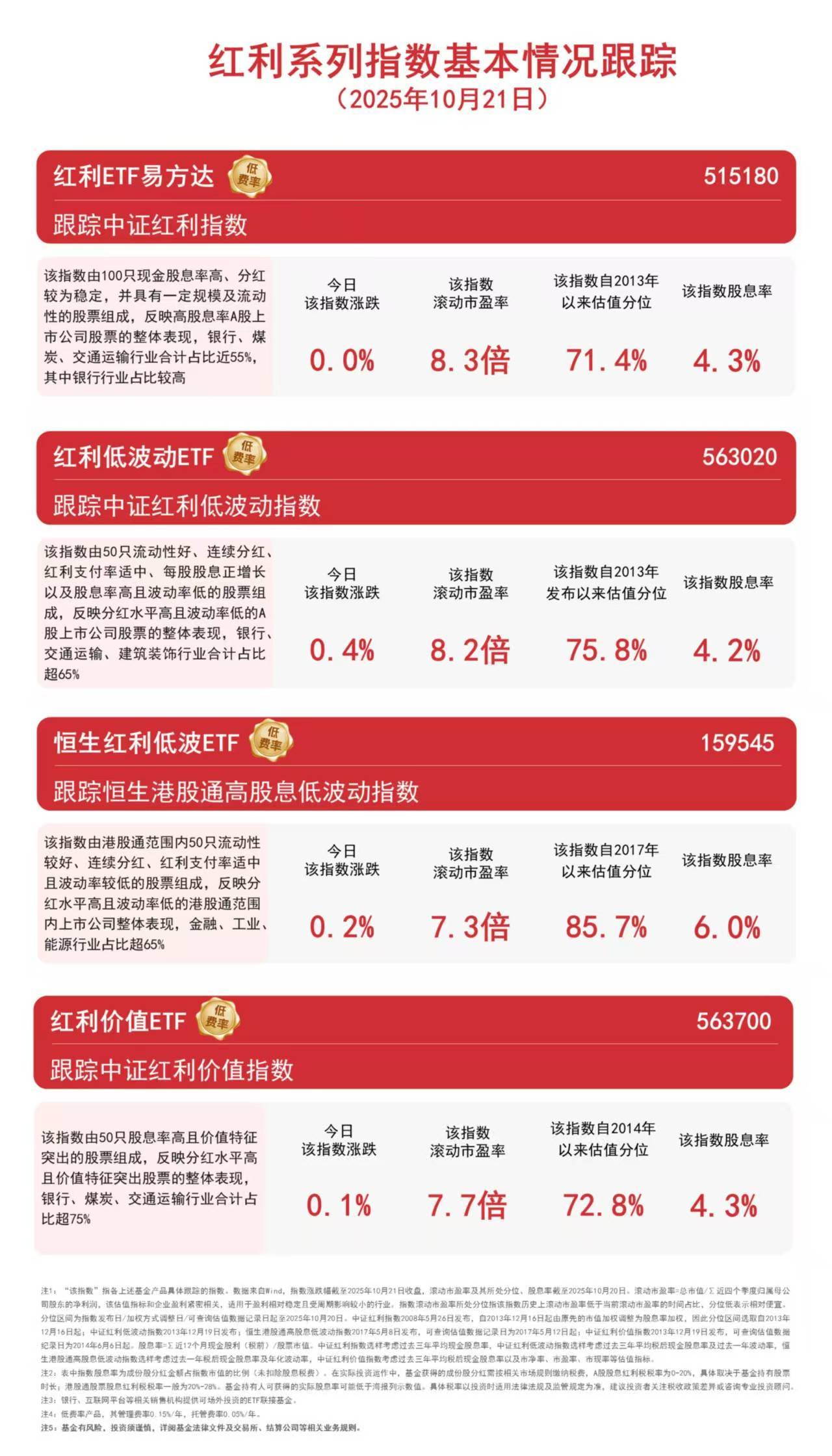
今日,红利板块集体收涨,截至收盘,中证红利低波动指数上涨0.4%,恒生港股通高股息低波动指数上涨0.2%,中证红利价值指数上涨0.1%,中证红利指 数上涨0.04%。Wind数据显示,截至昨日,红利ETF易方达(515180)近五个交易日合计"吸金"约5亿元,最新规模超100亿元。 日前,易方达中证红利ETF联接基金(A/C/Y:009051/009052/022925)发布分红公告,每10份基金份额分红0.52元,权益登记日和除息日为10月20日,现金 红利发放日为10月21日。 每日经济新闻 ...
A500ETF易方达(159361)标的指数涨约1.6%,机构称本轮慢牛行情的根基并未动摇
Mei Ri Jing Ji Xin Wen· 2025-10-21 05:29
Group 1 - The A-share market opened high and continued to rise, with sectors like artificial intelligence and communications experiencing significant growth [1] - As of 11:20, the A500 ETF managed by E Fund (159361) saw an increase of approximately 1.6%, with notable stocks such as Taiji Industry hitting the daily limit, and Zhongji Xuchuang rising over 9% [1] - There is a noticeable trend of capital entering the market through ETFs, with a net subscription of 153 million units yesterday and an additional net subscription of about 290 million units as of 11:20 today [1] Group 2 - Analysts suggest that the foundation for the current slow bull market remains strong, supported by ongoing global tech investment enthusiasm, "anti-involution" policies, and increased household savings entering the market, indicating potential for continued strength in the A-share index in the fourth quarter [1] - The CSI A500 Index consists of 500 stocks with large market capitalization and good liquidity, reflecting the overall performance of representative companies across various industries, with a high proportion of emerging industries like information technology and healthcare [1] - The management fee rate for the A500 ETF by E Fund is only 0.15% per year, which can help investors to cost-effectively allocate to core A-share assets [1]
超4500只个股上涨,A500ETF易方达(159361)、沪深300ETF易方达(510310)助力布局A股核心资产
Sou Hu Cai Jing· 2025-10-21 05:29
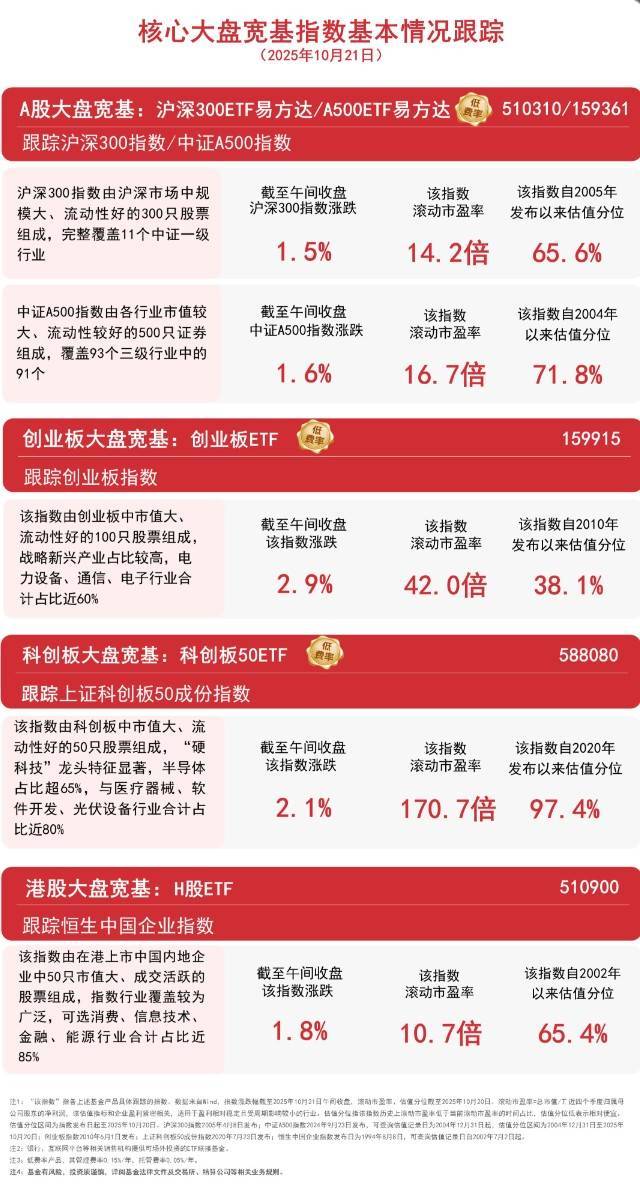
Core Points - The A-share market saw a collective rise in the three major indices, with the Shanghai Composite Index increasing by 1.2% and surpassing the 3900-point mark, while over 4500 stocks in the market experienced gains [1] - The Hong Kong stock market opened high and continued to rise, with technology stocks experiencing significant gains [1] Index Performance - The CSI 300 Index rose by 1.5% and has a rolling price-to-earnings ratio of 14.2 times, placing it in the 65.6% valuation percentile since its inception in 2005 [2] - The CSI A500 Index increased by 1.6%, with a rolling price-to-earnings ratio of 16.7 times, ranking in the 71.8% valuation percentile since its launch in 2004 [2] - The ChiNext Index surged by 2.9%, with a rolling price-to-earnings ratio of 42.0 times, which is in the 38.1% valuation percentile since its establishment in 2010 [2] - The STAR Market 50 Index rose by 2.1%, with a rolling price-to-earnings ratio of 170.7 times, placing it in the 97.4% valuation percentile since its inception in 2020 [2]
机器人ETF易方达(159530)早盘净申购达3000万份,机构称机器人产业链有望于明年加速爆发
Mei Ri Jing Ji Xin Wen· 2025-10-21 05:26
Core Viewpoint - The robotics sector is experiencing a significant upward trend, driven by the rise of humanoid robots as the best carriers for AI, indicating a potential 10-year industrial cycle ahead [1] Industry Performance - The National Securities Robotics Industry Index rose by 1.4% - The CSI Intelligent Electric Vehicle Index increased by 2.2% - The CSI Consumer Electronics Theme Index surged by 3.5% - The CSI Internet of Things Theme Index climbed by 3.7% [1] Investment Activity - The E Fund Robotics ETF (159530) saw a net subscription of 30 million units in the morning session [1] Future Outlook - According to Dongwu Securities, humanoid robots are expected to initiate small-scale production by 2025, with rapid iteration and expansion of components [1] - The overall industry chain is anticipated to accelerate its growth by 2026 [1]