
香港交易所

Search documents
智通ADR统计|9月26日




智通财经网· 2025-09-25 22:26
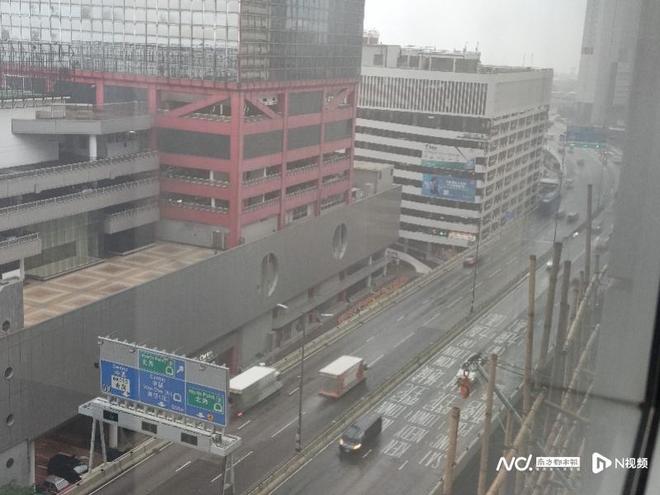
Market Overview - The Hang Seng Index closed at 26,404.18, down by 80.50 points or 0.30% on September 25 [1] - The index reached a high of 26,430.39 and a low of 26,319.63 during the trading session, with a trading volume of 66.046 million shares [1] Major Stocks Performance - HSBC Holdings closed at HKD 107.287, up by 0.17% compared to the previous close [2] - Tencent Holdings closed at HKD 648.343, down by 0.25% compared to the previous close [2] - Alibaba Group (W) saw a decline of 1.15%, closing at HKD 172.000 [3] - China Construction Bank dropped by 2.28%, closing at HKD 7.300 [3] - Xiaomi Group (W) increased by 4.48%, closing at HKD 59.450 [3] ADR Performance - Tencent's ADR price was USD 648.343, reflecting a decrease of 0.25% compared to its Hong Kong stock price [3] - Alibaba's ADR price was USD 170.695, down by 0.76% compared to its Hong Kong stock price [3] - HSBC's ADR price was USD 107.287, showing an increase of 0.17% compared to its Hong Kong stock price [3]

香港固定收益及货币市场发展路线图出炉
Shang Hai Zheng Quan Bao· 2025-09-25 18:14
Core Viewpoint - Hong Kong is taking significant steps to enhance its fixed income and currency markets, aiming to establish itself as a global hub for these sectors through a newly released roadmap that includes ten measures across four key areas [1][2][3] Group 1: Roadmap Overview - The roadmap focuses on four main areas: primary market issuance, secondary market liquidity, offshore RMB business, and next-generation infrastructure [1][2] - A dedicated task force for fixed income and currency was established in 2024 to explore market needs and develop the ecosystem [1] Group 2: Primary Market Issuance - Hong Kong plans to lead market development by issuing government bonds and promoting its advantages to target issuers and investors [1] - The goal is to expand the investor base, including family offices and funds, to attract more local and overseas issuers [1] Group 3: Secondary Market Liquidity - The implementation of an over-the-counter fixed income and currency derivatives system is aimed at enhancing liquidity [2] - Development of a central counterparty for repurchase transactions will provide necessary tools for managing financing, liquidity, and risk [2] Group 4: Offshore RMB Business - Hong Kong will enhance the application of offshore RMB and improve connectivity mechanisms to boost liquidity and product supply [2] - The focus is on adapting to global market changes and meeting diverse trends [2] Group 5: Next-Generation Infrastructure - Preparations for fixed income and currency infrastructure will include supporting the development of new electronic trading platforms [2] - The roadmap emphasizes innovation and the implementation of tokenized fixed income and currency products to maintain competitiveness [2] Group 6: Future Initiatives - The Hong Kong Monetary Authority (HKMA) and the Securities and Futures Commission (SFC) are collaborating with market participants to advance the measures outlined in the roadmap [2][3] - The SFC aims to expand the issuance of RMB fixed income products and enhance secondary market liquidity while optimizing risk management mechanisms [3]
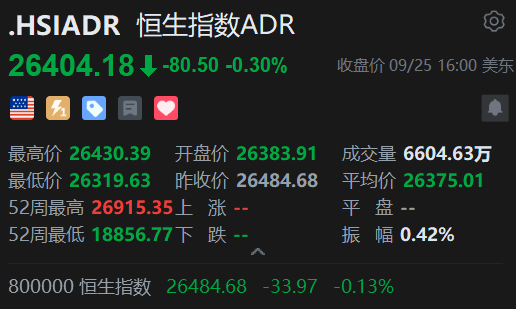
“打风不停市”满一年,香港市场首次在“十号风球”下交易!
Nan Fang Du Shi Bao· 2025-09-25 13:20
Core Viewpoint - The article highlights the resilience of Hong Kong's financial market during extreme weather events, particularly the recent super typhoon "Haikui," which saw the market maintain operations under the highest warning level, marking a significant achievement in the implementation of the "no market closure during typhoons" policy [1][4][11]. Group 1: Financial Market Operations - On September 24, Hong Kong's capital market operated under the "No Market Closure During Typhoons" policy for the first time during a "Signal No. 10" warning, showcasing the market's stability and competitiveness [1][11]. - The Hong Kong Monetary Authority and financial institutions coordinated closely to ensure smooth operations during the storm, allowing clients to conduct transactions via online channels [4][11]. - The stock market experienced a trading volume of approximately HKD 288.8 billion on September 24, with major indices rising between 1% to 2%, driven by positive developments in AI investments and overseas capital inflows [11][12]. Group 2: Government and Emergency Response - The Hong Kong government opened 50 temporary shelters for residents during the typhoon, a significant increase compared to previous instances [7]. - Emergency services handled numerous incidents, including 143 reports of people trapped in elevators and 454 automatic fire alarm reports, ensuring public safety during the storm [7][8]. - The Transport Department operated a 24-hour emergency traffic coordination center to monitor and manage the impact of the typhoon on transportation infrastructure [8]. Group 3: Impact on Financial Professionals - Many financial professionals opted to stay in nearby hotels or at their offices during the storm to ensure continuity in trading operations, leading to a surge in hotel bookings in the Central and Admiralty areas [12][13]. - The article suggests that the government could consider subsidies or insurance solutions to support financial institutions in securing accommodations for their staff during extreme weather events [13].
港股25日跌0.13% 收报26484.68点
Xin Hua Wang· 2025-09-25 09:57
Market Overview - The Hang Seng Index fell by 33.97 points, a decrease of 0.13%, closing at 26,484.68 points with a total turnover of 314.89 billion HKD [1] - The National Enterprises Index increased by 1.23 points, closing at 9,444.22 points, a rise of 0.01% [1] - The Hang Seng Tech Index rose by 56.04 points, closing at 6,379.19 points, an increase of 0.89% [1] Blue-Chip Stocks - Tencent Holdings rose by 0.23%, closing at 650 HKD [1] - Hong Kong Exchanges and Clearing fell by 0.59%, closing at 435.6 HKD [1] - China Mobile decreased by 0.7%, closing at 85.1 HKD [1] - HSBC Holdings dropped by 0.37%, closing at 107.1 HKD [1] Local Hong Kong Stocks - Cheung Kong Holdings fell by 1.25%, closing at 36.22 HKD [1] - Sun Hung Kai Properties decreased by 1.57%, closing at 91.05 HKD [1] - Henderson Land Development dropped by 1.46%, closing at 27.04 HKD [1] Chinese Financial Stocks - Bank of China fell by 2.34%, closing at 4.17 HKD [1] - China Construction Bank decreased by 2.28%, closing at 7.3 HKD [1] - Industrial and Commercial Bank of China dropped by 2.41%, closing at 5.67 HKD [1] - Ping An Insurance fell by 0.29%, closing at 52.25 HKD [1] - China Life Insurance decreased by 1.39%, closing at 21.26 HKD [1] Oil and Petrochemical Stocks - China Petroleum & Chemical Corporation fell by 0.49%, closing at 4.05 HKD [1] - China National Petroleum Corporation rose by 0.14%, closing at 7.08 HKD [1] - CNOOC Limited decreased by 0.37%, closing at 19 HKD [1]
德勤预计港股市场今年将有逾80只新股上市,募集2500亿至2800亿港元,港交所将稳居全球IPO融资额榜首
Mei Ri Jing Ji Xin Wen· 2025-09-25 08:45
Group 1 - Deloitte announced that the number of IPOs in Hong Kong is expected to exceed 80 by 2025, with the fundraising forecast raised from approximately HKD 200 billion to between HKD 250 billion and HKD 280 billion [1] - As of September 23, 2023, the total IPO fundraising in Hong Kong for the first three quarters reached approximately HKD 180 billion, with highlights including the return of Chinese concept stocks and the expansion of ETF products [1][2] - The technology sector is anticipated to remain a focal point for the market, with expectations for continued valuation improvements [1][2] Group 2 - In the first three quarters of 2025, Hong Kong's IPO market saw a significant increase, with 66 new listings compared to 45 in the same period last year, marking a 47% growth [2] - The total fundraising amount reached HKD 1,823 billion, a 228% increase from HKD 556 billion in the previous year, with six large IPOs contributing approximately 60% of the total [2][5] - The Hong Kong Stock Exchange (HKEX) remains the global leader in IPO fundraising, with a significant gap of over HKD 60 billion compared to the second-ranked New York Stock Exchange [4][5] Group 3 - The top ten global IPOs in terms of fundraising saw a slight decline of 3% year-on-year, with four of them listed on the HKEX, including Ningde Times at the top with HKD 41 billion [3] - The number of listing applications received by HKEX increased significantly, with 283 applications in the first eight months of 2025, up 123% from 127 applications in the same period last year [4] - The average price-to-earnings ratio for the Hong Kong main board reached 15 times, returning to levels seen in Q4 2021, indicating a recovery in the market [5]

人民币,大消息!
中国基金报· 2025-09-25 07:42
Core Viewpoint - The article discusses the upcoming release of the "Fixed Income and Currency Market Development Roadmap" by the Hong Kong government, which aims to enhance the internationalization of the Renminbi and strengthen Hong Kong's position as a global financial hub [2][4]. Group 1: Roadmap Overview - The "Roadmap" will focus on four pillars: strengthening bond issuance, enhancing secondary market liquidity, expanding offshore Renminbi business, and building new infrastructure [2]. - The roadmap is part of a broader strategy to promote the coordinated development of primary and secondary markets [2]. Group 2: Government Initiatives - The Hong Kong government plans to upgrade the fixed income and currency market ecosystem through three main directions: enhancing market infrastructure, improving market efficiency, and promoting financial innovation [6][7]. - Specific initiatives include optimizing asset custody and trading platforms, exploring electronic bond trading, and developing a more robust offshore Renminbi bond issuance mechanism [6][7]. Group 3: Support from the People's Bank of China - The People's Bank of China emphasizes its ongoing support for Hong Kong's development as an international financial center, highlighting the growth of the offshore Renminbi market and the increasing participation of foreign institutions in China's bond market [9][10]. - The central bank will continue to facilitate the issuance of high-quality Renminbi assets in Hong Kong and enhance the interconnectivity mechanisms between the mainland and Hong Kong [12]. Group 4: Market Growth and Opportunities - The fixed income market in Hong Kong has seen significant growth, with the Asian international bond market growing at an average rate of 16% annually from 2009 to 2024, compared to less than 4% globally [17]. - Hong Kong is positioned as a key hub for offshore Renminbi transactions, with over 70% of global Renminbi settlements occurring through the city [17]. Group 5: Future Directions - The Hong Kong Securities and Futures Commission aims to expand the issuance of Renminbi fixed income products and enhance the liquidity of the secondary market [19]. - There are plans to develop an electronic trading platform that encompasses bonds, repos, and foreign exchange to improve market efficiency and transparency [19]. Group 6: Collaboration and Regulatory Framework - The National Development and Reform Commission emphasizes the importance of collaboration between various stakeholders to create a more open and efficient financing environment in Hong Kong [21][22]. - Strengthening joint regulation and promoting sustainable development are key areas of focus to ensure the stability and growth of Hong Kong's financial markets [23].

港交所行政总裁陈翊庭:丰富产品货架 承接全球资金多元化配置需求
Zhong Guo Zheng Quan Bao· 2025-09-25 00:43
Core Insights - The Hong Kong Stock Exchange (HKEX) is witnessing a significant shift in foreign investment sentiment towards Chinese assets, moving from a stance of avoidance to one of necessity, driven by China's policy stability and technological advancements [1][3] Group 1: Investment Trends - HKEX's CEO highlighted that global diversification needs and the attractiveness of Chinese assets are leading foreign capital to transition from "cannot invest" to "cannot miss investing" in China [1][3] - In the first half of the year, HKEX reported a new stock financing amount of HKD 1,094 billion, reclaiming the top position among global exchanges, with a daily average trading volume of HKD 2,402 billion, a year-on-year increase of 118% [2] - Foreign capital is significantly returning to the Hong Kong market, with foreign subscriptions accounting for 70-80% of certain IPOs, indicating a robust demand from long-term investors from regions such as Europe, the Middle East, and Southeast Asia [2][3] Group 2: Market Dynamics - The shift in foreign investment logic is attributed to geopolitical tensions and a reassessment of asset allocation strategies, leading to a search for new investment opportunities in Hong Kong's leading and high-potential companies [2][3] - The average daily trading volume of Hong Kong stocks is projected to rise from approximately HKD 1,000 billion in 2023 to HKD 1,300 billion in 2024, further increasing to HKD 2,402 billion in the first half of 2025, with foreign trading volume accounting for about 70% [3] Group 3: Institutional Innovation - HKEX is committed to optimizing its institutional framework to meet diverse financing needs, with recent innovations such as the introduction of Chapter 18A and 18C rules allowing biotech and specialized technology companies to list without prior revenue [4][5] - The successful implementation of these rules has led to increased market recognition and a growing number of applications from companies seeking to list under these provisions [5] Group 4: Market Connectivity - The rise in IPO activity is complemented by a positive interaction with the A-share market, with "A+H" listings creating a beneficial cycle between the two markets [6] - HKEX aims to enhance its product offerings in fixed income, foreign exchange, and commodities to better compete globally, addressing current gaps in its market [6][7] - Future plans include expanding the range of products available through the Stock Connect program, including ETFs and bonds, to facilitate greater access for international investors [6][7]
智通ADR统计|9月25日
智通财经网· 2025-09-24 22:24
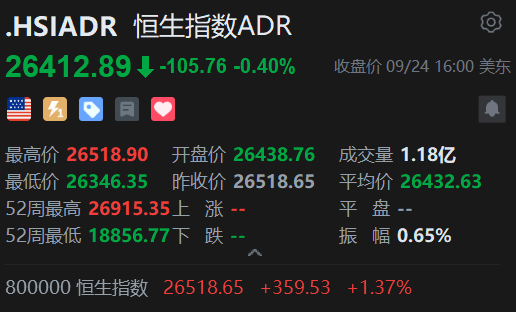
Market Overview - The Hang Seng Index (HSI) closed at 26,412.89, down by 105.76 points or 0.40% on September 24 [1] - The index reached a high of 26,518.90 and a low of 26,346.35 during the trading session [1] Major Blue-Chip Stocks Performance - HSBC Holdings closed at HKD 108.728, up by 1.14% compared to the Hong Kong close [2] - Tencent Holdings closed at HKD 643.360, down by 0.79% compared to the Hong Kong close [2] Stock Price Movements - Tencent Holdings (00700) latest price is HKD 648.500, with an increase of HKD 13.000 or 2.05% [3] - Alibaba Group (09988) latest price is HKD 174.000, with an increase of HKD 14.600 or 9.16% [3] - HSBC Holdings (00005) latest price is HKD 107.500, down by HKD 1.100 or 1.01% [3] - China Construction Bank (00939) latest price is HKD 7.470, down by HKD 0.030 or 0.40% [3] - Xiaomi Group (01810) latest price is HKD 56.900, up by HKD 1.450 or 2.61% [3] - AIA Group (01299) latest price is HKD 70.400, down by HKD 0.500 or 0.71% [3] - Meituan (03690) latest price is HKD 102.200, up by HKD 1.200 or 1.19% [3] - Hong Kong Exchanges and Clearing (00388) latest price is HKD 438.200, up by HKD 0.800 or 0.18% [3] - Industrial and Commercial Bank of China (01398) latest price is HKD 5.810, up by HKD 0.030 or 0.52% [3] - JD.com (09618) latest price is HKD 133.000, up by HKD 4.700 or 3.66% [3]
港交所行政总裁陈翊庭: 丰富产品货架 承接全球资金多元化配置需求
Zhong Guo Zheng Quan Bao· 2025-09-24 20:26
Core Viewpoint - The Hong Kong Stock Exchange (HKEX) is witnessing a significant shift in foreign investment sentiment towards Chinese assets, moving from a stance of avoidance to one of necessity, driven by China's policy stability and technological advancements [1][3]. Group 1: Investment Trends - Foreign capital is increasingly viewing Chinese assets as essential, with a notable change in investment logic from "Anything But China" to "Buy China" [3]. - In the first half of the year, HKEX reported a new stock financing amount of HKD 1,094 billion, reclaiming the top position among global exchanges [2]. - The average daily trading volume in the securities market reached HKD 2,402 billion, a year-on-year increase of 118% [2]. Group 2: Supply and Demand Dynamics - The supply side is robust, with over 200 companies currently processing IPO applications, nearly half of which are technology firms [2]. - A significant highlight on the demand side is the substantial return of foreign capital, with foreign investors participating in 70-80% of certain IPOs [2][3]. - The shift in global asset allocation strategies, influenced by geopolitical tensions and trade protectionism, is prompting investors to diversify away from USD assets towards Hong Kong stocks [2][3]. Group 3: Institutional Innovation - HKEX is committed to optimizing its institutional framework to meet diverse financing needs, exemplified by the introduction of the 18A and 18C listing rules, which allow biotech and specialized technology companies to go public [5]. - The 18C rule has already seen three companies listed and over ten applications submitted, indicating growing market acceptance [5]. Group 4: Market Connectivity - The "A+H" listing model has created a positive feedback loop, with average trading volume for "A+H" companies in A-shares increasing by approximately 15% this year [6]. - HKEX aims to enhance its product offerings in fixed income, foreign exchange, and commodities to better compete with global markets [6]. - Future plans include expanding the range of products available through the Stock Connect, including ETFs and bonds, to facilitate greater market integration [6][7].
丰富产品货架 承接全球资金多元化配置需求
Zhong Guo Zheng Quan Bao· 2025-09-24 20:18
Core Viewpoint - The Hong Kong Stock Exchange (HKEX) is witnessing a significant shift in foreign investment sentiment towards Chinese assets, driven by the increasing attractiveness of these assets and the demand for diversified global capital allocation [1][2][3] Group 1: Investment Trends - Foreign capital is transitioning from a passive to an active approach in investing in Chinese assets, with a notable increase in foreign participation in IPOs, exemplified by a large domestic company's IPO where foreign subscription reached 70-80% [2][3] - The global asset allocation logic is changing, with investors moving away from USD assets due to geopolitical tensions and trade protectionism, leading them to consider Hong Kong stocks as a viable alternative [2][3] - The investment logic for foreign capital is shifting from "Anything But China" to "Buy China," indicating a growing confidence in Chinese assets [2][3] Group 2: Market Performance - HKEX reported impressive performance in the first half of the year, with new stock financing reaching HKD 109.4 billion, reclaiming the top position among global exchanges, and an average daily trading volume of HKD 240.2 billion, up 118% year-on-year [1][2] - The average daily trading volume for Hong Kong stocks is projected to rise from approximately HKD 1 billion in 2023 to HKD 1.3 billion in 2024, and further to HKD 2.4 billion in the first half of 2025, with foreign capital accounting for about 70% of the trading volume [3][4] Group 3: Institutional Innovation - HKEX is committed to optimizing its institutional framework to meet the diverse needs of enterprises and investors, with recent innovations such as the introduction of Chapter 18A and 18C allowing biotech and specialized technology companies to list without prior revenue [4][5] - The introduction of these new listing rules reflects HKEX's proactive approach to align with long-term investor demands and support early-stage financing for innovative companies [5][6] Group 4: Market Connectivity - The IPO boom in Hong Kong is positively correlated with the A-share market, with "A+H" listings creating a virtuous cycle between the two markets [5][6] - HKEX aims to enhance its product offerings in fixed income, foreign exchange, and commodities to better compete globally, as current offerings are limited compared to US markets [6] - Future plans include expanding the range of products available through the Stock Connect program, such as ETFs and bonds, to facilitate greater access for foreign investors [6]