亚盛医药

Search documents
港股医药震荡拉升,恒生医药ETF(159892)涨超2%
Mei Ri Jing Ji Xin Wen· 2025-10-15 07:03
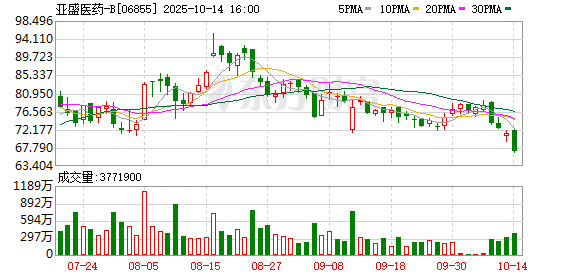
Core Viewpoint - The Hong Kong pharmaceutical sector, represented by the Hang Seng Biotechnology Index, experienced a significant increase, nearing a 3% rise, driven by active trading in the largest ETF, the Hang Seng Medicine ETF (159892) [1] Group 1: Market Performance - The Hang Seng Biotechnology Index showed strong performance with a nearly 3% increase in the afternoon session [1] - The Hang Seng Medicine ETF (159892) is the largest in its category, demonstrating active trading and good liquidity [1] - Notable individual stocks include MicroPort leading the gains, along with significant increases in WuXi AppTec, Ascentage Pharma, Kelun-Biotech, and JD Health [1] Group 2: Catalysts and Future Outlook - Data disclosure from the ESMO conference (October 17-21) is anticipated to be a key catalyst, with the potential for innovative drug data to exceed expectations, further boosting the sector [1] - Huafu Securities indicates that Chinese innovative drugs are undergoing a "quantitative change leading to qualitative change," with a positive outlook on the industry trend over the next 5-10 years [1] - Factors such as business development overseas, continuous data catalysts, and the ramp-up of new product sales are expected to drive the rise of innovative drugs [1]
创新药板块回暖,指数涨超2%,恒生创新药ETF(159316)近5个交易日持续“揽金”
Mei Ri Jing Ji Xin Wen· 2025-10-15 06:28
Core Viewpoint - The Hong Kong innovative drug sector has rebounded after a period of adjustment, with the Hang Seng Innovative Drug Index rising by 2.0% as of 14:00, indicating renewed investor interest in this segment [1]. Group 1: Market Performance - The Hang Seng Innovative Drug Index saw significant gains, with stocks such as Ascentage Pharma-B rising over 5%, and both 3SBio and Tonghua Dongbao Pharmaceutical-B increasing by more than 4% [1]. - The Hang Seng Innovative Drug ETF (159316) has experienced a net inflow of approximately 400 million yuan over the past five trading days, reflecting positive market sentiment [1]. Group 2: Upcoming Events - The 2025 European Society for Medical Oncology (ESMO) annual meeting is scheduled to take place from October 17 to October 21 in Berlin, Germany, which is expected to showcase several significant clinical research results, potentially boosting market interest in innovative drug assets [1]. Group 3: Index Composition - The Hang Seng Innovative Drug Index has excluded CXO companies in its compilation scheme, making it the first index with a "100% purity" focus on innovative drugs, accurately reflecting the overall performance of China's innovative pharmaceutical companies [1]. - The Hang Seng Innovative Drug ETF (159316) is currently the only product tracking this index, providing investors with a precise opportunity to capitalize on the development of the innovative drug industry [1].
双面“绣”苏州——苏州现代产业体系崛起的科创与资本叙事
Shang Hai Zheng Quan Bao· 2025-10-14 19:10
Core Insights - Suzhou's GDP reached 1.3 trillion yuan in the first half of 2025, with a year-on-year growth of 5.7%, maintaining its position as the top city in China by GDP among prefecture-level cities [1][2] - The "1030" industrial system aims to develop 10 major industrial clusters and 30 key industrial chains, targeting the establishment of four trillion-yuan industries by 2026, with industrial output reaching 5 trillion yuan [1][2] Group 1: Industrial Development - Suzhou's electronic information, equipment manufacturing, and advanced materials industries have each surpassed one trillion yuan in output [2] - The new energy industry is projected to reach 750 billion yuan in output by 2024, marking it as the fourth major trillion-yuan industry [2] - The city has established 225 A-share listed companies, showcasing a strong manufacturing base and innovation core [8] Group 2: Innovation and Technology - Suzhou ranks first in the number of national-level technology enterprise incubators and has the third-highest number of companies listed on the Sci-Tech Innovation Board [3] - The city has made significant strides in R&D, with total social R&D investment exceeding 100 billion yuan, accounting for approximately 4.15% of GDP [3] - Notable technological achievements include the world's first approved natural dual-target weight loss drug and the establishment of the first 8-inch gallium nitride production line [3] Group 3: Capital Investment - Suzhou has 38 recognized unicorn companies and 289 potential unicorns, leading the province in these metrics [7] - The Suzhou Angel Fund has invested in over 800 companies, supporting the growth of key sectors within the "1030" industrial system [7][8] - The city has developed a "fund matrix" that includes various funds targeting emerging industries, injecting capital into different stages of enterprise development [8] Group 4: Ecosystem and Collaboration - The local ecosystem encourages collaboration between startups and established companies, fostering innovation and growth [4][6] - Companies like Yasheng Pharmaceutical and Shanshi Network have relocated to Suzhou, attracted by its robust manufacturing and innovation environment [5] - The synergy between technology and capital is creating a vibrant industrial landscape, enhancing Suzhou's reputation as a "Smart Manufacturing City" [9]
苏州“绣”双面
Shang Hai Zheng Quan Bao· 2025-10-14 18:30
Core Viewpoint - Suzhou is leveraging its "1030" industrial system to drive economic growth, aiming to establish four trillion-yuan industries by 2026, with a focus on innovation and capital investment [2][3][10] Economic Performance - In the first half of 2025, Suzhou achieved a GDP of 1.3 trillion yuan, marking a year-on-year growth of 5.7%, maintaining its position as the top city among China's prefecture-level cities [2][3] - The city aims for a total industrial output value of 5 trillion yuan by 2026 [2] Industrial Development - Suzhou's electronic information, equipment manufacturing, and advanced materials industries have each surpassed a trillion yuan in output [3] - The new energy industry is projected to reach a value of 750 billion yuan by 2024 [3] Innovation and Technology - Suzhou ranks first in the number of national-level technology enterprise incubators and third in the number of companies listed on the Sci-Tech Innovation Board [4] - The city has a research and development investment that accounts for approximately 4.15% of its GDP, exceeding 100 billion yuan in total R&D spending [4] Capital Investment - Suzhou has 38 unicorn companies and 289 potential unicorns, leading the province in these metrics [8] - The Suzhou Angel Fund has invested in over 800 companies, significantly contributing to the growth of key sectors within the "1030" industrial system [8][9] Corporate Ecosystem - The city has established a comprehensive capital support system that nurtures companies from inception through to maturity, facilitating their growth and innovation [9] - Suzhou's listed companies have a combined R&D investment of approximately 15.69 billion yuan, with a research intensity of 3.87%, significantly higher than the A-share market average of 2.13% [9]


从“寒冬蓄力”到“H+美”双上市 解码亚盛医药突围之路
Shang Hai Zheng Quan Bao· 2025-10-14 18:21
Core Insights - The article highlights the journey of Ascentage Pharma, emphasizing its commitment to addressing unmet clinical needs through innovation and perseverance in the pharmaceutical industry [2][6]. Group 1: Company Overview - Ascentage Pharma, founded in 2009, has evolved from a small startup to a publicly listed company on both the Hong Kong Stock Exchange and NASDAQ, marking significant milestones in its growth [2][5]. - The company has successfully developed and commercialized two products: Nilotinib, which treats drug-resistant chronic myeloid leukemia, and a new Bcl-2 selective inhibitor, Lisenglitazone, which is the first domestically developed Bcl-2 inhibitor approved in China and the second globally [2][6]. Group 2: Financial and Investment Highlights - Ascentage Pharma has secured substantial funding over the years, including a $300 million investment from 3SBio in 2010, which was crucial for its survival during challenging times [4]. - The company raised nearly $100 million in Series A financing in 2015, which facilitated its establishment in Suzhou, benefiting from the region's vibrant biopharmaceutical ecosystem [4]. Group 3: Research and Development Focus - The company is dedicated to developing drugs that meet real clinical needs, with a pipeline that includes six products in clinical stages targeting various cancers, including non-small cell lung cancer and ovarian cancer [6][7]. - Ascentage Pharma aims to accelerate the internationalization of Nilotinib and further commercialize Lisenglitazone while expanding its pipeline to benefit more patients globally [6][8]. Group 4: Strategic Partnerships and Market Position - The company has engaged in significant business development (BD) transactions, including a notable $1 billion deal with Takeda Pharmaceutical for the global development and commercialization of Nilotinib, setting a record for domestic small molecule oncology drugs [7]. - Ascentage Pharma is transforming into a full-cycle enterprise encompassing drug research, production, and commercialization, enhancing its role in the biopharmaceutical industry ecosystem [7].
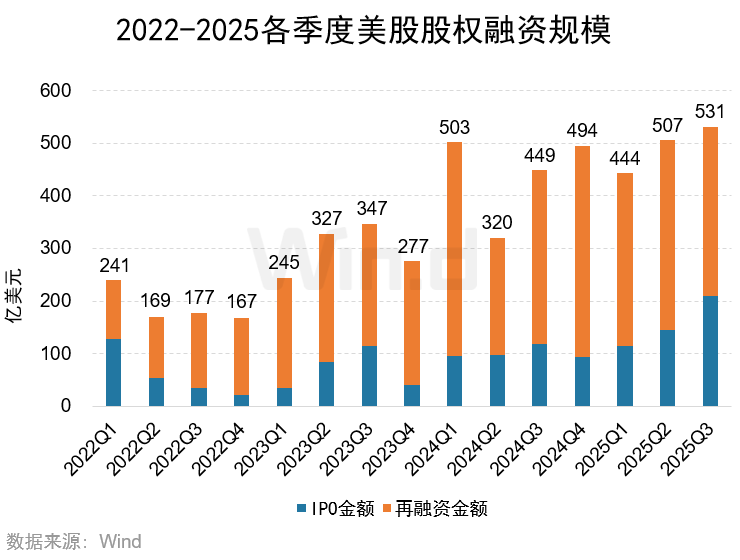
2025年前三季度美股市场股权融资规模总计1481亿美元
Zhi Tong Cai Jing· 2025-10-13 23:32
Core Insights - The U.S. equity underwriting market showed strong performance in the first three quarters of 2025, with total equity financing (including IPOs and refinancing) amounting to $148.1 billion, an increase of $20.9 billion or 16.40% year-over-year [1][3][38]. Equity Financing Overview - Total equity financing in the U.S. for the first three quarters of 2025 reached $148.1 billion, with IPOs contributing $46.9 billion (up 50.07% year-over-year) and refinancing totaling $101.2 billion (up 5.42% year-over-year) [3][7][38]. - The non-bank financial sector led the fundraising with $49.9 billion, followed by software services at $18.4 billion and pharmaceuticals at $13.8 billion [10][45]. IPO Market Analysis - A total of 310 companies went public in the first three quarters of 2025, an increase of 128 companies compared to the previous year [15]. - The Nasdaq remained the leading exchange for IPOs, with 246 companies raising $29.4 billion, accounting for 62.73% of the total IPO market [17]. - The largest IPO was by Venture Global, raising $1.75 billion, followed by CoreWeave at $1.5 billion and SailPoint Parent at $1.38 billion [29]. SPAC and Chinese Companies - There were 85 SPAC IPOs in the first three quarters of 2025, a significant increase of 56 from the previous year, raising $16.2 billion, up 190.93% year-over-year [32]. - 59 Chinese companies went public in the U.S., raising $1 billion, a decrease of 58.35% year-over-year [34]. Refinancing Trends - The refinancing market saw 665 events, a slight increase of 16 from the previous year, with total proceeds of $101.2 billion [2][38]. - The non-bank financial sector led refinancing with $24.2 billion, followed by software services at $12.5 billion and pharmaceuticals at $12.1 billion [45]. Underwriting Rankings - Goldman Sachs topped the IPO underwriting rankings with $4.758 billion from 29 deals, followed closely by Cantor Fitzgerald and JPMorgan [54][56]. - In refinancing, JPMorgan led with $15.458 billion from 58 deals, followed by Goldman Sachs and Morgan Stanley [58][59].
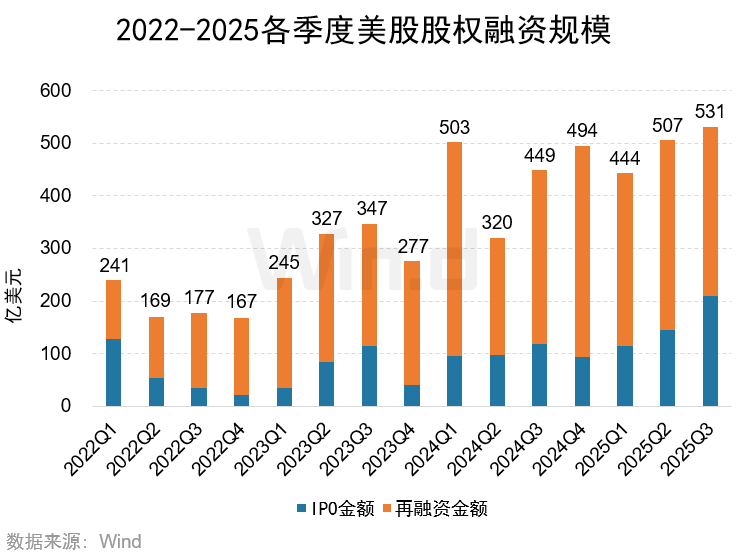
Wind:2025年前三季度美股市场股权融资规模总计1481亿美元
智通财经网· 2025-10-13 23:08
Core Insights - The US equity underwriting market showed strong performance in the first three quarters of 2025, with total equity financing (including IPOs and refinancing) amounting to $148.1 billion, an increase of $20.9 billion or 16.40% year-on-year [1][3][38]. Equity Financing Overview - Total equity financing in the US market reached $148.1 billion, with IPOs contributing $46.9 billion (up 50.07% year-on-year) and refinancing totaling $101.2 billion (up 5.42% year-on-year) [3][6][38]. - Non-bank financial sector led the fundraising with $49.9 billion, accounting for 33.68% of total financing [1][8]. IPO Market - A total of 310 companies went public in the first three quarters, an increase of 128 companies compared to the previous year, raising $46.9 billion [14][15]. - The Nasdaq remained the leading exchange for IPOs, with 246 companies listed, raising $29.4 billion, representing 62.73% of the total IPO market [15][19]. - The largest IPO was by Venture Global, raising $1.75 billion [29]. SPAC and Chinese Companies - SPAC IPOs saw significant growth, with 85 companies going public, raising $16.2 billion, a year-on-year increase of 190.93% [32]. - 59 Chinese companies listed in the US, raising $1 billion, a decrease of 58.35% year-on-year [34]. Refinancing Trends - There were 665 refinancing events, with a total amount of $101.2 billion, reflecting a 5.42% increase year-on-year [2][38]. - The non-bank financial sector led refinancing with $24.2 billion, followed by software services at $12.5 billion [45]. Underwriting Rankings - Goldman Sachs topped the IPO underwriting rankings with $4.758 billion from 29 deals, followed closely by Cantor Fitzgerald and JPMorgan [54][56]. - For refinancing, JPMorgan led with $15.458 billion from 58 deals, followed by Goldman Sachs and Morgan Stanley [58][59].
2025年前三季度美股股权承销排行榜
Wind万得· 2025-10-13 22:38
Market Overview - In the first three quarters of 2025, the US stock market showed strong performance with the Dow Jones Industrial Average rising by 9.06%, the Nasdaq increasing by 17.34%, and the S&P 500 up by 13.72% [2] - The total equity financing in the US stock market reached $148.1 billion, an increase of $20.9 billion or 16.40% compared to the same period last year [2] - The non-bank financial sector raised a total of $49.9 billion, accounting for 33.68% of the total financing [2] IPO Performance - A total of 310 companies successfully went public in the first three quarters of 2025, an increase of 128 companies year-on-year [17] - The total amount raised through IPOs was $46.9 billion, reflecting a year-on-year increase of 50.07% [17] - The largest IPO was by Venture Global, which raised $1.75 billion [31] SPAC and Chinese Companies - There were 85 SPAC IPOs in the first three quarters, a significant increase of 56 companies year-on-year, raising a total of $16.2 billion, up 190.93% [34] - 59 Chinese companies went public in the US, an increase of 20 companies year-on-year, but the total amount raised was only $1 billion, down 58.35% [35] Refinancing Trends - The total number of refinancing events was 665, an increase of 16 events year-on-year, with a total amount raised of $101.2 billion, up 5.42% [3][38] - The non-bank financial sector led refinancing with a total of $24.2 billion raised [43] Industry Distribution - The non-bank financial sector was the top industry for equity financing, raising $49.9 billion, followed by software services at $18.4 billion and pharmaceuticals at $13.8 billion [10] - In terms of the number of financing events, the pharmaceutical sector led with 237 events, followed by non-bank financial with 159 events [14] Underwriting Rankings - Goldman Sachs led the IPO underwriting rankings with $4.758 billion in underwriting amount and 29 deals [51] - For refinancing, JPMorgan topped the rankings with $15.458 billion in underwriting amount and 58 deals [55]
研判2025!中国镰状细胞病治疗行业产业链、市场规模及重点企业分析:行业迈入基因编辑驱动根治时代,治疗迎来技术突破窗口期[图]
Chan Ye Xin Xi Wang· 2025-10-10 01:27
Core Insights - The Chinese sickle cell disease treatment industry is transitioning from symptomatic treatment to curative treatment, driven by breakthroughs in gene editing technology [1][11] - The market size for sickle cell disease treatment in China is projected to reach approximately 4.287 billion yuan in 2024, representing a year-on-year growth of 66.03% [1][11] Industry Overview - Sickle cell disease is an autosomal recessive genetic disorder caused by mutations in the beta-globin gene, leading to abnormal hemoglobin (HbS) that causes red blood cells to deform into a sickle shape, resulting in hemolysis, vascular occlusion, and multi-organ ischemic damage [2][6] - Current treatment methods include medication, blood transfusions, hematopoietic stem cell transplantation, and gene therapy, with the goal of alleviating symptoms, preventing complications, and improving quality of life [4][11] Industry Development History - The early exploration phase from the 1950s to the 1980s focused on symptom management through blood type screening and family history investigations in high-prevalence areas [6][7] - The standard treatment phase from the 1990s to the 2010s saw the introduction of hydroxyurea and regular blood transfusions, although long-term transfusions led to iron overload [7][11] - The breakthrough phase from the 2010s to present has seen advancements in gene therapy, with significant clinical trials and the approval of therapies like CASGEVY by the FDA [7][11] Industry Value Chain - The upstream of the sickle cell disease treatment industry includes raw materials such as cells, growth factors, and gene editing tools like CRISPR-Cas9 [9][10] - The midstream focuses on research and production of sickle cell disease treatments, while the downstream primarily serves patients suffering from the disease [9][10] Market Size - The sickle cell disease treatment market in China is experiencing significant growth, with a projected market size of approximately 4.287 billion yuan in 2024, reflecting a 66.03% increase from the previous year [1][11] Key Companies' Performance - The industry is characterized by a "technology-driven" competitive landscape, with companies like Zhengxu Bio leading in gene therapy innovations [12][13] - Traditional pharmaceutical companies such as Heng Rui Medicine and Shijiazhuang Pharmaceutical Group leverage their production capabilities and insurance coverage to maintain a strong presence in the basic treatment market [12][13] Industry Development Trends 1. Continuous technological innovation is driving a paradigm shift in treatment approaches, with gene editing tools enabling targeted repair of the beta-globin gene [14] 2. Policy and market developments are fostering industry expansion, with the government prioritizing gene editing in its biopharmaceutical strategy [15] 3. Deepening global collaborations are enhancing the industry ecosystem, with partnerships between multinational and local companies accelerating the localization of gene therapies [16][17]



智通港股通占比异动统计|10月10日
智通财经网· 2025-10-10 00:37
Core Viewpoint - The report highlights the changes in the Hong Kong Stock Connect holdings, indicating which companies have seen the largest increases and decreases in ownership percentages over recent trading days [1][2][3]. Summary by Category Recent Changes in Holdings - GX Hengsheng High Dividend (03110) saw an increase of 0.22% in its Hong Kong Stock Connect holding percentage, bringing it to 2.09% [2] - The largest decrease was observed in Southern Hengsheng Technology (03033), which dropped by 0.31% to 59.93% [2] Five-Day Changes - The most significant increase in holdings over the last five trading days was for Dazhong Public Utilities (01635), which rose by 8.30% to 67.37% [3] - Conversely, Kingsoft Cloud (03896) experienced the largest decrease, falling by 2.65% to 25.92% [3] Twenty-Day Changes - Over the past twenty days, Dazhong Public Utilities (01635) also led with a substantial increase of 34.28%, reaching a holding percentage of 67.37% [4] - The largest decrease was recorded for Yisou Technology (02550), which fell by 13.04% to 33.85% [4]