当升科技

Search documents
全固态电池产业化提速
Zheng Quan Ri Bao· 2026-01-06 16:28
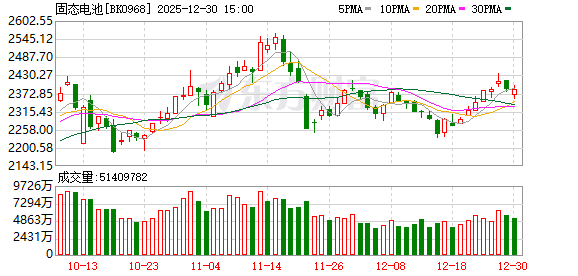
本报记者 李万晨曦 中信证券测算,2030年全球固态电池总出货量将超700GWh,其中全固态电池超200GWh。目前我国半固态电池已经量 产,全固态电池也在加速追赶,其整体目标是在2026年—2027年实现上车和小批量产,2030年实现商业化。 1月6日,A股固态电池板块表现亮眼,多只个股实现大幅上涨。 固态电池的产业化进程备受市场关注。据了解,在日前举行的2026年国际消费电子展(CES 2026)上,芬兰初创公司 Donut Lab宣布将推出其所称的"全球首款可用于OEM车辆量产的全固态电池"。 盘古智库(北京)信息咨询有限公司高级研究员余丰慧在接受《证券日报》记者采访时表示,作为新能源电池领域终极技 术方向之一,全固态电池以固态电解质替代传统液态电解液,是破解传统锂电池续航焦虑与安全隐患的核心方案。 市场不断升温 全固态电池领域利好频出,使得市场热度不断攀升。 政策层面,2025年12月30日,全国汽车标准化技术委员会发布《电动汽车用固态电池 第1部分:术语和分类》(征求意见 稿)。中国城市发展研究院投资部副主任袁帅表示,作为全球首部电动汽车用固态电池国家标准草案,其不仅明确了固态电池 的技术术语与分类 ...
华福证券:电池变革重要赛点 材料设备全新颠覆
Zhi Tong Cai Jing· 2026-01-06 06:44
华福证券发布研报称,发展固态电池已成为行业共识、全球竞争赛点:理论上能实现高比能、高安全性 的固态电池体系,是全球公认的颠覆性技术。减少液态电解质含量,提升固态电解质占比,逐步实现固 态化,是行业发展共识。由此带来的对材料体系、装备体系的颠覆,迫使全球企业、研究团队展开新一 轮的创新竞争,避免在新技术方向上的掉队风险。2027年实现小批量生产、工艺定型,基本上是国内外 企业一致预期的重要时间节点。 华福证券主要观点如下: 建议关注 主线1:关键材料:【硫化物电解质】当升科技(300073)、国瓷材料(300285)、容百科技、泰坦股 份(003036)、道氏技术(300409)等;【硫化锂】上海洗霸(603200)、厦钨新能、恩捷股份 (002812)、海辰药业(300584)、华盛锂电、光华科技(002741)等;【锂金属负极】中一科技 (301150)、天铁科技(300587)、道氏技术、英联股份(002846)等;【硅碳负极】璞泰来 (603659)、贝特瑞、杉杉股份(600884)、元力股份(300174)、道氏技术等;【辅材】博苑股份 (301617)、日播时尚(603196)、海辰药业、松井股份、 ...
钠离子电池行业-性能适配与经济性共振-有望迎来发展新周期
2026-01-05 15:42
Summary of Sodium-Ion Battery Industry Conference Call Industry Overview - The sodium-ion battery industry is gaining attention due to rising lithium prices, with companies like CATL starting to focus on this technology since 2022. Despite a subsequent decline in lithium prices affecting its application, sodium-ion batteries are still being utilized in two-wheeled vehicles and energy storage demonstration projects. The launch of "NaXing" by CATL and the development by Xiaoyao Battery are driving the industry's growth [1][4]. Key Insights and Arguments - **Performance and Economic Resonance**: The sodium-ion battery exhibits differentiated advantages in low-temperature and specific scenarios, particularly in terms of rate performance. As lithium prices trend upwards, the cost-effectiveness of sodium-ion batteries is expected to improve due to economies of scale, creating a dual-driven resonance that may lead to a new development cycle [2]. - **AIDC Power Supply Solutions**: The AIDC power supply solution opts for sodium batteries due to their large cell size, which meets millisecond response requirements, along with high safety and long lifespan. Haishen Energy has introduced a lithium-sodium collaborative AIDC long-duration energy storage solution, featuring a 2.28 MWh sodium battery storage system with millisecond response speed [3][8]. - **Mainstream Technology Routes**: The current market has three main technology routes: polyanionic, layered oxides, and Prussian blue. Polyanionic materials are gaining attention due to the availability of raw materials, while layered oxides offer high energy density but have high synthesis energy consumption. Prussian blue faces stability challenges [6]. Market Applications - Sodium-ion batteries are being pushed for large-scale applications in the power sector, particularly by major players like CATL. In the energy storage sector, especially in North America, there is an increasing demand for AIDC power supply solutions. Companies like Yiwei Lithium Energy are also exploring similar applications in UPS backup scenarios [5]. Development Potential - The sodium-ion battery industry is expected to experience significant growth in the coming years, driven by leading companies like CATL and the optimization of supply chains and product performance. Material manufacturers with strong R&D capabilities and solid customer bases are likely to benefit from this growth, leading to a recommended rating for the industry [7][11]. Material Suppliers' Progress - Midstream and upstream material suppliers have made notable progress in industrialization. Companies like Rongbai, Dangseng, and Zhenhua are focusing on technology reserves in layered oxide processes. A cooperation agreement between Rongbai Technology and CATL is expected to yield a potential annual procurement volume of 500,000 tons, with a target of achieving a scale of 100,000 tons by 2026 [9][10]. Future Outlook - The future of sodium-ion batteries appears promising due to their differentiated performance and economic advantages. As lithium prices continue to rise, the application space for sodium-ion batteries is expected to expand. Companies with strong R&D capabilities and solid market positions, such as Rongbai, Zhenhua, Dangseng, and leading players like CATL and Yiwei Lithium Energy, are recommended for investment consideration [11].

我国首份固态电池标准进入征求意见阶段,看好2026年固态电池投资机遇
Huafu Securities· 2026-01-04 12:02
行 业 研 华福证券 电力设备 2026 年 01 月 04 日 电力设备 究 行 业 动 态 我国首份固态电池标准进入征求意见阶段,看好 2026 年固态电池投资机遇 投资要点: 事件: 全国标准信息公共服务平台显示,国家标准计划《电动汽车用固态电池 第 1 部分:术语和分类》已经从起草进入到了征求意见阶段,为我国车用固 态电池标准体系的首个国家标准草案。 不仅是国内首个也是全球首个固态电池标准,将护航固态电池产业化 提速 跟 踪 根据同步披露的《编制说明》,截止目前暂未识别到国际、国外已发布的固 态电池标准,这也意味着,该征求意见稿是全球首个固态电池国家标准草 案。开展的车用固态电池标准化研究,有利于统一评价手段、规范产品质 量、支撑政府管理,基于强制性国家标准的逐步完善,车用固态电池产品 才能获取更清晰更真实的符合全固态电池的 3C 认证证书,将为市场端导入 铺平道路。 明确了固态电池统一定义,取消了"半固态电池"表述 首次在国家层面将电池划分为液态电池、混合固液电池和固态电池,这就 意味着"半固态电池"可作为"混合固液电池"的许用术语,全固态电池可 作为"固态电池"许用术语。我们认为这一规范,将极大减 ...
「钴奶奶」价格狂飙190%,产业链加速「去钴化」
3 6 Ke· 2026-01-02 02:35
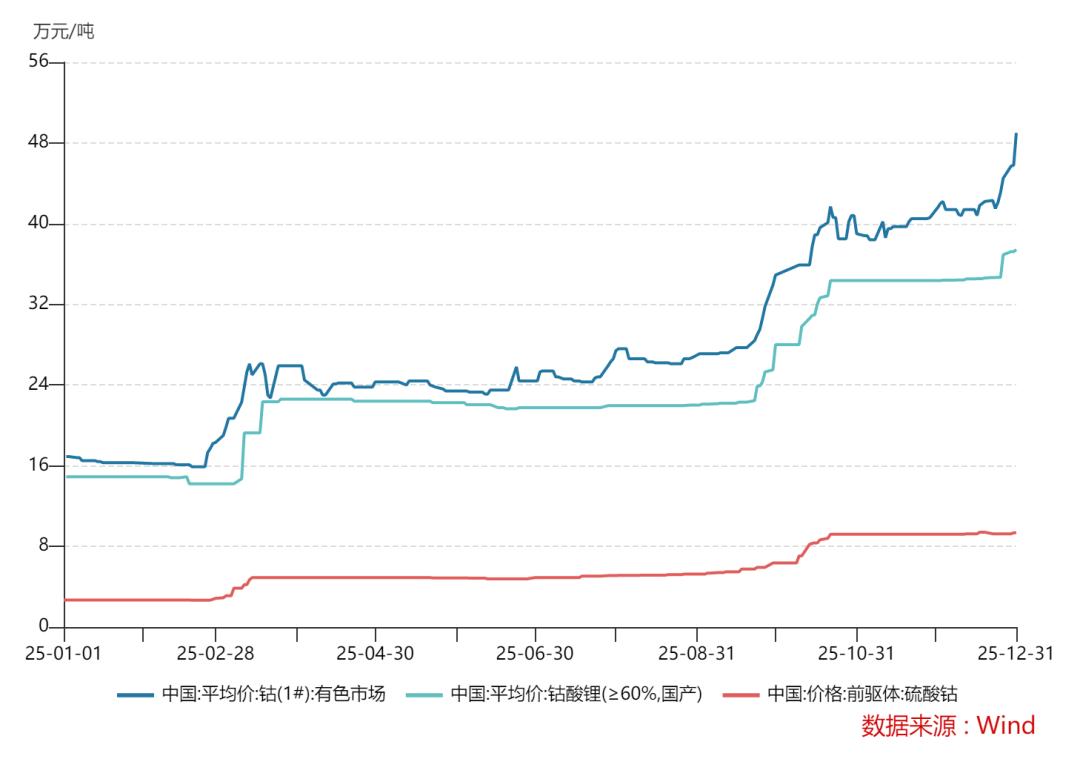
Core Viewpoint - The suspension of all artisanal cobalt mining activities in the Democratic Republic of Congo (DRC) has significantly impacted cobalt prices, which are expected to rise in 2025 due to supply constraints and policy restrictions [1][2]. Group 1: Cobalt Price Trends - As of December 31, 2025, the average price of cobalt in China reached 490,000 yuan per ton, marking a 190% increase since the beginning of 2025 [1]. - The supply situation has shifted from structural surplus to persistent shortage since the DRC implemented a cobalt export ban in February 2025, with a confirmed export quota of 96,600 tons per year for 2026-2027, a reduction of over 50% compared to 220,000 tons in 2024 [1][2]. Group 2: Lithium Cobalt and Battery Material Prices - Prices for lithium carbonate and cobalt sulfate have also surged since 2025, with increases of over 150% and 248% respectively, driven by rising costs of cobalt [2]. - Cobalt sulfate prices have led to a 30% increase in cobalt lithium battery prices since 2025, particularly affecting mid-nickel materials due to their high cobalt sulfate content [4]. Group 3: Market Dynamics and Shifts - The market is experiencing a structural shortage of cobalt, but this may be alleviated by increased recycling rates [2]. - The share of mid-nickel materials is declining as manufacturers shift towards high-nickel materials in response to rising cobalt prices, accelerating the industry's "de-cobaltization" trend [4][10]. Group 4: Company Performance and Production - In the first half of 2025, the revenue from cobalt lithium business for companies like Dingsheng Technology increased by 39.21% year-on-year to 330 million yuan, with a gross margin rise of 5.82% to 8.19% [5]. - Xiamen Tungsten New Energy reported a 45.38% year-on-year increase in cobalt lithium sales, maintaining high production capacity utilization [6]. Group 5: Future Market Expectations - The global 3C consumer electronics market is expected to enter a "volume reduction and price increase" adjustment cycle in 2026, with potential declines in demand for cobalt lithium materials [9]. - The demand for cobalt lithium is projected to stabilize at around 110,000 tons, with a slight expected decrease of approximately 0.7% [9]. Group 6: Industry Transition to Alternative Materials - The lithium battery industry is actively pursuing "de-cobaltization" strategies, focusing on high-nickel low-cobalt and iron phosphate materials to reduce costs [10]. - The market share of iron phosphate batteries is expected to reach 72% by 2030, while the demand for ternary batteries may decrease to 21% [13].

《关于26年实施大规模设备更新和消费品以旧换新政策的通知》点评:电动车补贴延续,26年电动车渗透率有望再提升
Shenwan Hongyuan Securities· 2025-12-31 07:12
Investment Rating - The industry investment rating is "Overweight" indicating a positive outlook for the sector compared to the overall market performance [2]. Core Insights - The report highlights the continuation of electric vehicle (EV) subsidies in 2026, which is expected to enhance the penetration rate of EVs and boost sales, particularly for mid to high-priced models [2]. - The implementation of a large-scale equipment renewal and consumer goods replacement policy reflects the government's commitment to supporting the consumption of new energy vehicles [2]. - The report anticipates a strong demand for lithium batteries in 2026, driven by the sustained growth in electric vehicle sales and the continuation of the old-for-new policy [2]. Summary by Sections Policy Impact - The 2026 policy includes subsidies for scrapping and replacing old vehicles, with personal consumers receiving up to 20,000 yuan for qualifying new energy vehicles [2]. - The policy aims to support the transition to low-emission vehicles, including electric trucks and city buses, thereby alleviating concerns about subsidy reductions for electric heavy trucks [2]. Market Performance - In 2025, the old-for-new policy significantly boosted the sales of new energy vehicles, with production and sales reaching 14.91 million and 14.78 million units respectively, marking a year-on-year growth of 31.4% and 31.2% [2]. - The report notes that the domestic power battery sales reached 1,044.3 GWh in 2025, reflecting a 50.3% year-on-year increase, indicating a robust market for battery manufacturers [2]. Investment Recommendations - The report suggests focusing on leading battery companies such as CATL, Zhongxin Innovation, and Yiwei Lithium Energy, as well as material suppliers like Hunan Youneng and Tianwei Technology, due to their strong market positions and growth potential [2]. - The anticipated increase in electric vehicle penetration and battery demand presents a favorable investment landscape for stakeholders in the new energy sector [2].


首个国标划定硬指标,固态电池产业化提速
Huan Qiu Wang Zi Xun· 2025-12-31 04:51
Core Viewpoint - The release of the first national standard for solid-state batteries in China marks a significant milestone in the industry's development, establishing clear definitions and high thresholds for key performance indicators, which is expected to facilitate the industrialization of solid-state battery technology [1][6]. Group 1: Definition and Standards - The new standard categorizes batteries into three types: liquid batteries, hybrid solid-liquid batteries, and solid-state batteries, eliminating the previously used term "semi-solid battery" [2]. - A critical performance indicator set by the new standard is that the weight loss rate of solid-state batteries must not exceed 0.5%, a significant tightening from the previous requirement of less than 1% [2][6]. - The standard aims to clarify the market and promote genuine technological innovation, thereby purging the market of "pseudo-solid" products [6]. Group 2: International Competition and Market Dynamics - The standard categorizes solid-state batteries based on electrolyte types and ion conduction types, which is expected to enhance China's competitive edge in the global solid-state battery technology race [4]. - The establishment of the national standard is seen as a strategic move to unify domestic technical interfaces and gain a voice in international regulations [4]. - Capital investment in the solid-state battery sector is increasing, with significant funding events indicating strong market recognition of this technology [5]. Group 3: Industry Impact and Investment Opportunities - Major companies are actively pursuing funding and investments to support the transition from laboratory to large-scale production of solid-state batteries [5]. - The market has seen a surge in institutional interest, with 22 solid-state battery concept stocks receiving institutional research in the fourth quarter [5]. - Companies with substantial technological reserves in core electrolyte routes and those achieving significant production capabilities are expected to benefit from the "Matthew effect" in the upcoming industrial wave [6].



固态电池首个国家标准出炉 机构扎堆调研股名单梳理
Xin Lang Cai Jing· 2025-12-31 00:17
Core Viewpoint - The first national standard for solid-state batteries has been publicly solicited for opinions, marking a significant step towards the industrialization of solid-state battery technology [1] Industry Summary - The national standard titled "Solid State Batteries for Electric Vehicles Part 1: Terminology and Classification" was released for public consultation on December 30 [1] - This standard clarifies the terminology, classification, and coding related to solid-state batteries, indicating a transition from laboratory research to industrial application [1] - A total of 54 listed companies in the A-share market are involved in the solid-state battery industry chain, reflecting growing interest and investment in this sector [1] Company Summary - In the fourth quarter, 22 concept stocks related to solid-state batteries have been investigated by institutions, with 16 of these stocks receiving attention from 10 or more research institutions [1] - Companies such as Rongbai Technology, Dandefluorine, and Dangseng Technology have attracted the most institutional research, with 267, 183, and 157 institutions respectively conducting investigations [1]
固态电池“标尺”来了,首个国家标准出炉,门槛大提升(附股)
Zheng Quan Shi Bao· 2025-12-31 00:11
Core Viewpoint - The first national standard for solid-state batteries has been publicly solicited for opinions, marking a significant step towards the industrialization of solid-state battery technology [1][2]. Group 1: National Standard Development - The national standard titled "Solid-State Batteries for Electric Vehicles Part 1: Terminology and Classification" has been released for public consultation, defining key terms, classifications, and coding related to solid-state batteries [2]. - The standard will be developed in four parts: terminology and classification, performance specifications, safety specifications, and lifespan specifications [4]. - The draft categorizes solid-state batteries based on the type of electrolyte, ion conduction type, and application area, including categories such as sulfide, oxide, polymer, and halide solid-state batteries [6]. Group 2: Stricter Classification and Standards - The draft specifies that solid-state batteries must have a weight loss rate of no more than 0.5%, which is stricter than the previous group standard of less than 1% [6]. - The standard aims to eliminate the concept of semi-solid batteries, focusing on clear definitions and classifications [5]. Group 3: Industry Implications - The establishment of a national standard is expected to unify technical standards, enhance industry collaboration, and strengthen China's position in international regulations, facilitating the transition from laboratory to mass production [7][8]. - The solid-state battery industry in China is experiencing significant capital investment, with major companies completing substantial financing rounds, indicating strong market confidence in the technology [9]. Group 4: Market and Investment Trends - A total of 54 listed companies in A-shares are involved in the solid-state battery supply chain, attracting institutional interest [10]. - In the fourth quarter, 22 concept stocks received institutional research, with companies like Rongbai Technology and Dandeng Technology being the most frequently researched [12]. - Companies are increasing their R&D investments, with several solid-state battery stocks reporting significant growth in R&D expenses as a percentage of revenue [13][14].

重磅!固态电池“标尺” 来了 首个国家标准出炉 门槛大幅提升(附股)
Zheng Quan Shi Bao Wang· 2025-12-31 00:06
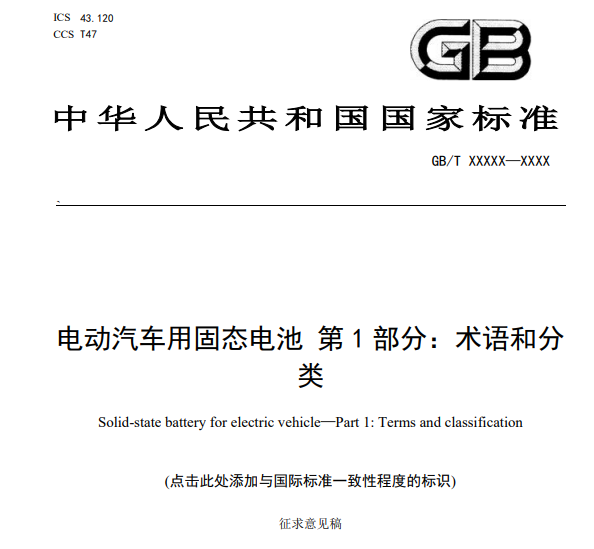
固态电池首个国家标准公开征求意见,标志着固态电池技术开始由实验室走向产业化。 固态电池首个国家标准出炉 证券时报·数据宝从全国汽车标准化技术委员会获悉,12月30日,固态电池首个国家标准——《电动汽车用固态电池第1部分:术语和分类》公 开征求意见(以下简称"征求意见稿")。征求意见稿明确了固态电池的相关术语、分类、编码等基础内容。 据悉,《电动汽车用固态电池》系列标准拟分为4个部分进行编制,包括术语和分类、性能规范、安全规范、寿命规范。此外,《电动汽车固 态电池用固体电解质技术规范》目前也已进入起草阶段。 固态电池分类明确,判定标准更加严格 上述征求意见稿显示,根据电池单体内部传递离子方式不同,将电池分为液态电池、混合固液电池和固态电池。这与此前中国汽车技术研究中 心透露的消息一致,即不再有半固态电池的说法。 另外,征求意见稿对固态电池根据电解质种类、传导离子种类、应用领域不同再次分类。 根据固体电解质种类不同,分为硫化物固态电池、氧化物固态电池、聚合物固态电池、卤化物固态电池、复合电解质固态电池等;根据传导离 子种类不同,分为固态锂离子电池、固态钠离子电池等类型;根据应用领域不同,分为高能量固态电池、高功率 ...