三元电池

Search documents
现货交投清淡,镍不锈钢维持震荡态势
Hua Tai Qi Huo· 2026-04-01 05:31
1. Report Industry Investment Rating - No information provided regarding the industry investment rating 2. Core Viewpoints of the Report - The nickel and stainless - steel markets are expected to maintain a volatile trend in the short term. For nickel, the market is in a state of game between policy and fundamentals, and it will likely remain in a range - bound oscillation. For stainless steel, it will follow the nickel price trend and also maintain an oscillatory state due to the influence of macro and policy factors [1][3][5] 3. Summary by Related Catalogs Nickel Variety Market Analysis - On March 31, 2026, the opening price of the main Shanghai nickel contract was 137,080 yuan/ton, and the closing price was 134,780 yuan/ton, a change of - 0.83% from the previous trading day. The trading volume was 290,411 (- 45,931) lots, and the open interest was 164,700 (- 11,544) lots [1] - The nickel market is in a state of game between policy and fundamentals. Policywise, the Indonesian export tax and nickel ore quota are still uncertain, but they support the price. Fundamentally, on the supply side, the nickel ore shortage continues, and the price of nickel ore is expected to rise. The supply of nickel iron and refined nickel is sufficient, but the cost is stably supported. The production of MHP is hindered, and the price remains strong. On the demand side, the profit of stainless - steel mills has improved, providing stable demand support. In the new - energy sector, the production and sales of new - energy vehicles meet expectations, but it is in the off - season, with limited month - on - month improvement. Ternary batteries contribute a small increase in demand, while downstream enterprises have weak procurement willingness and mainly make rigid - demand purchases [1] Nickel Ore and Spot - According to Mysteel, the premium of Indonesian nickel ore still has room to rise, and the RKAB quota approval progress is slow. The premium of the mainstream pyrometallurgical ore plants is likely to remain stable next month, and some may increase by 1 - 2 dollars/wet ton. The domestic trade ore price still has upward momentum. The price of Philippine nickel ore is weakening, and the traders' quotes are loosening. The 1.3% grade is quoted at 48 - 50 dollars/wet ton, and the CIF receiving price of the 1.4% grade is 71 dollars. Ocean freight may continue to decline, and the cost - side pressure is marginally relieved [2] - The Shanghai nickel price oscillated weakly during the day, and the center of the refined nickel spot price moved slightly downward. The premium of Jinchuan nickel decreased, while that of other brands remained stable, with sufficient overall supply. Market trading became lighter, and downstream enterprises only made rigid - demand purchases, with strong wait - and - see sentiment and insufficient willingness to chase high prices. The implementation of the Indonesian export tax is uncertain, the cost support at the ore end is stable, the domestic refined nickel production is at a high level, and the spot resources are sufficient. The premium of Jinchuan nickel changed by - 1,000 yuan/ton to 3,750 yuan/ton, the premium of imported nickel changed by 0 yuan/ton to - 350 yuan/ton, and the premium of nickel beans was 2,450 yuan/ton. The previous trading day's Shanghai nickel warehouse receipt volume was 57,858 (+ 685) tons, and the LME nickel inventory was 281,526 (- 48) tons [2] Strategy - In the short term, Shanghai nickel will likely maintain a range - bound oscillation. The recommended strategy for a single - side position is to conduct range - based operations. There are no recommended strategies for inter - period, cross - variety, spot - futures, or options trading [3] Stainless - Steel Variety Market Analysis - On March 31, 2026, the opening price of the main stainless - steel contract was 14,170 yuan/ton, and the closing price was 14,160 yuan/ton. The trading volume was 118,510 (- 1,569) lots, and the open interest was 97,783 (- 4,171) lots [3] - Stainless - steel prices mainly follow the nickel price trend and are greatly affected by Indonesian policies and the macro - environment. On the supply side, steel mills maintain high production plans. According to Mysteel statistics, the estimated crude - steel production of 43 domestic stainless - steel plants in March 2026 was 3.6995 million tons, a month - on - month increase of 0.9895 million tons, an increase of 36.51%, and a year - on - year increase of 5.34%. The planned production in April is 3.6847 million tons, a month - on - month decrease of 0.4% and a year - on - year increase of 5.2%. On the demand side, it has entered the traditional consumption peak season, and downstream demand is stable, but it is mainly on - demand procurement without stockpiling. In April, consumption is expected to continue to recover, orders will ease, and inventory is unlikely to rise, providing bottom support for prices [4] - Although the futures market has weakened, the stainless - steel spot market is generally stable, and traders' quotes mostly remain unchanged. Downstream terminals maintain rigid - demand purchases. The stainless - steel price in the Wuxi market is 14,400 (+ 0) yuan/ton, and that in the Foshan market is 14,400 (+ 0) yuan/ton. The premium of 304/2B is 270 - 470 yuan/ton. According to SMM data, the ex - factory tax - inclusive average price of high - nickel pig iron yesterday remained unchanged at 1,083.0 yuan/nickel point [4] Strategy - In the short term, stainless - steel will follow the nickel price trend and is expected to maintain an oscillatory state. The recommended strategy for a single - side position is neutral. There are no recommended strategies for inter - period, cross - variety, spot - futures, or options trading [5]
2月国内电池装机
数说新能源· 2026-03-16 03:02
Core Viewpoint - The article provides an overview of the current state of the domestic battery production and sales in China, highlighting significant growth in production and sales of both power and energy storage batteries, while also noting fluctuations in month-over-month performance [2][3][4]. Group 1: Battery Production - In February, the domestic production of power and other batteries reached 141.6 GWh, representing a year-on-year increase of 41.3% but a month-on-month decrease of 15.7%. The production of ternary and lithium iron phosphate batteries was 26.9 GWh and 114.6 GWh, accounting for 19.0% and 80.9% respectively [2]. - Cumulatively, from January to February, the domestic production of power and other batteries totaled 309.7 GWh, up 48.8% year-on-year, with ternary and lithium iron phosphate production at 58.2 GWh and 251.3 GWh, making up 18.8% and 81.2% of the total [2]. Group 2: Battery Sales - In February, the sales of domestic power and energy storage batteries were 74.5 GWh and 38.6 GWh, showing year-on-year increases of 11.4% and 67.3%, but month-on-month declines of 27.4% and 16.2% respectively. Cumulatively, from January to February, the sales reached 177.2 GWh and 84.8 GWh, reflecting year-on-year growth of 36.5% and 108.9% [3]. Group 3: Battery Exports - In February, the exports of domestic power and energy storage batteries were 16.9 GWh and 7.0 GWh, with year-on-year increases of 31.9% and decreases of 15.5%, and month-on-month changes of -4.6% and +9.3% respectively. Cumulatively, from January to February, the exports totaled 34.6 GWh and 13.5 GWh, with year-on-year increases of 44.6% and decreases of 8.2% [4]. Group 4: Battery Installation - In February, the domestic power battery installation amounted to 26.3 GWh, down 24.6% year-on-year and 37.4% month-on-month. The installation of ternary and lithium iron phosphate batteries was 5.7 GWh and 20.6 GWh, representing 21.7% and 78.3% of the total [4]. - From January to February, the cumulative installation of domestic power batteries was 68.3 GWh, reflecting a year-on-year decrease of 7.2%, with ternary and lithium iron phosphate installations at 15.1 GWh and 53.3 GWh, accounting for 22.1% and 77.9% respectively [4]. Group 5: Market Leaders - The top three companies in domestic power battery installation for February were CATL with 12.90 GWh (49.1% market share), BYD with 3.56 GWh (13.6%), and Zhongxin Innovation with 1.58 GWh (6.0%) [4]. - Cumulatively, from January to February, the top three companies were CATL with 33.82 GWh (49.5%), BYD with 10.89 GWh (15.9%), and Guoxuan High-Tech with 3.93 GWh (5.8%) [4].




沪镍不锈钢市场周报:宏观施压供需两弱,镍不锈钢震荡调整-20260313
Rui Da Qi Huo· 2026-03-13 12:03
1. Report Industry Investment Rating - No relevant content provided 2. Core Viewpoints of the Report - It is expected that Shanghai nickel will experience short - term oscillatory adjustments. Attention should be paid to the pressure at the 140,000 level and the support of MA60 [6]. - It is predicted that the stainless - steel futures price will undergo oscillatory adjustments. Attention should be paid to the support at 14,000 [6]. 3. Summary by Relevant Catalogs 3.1 Weekly Highlights - **Shanghai Nickel**: This week, the main contract of Shanghai nickel oscillated and adjusted, with a weekly change of - 0.15% and an amplitude of 5.83%. As of this week, the closing price of the main contract was 136,930 yuan/ton [6]. - **Stainless Steel**: This week, stainless - steel oscillated and adjusted, with a weekly change of - 0.11% and an amplitude of 2.92%. As of this week, the closing price of the main contract was 14,190 yuan/ton [6]. - **Market Outlook**: Macroeconomic factors include the US initiating 301 investigations against 16 trading partners and the escalation of the Middle - East situation. Fundamentally, the nickel ore import volume is expected to decline as the Philippines enters the rainy season, but Indonesia's RKAB plan may ease supply concerns. The production profit of refined nickel in China has a profit margin, and the output is expected to rise. The demand from stainless - steel mills and new - energy vehicles is improving. The domestic nickel inventory continues to increase, while the overseas LME inventory slightly decreases. For stainless steel, the raw - material supply is tight, the production cost is increasing, and the downstream demand is in the traditional off - season, but the inventory pressure is controllable and is entering the de - stocking cycle [6]. 3.2 Futures and Spot Market - **Price Adjustment**: As of March 13, the closing price of Shanghai nickel was 136,930 yuan/ton, a decrease of 210 yuan/ton from last week; the closing price of stainless steel was 14,190 yuan/ton, a decrease of 20 yuan/ton from last week. The average price of nickel pig iron (1.5 - 1.7%) was 3,675 yuan/ton, a decrease of 75 yuan/ton from last week; the average price of nickel iron (7 - 10%) in the country was 1,105 yuan/nickel, an increase of 10 yuan/nickel from last week [12]. - **Basis**: As of March 13, the spot price of electrolytic nickel was 141,350 yuan/ton, with a basis of 4,420 yuan/ton; the closing price of stainless steel was 14,950 yuan/ton, with a basis of 760 yuan/ton [17]. - **Price Ratio**: As of March 13, the price ratio of Shanghai nickel to stainless steel on the Shanghai Futures Exchange was 9.65, unchanged from last week; the price ratio of Shanghai tin to Shanghai nickel was 2.73 yuan/ton, a decrease of 0.14 from last week [23]. - **Net Long Positions**: As of March 13, 2026, the net long position of the top 20 in Shanghai nickel was - 77,442 lots, a decrease of 4,049 lots from March 9, 2026. The net long position of the top 20 in stainless steel was - 4,218 lots, an increase of 5,570 lots from March 9, 2026 [29]. 3.3 Industrial Chain Situation - **Supply Side** - **Nickel Ore and Electrolytic Nickel**: As of March 6, the nickel ore inventory in major domestic ports was 9.2433 million tons, a decrease of 784,100 tons from last week. As of March 13, the production profit of electrowon nickel was 3,450 yuan/ton, an increase of 8,950 yuan/ton from last week [35][36]. - **Domestic Production and Import**: In December 2025, the electrolytic nickel production was 29,058 tons, a year - on - year decrease of 0.16%. In December 2025, the import volume of refined nickel and alloys was 23,861.23 tons, a year - on - year increase of 85.74%; from January to December, the cumulative import volume was 233,114.881 tons, a year - on - year increase of 133.41% [41]. - **Inventory**: As of March 13, the inventory of Shanghai nickel on the Shanghai Futures Exchange was 63,681 tons, an increase of 1,912 tons from last week. As of March 13, the LME nickel inventory was 285,684 tons, a decrease of 66 tons from last week [47]. - **Demand Side** - **Stainless Steel Production and Export**: In February 2026, the total output of stainless - steel crude steel was 2.71 million tons, a month - on - month decrease of 23.37%. Among them, the output of 400 - series was 572,300 tons, a month - on - month decrease of 11.3%; the output of 300 - series was 1.3194 million tons, a month - on - month decrease of 28.99%; the output of 200 - series was 818,300 tons, a month - on - month decrease of 20.79%. In December 2025, the stainless - steel import volume was 141,400 tons, a month - on - month increase of 32,300 tons; the export volume was 404,300 tons, a month - on - month increase of 71,300 tons. From January to February, the cumulative net import volume was - 2.7322 million tons, a year - on - year decrease of 262,900 tons [51]. - **Inventory in Key Areas**: As of March 13, the stainless - steel inventory in Foshan was 363,861 tons, a decrease of 10,730 tons from last week; the stainless - steel inventory in Wuxi was 579,576 tons, a decrease of 7,428 tons from last week [56]. - **Stainless - Steel Production Profit**: As of March 13, the stainless - steel production profit was - 63 yuan/ton, a decrease of 47 yuan/ton from last week [60]. - **Downstream Industries** - **Real Estate and Home Appliances**: From January to December 2025, the new housing construction area was 587.6996 million square meters, a year - on - year decrease of 20.4%; the housing completion area was 603.4813 million square meters, a year - on - year decrease of 18.1%; the real - estate development investment was 827.8814 million square meters, a year - on - year decrease of 17.2%. In December 2025, the air - conditioner output was 21.6289 million units, a year - on - year decrease of 8.72%; the household refrigerator output was 10.0115 million units, a year - on - year increase of 11.35%; the household washing - machine output was 11.975 million units, a year - on - year decrease of 2.36%; the freezer output was 2.9759 million units, a year - on - year increase of 9.04% [64]. - **Automobile and Machinery**: In February 2026, the production of new - energy vehicles in China was 1.672 million units, a year - on - year decrease of 43.1%; the sales volume was 1.805 million units, a year - on - year decrease of 32.4%. In December 2025, the excavator output was 37,305 units, a year - on - year increase of 20.8%; the large - and medium - sized tractor output was 32,064 units, a year - on - year increase of 6.3%; the small - tractor output was 10,000 units, a year - on - year decrease of 16.7% [68].
2月锂电:储能高增108%,动力出海托底
高工锂电· 2026-03-13 11:07
Core Viewpoint - The energy storage and power battery industry is experiencing high growth, with strong fundamentals supporting long-term development despite short-term pressures from seasonal factors [3]. Group 1: Industry Performance - In February, the combined production of power and energy storage batteries in China reached 141.6 GWh, a year-on-year increase of 41.3%, while sales totaled 113.2 GWh, up 25.7% year-on-year [4]. - Cumulative production from January to February was 309.7 GWh, with cumulative sales of 262.0 GWh, reflecting year-on-year growth of 48.8% and 53.8% respectively, indicating a solid long-term demand foundation [4]. - Despite a month-on-month decline in production and sales of 15.7% and 23.9% respectively in February, the strong growth in energy storage batteries provided crucial support, reinforcing the dual-track development of the industry [4]. Group 2: Sales Structure - Energy storage batteries continue to lead in growth, with February sales of 38.6 GWh, accounting for 34.1% of total sales, and a year-on-year growth rate of 67.3%, which is over six times that of power batteries [5]. - Cumulatively, energy storage battery sales from January to February reached 84.8 GWh, a significant year-on-year increase of 108.9%, representing 32.4% of total sales, up 8.6 percentage points from the previous year [5]. Group 3: Export Market - In February, the combined export of power and energy storage batteries was 23.9 GWh, a year-on-year increase of 13.2%, accounting for 20.6% of total sales, up from 16.2% in January [6]. - Cumulative exports from January to February reached 48.0 GWh, with a year-on-year growth of 24.6%, highlighting the increasing contribution of overseas markets [6]. - Power battery exports in February were 16.9 GWh, making up 70.6% of total exports, with a year-on-year growth of 31.9% [6]. Group 4: Domestic Market Trends - In February, domestic power battery installation volume was 26.3 GWh, reflecting a month-on-month decline of 37.4% and a year-on-year decline of 24.6% [8]. - The performance of different battery technologies varied significantly, with lithium iron phosphate batteries accounting for 78.3% of total installations, while ternary batteries showed better resilience with a smaller decline [8]. - The average energy capacity of new energy vehicles reached 75.9 kWh in February, a year-on-year increase of 52.6%, indicating a trend towards higher energy density models [9]. Group 5: Market Competition - The competitive landscape of the industry is undergoing marginal adjustments, with a faster exit of small and medium-sized enterprises, leading to a slight increase in market concentration among leading companies [11]. - In February, only 30 power battery companies achieved installation support, a decrease of 8 companies year-on-year, while the top 10 companies accounted for 94.3% of the installation volume, reflecting a strengthening of market dominance by leading firms [11].
镍、不锈钢月度策略报告-20260302
Guang Da Qi Huo· 2026-03-02 12:05
Report Title - Nickel & Stainless Steel Monthly Strategy Report, March 2026 [1] 1. Report Industry Investment Rating - Not provided in the content 2. Core Viewpoints of the Report - With the tightening of nickel ore quotas and the reality and expectation of a shortage in nickel ore supply, the premium of nickel ore has gradually strengthened to $35 - $40 per wet ton, and the price of nickel iron has also strengthened, leading to an upward shift in the support for the pyrometallurgical process of nickel prices. After the holiday, it enters the traditional peak season, and the demand has improved month - on - month. Stainless steel experiences seasonal inventory accumulation after the holiday, and the crude steel production schedule in March has increased month - on - month, with relatively firm cost support. In the new energy sector, according to third - party data, the production schedule of ternary materials in March has also increased. Fundamentally, cost is the core support. Currently, the inventory pressure of primary nickel is still high based on weekly data. Opportunities for light - position trial long positions near the cost line can still be continuously monitored, along with the inventory situation of primary nickel. If the subsequent visible inventory can be significantly depleted, it may have a further positive feedback on prices. Additionally, overseas macro risks need to be vigilant [4]. 3. Summary According to Relevant Catalogs 3.1 Price - In February, nickel prices fluctuated widely. The monthly decline of SHFE nickel was 0.7%, and the decline of LME nickel was 2.2% [6]. 3.2 Inventory - During the week, LME inventory increased by 270 tons to 287,976 tons; SHFE nickel inventory decreased by 27 tons to 53,131 tons, social inventory increased by 2,036 tons to 76,538 tons, and bonded - area inventory remained at 2,200 tons [6][16]. 3.3 Supply 3.3.1 Nickel Ore - The premium of Indonesian nickel ore increased by $4.5 per ton to $37 per wet ton. The premium of 1.5% nickel ore from the Philippines increased by $1 per ton to $8.0 per wet ton [4][6][22]. 3.3.2 Refined Nickel - In February, the estimated production of electrolytic nickel decreased by 5% month - on - month to 35,800 tons [6]. 3.3.3 Nickel Iron - The mainstream market quotes are concentrated at 1,080 - 1,100 yuan per nickel (including tax at the hatch), and some scattered orders are quoted as high as 1,130 - 1,150 yuan per nickel [4][6][25]. 3.3.4 Intermediate Products - The discount decreased slightly month - on - month, the spot price weakened, and trading activity declined [4][6]. 3.4 Demand 3.4.1 New Energy - The weekly production of ternary materials decreased by 664 tons to 15,617 tons, and the inventory decreased by 533 tons to 17,234 tons. The weekly production increased by 11.6% to 26 GWh, among which the production of lithium - iron batteries increased by 11.1% to 20 GWh, and the production of ternary batteries increased by 13.2% to 6 GWh. The Passenger Car Association predicts that after the holiday, the price - cut promotion ability of new - energy vehicle manufacturers will decline. The weak price elasticity will make consumers more cautious, and it may suppress the normal release of car - buying demand in the short term. However, anti - involution in prices is a long - term benefit, which helps to improve the wait - and - see sentiment in car - buying and guide the healthy development of industrial consumption [4][6][46]. 3.4.2 Stainless Steel - This month, the overall price of stainless steel decreased slightly, and the price strengthened again in the past week. The total social inventory of stainless steel in 89 warehouses of the national mainstream market was 1.173 million tons, a week - on - week increase of 16.57%. Among them, the inventory of the 300 series increased by 80,000 tons to 729,000 tons. According to Mysteel, the crude steel production schedule in March is 3.6335 million tons, a month - on - month increase of 32.69% and a year - on - year increase of 3.46%. Among them, the 200 series is 1.0771 million tons, a month - on - month increase of 28.18% and a year - on - year increase of 11.63%; the 300 series is 1.8948 million tons, a month - on - month increase of 43.24% and a year - on - year decrease of 0.37%; the 400 series is 661,600 tons, a month - on - month increase of 15.02% and a year - on - year increase of 2.51%. Raw materials are stronger than finished products, and the spot profit has weakened slightly [4][6][57]. 3.5 Supply - Demand Balance - Not provided in detail in the content 3.6 Options - Charts related to historical volatility, historical volatility cone, and the put - call ratio of open interest and trading volume of SHFE nickel options are presented [90][91][95]
开年锂电:淡季不淡,储能增速超160%
高工锂电· 2026-03-02 11:19
Core Viewpoint - The energy storage battery sector is experiencing growth rates that significantly exceed those of the power battery sector, with strong market demand supporting this trend despite short-term production and consumption slowdowns due to the Spring Festival holiday [3][5]. Production and Sales Data - In January, the combined production of power and energy storage batteries in China reached 168.0 GWh, representing a substantial year-on-year increase of 55.9%, while total sales amounted to 148.8 GWh, with an even higher year-on-year growth rate of 85.1% [4]. - Although production and sales saw month-on-month declines of 16.7% and 25.4% respectively, the demand for both power and energy storage batteries remains robust, highlighting the industry's resilience [5]. Sales Structure and Growth Trends - The sales structure indicates a shift in growth dynamics, with power battery sales at 102.7 GWh, accounting for 69.0% of total sales and showing a year-on-year increase of 63.2%. Energy storage batteries performed even better, with sales of 46.1 GWh, representing 31.0% of total sales and a remarkable year-on-year growth rate of 164.0% [6]. Future Projections - According to GGII forecasts, China's total lithium battery shipments are expected to exceed 2.3 TWh in 2026, with energy storage lithium battery shipments surpassing 850 GWh and growth rates exceeding 35%. Power battery shipments (including those for passenger and commercial vehicles) are projected to exceed 1.3 TWh, with growth rates over 20% [7]. Export Market Dynamics - The export market continues to show growth, although with notable structural differentiation. In January, the combined export of power and energy storage batteries was 24.1 GWh, down 26.0% month-on-month but up 38.3% year-on-year, accounting for 16.2% of monthly sales [7]. - Power battery exports reached 17.7 GWh, making up 73.3% of total exports, with a slight month-on-month decline of 7.1% but a year-on-year increase of 59.3%. In contrast, energy storage battery exports faced challenges, with a volume of 6.4 GWh, down 52.6% month-on-month and only a slight year-on-year increase of 1.4% [7]. Technical Trends - The dominance of lithium iron phosphate (LFP) batteries remains strong, with a January shipment volume of 32.7 GWh, representing 77.7% of total shipments and a year-on-year growth of 8.1%. In comparison, ternary batteries had a shipment volume of 9.4 GWh, accounting for 22.3% of the total, with a modest year-on-year growth of 9.6% [9]. Application Trends - There is a significant shift in terminal demand, moving from traditional pure electric passenger vehicles to hybrid models, particularly in the commercial vehicle sector. In January, pure electric passenger vehicle shipments accounted for 60.3%, showing a slight year-on-year decline of 1.4%, while plug-in hybrid vehicle shipments surged to 22.6%, with a year-on-year increase of 22.9% [10]. - The average battery capacity of new energy vehicles in China reached 59.5 kWh in January, reflecting a year-on-year increase of 22.8%. This includes average capacities of 63.6 kWh for pure electric passenger vehicles and 34.6 kWh for plug-in hybrid vehicles, which grew by 19.2% and 29.7% respectively [10]. Competitive Landscape - The competitive landscape is undergoing subtle changes, with a slight loosening of concentration among leading companies. In January, 33 domestic power battery companies achieved vehicle matching, a decrease of 3 from the previous year. The market share of the top 10 companies accounted for 95.7%, showing a minor year-on-year decline of 1.1 percentage points [10].
正力新能2025净利超预期增长近8倍
高工锂电· 2026-02-27 12:29
Core Viewpoint - Jiangsu Zhengli New Energy Battery Technology Co., Ltd. (Zhengli New Energy) is expected to achieve a net profit of 6.8 to 8.2 billion yuan in the fiscal year 2025, representing a growth of 647.25% to 801.10% compared to the previous year, driven by increased market demand and improved production efficiency through AI-driven closed-loop systems [2]. Group 1: Financial Performance - The company reported a total shipment of 7.8 GWh in the first half of 2025, generating revenue of 31.72 billion yuan, a year-on-year increase of 71.9% [4]. - The net profit for the first half of 2025 reached 2.20 billion yuan, reversing a loss of 1.30 billion yuan in the same period of 2024, achieving 2.4 times the net profit of the entire year of 2024 [4]. - Each GWh of battery shipped contributes a net profit of 0.43 to 0.51 billion yuan, indicating strong profitability per unit [4]. Group 2: Market Position and Capacity - Zhengli New Energy's battery shipment volume for 2025 is projected to be approximately 15.93 GWh, with a market share of 2.07%, an increase of 0.27 percentage points from 2024 [3]. - The company plans to increase its production capacity to 50.5 GWh by 2026, with a current capacity of 25.5 GWh, which is among the smallest in the top-tier domestic battery manufacturers [4]. - The company is ranked among the top 10 in domestic power battery shipments for three consecutive years [3]. Group 3: Product and Technology Development - Zhengli New Energy has a balanced shipment structure, with 14.8 GWh of lithium iron phosphate batteries and 1.13 GWh of ternary batteries shipped in 2025, maintaining strong positions in both segments [6]. - The company has begun to apply its aviation battery technology to the automotive sector, enhancing its product offerings and safety standards [7]. - The introduction of advanced battery technologies, such as the second-generation "three highs and one fast" aviation power battery, is expected to improve performance metrics across its product lines [7]. Group 4: Customer Base and Partnerships - Zhengli New Energy has established a diverse customer base, supplying batteries to various brands including GAC Toyota, SAIC General, and new energy vehicle manufacturers like Leap Motor [9][10]. - The company is a key supplier for multiple models, including the Buick GL8 and various models from GAC and FAW, showcasing its strong market presence [9].

碳酸锂:津巴布韦禁令发酵助推盘面强势运行,成材:重心下移偏弱运行
Hua Bao Qi Huo· 2026-02-26 02:42
Report Summary 1. Report Industry Investment Rating No information provided. 2. Core View of the Report Supply and demand have returned to a tight balance, and prices are expected to run strongly within a certain range [4]. 3. Summary by Relevant Catalogs 3.1 Lithium Carbonate Market - Yesterday, the price of the main lithium carbonate futures contract closed at 166,480 yuan/ton, with increased trading volume and open interest, and the long - short ratio decreased month - on - month. Guangzhou Futures Exchange inventory decreased by 330 lots to 38,525 lots. The average price of SMM electric carbon was 161,750 yuan/ton, with an electric - industrial price difference of 3,500 yuan/ton. Downstream demand was for replenishment, while upstream suppliers were reluctant to sell and held up prices, resulting in light trading [2]. - After the market yesterday, Zimbabwe suspended lithium exports (with an annual production capacity of about 220,000 tons), increasing supply concerns. The current tight supply - demand situation and low inventory in China, along with emotional disturbances, boosted the futures price [2]. 3.2 Raw Material Fundamentals - Supply side: Before the festival, the price of spodumene concentrate (CIF) rose slightly, while that of mica decreased slightly. The SMM weekly operating rate was 46.02% (-1.27%), and the operating rates of all processes except lithium mica decreased. The SMM weekly total output was 20,184 tons (-560 tons), indicating a slight contraction in supply [3]. - Demand side: There was a differentiation in demand. Lithium iron phosphate production increased and inventory decreased, while ternary production and inventory both decreased. As of February 8, the penetration rate of new energy vehicle sales in SMM dropped to 36.3%, at a relatively low level. In January, the combined production of power and energy - storage batteries was 168.0 GWh, a month - on - month decrease of 16.7% and a year - on - year increase of 55.9%; sales were 148.8 GWh, a month - on - month decrease of 25.4% and a year - on - year increase of 85.1%. Energy - storage cells had strong production and sales and low inventory, being a structural highlight [3]. - Inventory side: Before the festival, the SMM four - location sample social inventory increased by 3,160 tons to 46,210 tons. The sample weekly total inventory decreased to 102,932 tons, and the total inventory days decreased to 29.6 days, returning to a tight - balance pattern [3]. 3.3 Macro - policy and International Environment - Macro - policy: On the demand side, subsidies for trading in old cars for new ones and export tax rebates for batteries directly stimulate terminal consumption and improve macro - liquidity. On the supply side, the National Development and Reform Commission issued a management method for the comprehensive utilization of new energy vehicle power batteries in January, raising recycling thresholds and eliminating backward production capacity, which will optimize domestic supply in the long term and raise the cost - support center. Industrial planning, including the development of Qinghai salt lakes, the focus of energy - storage in the 15th Five - Year Plan, and a series of deployments in the Central Economic Work Conference, work together to support long - term supply - demand balance. The central bank's structural interest - rate cuts strengthen the long - term positive atmosphere [4]. - International environment: On February 20, the US Supreme Court ruled that the IEEPA tariff was illegal, and the White House imposed a 15% temporary tariff. The tariff on energy - storage cells decreased from 48.4% to 43.4%, improving export profit margins and benefiting demand during the window period [4].
404批新车公告:小鹏首款6座SUV全系搭载中创新航电池
高工锂电· 2026-02-25 10:14
Core Viewpoint - The article discusses the emerging competition in the 6-seat SUV market, highlighting the increasing focus of various automakers on this segment, which offers larger space and comfort compared to traditional 5-seat SUVs [2][5]. Group 1: New Vehicle Announcements - The Ministry of Industry and Information Technology announced 88 new vehicles, with notable contributions from brands like Volvo, Zeekr, BYD, Geely, Haval, and Xpeng [2]. - Key new models include the Xpeng GX, BYD Tang, Li Auto L9, AITO M8, and Leap Motor D19, all of which are 6-seat SUVs [2]. - Volvo leads with 14 new models, surpassing domestic brands, and all new vehicles are equipped with batteries from CATL, with 12 models using ternary batteries [2][3]. Group 2: Battery Supply and Technology - CATL remains the leading battery supplier, providing nearly half of the new vehicle battery configurations, followed by companies like Honeycomb Energy and Aodong [4]. - The Xpeng GX will feature various versions, including pure electric and range-extended models, marking a significant step in Xpeng's strategy to offer a dual-energy vehicle lineup [4]. - The shift to 6-seat SUVs necessitates larger battery capacities to maintain comfort and trunk space, leading to an upgrade in battery configurations [6]. Group 3: Market Trends and Implications - The market share of 5-seat SUVs is projected to be nearly 90% by 2025, while 6-seat SUVs are beginning to show growth [6]. - The transition from 5-seat to 6-seat SUVs impacts battery companies by requiring larger battery capacities, which in turn influences the choice of battery materials and configurations [6][8]. - The demand for 6-seat SUVs drives innovation in battery technology, as manufacturers seek batteries that are long-lasting, fast-charging, safe, and lightweight [8]. Group 4: Competitive Landscape - Major battery manufacturers, including CATL, Aodong, and LG, are accelerating efforts to secure clients in the 6-seat SUV market, indicating a new competitive landscape [9].


崔东树:1月我国电池供需逐步改善 重卡电池暴增
智通财经网· 2026-02-22 06:12
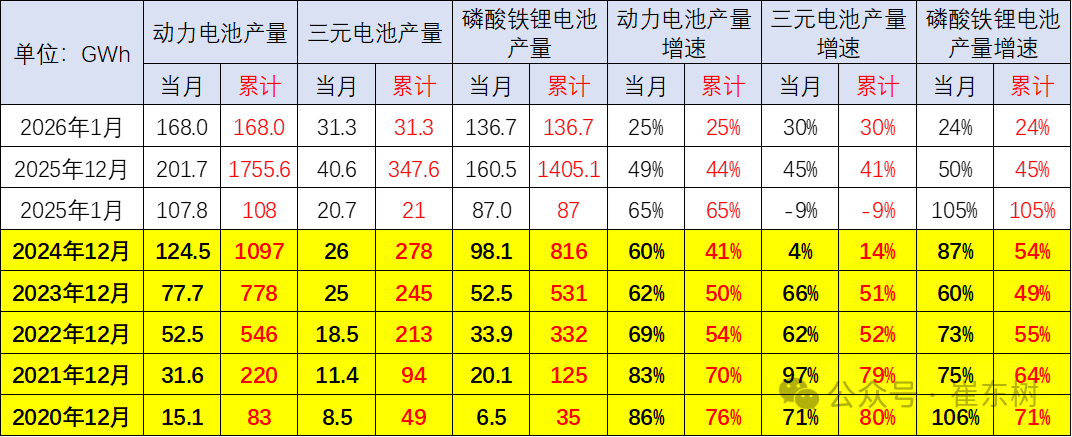
Core Insights - The overall performance of the power battery market in January 2026 is weak, with both exports and domestic sales showing mediocre results, leading to a decline in the growth rate of battery production from over 40% to 25% year-on-year [1][3][9] Group 1: Battery Production and Demand - In January 2026, the total production of power and other batteries reached 168 GWh, marking a 25% increase year-on-year [1] - The demand for installed batteries is heavily reliant on the surge in heavy-duty vehicle batteries due to high subsidies [1][3] - The installation rate of power batteries has decreased significantly, dropping to 25% in January 2026, with ternary batteries at 30% and lithium iron phosphate batteries at 24% [2][4] Group 2: Market Trends and Changes - The demand for batteries in the energy storage sector has increased rapidly, influenced by the global energy crisis stemming from the Russia-Ukraine conflict, leading to a notable decline in the proportion of installed batteries [3][8] - The growth rate of power batteries has lagged behind the growth of complete vehicles in 2021 and 2022, with a low installation rate expected for 2023 and 2024 [3][4] - The market for pure electric passenger vehicles continues to dominate, while plug-in hybrid passenger vehicles have risen to second place in terms of battery demand [7][8] Group 3: Competitive Landscape - The competitive landscape of battery manufacturers remains relatively stable, with the number of supporting battery companies at a low of 33 in January 2026 [10][11] - CATL's market share increased to 50.1% in the first quarter of 2026, while BYD's share decreased to 17.5%, indicating a significant concentration of market power among leading manufacturers [15] - The trend of vehicle manufacturers increasingly collaborating with battery producers is becoming more pronounced, suggesting a shift towards integrated supply chains in the industry [12][15]