爱旭股份

Search documents
当前时点如何看消费顺周期
2026-01-30 03:12
当前时点如何看消费顺周期?20260129 摘要 房地产市场:预计 2027 年接近底部,短期一线城市二手房成交量回升, 价格跌幅收窄,政策稳定预期,显示边际向好信号。关注未来超常规政 策如房贷结构性工具、公积金降息及城市更新货币化安置。 货币政策与流动性:央行维持低利率,定期存款到期或转向理财及权益 市场,活期存款增加,资金更易流入资本市场。地产板块持仓比例仅 0.4%,刷新历史新低,估值修复迅速。 财政政策与消费:财政支出倾斜社保民生等领域,多地发放消费券支撑 春节消费,1 月政府债同比多增,表明财政前置发力。2026 年一季度经 济量价预计整体提升。 通胀预期:春节临近及季节性因素致蔬菜、水果、白酒价格上涨,国际 金属价格上行推动 PPI 向 CPI 传导,预计 2026 年 CPI 中枢高于去年。 白酒板块持仓降至新低,有望迎来反弹。 消费品市场:大众品复苏节奏超前于白酒,连锁业态维持高景气,规模 效应提升利润率。调味品板块库存消化完毕,进入发货周期,餐饮供应 链复苏,经销商备货积极。 Q&A 当前如何看待消费顺周期的表现? 当前消费顺周期的表现主要受到几个因素的影响。首先,从地产层面来看,我 们总结 ...
“能源绿色低碳转型”看山东之济南新旧动能转换起步区:场景创新和产业导入协同推进
Zhong Guo Fa Zhan Wang· 2026-01-29 14:53
Core Viewpoint - The Jinan New and Old Kinetic Energy Conversion Pilot Zone is committed to promoting green, low-carbon, and high-quality development by focusing on the "dual carbon" goals and exploring innovative reforms in the energy sector [1] Group 1: Energy Transition Initiatives - The pilot zone is recognized as the only pilot unit in Jinan for energy green and low-carbon transition, establishing a collaborative work mechanism among multiple departments to ensure the implementation of pilot projects [1] - A detailed construction plan for the energy green low-carbon transition pilot for 2025 has been issued, outlining annual goals, key tasks, and project lists to enhance policy support and resource allocation [1] Group 2: Collaborative Development Models - The green low-carbon vehicle network interactive charging and swapping demonstration station has been developed through collaboration between Jinan Power Supply Company and local government, featuring advanced technology and comprehensive facilities [2] - The station includes 123 charging and swapping spots, with 104 charging piles, and integrates various elements such as photovoltaic, energy storage, and V2G technologies [2] Group 3: Clean Energy Utilization - The pilot zone is actively promoting photovoltaic power generation integrated with buildings, achieving a total installed capacity of approximately 49,000 kW and an annual power generation of 57 million kWh [3] - Geothermal energy utilization projects have been developed, covering a heating area of about 220,000 square meters, leveraging the region's rich geothermal resources [3] - Hydrogen energy applications are being expanded, with over 100 hydrogen-powered vehicles promoted for urban construction and logistics [3] Group 4: Advanced Technology and Equipment - The Aiko Solar high-efficiency battery module project has been established, with a production capacity of 3 GW and an expected full production by 2026, featuring innovative ABC photovoltaic battery components [4] - A 350 million yuan investment project for perovskite solar cells is underway, focusing on high-efficiency and stable production processes [4] Group 5: Comprehensive Smart Energy Development - A "1+4" planning system has been established to manage electricity supply, heating, and comprehensive smart energy services, with a draft plan already in progress [5] - A multi-energy integrated management system is being constructed, incorporating various energy forms and advanced technologies for better control and visibility [5] Group 6: Project Implementation - Ongoing projects include the construction of integrated heating and cooling systems, green electricity supply for industrial parks, and hydrogen energy pilot projects, leveraging the demonstration effects of the low-carbon vehicle network interactive charging station [6]

银浆价格突然暴涨光伏企业承压,高盛研判:行业短期成本压力陡增
Zhi Tong Cai Jing· 2026-01-29 12:28
Core Viewpoint - The silver price surge is significantly impacting the production costs of the photovoltaic (PV) industry, leading to a restructured cost structure and increased pressure on profitability, with a consensus emerging around the need for silver alternatives in the industry [1]. Group 1: Price Dynamics - The price of silver paste has become the largest variable, with significant increases in January, leading to a rise in the unit production cost of battery cells and modules by 0.03 yuan per watt [2]. - The cost of silver now accounts for 20% of the total production cost of modules, a substantial increase from 7% in Q3 2025 and 11% in Q4 2025, making it the core cost component [2]. Group 2: Impact of Silver Price Surge - The rise in silver prices has redefined the cost structure of the PV industry, with silver paste now constituting over 20% of component costs, compared to less than 10% previously, leading to severe profit compression for companies [3]. - Major companies are expected to report significant losses in 2025, with Tongwei Co. projected to lose 9-10 billion yuan and Trina Solar expected to lose 6.5-7.5 billion yuan, resulting in an overall industry gross margin drop from 15% in 2024 to below 5% [3]. Group 3: Challenges in Price Transmission - Companies are attempting to raise prices in response to cost pressures, but face limitations due to market conditions, with only short-term relief available through export tax rebates [4]. - The market for PV components is characterized by oversupply, limiting the ability of companies to pass on costs to downstream project developers, which may lead to loss of market share if prices are raised individually [6]. Group 4: Technological Evolution and Industry Outlook - The surge in silver prices is accelerating technological innovation in the PV industry, with a focus on reducing silver dependency, which is expected to lead to a market reshuffle [7]. - By 2026, the PV industry is anticipated to operate under increased antitrust regulations and efforts to combat internal competition, with pricing closely following the cost reduction progress of leading companies [7]. Group 5: Investment Strategies - Investment focus is shifting towards companies with high efficiency and low costs, emphasizing the importance of capacity utilization rates and cost reduction progress in improving profitability [7]. - Specific investment directions include short-term solutions like silver-coated copper paste, mid-term solutions such as copper plating, and long-term exploration of pure copper paste [9].
新能源如何应对资源上涨-银价上涨倒逼降本-光伏铜代银趋势已来
2026-01-29 02:43
Summary of Key Points from the Conference Call Industry Overview - The conference call focuses on the **photovoltaic (PV) industry** and its relationship with **silver prices** and **copper substitution technologies**. The global silver consumption in the PV sector is projected to reach **7,000 tons** by **2025**, corresponding to an annual production of **600-700 GW** of PV modules, with each GW consuming approximately **10 tons** of silver [1][2]. Core Insights and Arguments - **Silver's Role in PV**: Silver is crucial for manufacturing silver paste used in solar cells, enhancing efficiency by reducing contact resistance. The recent surge in silver prices, driven by industrial demand, has significantly impacted the cost structure of PV modules, with silver costs now accounting for nearly **30%** of total costs, surpassing silicon and glass [1][2][3]. - **Copper Substitution Necessity**: The rising silver prices have made copper substitution a pressing need. The copper substitution technologies include: 1. **Silver-coated copper paste**: Currently the most mature and fastest-implementing solution, allowing for a silver content of **20%-30%** while maintaining cost-effectiveness and performance [1][3]. 2. **Electroplated copper**: A long-term ideal solution that eliminates silver entirely, with companies like Aiko achieving mass production [2][4]. 3. **Copper paste**: An emerging solution still in the R&D phase, facing challenges related to oxidation and welding stability [4]. - **Cost Reduction Strategies**: The transition to copper alternatives is expected to accelerate, with silver-coated copper technology projected to increase its market share from **10%-20%** to **45%-50%** by **2026** [5]. Additional Important Insights - **Market Dynamics**: The demand for silver in the PV industry is approximately **18%-20%** of total silver demand, indicating a significant impact on the silver market due to fluctuations in PV demand [2][3]. - **Challenges in Copper Technologies**: The electroplated copper technology faces challenges such as copper oxidation, migration risks, and production stability, which need to be addressed for successful implementation [4][6]. - **Impact on Equipment Manufacturers**: Equipment manufacturers, particularly those producing copper electroplating devices, are expected to see increased orders as the industry shifts towards copper technologies [6][7]. - **Long-term Beneficiaries**: Companies with advanced technologies, quality products, and strong customer relationships are likely to benefit the most from the transition to copper alternatives. This includes firms focused on material R&D and equipment manufacturing [8]. - **Profitability and Market Relationships**: While rising silver prices may increase material costs, they also present opportunities for profit release for silver-coated copper manufacturers. Establishing strong ties with end customers is crucial for the acceptance of new technologies [7][8].
预计2025年天津新能源产业实现产值800亿元
Zhong Guo Chan Ye Jing Ji Xin Xi Wang· 2026-01-29 00:35
Group 1 - The core viewpoint of the articles highlights Tianjin's ambition to establish a comprehensive "wind, solar, lithium, hydrogen" new energy industry chain by 2025, with projected output value exceeding 74 billion yuan in the first 11 months of 2025, representing a 10% year-on-year growth [1] - The new energy industry in Tianjin is characterized by a long industrial chain, high relevance, and strong driving force, serving as a crucial vehicle for high-quality manufacturing development [1] - Tianjin currently has over 110 enterprises in the new energy industry chain, indicating a robust industrial presence [1] Group 2 - In 2025, Tianjin plans to implement specific measures to enhance the photovoltaic industry, supporting TCL Zhonghuan in N-type high-efficiency silicon wafer research and other key technological advancements [2] - The city aims to accelerate technological iteration and model innovation in the new energy sector by 2026, promoting a transition towards a "manufacturing + service" model [2] - Key focus areas for technological innovation include improving photovoltaic conversion efficiency and advancing next-generation solar cell technologies, with an emphasis on collaboration between research institutions and enterprises like TCL Zhonghuan [2]

加快城市群一体化和都市圈同城化
Qi Lu Wan Bao· 2026-01-28 11:05
Group 1 - The core viewpoint of the article emphasizes the integration and collaborative development of the Jinan and Qingdao urban agglomerations, aiming to enhance connectivity and economic cooperation by 2026 [2] - The Shandong provincial government plans to implement the "Strong Provincial Capital" strategy for Jinan and the "Strong Leading Role" strategy for Qingdao, while supporting Yantai's development as a green and low-carbon high-quality demonstration city [2] - By 2025, 130 collaborative demonstration projects between the two urban areas are expected to complete investments exceeding 160 billion yuan, with key projects like the Weichai Qingdao Smart Heavy Industry Project and Jinan CRRC Sifang Liangwang Vehicle Base being completed [2] Group 2 - The transportation network is being optimized with the opening of the Weifang-Yantai high-speed railway and the acceleration of the Weifang-Suzhou high-speed railway connection, contributing to the formation of a 1-1.5 hour commuting circle [2] - A "Cloud Hand-in-Hand Alliance" for government services has been established between Qingdao and Jinan, enabling 27 government service items to be processed across cities [3] - The establishment of the Shandong Modern Marine Higher Education Community, involving 83 universities, research institutes, and enterprises, aims to enhance educational collaboration and public service sharing [3]
多数光伏企业2025年延续亏损状态,部分企业锚定2026年业绩扭亏
第一财经· 2026-01-27 12:49
Core Viewpoint - The photovoltaic (PV) industry in A-shares is facing significant losses, with many leading companies projecting substantial pre-loss figures for 2025 due to a challenging operating environment and supply-demand imbalances [2][3]. Group 1: Financial Performance and Projections - Major PV companies are expected to report significant pre-loss figures for 2025, including Tongwei Co. with a projected loss of 9 to 10 billion yuan, LONGi Green Energy with 6 to 6.5 billion yuan, and JinkoSolar with 5.9 to 6.9 billion yuan [2]. - The overall operating environment remains difficult, with many companies experiencing nine consecutive quarters of losses since Q4 2023, driven by price declines and insufficient end-demand [3]. Group 2: Industry Dynamics - The PV module prices are under pressure due to "involutionary competition" and a lack of terminal demand, with market transaction prices around 0.6 yuan per watt expected in mid-2025 [3]. - The industry is witnessing a supply surplus, with production rates declining across various segments, while core material prices, such as silver, continue to rise [3]. Group 3: Recovery Efforts and Future Goals - Some companies are beginning to emerge from the loss cycle, with LONGi Green Energy projecting a maximum reduction in losses of 30.38% and Aiko Solar up to 77.44% compared to 2024 [4]. - The China Photovoltaic Industry Association noted a 16.9% year-on-year decline in revenue for the main industry chain in the first three quarters of 2025, but an improvement in gross margins to 3.64% [4]. - Several leading PV companies have set profit targets for 2026, with Trina Solar aiming for a net profit of no less than 200 million yuan and LONGi Green Energy targeting positive net profits in subsequent years [5].






多数光伏企业2025年延续亏损状态,部分企业锚定2026年业绩扭亏
Di Yi Cai Jing· 2026-01-27 10:56
Core Viewpoint - The keyword "pre-loss" has become prominent in the 2025 performance forecasts of various photovoltaic companies, indicating that most firms continue to face losses due to operational challenges and supply-demand imbalances in the industry [1] Group 1: Financial Performance - Leading photovoltaic companies are forecasting significant losses for 2025, with Tongwei Co. expecting a loss of 9 to 10 billion yuan, LONGi Green Energy forecasting a loss of 6 to 6.5 billion yuan, and JinkoSolar projecting a loss of 5.9 to 6.9 billion yuan [1] - The overall photovoltaic industry has experienced nine consecutive quarters of losses since Q4 2023, driven by a decline in component prices due to intense competition and insufficient end-user demand [1][2] Group 2: Industry Challenges - The photovoltaic industry is facing a supply surplus, with core raw material prices rising while product prices continue to decline, leading to significant operational pressure on companies [2] - The ongoing low operating rates and the deepening market reforms in the domestic electricity sector, along with increasing trade barriers abroad, have created a complex and challenging operating environment for photovoltaic companies [2] Group 3: Recovery Efforts - Some companies are beginning to emerge from the loss cycle, with LONGi Green Energy expecting to reduce losses by up to 30.38% and Aiko Solar by up to 77.44% compared to 2024 [2] - The China Photovoltaic Industry Association reported a 16.9% year-on-year decline in revenue for the main industry chain in the first three quarters of 2025, although gross margins improved to 3.64% [2] Group 4: Future Goals - Companies like Trina Solar have set profit targets for 2026, aiming for a net profit of no less than 200 million yuan, with increasing targets for subsequent years [3] - LONGi Green Energy's employee stock ownership plan also includes targets for positive net profit in 2026, with specific profit goals for 2027 and 2028 [3] Group 5: Price Adjustments - Trina Solar has raised its component prices three times this month, with prices now ranging from 0.88 to 0.92 yuan per watt, reflecting a response to industry self-discipline [4] - Major component manufacturers are increasing prices by 0.02 to 0.04 yuan per watt, and there is a growing willingness among intermediate suppliers to support price increases [4]
出差时突发疾病,上海知名科创投资人朱旭东离世
Xin Lang Cai Jing· 2026-01-27 04:57
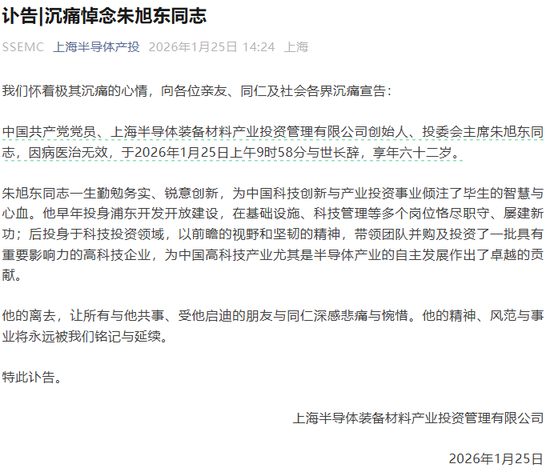
Core Viewpoint - The news reports the passing of Zhu Xudong, a prominent figure in the semiconductor investment sector, who died on January 25, 2026, at the age of 62 due to an illness while on a business trip in Haikou [1][5][12]. Company Overview - Shanghai Semiconductor Equipment Materials Industry Investment Management Co., Ltd. (referred to as "Shanghai Semiconductor Investment") was established in January 2018 and completed registration with the Asset Management Association of China on July 25, 2018 [4][11]. - The company focuses on investments in the semiconductor equipment, materials, and components sectors, managing over 8 billion yuan (approximately 1.2 billion USD) across various funds and having invested in over 50 semiconductor projects covering the entire industry chain [4][11]. Zhu Xudong's Contributions - Zhu Xudong was a doctoral graduate from Tongji University and held various leadership roles in the Shanghai Pudong New Area, including Chairman of Shanghai Pudong Science and Technology Investment Co., Ltd. from 2012 [4][12]. - He played a pivotal role in the acquisition and investment of significant high-tech companies, contributing to the development of China's semiconductor industry by addressing key shortcomings such as technology gaps and ecosystem deficiencies [6][12]. - Under his leadership, Shanghai Semiconductor Investment became a major platform for investments, focusing on long-term partnerships and strategic acquisitions to enhance technological capabilities within the semiconductor sector [14]. Investment Strategy - Zhu Xudong's investment philosophy, termed the "endurance model," emphasizes the importance of patience, human-centric investment, and strategic decision-making [14]. - The model highlights the significance of investing in the right people and maintaining a long-term commitment to the growth of the companies in which investments are made [14].
出差时突发疾病,上海知名科创投资人离世
母基金研究中心· 2026-01-27 04:14
Core Viewpoint - The article discusses the passing of Zhu Xudong, the founder and chairman of the Shanghai Semiconductor Equipment Materials Industry Investment Management Co., who significantly contributed to the semiconductor industry in China through strategic investments and leadership [2][5][6]. Company Overview - Shanghai Semiconductor Equipment Materials Industry Investment Management Co. was established in January 2018 and focuses on investing in the semiconductor equipment, materials, and components sectors, managing over 8 billion yuan in assets and having invested in more than 50 semiconductor projects across the entire industry chain [4][5]. - The company manages the Shanghai Semiconductor Equipment Materials Industry Investment Fund and several project-based funds, covering areas such as equipment, materials, components, EDA, design, manufacturing, and testing [4]. Zhu Xudong's Contributions - Zhu Xudong, a PhD from Tongji University and a senior engineer, held various leadership roles in technology and investment sectors before founding the company. He was instrumental in the establishment of the Shanghai Semiconductor Equipment Materials Industry Investment Fund and led significant investments in high-tech companies [4][5][6]. - He identified key shortcomings in China's semiconductor industry, such as the lack of technology, leading companies, and ecosystem, and initiated privatization efforts for overseas semiconductor firms [6]. - Zhu's investment strategy included a focus on long-term partnerships with key individuals in the industry, exemplified by his support for companies like Aojie Technology, which successfully went public on the STAR Market [7]. Recent Developments - Zhu Xudong's recent passing occurred during a business trip, which shocked many in the industry, highlighting his active role in project evaluations and investments until his last days [5][6]. - The company expressed its commitment to continue Zhu's vision and contributions to the semiconductor industry, emphasizing his impact on the autonomous development of China's high-tech sector [5].