
中国平安

Search documents
港股投资周报:物科技领涨,港股精选组合本周相对恒指超额4.12%-20260110
Guoxin Securities· 2026-01-10 08:27
Quantitative Models and Construction Methods 1. Model Name: Hong Kong Stock Selection Portfolio - **Model Construction Idea**: The model aims to select stocks with both fundamental support and technical resonance from an analyst-recommended stock pool[14][15] - **Model Construction Process**: - **Step 1**: Construct an analyst-recommended stock pool based on three types of analyst recommendation events: upward earnings forecast revisions, initial analyst coverage, and analyst report titles exceeding expectations[15] - **Step 2**: Perform dual-layer selection on the analyst-recommended stock pool using fundamental and technical dimensions to select stocks with both fundamental support and technical resonance[15] - **Step 3**: The backtest period for the Hong Kong Stock Selection Portfolio is from January 1, 2010, to December 31, 2025. Considering transaction costs in a fully invested state, the portfolio's annualized return is 19.08%, with an excess return of 18.06% relative to the Hang Seng Index[15] - **Model Evaluation**: The model demonstrates a strong performance with significant excess returns over the Hang Seng Index, indicating its effectiveness in stock selection[15] Model Backtest Results - **Hong Kong Stock Selection Portfolio**: - **Annualized Return**: 19.08%[15] - **Excess Return**: 18.06% relative to the Hang Seng Index[15] - **Information Ratio (IR)**: 1.19[20] - **Tracking Error**: 14.60%[20] - **Maximum Drawdown**: 23.73%[20] - **Return-to-Drawdown Ratio**: 0.76[20] Quantitative Factors and Construction Methods 1. Factor Name: Stable New High Stocks - **Factor Construction Idea**: The factor aims to identify stocks that have recently reached new highs and exhibit stable price paths, leveraging the momentum and trend-following strategies that are particularly effective in the Hong Kong market[21] - **Factor Construction Process**: - **Step 1**: Calculate the 250-day new high distance using the formula: $$ 250 \text{ day new high distance} = 1 - \frac{Close_t}{\text{ts\_max(Close, 250)}} $$ where $Close_t$ is the latest closing price, and $\text{ts\_max(Close, 250)}$ is the maximum closing price over the past 250 trading days[23] - **Step 2**: Screen stocks that have reached a 250-day new high in the past 20 trading days based on analyst attention, relative stock strength, price path stability, and new high continuity[23] - **Step 3**: Select stocks with the following criteria: - Analyst attention: At least 5 buy or hold ratings in the past 6 months - Relative stock strength: Top 20% in terms of price change over the past 250 days - Price path stability: Top 50% based on price displacement ratio and 250-day new high distance over the past 120 days - Trend continuity: Top 50 stocks based on the 250-day new high distance over the past 5 days[24] - **Factor Evaluation**: The factor effectively captures stocks with strong momentum and stable price paths, which are likely to continue their upward trends[21][23] Factor Backtest Results - **Stable New High Stocks**: - **Example Stocks**: J&T Express-W, China Eastern Airlines, Youran Dairy, Hansoh Pharmaceutical, China XLX Fertilizer, etc.[23][29] - **Sector Distribution**: Most new high stocks are in the cyclical sector, followed by finance, technology, consumer, manufacturing, and healthcare sectors[23][29]
给具身机器人上保险
经济观察报· 2026-01-10 08:22
Core Viewpoint - The demand for insurance has become a prerequisite for the mass sales of embodied robots, which is a significant shift in the industry [5][10]. Group 1: Market Development - The founder of an embodied robot company, Hu Lei, is optimistic about producing over 200 robots for commercial performances this year, which is more than five times the output expected in 2025 [2]. - The "Ecological Report on Humanoid Robots 2025" indicates that the industry is entering a phase of large-scale production, with leading companies expected to deliver thousands of units [3]. - The spending on embodied intelligent robots in China is projected to exceed $1.4 billion in 2025 and soar to $77 billion by 2030, with a compound annual growth rate (CAGR) of 94% [9]. Group 2: Insurance Demand - As the number of robots purchased increases, downstream companies are increasingly aware of the risks and are requesting insurance to cover potential damages and liabilities [4][10]. - Major insurance companies have begun to offer specialized insurance products for embodied robots, but they face challenges in risk assessment due to a lack of operational data from manufacturers [5][15]. - The relationship between embodied robots and insurance is likened to the necessity of car insurance for vehicles, highlighting the growing need for insurance as robots are used in various applications [12]. Group 3: Challenges in Insurance - Insurance companies are hesitant to offer mass coverage due to the absence of critical operational data, which is often withheld by manufacturers citing confidentiality [15][16]. - The uniform appearance of robots poses a risk of fraud in claims, leading insurers to limit the number of robots they cover [16]. - The rapid technological advancements in embodied robots outpace the development of insurance risk models, complicating the underwriting process [21][22]. Group 4: Solutions and Innovations - Insurance companies are exploring partnerships with robot leasing platforms to obtain necessary data while managing risks through innovative models like "insurance + leasing" [19][20]. - There is a push for dynamic risk assessment models that can adapt to the fast-paced changes in robot technology and application scenarios [22]. - Collaborative efforts between insurance companies, research institutions, and manufacturers are essential for developing a comprehensive risk database for accurate pricing and risk management [22].




45—59岁中年人重疾出险高达五成
21世纪经济报道· 2026-01-10 07:31
Core Insights - The insurance industry in China has shown a significant increase in claims payments for 2025, with major companies reporting substantial growth in their compensation amounts, indicating a shift in the role of commercial insurance towards becoming a more integral part of daily healthcare payments [1][3] Group 1: Claims Payment Trends - The total claims amount for China Life exceeded 100.4 billion yuan, a year-on-year increase of 10%, while New China Life reported 14.7 billion yuan in claims, averaging 40.29 million yuan per day [1] - Medical insurance claims have become the mainstream, with high-frequency, low-amount claims dominating the structure, as evidenced by 91.06% of claims from Fude Life Insurance being medical-related [3] - The report highlights a structural mismatch in family insurance coverage, particularly for the middle-aged demographic, where individuals aged 45-59 accounted for 55.48% of critical illness claims but had a lower average payout compared to minors [4] Group 2: Technological Advancements in Claims Processing - The insurance industry is increasingly leveraging AI and big data to enhance efficiency, with companies like Taikang Online processing over 2.5 billion claims in 2025, achieving an average processing time of 0.1 seconds per claim [6][7] - Automation in claims processing has reached 97% for Fude Life Insurance, significantly improving turnaround times and customer experience [6] - Direct settlement systems have been implemented, allowing for immediate claims processing upon patient discharge, with China Life serving 8.17 million people through this service [7] Group 3: Alignment with National Strategies - The insurance sector is actively supporting national strategies, with products designed for rural revitalization and technological innovation, such as China Pacific Insurance's coverage for 60,000 patents [9] - Insurance companies are focusing on agricultural risk management, with significant payouts for crop and livestock insurance, demonstrating their role in supporting the agricultural sector [10] - The industry is also adapting to the aging population by enhancing services for elderly clients, with China Life serving over 15.17 million elderly customers and providing tailored claims services [10] Group 4: Evolving Role of Insurance - The 2025 claims reports indicate a transformation of the insurance industry from merely providing financial compensation to becoming a risk management partner, integrating deeply into healthcare payments and national strategies [11]

【金融头条】给具身机器人上保险
Jing Ji Guan Cha Bao· 2026-01-10 04:45
Core Insights - The article highlights the significant growth and challenges in the production and insurance of embodied robots, indicating a shift towards mass production and the necessity for insurance coverage to mitigate risks associated with their use [1][2][3]. Group 1: Production and Market Growth - The founder of an embodied robot company, Hu Lei, is optimistic about producing over 200 robots for commercial performances this year, which is more than five times the expected output by 2025 [1]. - The Shanghai University of Finance and Economics reported that the embodied robot industry is entering a phase of large-scale production, with leading companies expected to deliver thousands of units [2]. - The market for embodied intelligent robots in China is projected to exceed $1.4 billion by 2025 and reach $77 billion by 2030, with a compound annual growth rate (CAGR) of 94% [8]. Group 2: Insurance Challenges - As the quantity of robots purchased increases, downstream companies are increasingly concerned about the financial risks associated with accidents, leading them to request insurance coverage for the robots [3][9]. - Major insurance companies have begun to offer specialized insurance products for embodied robots, but they face challenges in risk assessment due to a lack of operational data from manufacturers [5][12]. - The insurance market for embodied robots is currently characterized by limited coverage, with most policies only insuring a small number of units due to the need for extensive operational data that companies are reluctant to share [12][13]. Group 3: Solutions and Innovations - Insurance companies are exploring partnerships with robot leasing platforms to address data acquisition challenges and reduce moral hazard risks [15][16]. - The integration of insurance with leasing models is seen as a potential solution to enhance data sharing and risk management, allowing for better risk assessment and coverage [15][17]. - There is a push for dynamic risk modeling and intelligent underwriting management to keep pace with the rapid technological advancements in embodied robots [17][18].

阳光财险青岛分公司又领罚单,因同类问题多次被罚
Qi Lu Wan Bao· 2026-01-10 04:16
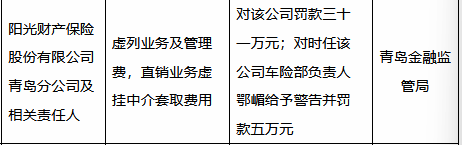
Group 1 - The core issue is that Sunshine Property Insurance Company was fined 310,000 yuan for falsely reporting business and management fees, as well as for misrepresenting direct sales to siphon off intermediary fees [3][4] - This is not the first time the company has faced penalties for similar issues; in March 2020, it was fined 370,000 yuan for similar violations, and in late 2022, it received a warning and a fine of 10,000 yuan for non-compliance in the management of senior executives [4] - Since 2025, the total fines for the group's subsidiaries have exceeded 15 million yuan, with violations covering a wide range of issues including data falsification, fraudulent claims, and illegal rebates [4] Group 2 - In 2024, the company achieved a record high in total premiums with an 8% year-on-year growth, but the growth rate has significantly slowed to 5.7% in the first half of 2025 compared to the same period in 2024 [5] - The net profit for the first half of 2025 was 3.39 billion yuan, reflecting a year-on-year growth of 7.8%, which is a stark contrast to the previous year's growth of 45.8% [5] - Compared to industry leaders, the gap is widening; in the first half of 2025, Ping An Insurance reported total premium income of 423.45 billion yuan, which is 5.2 times that of Sunshine, and a net profit of 93.54 billion yuan, which is 27.6 times that of Sunshine [5]
非车险“报行合一”最权威解释出炉;利明光接任中国人寿法人;中国人寿2025年理赔金额超1004亿|13精周报
13个精算师· 2026-01-10 03:04
Regulatory Dynamics - The Financial Regulatory Bureau has provided the most authoritative explanation for the "reporting and operation integration" of non-auto insurance [6] - The Guangdong Financial Regulatory Bureau is promoting the establishment of private equity securities investment funds by insurance companies in Guangdong [11] - The Jiangxi government supports insurance institutions in enhancing risk reduction service levels and providing comprehensive insurance solutions for technology-based enterprises [14] Company Dynamics - Ping An Life has made its fourth stake increase in China Merchants Bank H-shares, reaching a holding ratio of over 20% [18] - Ping An Life has also increased its stake in Agricultural Bank of China H-shares to over 20% [19] - Sunshine Life plans to reduce its stake in Huakang Clean by 3% [22] - China Life has reported over 62.24 million claims in 2025, with total payouts exceeding 100.4 billion [32] - New China Life reported a maximum payout of 10.5 million in 2025 [33] - People's Insurance Company of China reported over 2 billion claims in 2025, with a year-on-year growth of over 10% [36] Industry Dynamics - The short-term large-denomination deposit rates have entered the "0" range, with experts predicting a continued downward trend [47] - Insurance stocks have collectively surged, with Ping An, New China Life, and China Pacific Insurance reaching historical highs [49][50] - The issuance scale of insurance companies' bonds has exceeded 100 billion for three consecutive years [54] - 93.4% of combination-type insurance asset management products achieved positive returns in 2025 [55] - The insurance industry has entered a new cycle of predetermined interest rates, with significant changes in pricing logic [56]



天津日报数字报刊平台-公告
Xin Lang Cai Jing· 2026-01-09 20:46
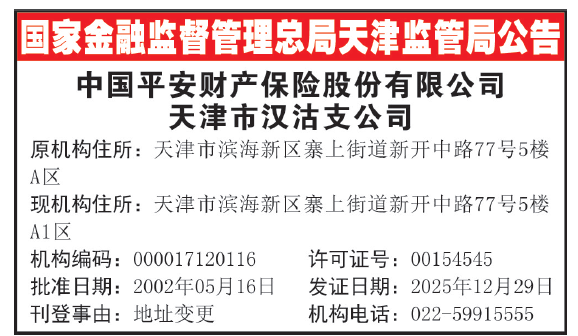
Group 1 - The announcement pertains to the address change of China Ping An Property Insurance Co., Ltd., Tianjin Hangu Branch [1] - The previous address was located at 5th Floor, No. 77, Xinkai Middle Road, Zhaishang Street, Binhai New Area, Tianjin [1] - The new address remains the same as the previous one, indicating no actual relocation [1]
中国平安人寿专属商业养老保险结算利率公告
Shang Hai Zheng Quan Bao· 2026-01-09 18:38
Group 1 - The settlement interest rates for 2025 have been announced, applicable only for that year and do not represent future investment returns [2] - The next announcement date for the settlement interest rates is January 9, 2027 [3] - The annualized interest rates for the exclusive commercial pension insurance products are approximately 2.700% for the conservative type and 3.000% for the progressive type [4]
北向资金2025年持股数据亮相 重仓电力设备、电子、有色金属三大方向
Shang Hai Zheng Quan Bao· 2026-01-09 18:33
Group 1 - As of the end of Q4 2025, northbound funds held a total of 3,257 stocks, with a total holding amount of approximately 1,077.09 billion shares and a total market value of about 2.59 trillion yuan, showing an increase from the previous quarter [1] - The top holdings of northbound funds include leading stocks such as CATL, Midea Group, Kweichow Moutai, and China Merchants Bank, with CATL's market value held by northbound funds reaching 254.34 billion yuan, significantly higher than Midea Group's 77.05 billion yuan [2] - The three major sectors heavily invested by northbound funds are power equipment, electronics, and non-ferrous metals, marking a shift from the previous year's focus on power equipment, banking, and food and beverage [2] Group 2 - In Q4 2025, the sectors with the largest increase in market value for northbound funds were non-ferrous metals, communications, and basic chemicals, with notable individual stocks including Zijin Mining and China Aluminum [3] - The estimated net purchases by northbound funds for CATL reached 45.63 billion yuan, making it the top stock, followed by Northern Huachuang and BYD with net purchases of 24.89 billion yuan and 13.03 billion yuan respectively [3] - Looking ahead to 2026, foreign investment in Chinese stocks is expected to increase, with potential buying funds estimated to reach 10 billion dollars, driven by global long-term investors seeking diversification [4]



