重庆银行

Search documents
上市银行2024年年报综述:营收降幅收敛,分红稳定关注股息配置价值
Ping An Securities· 2025-04-03 00:42
Investment Rating - The report maintains an "Outperform" rating for the banking sector, indicating a positive outlook compared to the broader market [1]. Core Insights - The report highlights that the net profit of listed banks is expected to grow by 1.8% year-on-year for 2024, with a notable increase in growth rate compared to the first three quarters [4][10]. - Revenue decline is narrowing, with a projected revenue growth rate of -0.6% for 2024, an improvement from -1.6% in the previous quarters [11][14]. - The report emphasizes the importance of domestic economic recovery and the impact of recent growth-stabilizing policies on banking performance [14]. Summary by Sections 1. Profitability Breakdown - The net interest income for listed banks is expected to decline by 2.3% in 2024, an improvement from a 3.2% decline in the first three quarters [11][12]. - Non-interest income, particularly from investment gains, is projected to increase by 28% due to falling bond yields, partially offsetting revenue pressures [11][12]. - The report notes that the cost-to-income ratio has increased to 32.8%, reflecting a 0.5 percentage point rise year-on-year [7]. 2. Operational Analysis - Asset growth for listed banks has decreased to 7.2%, with loan growth at 7.7%, indicating stable overall growth despite a slight decline [22][23]. - The annualized net interest margin is projected to decrease to 1.43%, primarily due to asset pricing pressures [24]. - The report indicates that the quality of assets remains stable, with non-performing loan ratios showing slight fluctuations but overall stability [7][22]. 3. Dividend and Investment Recommendations - The report highlights a stable dividend payout ratio, with 9 banks increasing their dividend rates compared to the previous year [7]. - Investment recommendations focus on "pro-cyclical and high dividend" strategies, with an average dividend yield of 4.3% for the sector, which remains attractive compared to risk-free rates [7][8]. - Specific banks recommended for investment include Chengdu Bank, Suzhou Bank, and Ningbo Bank, which are expected to benefit from regional economic recovery [8][14].






重庆银行股份有限公司关于可转债转股结果暨股份变动公告
Shang Hai Zheng Quan Bao· 2025-04-02 18:17
Core Viewpoint - The announcement details the conversion results of the convertible bonds issued by Chongqing Bank, highlighting the limited conversion activity and the substantial amount of unconverted bonds remaining. Group 1: Convertible Bond Issuance Overview - Chongqing Bank was approved to publicly issue convertible bonds totaling RMB 13 billion, with a face value of RMB 100 per bond and a maturity of 6 years [3] - The coupon rates for the bonds increase progressively from 0.20% in the first year to 3.50% in the sixth year [3] - The bonds were listed on the Shanghai Stock Exchange on April 14, 2022, under the name "重银转债" and code "113056" [3] Group 2: Conversion Status - As of March 31, 2025, a total of RMB 762,000 worth of convertible bonds have been converted into 70,884 shares of A-shares, representing 0.0020% of the total shares outstanding prior to conversion [2][4] - During the first quarter of 2025, RMB 66,000 worth of bonds were converted, resulting in 6,642 shares [2][4] - The amount of unconverted convertible bonds as of March 31, 2025, stands at RMB 12,999,238,000, accounting for 99.9941% of the total issuance [2][4] Group 3: Share Capital Changes - The announcement includes a note on share capital changes, indicating that the increase in shares is primarily due to the conversion of bonds and other changes related to the public offering [5]
信用卡拐点之际:流通卡收缩,建行成首家信用卡贷款规模破万亿银行丨年报观察
Xin Lang Cai Jing· 2025-04-02 13:21
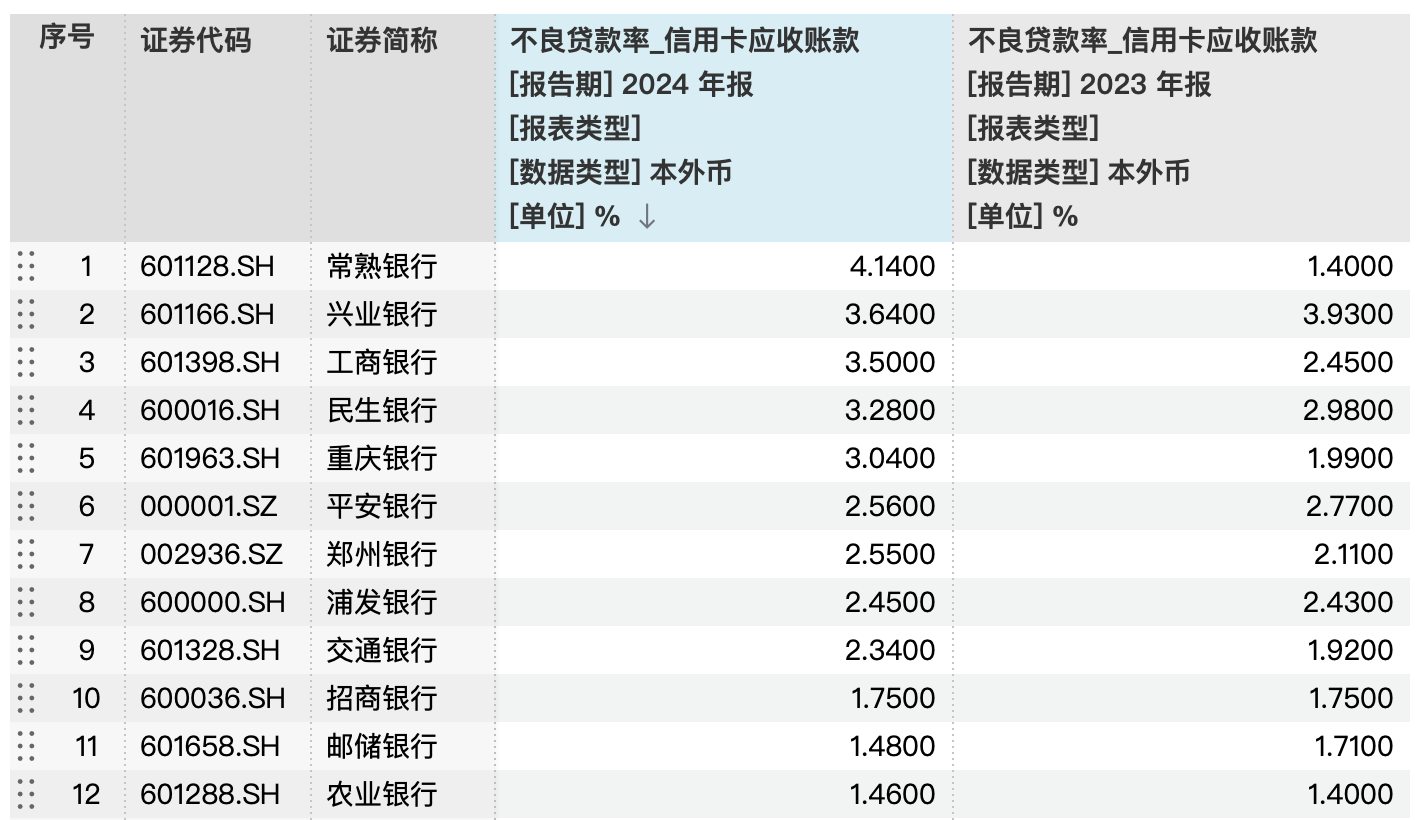
Core Insights - The credit card business in China is facing challenges, with a notable decline in transaction volumes and an increase in non-performing loans, despite some banks like China Construction Bank achieving significant growth in credit card loan balances [1][4][8]. Group 1: Credit Card Loan Balances - China Construction Bank (CCB) has become the first bank in the country to surpass 1 trillion yuan in credit card loans, reaching 1.07 trillion yuan in 2024, an increase of 688 billion yuan from the end of 2023 [2][3]. - Agricultural Bank of China (ABC) showed the most significant growth in credit card loans, increasing by 1.587 billion yuan, with its share in personal loans rising from 8.67% to 9.73% [3]. - Ping An Bank experienced a substantial reduction in credit card loans, with a balance of 435 billion yuan, down 791 billion yuan year-on-year, leading to a decrease in its share of personal loans from 25.99% to 24.62% [3]. Group 2: Asset Quality and Non-Performing Loans - The overall asset quality of credit card loans has deteriorated, with banks like Changshu Bank and Chongqing Bank reporting significant increases in non-performing loan ratios, rising to 4.14% and 3.04% respectively [4][5]. - The total amount of overdue credit card loans reached 123.964 billion yuan by the end of 2024, marking a year-on-year increase of 26.32% [5]. Group 3: Market Trends and Consumer Behavior - The total number of credit cards in circulation has decreased significantly, dropping from 807 million in mid-2022 to 727 million by the end of 2024, a reduction of 80 million cards [8]. - Credit card transaction volumes have also declined, with major banks like China Merchants Bank and Ping An Bank reporting decreases in credit card spending of approximately 390 billion yuan and 460 billion yuan respectively [8][10]. - The shift towards consumer loans is evident, with several banks reporting an increase in the proportion of consumer loans within their personal loan portfolios, indicating a strategic pivot in response to market conditions [11][12]. Group 4: Strategic Adjustments by Banks - Some banks are restructuring their credit card operations, with China Merchants Bank and Ping An Bank focusing on high-quality customer acquisition and adjusting their credit card issuance strategies [8][10]. - Traffic Bank is transitioning to a localized management model for its credit card business, aiming to provide integrated financial services to better meet customer needs [10].






大新银行集团股价单日重挫12% 信贷减值亏损增至17.91亿港元
Mei Ri Jing Ji Xin Wen· 2025-03-31 14:41
Core Viewpoint - Dah Sing Bank Group reported a significant increase in credit impairment losses, which raised concerns among investors despite a year-on-year increase in net profit [1][2]. Financial Performance - The company reported a net profit attributable to shareholders of HKD 2.06 billion, representing a year-on-year growth of 10.8% [1]. - Net interest income for 2024 was HKD 5.288 billion, up 9.8% year-on-year [2]. - Non-interest income, specifically net service fees and commission income, surged by 53.3% to HKD 1.328 billion [2]. - Operating profit before impairment losses increased by 31%, driven by a 50% rise in non-interest income and stable operating costs [2]. Credit Impairment Losses - Credit impairment losses skyrocketed by 145% to HKD 1.791 billion, primarily attributed to customer loans and advances [1][2]. - The bank indicated that the property-related loan market in Hong Kong and mainland China faced ongoing challenges, contributing to the increase in impairment losses [2]. - The bank's property investment loans were approximately HKD 23 billion, down 3% year-on-year, while property development loans decreased by 7% to about HKD 6.4 billion [2]. Market Conditions - The demand for loans in the market has stagnated, leading to weak loan growth [2]. - The bank's management noted that the non-performing loan ratio for local commercial real estate remains at a controllable level, but the commercial real estate market is developing slowly, with expectations of continued declines in loan amounts this year [2].

资产规模、经营效益“双增” 重庆银行加速迈向“万亿”新征程
Zhong Guo Jin Rong Xin Xi Wang· 2025-03-31 13:02
近日,重庆银行股份有限公司发布2024年年度报告。报告显示,截至2024年末,重庆银行资产总额达到 8566亿元,较上年末增长12.7%;营业收入136.8亿元,同比增长3.5%。 转自:新华财经 重庆银行主动融入和服务成渝地区双城经济圈建设,支持成渝中线高铁、轨道交通15号线等重大项目建 设超250个,项目数量较去年翻倍增长,信贷投放超1500亿元,同比多投400亿元。 此外,聚焦"通道+经贸+产业"融合发展主线,落地全国首笔陆海新通道多式联运"一单制"数字提单信用 证业务,上线"信保e融"等新产品,积极助力西部陆海新通道建设,全年服务业务量超1200亿元。 近年,重庆银行加力做好金融"五篇大文章",服务实体经济扩面增效,科技型企业、绿色、普惠、制造 业贷款增速分别达到32%、40%、22%、14%。 2024年,重庆银行实现资产规模稳步上升,其中各项贷款总额4406亿元,增长477亿元,增幅为 12.1%;各项存款余额4741亿元,增长593亿元,增幅为14.3%,其中储蓄存款增长486亿元,增幅 24.2%。2024年总资产、各项贷款、各项存款增量均居重庆市银行业前列,存贷款余额市场占有率分别 提升0. ...
业绩分化涨跌互现 信用卡“寒冬”已过?
Zhong Guo Jing Ying Bao· 2025-03-28 18:51
Core Insights - The credit card industry is experiencing significant performance divergence among banks, with a notable reduction in credit card stock and transaction volumes in 2024 [1][2] - Banks are adjusting their business strategies and enhancing risk control measures while restructuring their organizational frameworks to adapt to the current economic downturn [1][7] - The credit card business is expected to face both opportunities and challenges as the Chinese economy stabilizes and consumer markets recover starting in 2025 [1][11] Performance Trends - As of the end of 2024, major banks like China Merchants Bank and Ping An Bank reported declines in credit card circulation and transaction volumes, with Ping An Bank's circulation down by 12.92% [2][4] - The total number of credit cards in China decreased by 5.14% year-on-year, with the overall number of bank cards growing only slightly by 1.29% [2][6] Risk Management and Strategy Adjustments - Banks are focusing on risk management and adjusting their credit card business strategies, with an emphasis on improving asset quality and managing risks throughout the credit lifecycle [7][8] - The number of overdue credit card loans has increased, with the total amount of overdue loans reaching 1.42% of the total credit card balance by the end of 2024, the highest level in seven years [5][6] Market Dynamics - The credit card business is transitioning from aggressive growth to a focus on existing customer bases, with banks increasingly prioritizing localized management and tailored services [9][10] - The shift towards refining operations and enhancing customer engagement is seen as a tactical adjustment rather than a strategic retreat, aimed at optimizing resource allocation [9][10] Future Outlook - With the implementation of policies aimed at boosting consumption, the credit card business is anticipated to enter a new growth phase in 2025, supported by the overall recovery of the consumer market [11]
12家A股上市行晒科技赋能成绩单:有的投入200多亿,有的增长近30%
Sou Hu Cai Jing· 2025-03-28 14:11
Core Insights - The banking industry is undergoing a digital transformation driven by advancements in artificial intelligence, big data, and cloud computing, with 12 banks, including major players like Bank of China and China Merchants Bank, having released their 2024 financial reports by March 28 [1] Investment and Talent Development - Major state-owned banks continue to dominate in technology investment, with Bank of China investing CNY 23.809 billion, accounting for 3.76% of its revenue, a year-on-year increase of 0.27 percentage points [2] - Postal Savings Bank's technology investment reached CNY 12.296 billion, a 9.03% increase year-on-year, representing 3.53% of its revenue [2] - In contrast, China Communications Bank's technology investment fell to CNY 11.433 billion, a decrease of 4.94% year-on-year, although it still had the highest revenue ratio at 5.41% among the six major banks [2] - Among joint-stock banks, investments from China Merchants Bank, CITIC Bank, and Industrial Bank were CNY 13.35 billion, CNY 10.945 billion, and CNY 8.377 billion, respectively, with their revenue ratios declining [3] - Smaller banks like Chongqing Bank and Changshu Bank are increasing their technology investments, with Chongqing Bank's investment growing by 20% year-on-year to CNY 0.574 billion [3] Talent Acquisition and Growth - By the end of 2024, Bank of China had 14,940 employees in its technology division, an increase of 2,234, representing 4.78% of total staff [4] - Postal Savings Bank's IT team grew to over 7,200, a 2% increase, making up 3.6% of its total workforce [4] - China Communications Bank leads in technology talent, with 9,041 employees, a 15.70% increase, accounting for 9.44% of total staff [4] - Joint-stock banks like China Merchants Bank and Industrial Bank also showed strong talent density, with China Merchants Bank's R&D staff reaching 10,900, representing 9.3% of total employees [4] Technological Advancements and Applications - Banks are leveraging technology to enhance various business scenarios, with Bank of China adding over 900 new business scenarios through AI and automation [9] - China Communications Bank's mobile banking app reached over 55 million monthly active users, a 630,000 increase year-on-year, with 80% of new loans coming from online channels [9][10] - Postal Savings Bank launched an AI-driven trading assistant that has processed over CNY 1.5 trillion in inquiries, achieving a 94% reduction in transaction time [11] - CITIC Bank developed an AI system with over 1,600 applications across various business areas, while Industrial Bank optimized its AI applications in over 70 scenarios [12] Overall Industry Trends - The banking sector is experiencing a "Matthew Effect" where larger banks benefit more from technology investments, while smaller banks are finding unique paths to digital transformation [3][13] - The industry is entering a new phase of "technology reconstruction," with technology integration becoming pervasive across various operational scenarios [13]



银行不良贷款“气候图”出炉!信贷风险持续出清,经济大省略有波动
券商中国· 2025-03-27 23:43
Core Viewpoint - The overall asset quality of the banking industry in most regions remains stable by the end of 2024, but specific data shows widespread fluctuations across different areas [1][2]. Summary by Sections National Overview - By the end of 2024, 16 out of 26 regions reported an increase in non-performing loan (NPL) ratios compared to the beginning of the year, indicating slight declines in asset quality in several major economic provinces [1][2]. - The national commercial bank NPL ratio decreased from 1.59% at the end of 2023 to 1.50% at the end of 2024, a reduction of 0.09 percentage points [3]. Regional Performance - Regions like Gansu, Hebei, and Guangxi achieved a "double decline" in both NPL ratios and NPL scales, with Gansu's NPL ratio dropping by 0.62 percentage points to 2.56% [5][6]. - Economic provinces such as Guangdong, Zhejiang, and Jiangsu experienced slight fluctuations in NPL ratios, with Guangdong's ratio increasing by 0.17 percentage points to 1.52% [7][8]. Specific Regional Data - Black龙江's NPL ratio rose by 0.40 percentage points to 2.60%, indicating a significant increase in asset quality concerns [4][7]. - In contrast, regions like Beijing, Shanghai, and Shenzhen saw minor increases in their NPL ratios, with Beijing's ratio rising by 0.02 percentage points to 0.79% [8][9]. Institutional Disparities - Nationally, large banks maintained stable asset quality, with 10 out of 16 listed banks reporting a decrease in NPL ratios by the end of 2024 [10]. - However, local small and medium-sized banks faced higher risk levels, with rural commercial banks reporting an NPL ratio of 2.8%, despite a decrease of 0.54 percentage points [11][12]. Future Outlook - The government plans to enhance risk resolution efforts for small banks, particularly rural financial institutions, through various measures including capital supplementation and restructuring [12].

天津银行姗姗未至“万亿俱乐部”
Bei Jing Shang Bao· 2025-03-25 14:17
Core Viewpoint - Tianjin Bank is lagging behind its peers in the race to join the "trillion club," with its asset scale and profitability falling short compared to other city commercial banks in major municipalities [1][3]. Financial Performance - Tianjin Bank reported total assets of 925.99 billion yuan, a year-on-year increase of 10.1%, and total liabilities of 856.58 billion yuan, up 10.4% from the previous year [3]. - Operating income for 2024 was 16.71 billion yuan, a growth of 1.5%, while net profit attributable to shareholders was 3.80 billion yuan, up 1.1%, both showing a decline in growth rates compared to 2023 [3][4]. - Interest income decreased by 0.7% to 30.99 billion yuan, with net interest income also declining by 0.9% [3][4]. Industry Context - The banking sector is facing a general contraction in interest margins, with only 12 out of 42 A-share listed banks reporting an increase in net interest income in the first half of 2024 [4]. - Since its listing in 2016, Tianjin Bank has not surpassed its pre-listing net profit peak of 4.92 billion yuan, with significant fluctuations in profit growth rates from 2019 to 2023 [4]. Intermediate Business Performance - Tianjin Bank's net income from fees and commissions was 1.68 billion yuan, a 6.9% increase, primarily driven by growth in settlement and clearing fees [6]. - However, there was a significant decline in consulting fees (down 70.8%) and card fees (down 14.9%), indicating challenges in diversifying its intermediate business [6][7]. Asset Quality Concerns - The overall non-performing loan (NPL) ratio remained stable at 1.7%, but the amount of NPLs increased by 7.9 billion yuan to 7.61 billion yuan [7][8]. - The overdue loans for 1 to 3 years and over 3 years saw significant increases of 102.8% and 72.9%, respectively, raising concerns about asset quality [8]. Future Strategies - Tianjin Bank is pursuing a "dual five battle" strategy focusing on risk management, revenue growth, cost control, deposit mobilization, and litigation [9]. - The bank is also investing in the consumer finance sector through a partnership with several companies, aiming to enhance its retail business and financial inclusion efforts [10].
【Fintech 周报】互联网消费贷上限提至30万元;国有四大行春招缩编;去年银行业金融机构法人减少195家
Tai Mei Ti A P P· 2025-03-24 07:35
Regulatory Dynamics - The upper limit for personal internet consumer loans has been raised to 300,000 yuan, with potential increases to 500,000 yuan for clients with good credit and high consumption needs [3] - The People's Bank of China emphasizes the need for a secure and efficient financial infrastructure, promoting the application of AI models in the financial sector [4] Industry Dynamics - The four major state-owned banks in China have reduced their spring recruitment plans for 2025, with significant cuts in hiring numbers compared to the previous year [6] - The number of banking institutions in China decreased by 195 in 2024, reflecting ongoing structural reforms in the banking sector [7] Corporate Performance - Zhaolian Consumer Finance reported a net profit of 3.016 billion yuan for 2024, with total assets reaching 163.751 billion yuan [10] - Traffic Bank's total assets grew to 14.90 trillion yuan in 2024, with a net profit of 93.586 billion yuan, marking a slight increase from the previous year [10] - Tianjin Bank achieved a net profit of 3.829 billion yuan in 2024, with total assets increasing by 10.1% [11] - Chongqing Bank's non-interest income rose by 26.72% year-on-year, with total assets reaching 856.642 billion yuan [11] International Dynamics - Pakistan plans to create a legal framework for cryptocurrency trading to attract international investment and develop its local ecosystem [14] - Deutsche Bank announced plans to further reduce the number of branches and cut approximately 2,000 jobs to lower costs [14]