
大疆创新

Search documents
合肥冲出百亿IPO:复旦校友造出“黑科技屏”,打破索尼垄断
创业邦· 2025-10-30 03:34
Core Viewpoint - The article highlights the entrepreneurial journey of Gu Tie, a prominent figure in the tech industry, who is on the verge of achieving his second IPO with his company, Shiya Technology, which specializes in silicon-based OLED microdisplays and has made significant strides in breaking foreign monopolies in high-tech fields [3][16]. Company Overview - Gu Tie, a graduate of Fudan University, has founded three technology companies: Yisui Technology, Guangwei Technology, and Shiya Technology, focusing on high-tech sectors and achieving domestic replacements for imported technologies [3][9]. - Shiya Technology is recognized as the third-largest global supplier of digital X-ray detectors and the leading supplier in China, having successfully listed on the Sci-Tech Innovation Board [3][9]. - Shiya Technology's silicon-based OLED microdisplays are crucial components for AR/VR devices, with the company positioned as the second-largest player globally, following Sony [4][15]. Market Position and Performance - Shiya Technology's silicon-based OLED microdisplays have achieved a market share of 35.2%, while Sony holds 50.8%, indicating a strong competitive position in the industry [15]. - The company has established partnerships with major clients, including DJI, ByteDance, and Lenovo, and is currently in the process of an IPO application on the Sci-Tech Innovation Board [5][33]. Financial Performance - Shiya Technology has shown steady revenue growth, with projected revenues of 1.90 billion, 2.15 billion, 2.80 billion, and 1.50 billion yuan from 2022 to the first half of 2025, respectively [26]. - The company has been operating at a loss, with net losses of 2.79 billion, 3.64 billion, 3.08 billion, and 1.43 billion yuan during the same period, primarily due to high R&D expenditures and investments in production capacity [29][30]. Future Outlook - The company anticipates achieving profitability by 2026, driven by the expected increase in demand for silicon-based OLED microdisplays [30]. - Shiya Technology plans to raise approximately 2.015 billion yuan through its IPO, with funds allocated for expanding production lines and building a research center [33].


“十五五”俄罗斯民用无人机行业市场全景调研与投资前景展望分析(2026)-中金企信发布
Sou Hu Cai Jing· 2025-10-30 02:42
Core Insights - The civil drone industry is rapidly evolving, driven by both consumer and industrial segments, with significant growth potential in various applications [6][9][10]. Government Initiatives - Governments worldwide are actively promoting the drone industry as a strategic emerging sector, focusing on economic upgrades, technological advancements, and national security [7][8]. - Major economies like China, the US, and the EU are implementing policies to foster the development of the civil drone sector, aiming for substantial market growth by 2030 [8]. Market Growth - The global civil drone market is projected to grow from CNY 65.74 billion in 2019 to CNY 193.83 billion by 2024, with a compound annual growth rate (CAGR) of 24.14% [9]. - China is the largest market for civil drones, expected to account for over 57% of the global market share by 2024 [9]. Segment Dynamics - The industrial drone segment is becoming the dominant force in the civil drone market, surpassing the consumer segment since 2021, driven by applications in agriculture, logistics, and emergency services [10][11]. - The consumer drone market is also growing, with a projected increase from CNY 38.14 billion in 2019 to CNY 77.53 billion by 2024, at a CAGR of 15.24% [10]. Competitive Landscape - The industrial drone sector exhibits a competitive landscape characterized by diverse technological needs and localized service demands, leading to a "multi-strong competition" scenario [12]. - Companies like DJI are leading the consumer drone market, while the industrial segment sees various players specializing in specific applications [11][12]. Future Outlook - The civil drone market in China is expected to grow from CNY 43.51 billion in 2019 to CNY 110.85 billion by 2024, with industrial drones driving this growth [11]. - The ongoing technological advancements and policy support are anticipated to further expand the market, with industrial drones poised for explosive growth [12].

影石刘靖康暗指大疆垄断?称其“前无古人,后无来者”
Nan Fang Du Shi Bao· 2025-10-29 13:50
Core Insights - Liu Jingkang, founder and CEO of Insta360, praised DJI's chairman Wang Tao, calling him a "monopoly king" in consumer electronics, indicating a strong competitive landscape in the industry [1][3] - Recent market data shows DJI has captured 66% of the global market share in the action camera segment, surpassing GoPro, while Insta360 holds approximately 13% [3][4] - DJI's Osmo 360 has achieved 49% market share in China and 43% globally in the panoramic camera market within three months of its launch, reshaping the industry dynamics [3][4] Market Dynamics - DJI has maintained a dominant position in the global consumer drone market, holding 70-80% market share, attributed to long-term technological investment and product innovation [4][6] - Despite DJI's leading position, competition remains active with players like Insta360, GoPro, and Sony in the action camera and panoramic imaging segments, indicating a dynamic competitive environment [4][6] - The consumer electronics industry is characterized by rapid technological iterations and strong substitutability, making it difficult for any company to achieve true monopoly status [4][6] Competitive Strategies - DJI's recent price cuts during the "Double Eleven" shopping festival have sparked consumer dissatisfaction and are perceived as a strategy to suppress competition [6][7] - Liu Jingkang acknowledged that Insta360's market entry into drones may have influenced DJI's pricing strategies, highlighting the competitive interplay between the two companies [6][7] - Both companies are engaged in direct competition, with Insta360 launching a consumer drone brand and DJI rapidly gaining market share with its Osmo 360 camera [6][7]


2025年工业无人机品牌推荐
Tou Bao Yan Jiu Yuan· 2025-10-29 11:56
Investment Rating - The report indicates a strong growth potential for the industrial drone industry, with a compound annual growth rate (CAGR) of 33.33% from 2019 to 2024 globally and 33.79% in China, suggesting a positive investment outlook [8][9]. Core Insights - The industrial drone industry in China is experiencing explosive growth, becoming a core driver of the low-altitude economy, with a complete ecosystem formed across the supply chain [5]. - The global industrial drone market is projected to grow from CNY 27.6 billion in 2019 to CNY 116.3 billion by 2024, and further to CNY 269.6 billion by 2029 [8]. - Key drivers for the Chinese industrial drone market include improved policy support, rapid expansion of application scenarios, deep integration of AI technology, and accelerated integration of the supply chain [9]. Market Background - The industrial drone industry is defined as drone systems aimed at professional production, operations, or data services, characterized by stronger adaptability, payload capacity, endurance, and task extensibility compared to consumer drones [6]. - The development of industrial drones has evolved from military drone modifications to commercial applications, currently entering a phase of deepening intelligence integration with AI capabilities [7]. Market Status - The Chinese industrial drone market is expected to grow from CNY 15.18 billion in 2019 to CNY 65.07 billion by 2024, with a projected growth to CNY 171.01 billion by 2029 [8]. - The supply side of the market features differentiated competition among companies focusing on various industry scenarios, including surveying, inspection, security monitoring, agriculture, and emergency rescue [10]. Market Competition - The report identifies ten leading industrial drone brands, including DJI, Zongheng, and EHang, evaluated based on market share, model variety, and application coverage [12]. - The competition in the multi-rotor industrial drone market is intense, while the fixed-wing market is more concentrated due to higher technical barriers [13]. Development Trends - AI technology is deeply integrated into the surveying field, enabling intelligent and automated data processing, autonomous path planning, and real-time defect identification in inspection scenarios [26]. - The report highlights the fusion of multiple data sources, including satellite remote sensing and 3D laser scanning, to create an integrated regulatory system [27].
刘靖康阴阳垄断,影石对大疆针尖对麦芒,影像赛道一山不容二虎?
3 6 Ke· 2025-10-29 09:59
Core Viewpoint - The competition between Insta360 (Yingshi Innovation) and DJI has intensified, with Insta360's chairman Liu Jingkang suggesting DJI's monopoly in a recent social media post, highlighting the rivalry between the two companies in the imaging sector [1][3]. Company Performance - Insta360 holds over 80% of the global market share in panoramic cameras, while DJI has over 70% in consumer drones, indicating a competitive landscape where both companies have significant market power [3]. - After going public in June 2025, Insta360's stock price surged by 536.6%, reaching a market capitalization of 120.7 billion yuan [3][4]. - In Q3 2025, Insta360 reported a revenue of 2.94 billion yuan, a year-on-year increase of 92.64%, with total revenue for the first three quarters reaching 6.61 billion yuan, up 67.18% year-on-year [4]. Competitive Dynamics - DJI has responded to Insta360's market entry by launching its own panoramic camera, the Osmo 360, and has been actively lowering prices to maintain competitiveness [4][5]. - A recent market research report indicated that DJI's market share in the action camera segment reached 66% in Q1-Q3 2025, surpassing GoPro, while its share in the panoramic camera market reached 49% in China and 43% globally [5]. - The rivalry has escalated, with both companies engaging in aggressive marketing and product launches, indicating a shift in the competitive landscape of the imaging industry [6][9]. Market Trends - The drone and imaging markets are becoming increasingly competitive, with new entrants like OPPO and vivo rumored to be entering the drone market, further intensifying the competition against established players like DJI and Insta360 [13]. - DJI has begun to lower prices across multiple product lines in response to the competitive pressure from Insta360, marking a significant shift in its market strategy [14][16]. - The emergence of new competitors and the aggressive strategies of existing players suggest that the imaging and drone markets are entering a phase of heightened competition, which could lead to innovation and growth opportunities [20].
好盈科技科创板IPO,聚焦无人机动力系统领域,上市前多次分红
Ge Long Hui· 2025-10-29 09:45
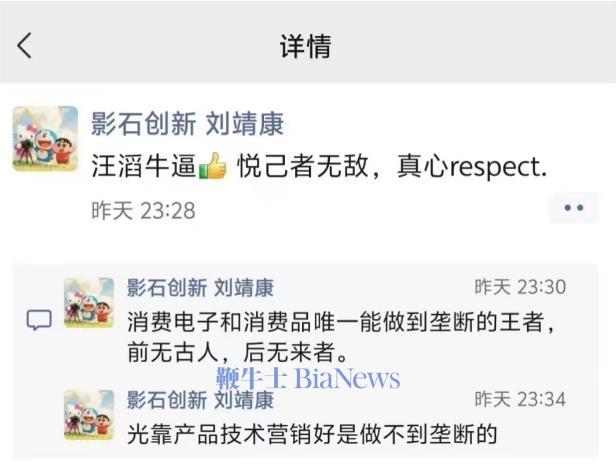
Group 1: Company Overview - Shenzhen is a significant base for China's high-tech industry, known as "China's Silicon Valley," housing major tech companies like Huawei and Tencent, and has over 400 A-share listed companies [1] - Haoying Technology Co., Ltd. has submitted its IPO application to the Shanghai Stock Exchange's Sci-Tech Innovation Board, with Guolian Minsheng Securities as the sponsor [1][19] - The company specializes in the research, production, and sales of drone power systems, which are critical components that determine the safety, reliability, and performance of drones [1][4] Group 2: Business Performance - From 2022 to the first half of 2025, the revenue share from drone power systems increased from 39.94% to 75.57%, while the share from other systems decreased [4][5] - The company's revenue for 2022, 2023, 2024, and the first half of 2025 was approximately 468 million, 546 million, 738 million, and 580 million respectively, with net profits of about 82 million, 94 million, 152 million, and 139 million [15] - The comprehensive gross margin for the same periods was 44.88%, 45.68%, 47.41%, and 44.85%, indicating some fluctuations influenced by sales prices and production costs [15] Group 3: Market Dynamics - The global drone power system market is projected to reach 10.308 billion in 2024, with a compound annual growth rate (CAGR) of 19.05% from 2019 to 2024 [15] - The Chinese drone market is expected to reach 110.849 billion in 2024, accounting for 57.19% of the global market, with industry-level drones growing faster than consumer-level drones [11] - Haoying Technology holds a global market share of 4.12% in drone power products, ranking among the top tier of third-party suppliers [17] Group 4: Competitive Landscape - The consumer drone market is dominated by DJI, while the industry-level drone market is still developing with a diverse competitive landscape [17] - The company faces competition from both self-manufactured drone power systems by drone manufacturers and third-party suppliers [17] - The supply chain includes upstream raw material producers and downstream drone manufacturers, with potential risks from self-manufacturing by clients [6][7][8] Group 5: Future Prospects - The company plans to raise 1.96 billion for projects including a high-end power system smart industrial park and R&D center upgrades [20][22] - The company has a history of cash dividends, distributing approximately 20 million in 2022 and 2024, and 30 million in the first half of 2025 [20] - The company is positioned to benefit from the rapid rise of the low-altitude economy and the expansion of drone applications [20]
影石创始人刘靖康称大疆董事长汪滔垄断:前无古人,后无来者
Sou Hu Cai Jing· 2025-10-29 07:11
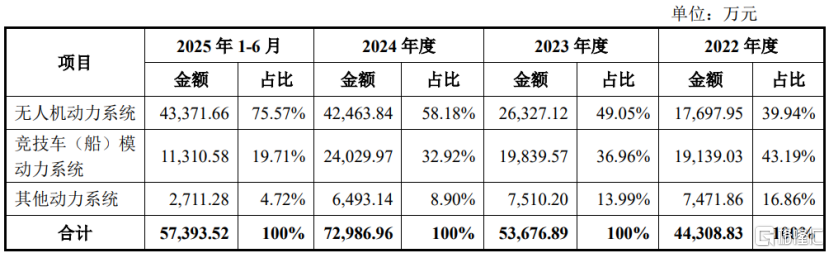
Group 1 - Liu Jingkang, founder and chairman of YingShi Innovation, praised DJI's chairman Wang Tao, calling him the only king capable of monopolizing the consumer electronics and consumer goods market, stating that "one cannot achieve monopoly solely through product technology and marketing" [1] - DJI announced significant price reductions on multiple products, with some items seeing price drops exceeding 1,000 yuan, which became a trending topic on Weibo [3] - Liu Jingkang suggested that the price cuts at DJI might be influenced by YingShi's actions, offering a 100 yuan voucher to customers who purchased DJI products between October 2 and October 8 as an apology [5] Group 2 - DJI entered the panoramic camera market in July this year with the launch of the Osmo360, which directly competes with YingShi's core business [6] - YingShi also ventured into the drone market by releasing the world's first panoramic drone, with Liu Jingkang expressing that the motivation for entering the drone sector was the potential for market growth, while also showing great respect for DJI [8]

影石创新董事长刘靖康致敬大疆创新董事长汪滔:消费电子和消费品唯一能做到垄断的王者!前无古人,后无来者
Sou Hu Cai Jing· 2025-10-29 06:11
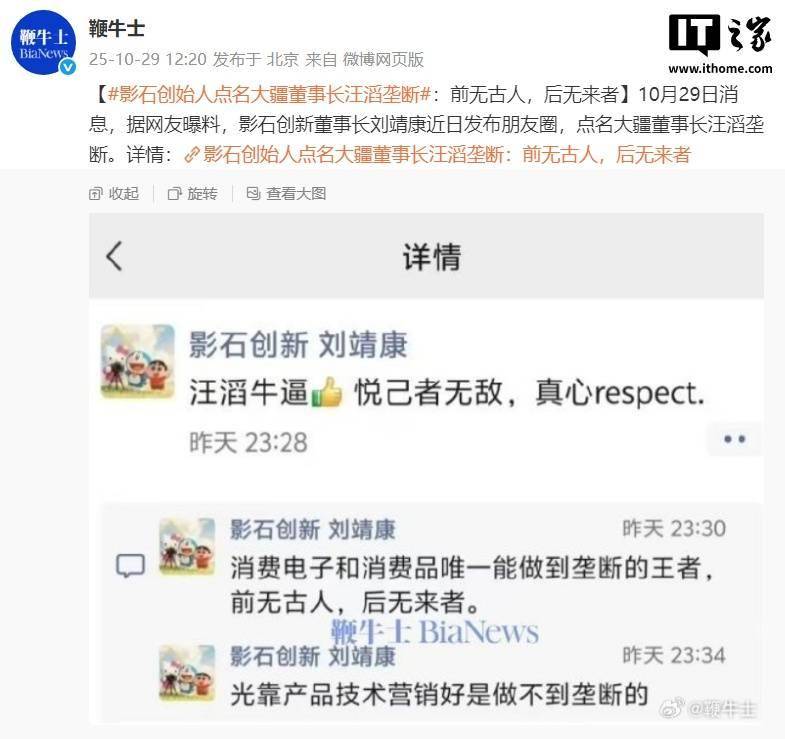
Core Viewpoint - Liu Jingkang, Chairman of Yingshi Innovation, expressed deep admiration for Wang Tao, Chairman of DJI Innovation, highlighting him as the only true monopolist in consumer electronics and consumer goods, stating that such a monopoly is unprecedented and unlikely to be replicated in the future [1] Group 1 - Liu Jingkang emphasized that achieving monopoly status requires more than just strong product technology and marketing [1]
影石刘靖康致敬大疆汪滔:前无古人,后无来者
Xin Lang Ke Ji· 2025-10-29 05:47
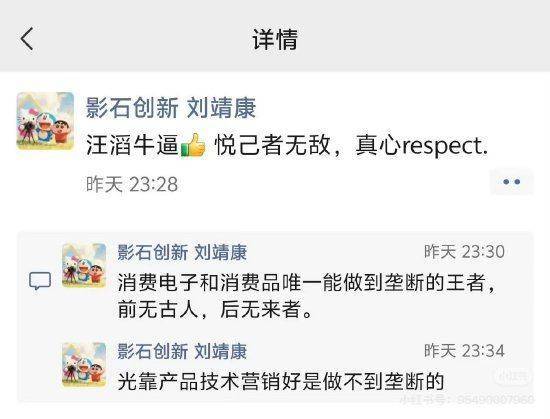
Core Viewpoint - Liu Jingkang, chairman of Yingshi Innovation, expressed deep admiration for Wang Tao, chairman of DJI Innovation, highlighting him as the only true monopolist in consumer electronics and consumer goods, stating that such a monopoly is unprecedented and unlikely to be replicated in the future [1] Summary by Categories - **Industry Leadership** - Wang Tao is recognized as a dominant figure in the consumer electronics and consumer goods sectors, achieving a level of monopoly that is considered unmatched historically [1] - **Monopoly Insights** - Liu Jingkang emphasized that achieving such a monopoly requires more than just superior product technology and marketing skills, indicating the complexity of market dominance [1]
IFA CEO:中国品牌抢滩欧洲市场,AI应用和本土化策略是关键
Di Yi Cai Jing Zi Xun· 2025-10-24 09:31
Group 1 - The CEO of IFA, Leif Lindner, visited Shenzhen to explore new partnerships and noted the significant transformation of the city, highlighting its innovation spirit and high efficiency [1] - The number of Chinese exhibitors at the IFA has increased dramatically, with 764 companies participating this year compared to 420 last year, marking a historical high and representing over one-third of total exhibitors [2] - Chinese brands are gaining opportunities in the German market as Japanese competitors like Sony and Panasonic are losing market share, with Hisense and TCL ranking third and fourth respectively [2] Group 2 - European consumer perceptions of Chinese products have improved over the past five years, with Chinese companies becoming more professional and leveraging AI and supply chain advantages [3] - The trend of "global localization" is becoming crucial for Chinese firms, as brand loyalty is decreasing and consumers focus more on product functionality rather than brand names [3] - Companies are advised to invest in after-sales service to build a good reputation, as this is often overlooked due to cost considerations [3]