
中国人民银行

Search documents
央行新增千亿元支农支小再贷款 支持防汛救灾及灾后重建
Yang Shi Xin Wen Ke Hu Duan· 2025-08-19 10:20
Core Viewpoint - The People's Bank of China has announced an additional 100 billion yuan in re-lending to support agriculture and small enterprises, particularly in flood-affected regions, to enhance credit support for recovery efforts [1] Group 1: Financial Support Measures - The central bank's new re-lending quota aims to encourage financial institutions to increase credit support for small and micro enterprises, individual businesses, and agricultural sectors in disaster-hit areas such as Beijing, Hebei, Jilin, Shandong, and Gansu [1] - The People's Bank of China will supervise local branches to effectively utilize the new re-lending quota and guide financial institutions in meeting the financing needs for flood relief and post-disaster reconstruction [1] Group 2: Targeted Beneficiaries - The focus of the financial support will be on operational entities, especially small and micro enterprises, individual businesses, and agricultural and livestock enterprises, as well as farmers in the affected regions [1]
央行新增支农支小再贷款额度1000亿元 支持部分地区防汛救灾及灾后重建
Xin Jing Bao· 2025-08-19 10:15
Core Viewpoint - The People's Bank of China has announced an additional 100 billion yuan in re-lending to support agriculture and small enterprises in disaster-affected areas, particularly focusing on small and micro businesses, individual businesses, and agricultural enterprises [1] Group 1: Financial Support Measures - The central bank aims to enhance financial support for disaster relief and post-disaster reconstruction efforts in regions such as Beijing, Hebei, Jilin, Shandong, and Gansu [1] - The new re-lending quota is specifically designed to encourage financial institutions to increase credit support for affected business entities [1] Group 2: Implementation and Guidance - The People's Bank of China will supervise local branches to effectively utilize the new re-lending quota [1] - Financial institutions are being guided to actively engage with the financing needs related to disaster relief and reconstruction [1]
央行新增支农支小再贷款额度1000亿元支持部分地区防汛救灾及灾后重建
Zheng Quan Shi Bao Wang· 2025-08-19 10:11
Core Viewpoint - The People's Bank of China has announced an additional 100 billion yuan in re-lending for agricultural and small business support, aimed at enhancing credit support for affected regions and sectors [1] Group 1: Financial Support Measures - The new re-lending quota of 100 billion yuan is intended to encourage financial institutions to increase credit support for small and micro enterprises, individual businesses, and agricultural sectors in disaster-affected areas [1] - The targeted regions for this financial support include Beijing, Hebei, Jilin, Shandong, and Gansu [1] Group 2: Future Actions - The People's Bank of China will supervise local branches to effectively utilize the new re-lending quota [1] - Financial institutions are guided to actively address the financing needs for flood relief and post-disaster reconstruction, supporting businesses in resuming operations [1]
一张“贷款明白纸” 让企业贷款成本阳光透明
Xin Jing Bao· 2025-08-19 08:53
Core Viewpoint - The People's Bank of China is implementing a pilot program to clarify the comprehensive financing costs of corporate loans, allowing businesses to understand all associated costs upfront, thereby reducing financing costs and enhancing transparency [1][2][4]. Group 1: Pilot Program Implementation - The pilot program for clarifying corporate loan costs began in September 2024 across five provinces: Shanxi, Jiangxi, Shandong, Hunan, and Sichuan [1]. - The program involves banks and enterprises filling out a "Loan Clarity Sheet" that details interest and non-interest costs, ensuring transparency and protecting consumer rights [1][2]. Group 2: Impact on Financing Costs - The pilot has led to a noticeable decrease in financing costs for small and medium-sized enterprises, with banks now providing clearer information on loan costs [2][4]. - For example, a small enterprise saved over 20,000 yuan by understanding the full cost breakdown through the "Loan Clarity Sheet" [3]. Group 3: Enhanced Transparency and Trust - The "Loan Clarity Sheet" lists all loan-related costs, including interest and various fees, reducing information asymmetry and allowing businesses to make informed decisions [4][8]. - This initiative has prompted banks to improve their services and tailor products to better fit the needs of enterprises, thereby fostering trust between banks and businesses [7][9]. Group 4: Case Studies of Cost Savings - A case study highlighted that a business was able to switch to a lower interest loan after filling out the "Loan Clarity Sheet," resulting in significant savings [6]. - Another example showed a company avoiding a 30,000 yuan "bridge fee" by utilizing a no-repayment loan renewal process, demonstrating the practical benefits of the program [9].




中国人民银行与泰国银行续签双边本币互换协议
Xin Hua She· 2025-08-19 02:56
Core Viewpoint - The People's Bank of China and the Bank of Thailand have renewed a bilateral currency swap agreement, enhancing financial cooperation and trade facilitation between the two countries [1] Group 1: Agreement Details - The renewed currency swap agreement has a scale of 700 billion RMB (approximately 370 billion THB) [1] - The agreement is valid for five years and can be extended upon mutual consent [1] Group 2: Implications - The agreement aims to deepen monetary and financial cooperation between China and Thailand [1] - It is expected to promote bilateral trade and investment facilitation [1] - The agreement also contributes to maintaining stability in the financial markets [1]
第二季度中国货币政策执行报告显示:货币政策逆周期调节效果明显
Ren Min Ri Bao Hai Wai Ban· 2025-08-19 02:06
Core Viewpoint - The People's Bank of China (PBOC) has effectively implemented counter-cyclical monetary policy measures in 2023, resulting in stable financial growth and a favorable environment for high-quality economic development [1][2]. Group 1: Monetary Policy Implementation - The PBOC has maintained reasonable growth in monetary credit, with the social financing scale and broad money supply (M2) increasing by 8.9% and 8.3% year-on-year, respectively, as of June [1]. - New corporate loans and personal housing loan rates have decreased by approximately 45 basis points and 60 basis points year-on-year, respectively, indicating an optimization in credit structure [1]. - The RMB exchange rate has remained stable, with the mid-point exchange rate against the USD at the end of June being roughly the same as at the end of the previous year [1]. Group 2: Future Policy Directions - The PBOC aims to balance short-term and long-term goals, economic growth and risk prevention, and internal and external equilibria, enhancing the effectiveness and foresight of macroeconomic regulation [2]. - The report emphasizes the need for a moderately loose monetary policy, ensuring liquidity remains ample and aligning the growth of social financing and money supply with economic growth and price level expectations [2]. - The PBOC plans to improve the interest rate adjustment framework and enhance the transmission mechanism of market interest rates, aiming to lower bank funding costs and further reduce overall financing costs [3]. Group 3: Support for Key Sectors - The PBOC will continue to support key sectors such as technology innovation, consumption, small and micro enterprises, and stabilize foreign trade through structural monetary policy tools [3].
8月19日央行开展5803亿元7天期逆回购操作
Zhong Guo Xin Wen Wang· 2025-08-19 02:03
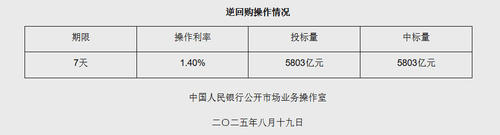
中新网8月19日电 据央行网站消息,2025年8月19日中国人民银行以固定利率、数量招标方式开展 了5803亿元逆回购操作。具体情况如下: | 期限 | 逆回购操作情况 操作利率 | 投标量 | 中标量 | | --- | --- | --- | --- | | 7天 | 1.40% | 5803亿元 CARD 11.000 | 5803亿元 | ...

货币市场日报:8月18日
Xin Hua Cai Jing· 2025-08-18 13:33
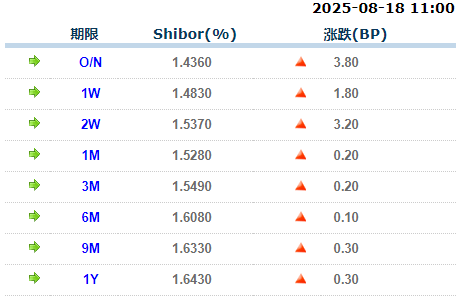
Group 1 - The People's Bank of China conducted a 7-day reverse repurchase operation of 266.5 billion yuan at an interest rate of 1.40%, maintaining the previous rate, resulting in a net injection of 154.5 billion yuan after 112 billion yuan of reverse repos matured [1] - The Shanghai Interbank Offered Rate (Shibor) for overnight loans increased by 3.80 basis points to 1.4360%, while the 7-day Shibor rose by 1.80 basis points to 1.4830%, and the 14-day Shibor increased by 3.20 basis points to 1.5370% [2][3] Group 2 - In the interbank pledged repo market, various rates saw slight increases, with the 7-day and 14-day rates both surpassing 1.5%. The weighted average rates for DR001 and R001 rose by 4.7 basis points and 6.5 basis points, respectively, while transaction volumes decreased significantly [4] - The money market maintained a tense liquidity situation, with overnight rates stabilizing around 1.55% and 7-day rates between 1.53% and 1.55% after the central bank's operations [9] Group 3 - Agricultural Bank successfully issued a floating-rate green financial bond in the interbank market with a scale of 6 billion yuan and a term of 3 years at an interest rate of 1.80%. This bond is the first in the market linked to the central bank's reverse repo rate [12]
沪指今日盘中创近10年新高;央行把促物价合理回升作为把握货币政策重要考量|每周金融评论(2025.8.11-2025.8.18)
清华金融评论· 2025-08-18 10:25
Group 1: Market Performance - The Shanghai Composite Index (SHCI) reached a nearly 10-year high on August 18, 2025, breaking the previous high of 3731.69 points set on February 18, 2021, with a closing increase of 0.85% to 3728.03 points and a trading volume exceeding 2.8 trillion yuan [4][5]. - The surge in the SHCI is attributed to three main drivers: significant inflow of new capital, supportive policies and institutional benefits, and strong performance in key sectors such as technology and finance [5][6]. Group 2: Economic Policies - The People's Bank of China (PBOC) emphasized the importance of promoting reasonable price recovery as a key consideration in monetary policy, aiming to prevent deflation risks and stimulate demand through appropriate monetary easing [7][9]. - The implementation of personal consumption loan interest subsidy policies aims to enhance consumer spending and support service sector businesses, reflecting a shift in fiscal and financial policy focus towards improving living standards and promoting consumption [6][7]. Group 3: International Trade and Energy - U.S. President Trump announced no plans to impose tariffs on China for purchasing Russian oil, which alleviates trade tensions and stabilizes the global energy market, allowing China to secure its energy supply [6][9]. - The decision to delay tariffs is expected to reduce market uncertainties and prevent potential disruptions similar to those experienced during the 2024 U.S.-China trade conflict [6][9]. Group 4: Financial Statistics - As of July 2025, China's broad money supply (M2) reached 329.94 trillion yuan, growing by 8.8% year-on-year, while narrow money supply (M1) increased by 5.6% [11]. - The social financing scale stood at 431.26 trillion yuan, with a year-on-year growth of 9%, indicating a robust recovery in the economy and financial market [11].
二季度货币政策执行报告释放了三大信号
Zheng Quan Ri Bao· 2025-08-17 16:25
Monetary Policy Focus - The core viewpoint of the report emphasizes the implementation and refinement of a moderately loose monetary policy, indicating a shift towards ensuring effective execution of previously announced financial policies [1][2] - The report highlights the importance of tracking the transmission and actual effects of prior policies, suggesting a cautious approach to further easing measures in the short term [2][3] Credit Support and Financial Structure - The report indicates a change in focus from increasing credit volume to stabilizing credit support, reflecting a shift towards quality over quantity in financial services [4][5] - It emphasizes the need to observe broader financial indicators such as social financing scale and M2, rather than solely focusing on loan amounts, to better assess the effectiveness of financial support for the real economy [5][6] Financial Services and Economic Structure - The report outlines initiatives to enhance financial services for small and micro enterprises, support technological innovation, and improve the quality of service consumption, aiming to optimize the credit structure in alignment with economic transformation [6][7] - It notes a significant shift in the structure of new loans, with a growing proportion directed towards strategic economic sectors, indicating a focus on sustainable financial support for high-quality economic development [6][7]