
博时基金

Search documents
“专业买手”最新重仓基金曝光,这些基金涨超100%
21世纪经济报道· 2025-09-04 03:36
Core Viewpoint - The article highlights the investment preferences of Fund of Funds (FOF) in the second quarter of 2023, indicating a strong preference for bond funds, while also noting significant interest in ETFs, actively managed equity funds, and QDII funds as the capital market recovers [1][2]. Summary by Sections FOF Investment Preferences - In the second quarter, bond funds remained the primary focus for FOFs, with the highest market value held in the Hai Fu Tong Zhong Zheng Short Bond ETF, exceeding 1.643 billion yuan [3][4]. - The top three bond funds held by FOFs include: - Hai Fu Tong Zhong Zheng Short Bond ETF: 1.643 billion yuan, with a year-to-date increase of 1.03% - Bo Shi Zhong Dai 0-3 Year National Development Bank ETF: 1.022 billion yuan, with a year-to-date increase of 0.47% - Bo Shi Credit Preferred E: 1.016 billion yuan, with a year-to-date increase of 1.07% [4][5]. Active Equity Funds - The article notes that among the top 30 actively managed equity funds held by FOFs, 21 funds achieved returns exceeding 20% in the year-to-date period [1][15]. - The highest market value for an actively managed equity fund held by FOFs is the Yi Fang Da Ke Rong, valued at 384 million yuan, despite a reduction of over 380,000 shares [15][17]. QDII Funds - QDII funds have also gained traction, with the highest market value held in the Hua Xia Hang Seng ETF, totaling over 800 million yuan [20][21]. - Notably, two QDII funds, the Hui Tian Fu Hong Kong Advantage Selected A and the Guang Fa Zhong Zheng Hong Kong Innovation Drug ETF, reported returns exceeding 100% [20][21]. ETF Performance - The total scale of ETFs surpassed 4.31 trillion yuan, marking a 15.57% increase from the end of the previous year [10]. - The top five ETFs held by FOFs in terms of market value include: - Hai Fu Tong Zhong Zheng Short Bond ETF: 1.643 billion yuan - Bo Shi Zhong Dai 0-3 Year National Development Bank ETF: 1.022 billion yuan - Hua An Gold ETF: 1.004 billion yuan, with a year-to-date increase of 26.60% - Hua Xia Hang Seng ETF: 835 million yuan, with a year-to-date increase of 23.56% [10][12]. Market Outlook - FOF managers express optimism about the market's future, emphasizing the need for cautious investment strategies amid rapid industry rotations [24]. - The article suggests that the market's liquidity is relatively abundant, which may lead to faster value discovery compared to previous years [24].


公募基金集体降费,上半年单只基金平均管理费同比再降27万元
21世纪经济报道· 2025-09-04 03:36
Core Viewpoint - The public fund industry in China has been undergoing significant fee reforms since July 2023, with a focus on reducing management fees across various fund types, including active equity funds, ETFs, and QDII funds, leading to a notable decrease in overall management fees and a shift towards performance-based fee structures [1][6][7]. Group 1: Fee Reduction Progress - As of the first half of 2025, the total management fees collected by 196 public fund institutions amounted to 62.313 billion yuan, a slight increase from 61.469 billion yuan in the same period of 2024, but the average management fee per fund decreased from 5.226 million yuan to 4.957 million yuan, reflecting a reduction of 26.9 thousand yuan [1]. - The overall management fee scale has decreased by 12.6% over the past two years, with the average management fee per fund dropping by 1.7 million yuan [1]. Group 2: Top Fund Managers - The top 10 public fund managers accounted for nearly 40% of the total management fees in the market, with a total of 24.142 billion yuan in management fees, showing a slight decrease of 0.15% compared to the previous year [3]. - Four public fund managers reported a decline in management fees exceeding 100 million yuan, with E Fund, CCB Principal Asset Management, and Huatai-PB Asset Management leading the reductions [3][4]. Group 3: Fund Type Performance - Active equity funds collected 19.583 billion yuan in management fees in the first half of 2025, down 6.79% from the previous year, with mixed funds contributing 12.186 billion yuan, representing 62.23% of the total [6]. - The introduction of floating fee rate funds has been a key development in the fee reform, with 31 such funds launched, totaling over 34 billion yuan in scale [7]. Group 4: Trading Commission Changes - Public funds have seen a significant reduction in trading commissions, with a total of 4.472 billion yuan paid to brokers in the first half of 2025, down 33.98% from 6.774 billion yuan in the same period of 2024 [9]. - The top three public fund managers by commission payments were E Fund, GF Fund, and Fortune Fund, all experiencing substantial declines in commission costs compared to the previous year [9][10]. Group 5: Future Outlook - The ongoing fee reform in the public fund industry is expected to continue along the lines of "management fees - trading fees - sales fees," aiming to reshape the industry's profit distribution and enhance investor satisfaction [10].
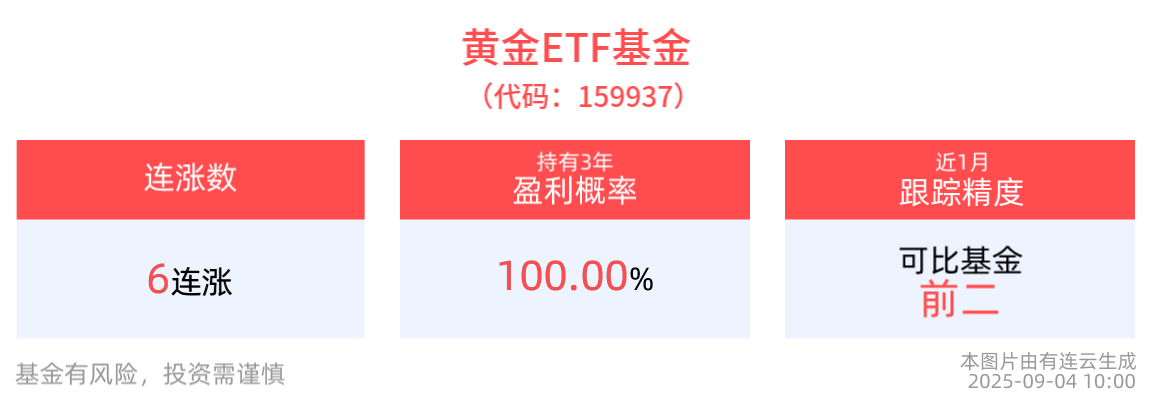
金价再创新高,COMEX黄金涨破3600美元,黄金ETF基金(159937)近1周日均成交放量超7亿元,备受资金关注
Sou Hu Cai Jing· 2025-09-04 03:28
Core Insights - The gold ETF fund (159937) has seen a 0.04% increase, marking its sixth consecutive rise, with the latest price at 7.76 yuan [2] - Over the past week, the gold ETF fund has accumulated a 4.26% increase [2] - The liquidity of the gold ETF fund shows a turnover of 0.71% with a transaction volume of 207 million yuan, and an average daily transaction of 707 million yuan over the past week, ranking it among the top three comparable funds [2] - COMEX gold futures rose by 0.82% to $3621.80 per ounce, reaching a record high of $3640.10 during the session [2] - A U.S. government report indicated a larger-than-expected decline in job vacancies for July, suggesting a cooling labor market [2] - The probability of a 25 basis point rate cut by the Federal Reserve during the policy meeting on September 16-17 surged to 98% according to the CME Group's FedWatch tool [2] Market Analysis - According to CITIC Securities, gold has been in a volatile market since late April, influenced by tariff impacts, U.S. fiscal policies, geopolitical factors, and central bank gold purchases, creating a complex balance of bullish and bearish forces [2] - Changes in these factors may initiate an upward trend for gold prices, with expectations of tariff improvements potentially stabilizing, while the impact of stagflation may just be beginning to manifest [2] - The likelihood of a significant decrease in geopolitical risks within the year remains low, and the Federal Reserve may initiate an early rate cut [2] - The trend of global central banks purchasing gold is expected to remain stable [2]
国债市场早盘持续拉升,30年国债ETF博时(511130)连续13日获资金净流入,合计“吸金”近46亿元
Sou Hu Cai Jing· 2025-09-04 03:04
Core Viewpoint - The recent developments in the 30-year government bond ETF market indicate a positive trend in liquidity and collaboration between the Ministry of Finance and the People's Bank of China, aiming to ensure the stable and healthy development of the bond market [3][4]. Group 1: Market Performance - As of September 4, 2025, the 30-year government bond ETF (博时, 511130) rose by 0.46%, with a latest price of 109.53 yuan [3]. - Over the past two weeks, the ETF has accumulated a total increase of 1.04% [3]. - The ETF recorded a turnover rate of 7.76% during the trading session, with a transaction volume of 1.583 billion yuan [3]. - The average daily transaction volume over the past month reached 4.370 billion yuan [3]. Group 2: Fund Inflows - The 30-year government bond ETF has seen continuous net inflows for 13 days, with a maximum single-day net inflow of 1.504 billion yuan, totaling 4.596 billion yuan in net inflows [4]. - The average daily net inflow during this period was 354 million yuan [4]. Group 3: Institutional Insights - A recent meeting between the Ministry of Finance and the People's Bank of China emphasized the importance of collaboration and coordination in the current economic landscape, highlighting the increasing significance of fiscal policy [3]. - The focus areas for the working group are diversifying beyond just government bond trading, indicating a potential for more optimistic liquidity conditions [3].

两市ETF两融余额减少2184.16万元丨ETF融资融券日报
2 1 Shi Ji Jing Ji Bao Dao· 2025-09-04 02:38
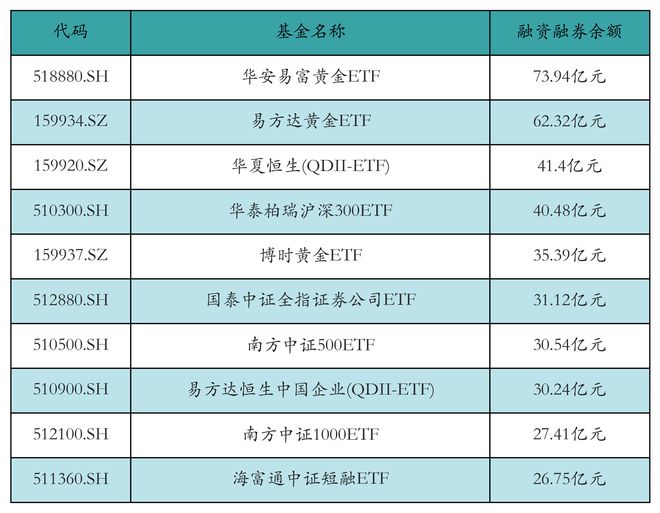
Market Overview - As of September 3, the total ETF margin balance in the two markets is 109.101 billion yuan, a decrease of 21.8416 million yuan from the previous trading day [1] - The financing balance is 101.737 billion yuan, an increase of 46.5578 million yuan from the previous trading day [1] - The securities lending balance is 7.364 billion yuan, a decrease of 68.3994 million yuan from the previous trading day [1] ETF Margin Balance - The top three ETFs by margin balance on September 3 are: - Huaan Yifu Gold ETF (7.394 billion yuan) - E Fund Gold ETF (6.232 billion yuan) - Huaxia Hang Seng (QDII-ETF) (4.14 billion yuan) [2] ETF Financing Buy Amount - The top three ETFs by financing buy amount on September 3 are: - Hai Fudong Zhong Zheng Short Bond ETF (2.321 billion yuan) - E Fund Zhong Zheng Hong Kong Securities Investment Theme ETF (1.338 billion yuan) - Bosera Zhong Zheng Convertible Bonds and Exchangeable Bonds ETF (1.205 billion yuan) [3][4] ETF Financing Net Buy Amount - The top three ETFs by financing net buy amount on September 3 are: - Guotai Zhong Zheng All Index Communication Equipment ETF (333 million yuan) - Guotai Zhong Zheng All Index Securities Company ETF (262 million yuan) - Fuguo Zhong Dai 7-10 Year Policy Financial Bond ETF (129 million yuan) [5][6] ETF Securities Lending Sell Amount - The top three ETFs by securities lending sell amount on September 3 are: - Southern Zhong Zheng 500 ETF (56.2505 million yuan) - Huatai Bairui Hu Shen 300 ETF (32.6191 million yuan) - Southern Zhong Zheng 1000 ETF (13.4606 million yuan) [7][8]
公募费率改革两年:单只基金平均让利170万元
2 1 Shi Ji Jing Ji Bao Dao· 2025-09-04 01:59
Core Viewpoint - The public fund industry in China has seen significant fee reforms since July 2023, with a notable reduction in management fees and the introduction of floating fee structures, indicating a shift towards aligning the interests of fund managers and investors [1][5]. Summary by Sections Fee Reduction Progress - Since the implementation of the fee reform plan, the average management fee per fund has decreased from 5.226 million yuan to 4.957 million yuan, a reduction of 26.9 thousand yuan [1]. - The total management fees collected by public funds in the first half of 2025 amounted to 62.313 billion yuan, a slight increase from 61.469 billion yuan in the same period of 2024, but a significant drop from 71.305 billion yuan in the first half of 2023, reflecting an overall decrease of 12.6% in management fees over two years [1]. Major Fund Companies - The top 10 public fund companies accounted for nearly 40% of the total management fees in the market, with a total of 24.142 billion yuan in management fees, showing a slight decrease of 0.15% compared to 2024 [2]. - Four public fund companies reported a decline in management fees exceeding 100 million yuan, with E Fund, CCB Principal Asset Management, and Huatai-PB Asset Management being the most affected [2]. Fund Types and Performance - Active equity funds collected 19.583 billion yuan in management fees in the first half of 2025, down 6.79% from the previous year, with mixed performance across different fund types [4]. - The introduction of floating fee structures has led to the issuance of 31 new floating fee funds, with a total scale exceeding 34 billion yuan, indicating a shift towards performance-based fee models [5]. Trading Commission Trends - Public funds have seen a significant reduction in trading commissions, with a total of 4.472 billion yuan paid to brokers in the first half of 2025, down 33.98% from 6.774 billion yuan in the same period of 2024 [6]. - The top three public funds in terms of trading commissions were E Fund, GF Fund, and Fortune Fund, all experiencing a decline in commission payments compared to the previous year [6][7]. Future Outlook - The ongoing fee reform is expected to continue along the lines of "management fees - trading fees - sales fees," aiming to reshape the industry's profit distribution and enhance investor satisfaction [7].
多家公募积极布局,ETF
Sou Hu Cai Jing· 2025-09-04 01:44
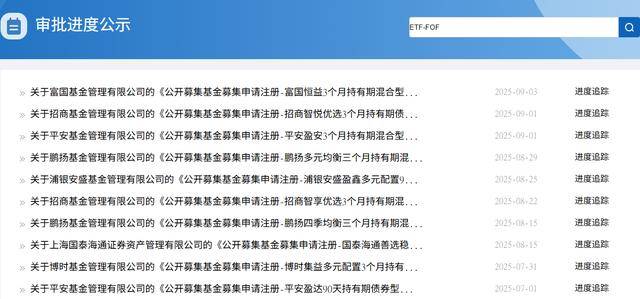
Core Insights - The China Securities Regulatory Commission (CSRC) has received applications for multiple ETF-FOF products, indicating a growing interest in this investment strategy among fund managers [1][2]. Group 1: ETF-FOF Product Applications - On September 3, 2023, the CSRC received an application from FuGuo Fund for the FuGuo HengYi 3-Month Holding Period Mixed Fund of Funds (ETF-FOF) [1]. - Other fund managers, including Ping An Fund, Guotai Junan Asset Management, Pengyang Fund, and others, have also submitted applications for similar ETF-FOF products [1]. - Specific products reported include Ping An YingDa 90-Day Holding Period Bond Fund of Funds (ETF-FOF), Ping An YingAn 3-Month Holding Period Mixed Fund of Funds (ETF-FOF), and Guotai Junan's Stable Allocation 3-Month Holding Period Mixed Fund of Funds (ETF-FOF) [1]. Group 2: Ongoing Issuance - The Xingzheng Global Yingfeng Multi-Asset Allocation 3-Month Holding Period Mixed Fund of Funds (ETF-FOF) is currently in the issuance phase [2]. Group 3: Approval Progress - The approval progress for various ETF-FOF applications is being tracked, with several applications expected to be processed by September 2025 [3].
产品定位短融ETF+,债市进攻时公司债ETF(511030)能获取更高超额收益
Sou Hu Cai Jing· 2025-09-04 01:44
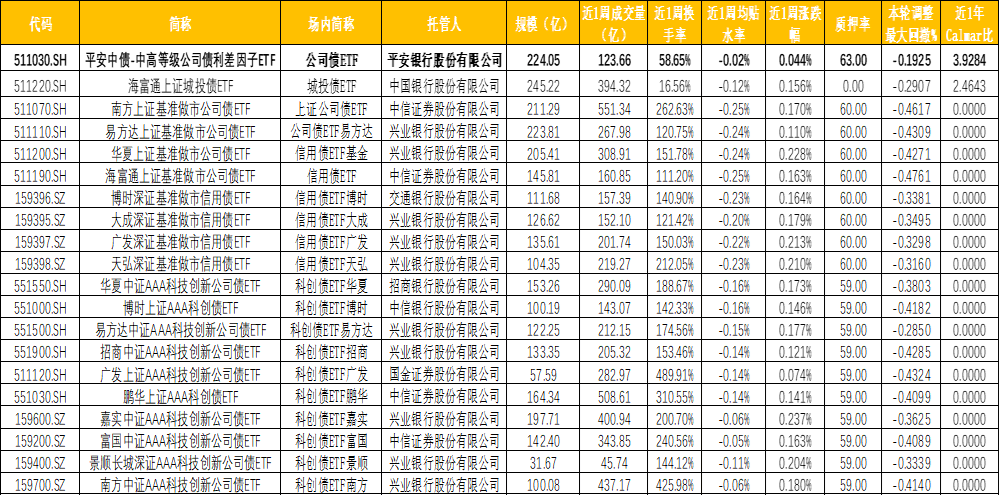
Group 1 - The bond market is expected to continue its upward trend, with the 10-year government bond yield projected to reach between 1.6% and 1.8% in the second half of the year [1] - The recent performance of the Ping An Company Bond ETF (511030) has been notable, with a short duration of 2 years and a static yield of 1.91%, making it a strong option during aggressive bond market conditions [1][2] - The Ping An Company Bond ETF has shown resilience during the recent bond market adjustment, ranking first in terms of drawdown control and experiencing minimal trading discounts [2] Group 2 - The central bank and finance working group are expected to restart government bond purchases soon, indicating potential support for the bond market [1] - The Ping An Company Bond ETF has seen a net inflow of 365 million in the past week, contrasting with significant net redemptions in other ETFs, highlighting its relative strength [1][2] - The bond market is currently viewed positively, with expectations for the 10-year government bond yield to target 1.65% within the month [1]
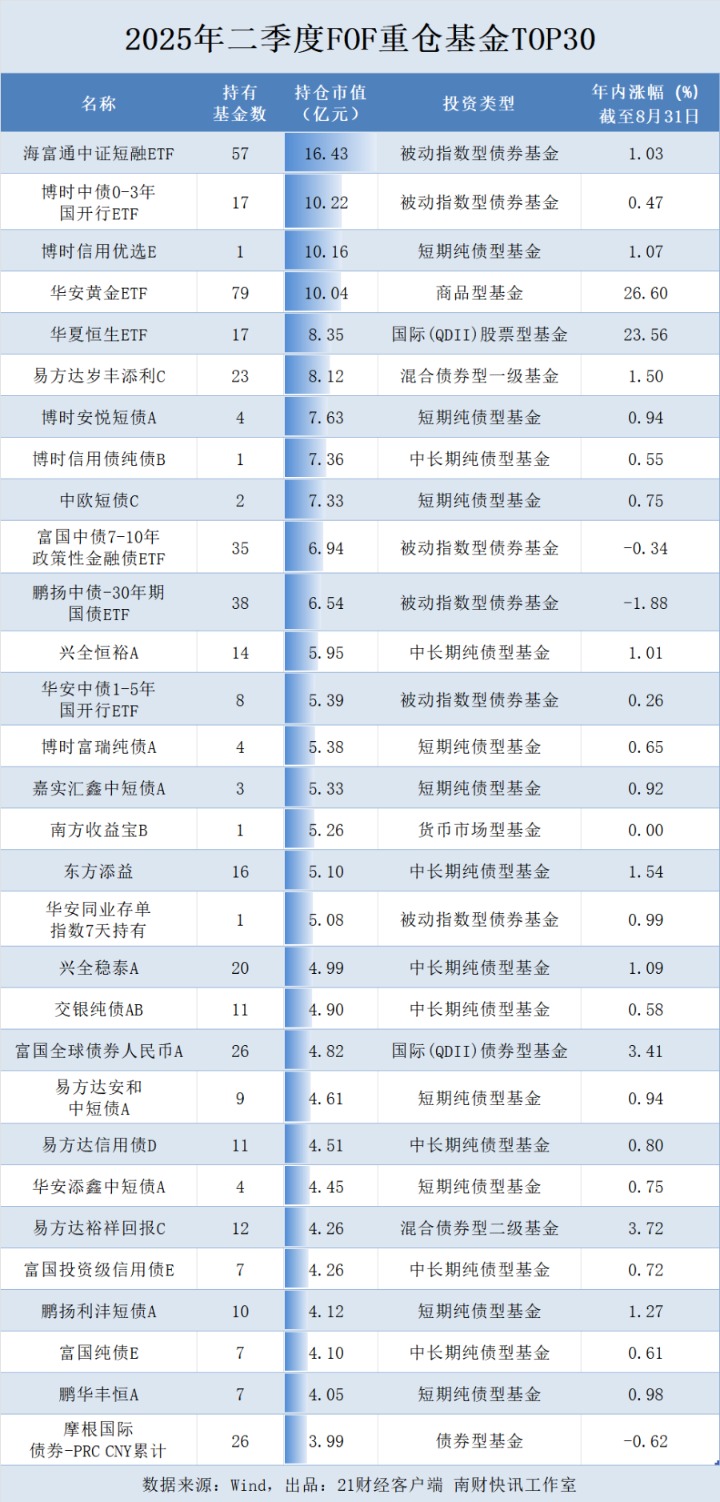
“专业买手”最新重仓基金曝光!这些基金涨超100%
2 1 Shi Ji Jing Ji Bao Dao· 2025-09-04 01:16
Core Viewpoint - The latest FOF (Fund of Funds) report reveals a strong preference for bond funds among FOF managers, with significant interest also in ETFs, actively managed equity funds, and QDII funds as the capital market recovers [1][2][8]. Summary by Category FOF Holdings Overview - In Q2, bond funds remained the primary focus for FOFs, with the highest market value held in Hai Fu Tong Zhong Zheng Short Bond ETF, exceeding 1.643 billion yuan [2][3]. - The top 30 actively managed equity funds held by FOFs saw 21 funds yielding over 20% returns, while two QDII funds achieved returns exceeding 100% [1][12]. Top Bond Funds Held by FOFs - The top bond funds held by FOFs include: - Hai Fu Tong Zhong Zheng Short Bond ETF: 1.643 billion yuan, 1.03% YTD return [3][9]. - Bo Shi Zhong Dai 0-3 Year National Development Bank ETF: 1.022 billion yuan, 0.47% YTD return [3][9]. - Bo Shi Credit Preferred E: 1.016 billion yuan, 1.07% YTD return [3][5]. Changes in Holdings - The most increased holdings in Q2 were primarily in bond funds, with Bo Shi Credit Preferred E seeing an increase of over 800 million shares [4][5]. - Other notable increases included South Fund Income Treasure B and Bo Shi Fu Rui Pure Bond A, both exceeding 400 million shares [4][5]. Performance of ETFs - The total scale of ETFs surpassed 4.31 trillion yuan, marking a 15.57% increase from the end of last year [8]. - The top five ETFs by market value held by FOFs include Hai Fu Tong Zhong Zheng Short Bond ETF and Bo Shi Zhong Dai 0-3 Year National Development Bank ETF, with significant interest in tech-focused ETFs showing strong performance [8][9]. Active Equity Funds - The highest valued actively managed equity fund held by FOFs was Yi Fang Da Ke Rong, with a market value of 384 million yuan, despite a reduction of over 380,000 shares [11][12]. - The top 30 actively managed equity funds had a positive performance, with two funds exceeding 80% returns [12][13]. QDII Funds Performance - The highest valued QDII fund held by FOFs was Hua Xia Hang Seng ETF, with a market value exceeding 800 million yuan [16]. - Two QDII funds, Huatai Fuhua Hong Kong Advantage Selection A and Guangfa Zhong Zheng Hong Kong Innovative Medicine ETF, achieved returns over 100% [16]. Market Outlook - FOF managers express optimism for future market performance, emphasizing the need for cautious investment strategies amid rapid industry rotations [17][18]. - The anticipated economic stabilization and potential dual easing of fiscal and monetary policies in developed economies could favor the Chinese capital market [17].
最高大涨69%,这类ETF受热捧
Zheng Quan Shi Bao· 2025-09-04 00:01
Group 1 - Gold prices have surged significantly, with spot gold reaching $3,550 per ounce and a year-to-date increase of over $925, representing a rise of more than 35% [1] - The domestic gold price for AU9999 has also increased by over 1%, closing at 809 yuan per gram, while major jewelry brands have raised their gold jewelry prices [1] - The A-share and Hong Kong stock markets have seen a collective benefit in the gold sector, with over 10 gold stocks doubling in price this year, and the largest increase in the Yongying Gold Stock ETF, which has risen by 69% [1] Group 2 - The recent bullish trend in the gold market is attributed to weak economic data reinforcing optimistic expectations for a Federal Reserve rate cut in September, alongside concerns over the Fed's independence [2][3] - The market anticipates that if former President Trump successfully influences the Fed's board, it could lead to a significant increase in the likelihood of further rate cuts next year [2] - The Fed's dovish stance, focusing on employment protection, has further bolstered market expectations for rate cuts, with a nearly 90% probability of a cut in September and potentially two cuts within the year [2] Group 3 - The loss of independence of the Federal Reserve is viewed as a significant positive for gold, as market expectations shift towards substantial monetary easing, which could lead to uncontrolled inflation [3] - Gold is perceived as a stable store of value amidst concerns over fiat currency devaluation, enhancing its attractiveness as a non-political asset [3] Group 4 - Gold-related ETFs have seen substantial gains, with commodity gold ETFs yielding around 30% and stock gold ETFs exceeding 60% in returns this year [4] - Individual stocks such as Laopu Gold and China National Gold International have surged over 200% this year, indicating strong performance in the gold mining sector [4] - The domestic gold mining companies are expected to play a crucial role in meeting the significant demand for gold, with a projected consumption of 985 tons in 2024 against a production of 377 tons [4] Group 5 - The current environment of Fed rate cuts historically supports strong gold price performance, and central bank gold purchases are likely to continue, providing medium-term support for gold prices [5] - Gold stocks are anticipated to benefit from market valuation corrections and price increases in the gold sector, leading to a potential "Davis double" effect [5] Group 6 - Long-term factors such as the Fed's rate cut cycle, increasing macroeconomic uncertainty, and global de-dollarization trends are expected to support gold prices [6] - The ongoing trend of central banks purchasing gold, particularly by the People's Bank of China, which has increased its reserves for nine consecutive months, indicates a strong demand for gold as a reserve asset [6] Group 7 - The potential legalization of stablecoins by the U.S. government may impact the credibility of the dollar and gold prices, with possible mixed effects depending on the stability and trustworthiness of these digital currencies [7] - If stablecoins effectively support dollar credibility, it could reduce the demand for gold as a hedge against currency devaluation, while unexpected credit risks could increase market risk premiums, benefiting gold [7]