
永赢黄金股ETF

Search documents
资金流向逆转 新发ETF纷纷上市
Shang Hai Zheng Quan Bao· 2026-02-08 17:31
Group 1 - The reversal of significant net outflows from stock ETFs occurred, with a net inflow of 6.965 billion yuan on February 3, marking the first net inflow since January 14 [1] - From February 3 to 6, multiple broad-based ETFs saw substantial net inflows, including 2.549 billion yuan into the Huaxia Science and Technology Innovation 50 ETF and 1.763 billion yuan into the Huaxia CSI A500 ETF [1] - Conversely, resource-themed ETFs experienced notable outflows, with the Huaxia Nonferrous Metals ETF seeing a net outflow of 4.364 billion yuan [1] Group 2 - A total of 10 new ETFs were launched from February 2 to 6, with an additional 6 ETFs set to list between February 9 and 11, contributing to market liquidity [2] - Significant investments in newly launched ETFs were made by entities such as China Shipbuilding Group, which purchased 100 million yuan worth of shares in the Fortune CSI Selected Shipbuilding Industry ETF [2] - The ETF market is expected to continue expanding, with numerous new products being reported by fund companies, including the Hang Seng A-share Power Grid Equipment ETF [2]
近90亿!抄底资金来了
Zhong Guo Ji Jin Bao· 2026-02-06 06:37
Core Viewpoint - The stock ETF market has shown significant resilience amid recent market volatility, with a net inflow of nearly 90 billion yuan on February 5, indicating strong investor interest despite broader market declines [1][2]. Group 1: Market Performance - On February 5, the A-share market opened lower due to declines in overseas technology stocks and precious metals, but the stock ETF market experienced a net inflow of 88.99 billion yuan [2]. - The total scale of all stock ETFs (including cross-border ETFs) reached 3.9 trillion yuan as of February 5 [2]. - The net inflow for A-share stock ETFs specifically was 34.95 billion yuan [1]. Group 2: ETF Inflows and Outflows - The leading inflows were observed in Hong Kong stock ETFs and thematic industry ETFs, with net inflows of 53.2 billion yuan and 19.47 billion yuan, respectively [2]. - Conversely, bond ETFs experienced a net outflow of 1.87 billion yuan [2]. - Notably, ETFs tracking the Hang Seng Technology Index saw a net inflow of 29.72 billion yuan, while those tracking the CSI 500 Index had a net outflow of 31.39 billion yuan [2]. Group 3: Fund Company Performance - Major fund companies such as Huaxia, Huatai-PB, and E Fund saw net inflows of 31.8 billion yuan, 28.5 billion yuan, and 28.2 billion yuan, respectively [2]. - In contrast, Southern and Jiashi funds experienced net outflows of 28.5 billion yuan and 3.8 billion yuan [2]. Group 4: Specific ETF Performance - E Fund's ETFs reached a total scale of 651.95 billion yuan, with significant inflows in various ETFs, including 9.2 billion yuan for the China Internet ETF and 3.6 billion yuan for the Hang Seng Technology ETF [3]. - Huaxia Fund's A500 ETF and Hang Seng Technology Index ETF also saw substantial inflows of 11.99 billion yuan and 6.5 billion yuan, respectively [3]. Group 5: Market Outlook - The market is expected to continue its oscillating pattern, with risks that have been accelerating in the short term, particularly in cyclical sectors like metals [5]. - Despite recent adjustments in the technology sector, the overall fundamental outlook remains robust, suggesting limited downside potential [5]. - Consumer sectors may present opportunities for recovery, especially with upcoming events like the Spring Festival and the National People's Congress [5].
净值和规模共振 资源主题ETF疾驰
Shang Hai Zheng Quan Bao· 2026-01-28 18:38
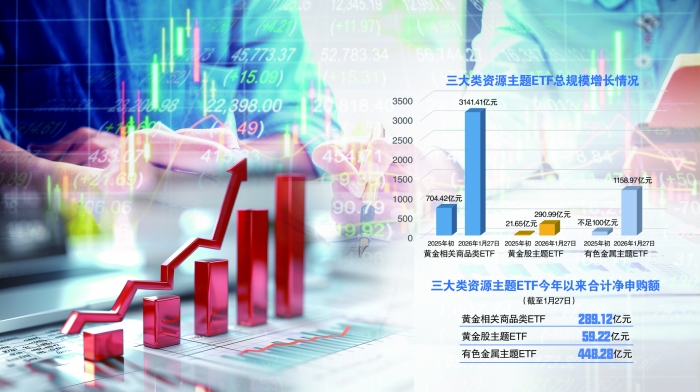
Group 1: Gold ETF Investment Surge - International gold prices have reached new highs this year, leading to a significant increase in gold-related ETFs, with the largest domestic gold ETF surpassing 120 billion yuan [2] - As of January 27, the net inflow into domestic gold-related ETFs reached 28.912 billion yuan, with a total scale of 314.141 billion yuan, up from 70.442 billion yuan at the beginning of 2025 [2] - Major gold ETFs include Huaxin Gold ETF at 120.572 billion yuan, Bosera Gold ETF at 52.177 billion yuan, and E Fund Gold ETF at 45.087 billion yuan [2] Group 2: Gold Stock Theme ETFs - Gold stock theme ETFs, focusing on companies related to the gold industry, have seen annual growth rates exceeding 50%, with a total net inflow of 5.922 billion yuan as of January 27 [3] - The scale of gold stock theme ETFs has increased from 2.165 billion yuan at the beginning of 2025 to 29.099 billion yuan by January 27, 2026, with Yongying Gold Stock ETF reaching 19.463 billion yuan [3] Group 3: Surge in Non-Ferrous Metal ETFs - Non-ferrous metal theme ETFs, which invest in resources like gold, copper, and aluminum, have also experienced significant growth, with net inflows of 44.828 billion yuan as of January 27 [5] - The total scale of non-ferrous metal theme ETFs reached 115.897 billion yuan, up from less than 10 billion yuan at the beginning of 2025, with notable ETFs including Southern Non-Ferrous Metal ETF at 41.444 billion yuan and Huaxia Non-Ferrous Metal ETF at 19.876 billion yuan [5] Group 4: Fund Manager Sentiment and Market Outlook - Fund managers have increased their focus on the non-ferrous metal sector, with a 2.3 percentage point increase in holdings as of the end of Q4 2025 compared to Q3 [6] - Factors driving the strong performance in the non-ferrous metal sector include low cycles in overseas real estate, manufacturing, and inventory, along with expectations of demand recovery post-Fed rate cuts [6] - The high profitability of the non-ferrous metal industry is expected to persist, with a shift towards growth attributes, although caution is advised regarding copper and aluminum in the short term [7]

FOF最新“购物车”曝光!大举扫货这些基金
券商中国· 2026-01-24 11:09
Core Viewpoint - The article highlights the latest trends in FOF (Fund of Funds) investments, indicating a preference for low-risk products and a strategic shift from gold ETFs to gold stock ETFs amidst rising international gold prices [1][4]. Group 1: FOF Investment Trends - In Q4 2025, FOFs favored low-risk products, with short-term bond ETFs being the most heavily weighted, particularly the Hai Fu Tong Short Bond ETF, held by 95 FOFs with a total market value of approximately 4.17 billion [3]. - The Guotai Li Xiang Medium and Short Bond C fund saw significant increases in holdings, with a quarterly change of about 1.49 billion shares, indicating a strategic shift in FOF allocations [3]. Group 2: Gold Investment Strategy - Despite rising international gold prices, FOFs reduced their holdings in gold ETFs, with a total reduction of 40.68 million shares in the Huaan Gold ETF alone, while simultaneously increasing their investments in gold stock ETFs [4][5]. - The increase in gold stock ETFs was notable, with FOFs adding 50.74 million shares in Yongying Gold Stock ETF and 24.03 million shares in Huaxia Gold Stock ETF, reflecting a shift in strategy towards higher potential returns in gold equities [4][5]. Group 3: FOF Market Growth - The overall scale of FOFs has surpassed 250 billion, driven by strong support from banking channels such as China Merchants Bank and China Construction Bank, which have launched successful asset allocation programs [2][7]. - As of the end of 2025, the total scale of FOFs reached 252.11 billion, marking a significant milestone in the market [7].

贵金属行情带火相关基金!白银期货基金单季度规模增超180%,多只有色主题产品份额翻倍
Sou Hu Cai Jing· 2026-01-21 04:21
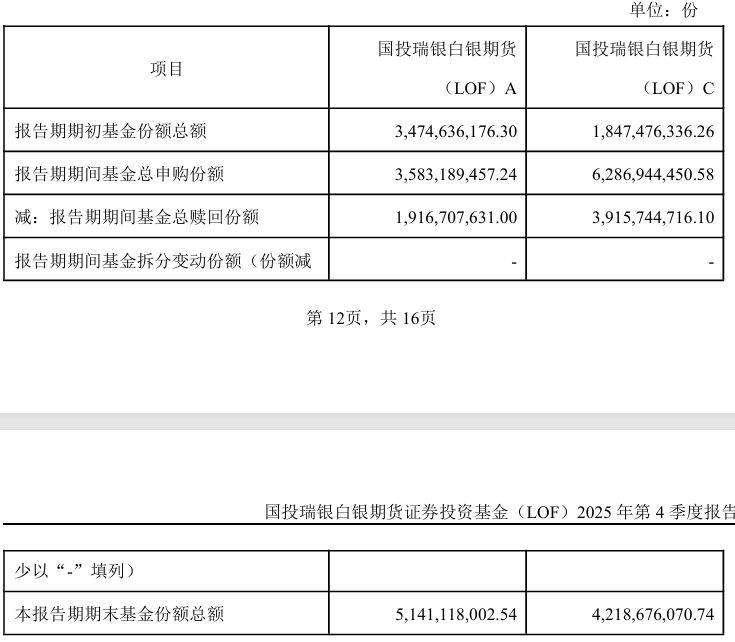
Core Viewpoint - The Guotou Ruijin Silver Futures Fund experienced significant growth in its scale during Q4 2025, despite restrictions on large subscriptions, with C-class shares seeing over 100% growth in a single quarter [1][4]. Fund Performance - The fund's total net asset value reached 18.9 billion yuan by the end of Q4, marking an increase of over 180% compared to 6.6 billion yuan at the end of Q3 [4]. - A-class shares saw subscriptions of approximately 3.58 billion units in Q4, with a total of 5.14 billion units by the end of the reporting period, despite 1.91 billion units being redeemed [2][4]. - C-class shares surged from 1.85 billion units at the beginning of the period to 4.22 billion units by the end, with subscriptions reaching 6.29 billion units and redemptions of 3.91 billion units [2][4]. Financial Metrics - The realized income for A-class shares was approximately 1.19 billion yuan, while C-class shares reported about 886.88 million yuan [5]. - The profit for A-class shares was around 3.03 billion yuan, and for C-class shares, it was approximately 2.49 billion yuan [5]. - The net asset value per share for A-class was 2.0320 yuan and for C-class was 2.0143 yuan at the end of the reporting period [5]. Performance Comparison - Over the past three months, A-class shares had a net value growth rate of 62.43%, underperforming the benchmark return of 64.75% by 2.32 percentage points [5]. - In the past three years, A-class shares achieved a net value growth rate of 177.98%, while the benchmark return was 214.58%, resulting in an underperformance of 36.60 percentage points [6]. - Over five years, A-class shares had a net value growth rate of 112.77%, compared to the benchmark return of 185.72%, leading to an underperformance of 72.95 percentage points [6]. Market Trends - Other thematic funds in the non-ferrous sector also saw significant growth in Q4, such as the Wanji Zhongzheng Industrial Non-ferrous Metals Theme ETF, which had total subscriptions exceeding 4.4 billion units [8]. - The market for precious metals, particularly silver, has been influenced by rising spot leasing rates and reduced COMEX deliverable inventories, leading to a "short squeeze" in the futures market [11]. - The outlook for 2026 suggests a potential "rate cut + fiscal expansion" cycle, which may boost the prices of precious metals due to increased government debt pressures and a weakening dollar [11].
全市场首只千亿元级黄金ETF亮相
Zheng Quan Ri Bao· 2026-01-15 16:48
Group 1 - The core point of the news is the emergence of the first gold ETF in the market to surpass 100 billion yuan, specifically the Huaan Gold ETF, which reached a scale of 100.76 billion yuan as of January 14 [1] - Since 2025, the Huaan Gold ETF has experienced rapid growth, increasing from 28.68 billion yuan at the beginning of 2025 to 93.99 billion yuan by the end of that year, with a growth of over 65 billion yuan [1] - The price of gold has been on the rise, with the London spot gold price breaking the 4,600 USD/ounce mark for the first time on January 12, and reaching a historical high of 4,643 USD/ounce on January 14 [1] Group 2 - In addition to the Huaan Gold ETF, there are other significant gold ETFs, including Bosera Gold ETF, E Fund Gold ETF, Guotai Gold ETF, and Huaxia Gold ETF, each with scales exceeding 40 billion yuan, all showing growth of over 10 billion yuan since early 2025 [2] - Other gold-related funds have also seen growth, such as the Yongying Gold Stock ETF, which increased from 1.65 billion yuan at the beginning of 2025 to 14.32 billion yuan by January 14, 2026 [2] Group 3 - Industry insiders view gold ETFs and linked funds as efficient and low-cost tools for ordinary investors to allocate gold [3] - Gold is highlighted as a core asset for hedging inflation risks and optimizing asset portfolios in the medium to long term, although investors are advised to be cautious of short-term market sentiment [3] - It is recommended that investors maintain a gold allocation of 10% to 20% in their portfolios to effectively optimize their investment mix [3]
国内首只千亿黄金ETF“诞生”
中国基金报· 2026-01-15 04:25
Group 1 - The core viewpoint of the article highlights that the Huaan Gold ETF has reached a significant milestone, becoming the first gold ETF in China to surpass 100 billion yuan in scale, achieving a total of 1007.62 billion yuan as of January 14 [2][5]. - The Huaan Gold ETF has seen substantial growth, with an increase of over 650 billion yuan expected by 2025, and an additional 67.77 billion yuan added in January 2026 alone [5]. - The article notes that the overall market for gold-related ETFs has attracted nearly 120 billion yuan in net inflows in 2025, with approximately 60 billion yuan flowing in during just the first eight trading days of the year [5]. Group 2 - The article discusses the factors influencing gold pricing in 2026, including anticipated interest rate cuts by the Federal Reserve, a weakening dollar, and ongoing geopolitical tensions [6][7]. - It mentions that central banks are continuing to purchase gold, and some commodities are being priced in yuan, reflecting changes in the global monetary system [6]. - The article emphasizes the low correlation between gold and other asset classes like stocks and bonds in the current domestic interest rate environment, highlighting gold's value in improving portfolio Sharpe ratios [7].
通华财富:9月市场震荡与政策协同下的投资新机遇
Sou Hu Cai Jing· 2025-10-20 03:53
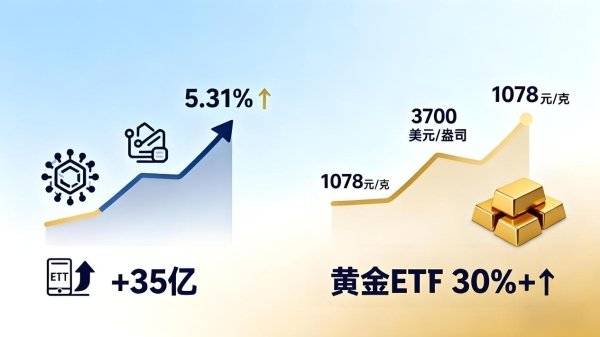
Global Market Performance - The global asset prices have shown significant divergence since September, with the A-share market continuing to fluctuate around 3800 points, while the Shenzhen Component and ChiNext indices demonstrate stronger resilience, indicating structural opportunities in growth sectors [3] - The Hong Kong stock market has strengthened under the expectation of a Federal Reserve rate cut, with the Hang Seng Tech Index rising by 5.31% in one week and net inflows into the E Fund Hang Seng Tech ETF exceeding 3.5 billion yuan in the past month, surpassing 20 billion yuan in total scale [3] - The gold market has maintained its strong performance, with spot gold prices in London surpassing 3700 USD per ounce on September 22, reaching a historical high, and domestic retail prices for gold exceeding 1078 yuan per gram [3] Policy Impact - Multiple significant policies have been implemented in September, impacting the capital market profoundly, including a 600 billion yuan reverse repurchase operation by the central bank to release medium- and long-term liquidity, effectively countering short-term pressures from government bond issuance and stock market fund diversion [5] - A personal consumption loan interest subsidy policy was officially implemented on September 1, expected to mobilize trillions of yuan in credit funds towards key sectors such as automotive, elderly care, and cultural tourism, directly boosting domestic demand [5] - The regulatory authorities are promoting the entry of medium- and long-term funds into the market, with the top 100 fund distribution institutions holding equity fund assets reaching 5.14 trillion yuan, a year-on-year increase of 5.89% [5] Investment Strategy - The company recommends a balanced allocation strategy focusing on three main directions: technology leaders in Hong Kong benefiting from liquidity improvement, consumption recovery sectors driven by policy, and high-dividend defensive assets such as utilities [7] - For gold investments, it is suggested to participate through gold ETFs and gold stocks, with a note on the short-term price increase and the importance of monitoring Federal Reserve policy expectations and dollar exchange rate fluctuations [7] - The "fixed income +" strategy has shown promising performance in 2025, with over 1700 products achieving positive returns year-to-date, and a median return exceeding 3%, making it suitable for conservative investors [7] Market Outlook - The company maintains an optimistic outlook for the fourth quarter, anticipating a resonance in monetary policy cycles between China and the U.S., the release of domestic policy dividends, and the deepening of capital market reforms [10]
基金公司限购黄金相关产品,工行、建行、招行等集体提示风险
2 1 Shi Ji Jing Ji Bao Dao· 2025-10-15 12:28
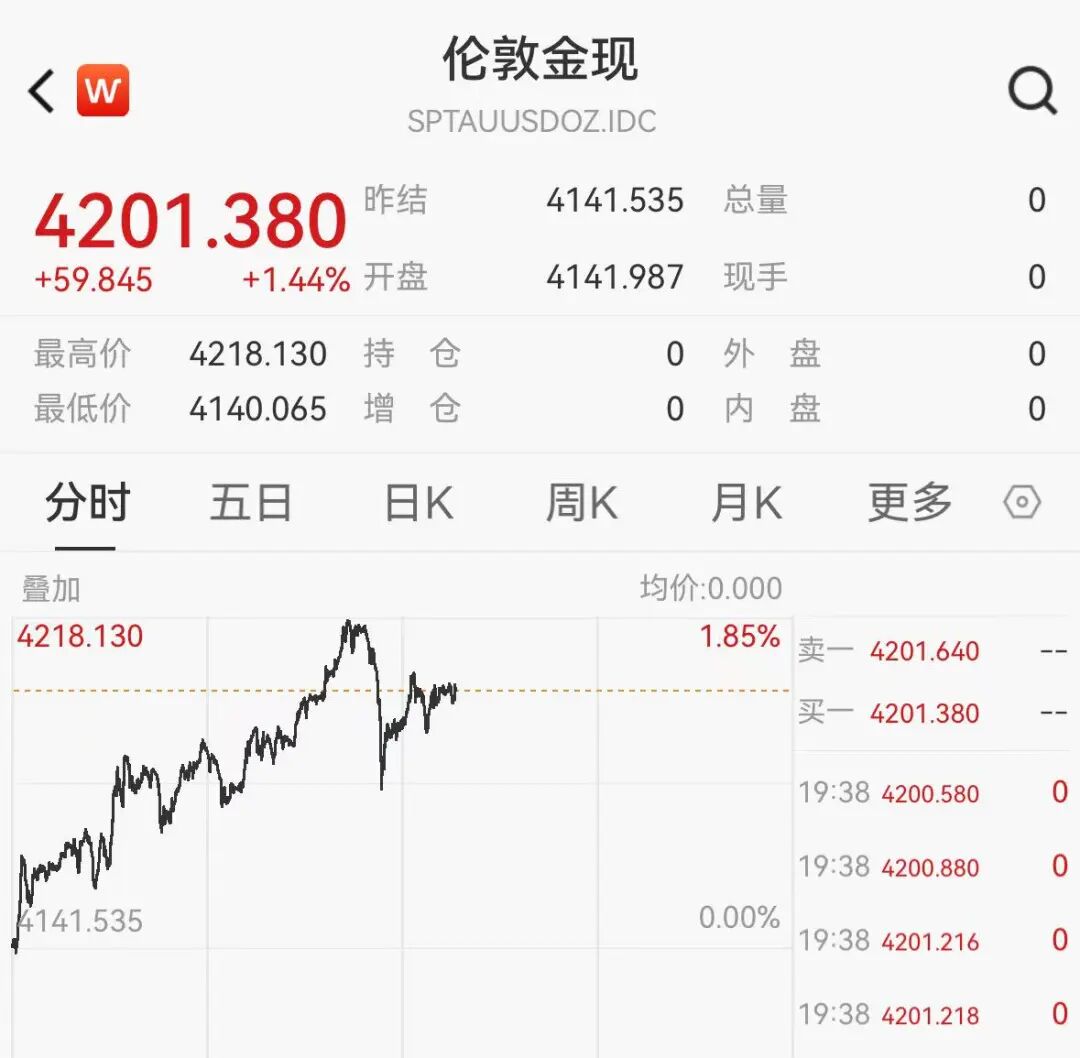
Core Viewpoint - Gold prices have reached new highs, peaking at $4,210 per ounce, indicating strong investor interest and potential overvaluation in the market [1][3]. Group 1: Gold Price Trends - As of October 15, gold prices have surged, with a peak of $4,218.13 per ounce and a daily increase of 1.44% [2]. - The average net asset value growth rate for gold-themed ETFs this year is 66%, with some ETFs seeing increases over 100% [7][8]. Group 2: Investor Sentiment - According to a recent Bank of America survey, 43% of investors view "going long on gold" as the most crowded trade, surpassing the 39% for "going long on the seven major U.S. stocks" [3][8]. - Despite the high interest in gold, the average allocation to gold among global investors is only 2.4%, indicating a discrepancy between sentiment and actual investment [8]. Group 3: Fund Management Actions - Due to the influx of capital into gold ETFs, several fund companies, including Huatai-PineBridge and Guotai Asset Management, have implemented large purchase limits on their gold-related funds [5][6]. - Huatai-PineBridge announced a limit of 20,000 RMB for single or cumulative purchases starting October 16, 2025, down from a previous limit of 50,000 RMB [5]. Group 4: Market Adjustments - Major banks have raised minimum investment amounts for gold accumulation products, with adjustments made by institutions like Industrial and Commercial Bank of China and Bank of China [10][11]. - The Shanghai Gold Exchange has also adjusted trading limits and margin requirements for gold and silver contracts, reflecting increased market volatility [12].






金价冲上4200美元/盎司 基金公司相关产品限购
2 1 Shi Ji Jing Ji Bao Dao· 2025-10-15 11:17
Group 1 - Gold prices reached a new high of $4,200 per ounce on October 15, with 43% of surveyed investors considering "going long on gold" as the most crowded trade, surpassing the 39% for "going long on the seven major US stocks" [1][3] - The significant inflow into gold ETFs has led to their total scale exceeding 200 billion yuan this year, prompting some fund companies to impose large purchase limits [1][3] - The average net asset value growth rate for gold-themed ETFs this year is 66%, with some funds seeing increases over 100% [3] Group 2 - Fund companies like Huatai-PineBridge and Guotai Junan have announced restrictions on large purchases of gold and silver funds to protect investors, with limits set at 20,000 yuan for certain funds [2] - The weighted average allocation to gold among global investors is only 2.4%, indicating a low actual investment despite high interest in gold as a safe haven [4] Group 3 - Major banks have raised margin requirements for gold trading due to increased volatility in gold prices, advising clients to manage their positions carefully [5][8] - Adjustments to minimum purchase amounts for gold accumulation products have been made by several banks, reflecting the changing market conditions [7][8]