
工商银行

Search documents
财经聚焦丨多项金融举措加速落地,对企业发展有哪些利好?
Xin Hua Wang· 2026-01-21 12:22
结构性降息助力企业轻装上阵 自1月19日起,中国人民银行下调再贷款、再贴现利率0.25个百分点。对此,长飞先进半导体(武汉)有限公司财务总监钱皓格外关注。 "去年在科技创新和技术改造再贷款支持下,我们从建设银行拿到的贷款利率大幅下降,每年能节省资金成本约445万元,希望今年利用低成 本资金加快项目建设进度。"钱皓说。 新华社北京1月21日电 题:多项金融举措加速落地,对企业发展有哪些利好? 新华社记者吴雨、任军 结构性货币政策利率迎来年内首降,增加支农支小再贷款额度5000亿元,单设民营企业再贷款……近日,围绕结构性货币政策工具,中国人 民银行出台一系列政策举措,支持企业抢抓先机,更好前行。 图为长飞先进半导体(武汉)有限公司技术人员在进行晶圆制造。(受访单位供图) 根据政策安排,下调后,3个月、6个月和1年期支农支小再贷款利率分别为0.95%、1.15%和1.25%,再贴现利率为1.5%,抵押补充贷款利率为 1.75%,专项结构性货币政策工具利率为1.25%。 这意味着银行从中国人民银行"借钱"更便宜,有望带动重点领域贷款利率下行。 "结构性降息有利于强化对商业银行的政策激励作用。"西南财经大学中国金融研究 ...


部分银行大额存单利率降至0字头
Di Yi Cai Jing· 2026-01-21 11:55
(文章来源:第一财经) 据央视财经,近期,记者注意到,多家银行年初以来发行的大额存单利率较去年出现下调,部分银行的 短期产品利率已降至1%以下,进入"0"字头区间。当前,工商银行、农业银行、中国银行等多家国有银 行的1个月及3个月期大额存单利率为0.9%,较往年明显下调。多家中小银行近期发行的3个月、6个月 等期限的大额存单利率也均下调,其中云南腾冲农商行等银行近期发行的3个月期大额存单,利率已步 入1%以下,进入"0"字头区间。此外,在多家银行手机App上,5年期大额存单已不见踪影,部分银行仅 剩下2年期及更短期限的产品。业内人士指出,在近期央行结构性降息降准,以及商业银行自身稳定净 息差的双重背景下,未来一段时期,银行定期存单的发行规模可能继续收缩,利率或将继续下行。 ...
银行CIO变阵:大行“老将”到龄辞任,中小行加速抢人
2 1 Shi Ji Jing Ji Bao Dao· 2026-01-21 11:49
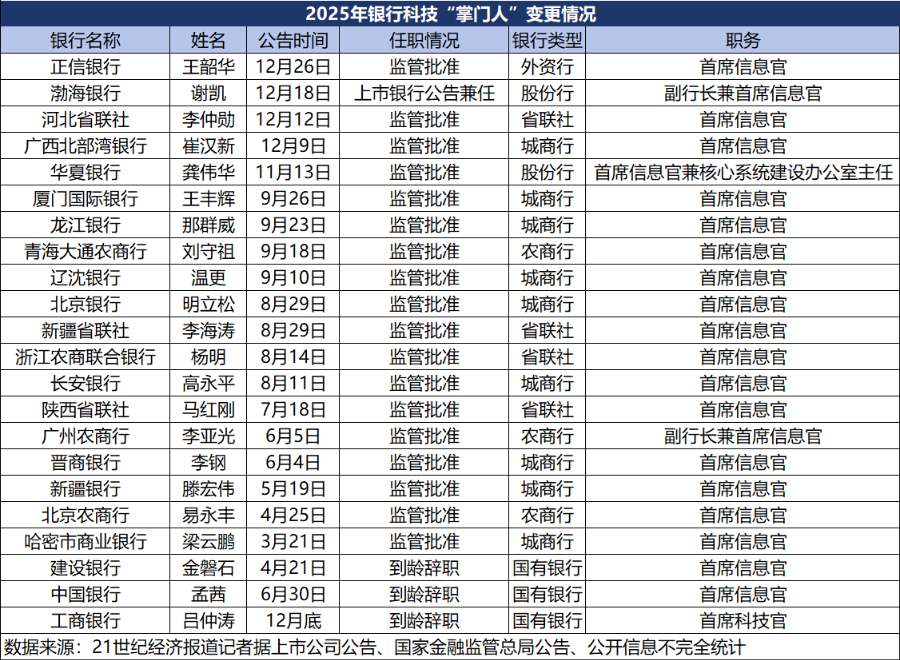
一方面,中行、建行、工行三家国有大行"老将"到龄退休交棒,中小银行也加速"抢人"步伐,从外部引进资深金融科技人才。 另一方面,多家银行副行长与首席信息官为同一人,为科技负责人给予更高的权责,从而深度参与战略决策,在上市银行业绩 发布会上,越来越多的首席信息官"亮相",从幕后走向台前。 "商业银行设立首席信息官,是银行数字化转型从'选择题'变为'必答题'的重要措施。"招联首席研究员、上海金融与发展实验室 副主任董希淼向记者表示,专设首席信息官有助于银行增强面向未来的发展能力与服务能力。 全年22家银行科技"一把手"变动 21世纪经济报道记者李览青 随着银行科技战略的不断推进,2025年,作为科技"掌门人"的首席信息官在银行数智化转型中承担着越来越重要的角色。 据21世纪经济报道记者不完全统计,2025年有22家银行科技"一把手"出现变更。 从中小银行的首席信息官聘任路径来看,既有内部提拔的业务骨干,亦有深耕金融科技领域的外部人才引进。 例如在龙江银行CIO那群威任职资格获批前,该行曾公开对外招聘,彼时其任职要求为,具有15年以上(含)信息科技相关工作 经验,曾任国有大型商业银行省级分行科技部门总经理;具有大学本 ...

尾盘,又有大动作
Sou Hu Cai Jing· 2026-01-21 11:29
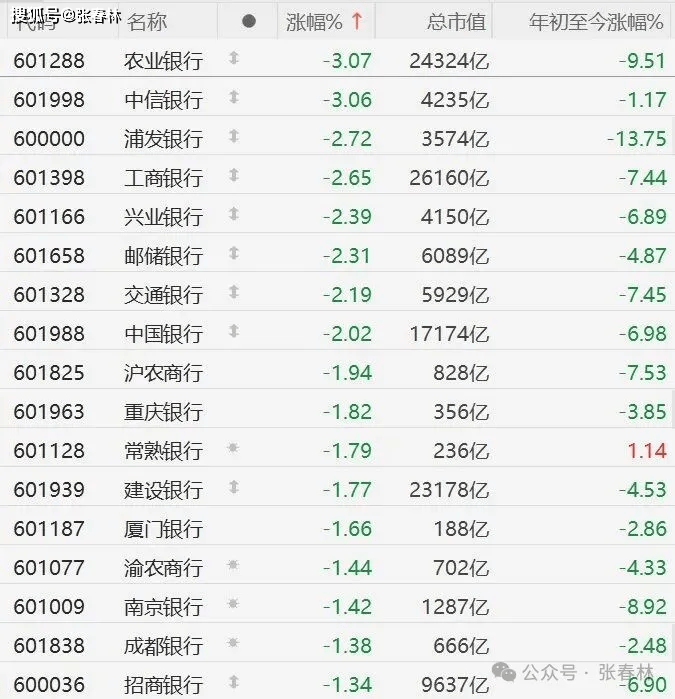
Market Overview - The market experienced a high and then a pullback, with the STAR 50 Index rising over 3%, indicating a mixed sentiment among investors [1] - Large funds are actively managing the market to prevent rapid index increases, aiming for a slow bull market [2] Index and Sector Performance - The Shanghai Composite Index is expected to fluctuate around the 4100-point mark, with an upper limit of 4190 points and a lower limit of 4000 points, suggesting a range-bound trading environment [3] - Key sectors showing strong performance include metals, gold, chips, and lithography machines, with the STAR 50 Index catching up after lagging behind other indices [3] Stock Performance - Traditional consumer stocks, particularly in the liquor sector, are experiencing a decline, while other sectors remain active [4] - A detailed table shows various banks' stock performance, with significant declines noted for major banks like Agricultural Bank (-9.51%) and Industrial and Commercial Bank (-7.44%) [5] Liquor Industry Insights - The liquor sector is anticipated to enter a new cycle around 2026, driven by economic recovery and potential monetary easing from the Federal Reserve [6][7] - Historical cycles of the liquor industry since 2003 indicate that demand has been influenced by various economic factors, suggesting a pattern that could repeat [6] Investment Strategy - The current market sentiment suggests a preference for sectors like chips and aerospace, while traditional sectors like liquor are viewed with skepticism [8] - The concept of contrarian investing is highlighted, emphasizing the challenges and potential rewards of investing in underperforming sectors [9]
多家银行扎堆发卫星上天
2 1 Shi Ji Jing Ji Bao Dao· 2026-01-21 11:25
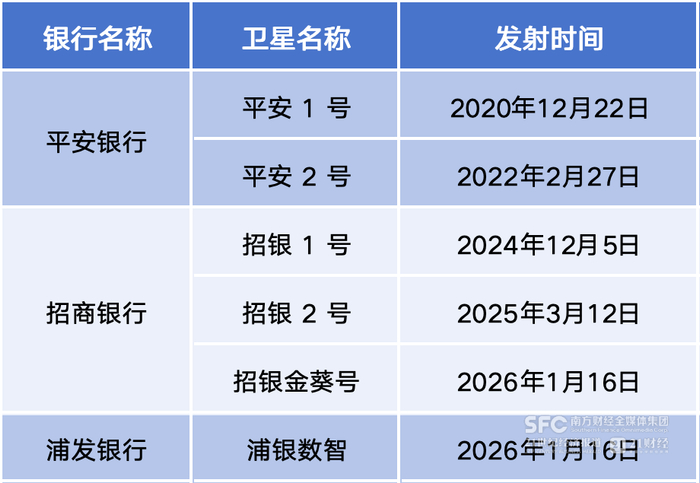
Core Viewpoint - The recent successful launch of satellites by major banks in China, including China Merchants Bank and Shanghai Pudong Development Bank, signifies a strategic shift towards utilizing satellite technology for enhancing financial services and risk management in the banking sector [1][2][5]. Group 1: Satellite Launches and Developments - China Merchants Bank launched the "Zhaoyin Jinkui" satellite on January 16, 2026, as part of the "Tianqi Constellation," which aims to enhance global coverage and communication capabilities [1][5]. - Shanghai Pudong Development Bank's "Puyin Shuzhi" satellite was also launched on the same day, contributing to the "Tianqi Constellation" [5]. - Previous satellite launches by Ping An Bank include "Ping An 1" in December 2020 and "Ping An 2" in February 2022, indicating a growing trend among banks to invest in satellite technology [2][3]. Group 2: Business Logic Behind Satellite Investments - Banks are leveraging satellite technology for remote monitoring of collateral and project progress, significantly improving post-loan management efficiency and reducing credit risk [2][8]. - The ability to maintain business continuity during extreme scenarios, such as natural disasters, is enhanced through satellite communication technology [13]. - By participating in satellite launches, banks are aligning with national strategies and expanding their financial services to support the commercial space industry [14]. Group 3: Applications of Satellite Technology in Banking - Satellite technology allows for real-time monitoring of agricultural and industrial activities, addressing information asymmetry in lending [8][10]. - The integration of satellite data into risk management systems has improved the accuracy of monitoring construction projects, with a reported precision of over 95% in tracking project progress [9][11]. - The use of satellite technology in supply chain finance helps overcome challenges faced by small and medium enterprises, enabling better access to credit [10][12]. Group 4: Future Prospects and Innovations - The ongoing development of satellite technology is expected to further penetrate various banking operations, enhancing risk prevention capabilities in sectors like agriculture and logistics [14][15]. - Innovations such as the "Dashanque" system by WeBank utilize satellite imagery and AI to assess agricultural productivity, providing tailored credit solutions to farmers [15]. - The trend of banks investing in satellite technology reflects a broader commitment to technological innovation and improved service delivery in the financial sector [16].



北京链家联合工行北京分行,在西城区落地房产证自助打印点
Bei Jing Shang Bao· 2026-01-21 11:20
Core Viewpoint - The collaboration between Industrial and Commercial Bank of China (ICBC) and Beijing Lianjia aims to enhance real estate transaction services by establishing a convenient financial service point that integrates transaction, registration, and financial services [1] Group 1: Service Implementation - A new real estate query and certificate printing integrated machine has been launched, allowing residents to access property information and print property certificates through a self-service process [1] - The machine operates securely by connecting to the Beijing real estate registration system, enabling a full self-service loop from identity verification to information query and certificate printing [1] - The service point is open on both weekdays and weekends, providing flexibility for residents to manage their time effectively [1] Group 2: Service Scope and Impact - The service currently covers key urban areas, specifically Xicheng and Chaoyang districts, enhancing the convenience of residents in real estate transactions [1] - The goal of the service center is to not only facilitate property transactions but also to implement more convenient services for residents, making the second-hand property transaction process easier [2]
1月20日贷款财政贴息四项政策点评:“一揽子”贷款财政贴息政策影响几何?
EBSCN· 2026-01-21 11:17
Investment Rating - The report maintains a "Buy" rating for the banking industry, indicating an expected investment return exceeding the market benchmark index by more than 15% over the next 6-12 months [29] Core Insights - The "package" loan interest subsidy policies aim to stimulate consumption and investment, focusing on enhancing effective domestic demand through financial and fiscal collaboration [2][7] - The new policies are expected to significantly increase the scale of interest subsidies compared to previous measures, with a projected subsidy scale of approximately 1000 to 2000 billion yuan for 2026 [17][19] Summary by Sections Loan Subsidy Policies - The policies include four main areas: subsidies for small and micro enterprises, equipment updates, service industry operators, and personal consumption loans, with a focus on key industries such as new energy vehicles and medical equipment [4][6] - The subsidy rate for small and micro enterprise loans is set at 1.5 percentage points, with a maximum loan amount of 50 million yuan per entity, potentially providing up to 150,000 yuan in subsidies [4][6] - The equipment update loan subsidy has been increased from 1% to 1.5%, expanding the scope to include technology innovation loans and related fields [4][6] - The personal consumption loan subsidy has removed previous restrictions, allowing for broader eligibility and a maintained subsidy rate of 1% [5][6] Economic Impact - The policies are designed to alleviate financial burdens on small and micro enterprises, encouraging investment and job stability, particularly in high-tech and essential service sectors [7][8] - The expected increase in loan demand from these sectors is anticipated to support the overall credit recovery in the economy, particularly for retail and service industries [7][8] Market Outlook - The report suggests that the coordinated fiscal and monetary policies will positively impact the banking sector's loan volume and pricing, particularly benefiting banks focused on small and micro enterprises and retail finance [23] - The banking sector has seen a decline in stock performance, and the new policies are expected to act as a catalyst for recovery, especially in the context of the "opening red" period for banks [23]
多家银行扎堆发卫星上天
21世纪经济报道· 2026-01-21 11:06
Core Viewpoint - The article discusses the recent satellite launches by major Chinese banks, highlighting their strategic shift towards utilizing satellite technology for enhancing financial services and risk management [1][4]. Group 1: Satellite Launches and Their Purpose - Three major banks, China Merchants Bank, Shanghai Pudong Development Bank, and Ping An Bank, have successfully launched satellites as part of their strategic initiatives to integrate satellite technology into their operations [4][5]. - The "Zhaoyin Jinqi" satellite launched by China Merchants Bank is designed to enhance global communication capabilities and improve data transmission efficiency, forming a comprehensive low-orbit satellite communication matrix [4][6]. - The "Puyin Shuzhi" satellite, launched simultaneously, is part of the "Tianqi Constellation" and aims to improve the performance and revisit time of the satellite network [4][6]. Group 2: Business Logic Behind Satellite Utilization - Banks are leveraging satellite technology for remote monitoring of collateral and project progress, significantly enhancing post-loan management efficiency and reducing credit risk [7][8]. - The use of satellite technology allows banks to gather unique spatial data, which can transform risk control and business models, addressing issues of information asymmetry in lending [7][9]. - For instance, China Merchants Bank has integrated remote sensing technology into its risk management system, achieving over 95% accuracy in monitoring construction progress of mortgage properties [8][9]. Group 3: Applications in Extreme Scenarios - In extreme scenarios such as natural disasters, satellite communication technology provides a solution to maintain business continuity when ground communication networks fail [12][13]. - China Merchants Bank has tested low-orbit satellite links for disaster recovery, establishing a foundation for an integrated emergency communication network [12][13]. Group 4: Supporting National Strategy and Commercial Space Industry - By participating in satellite launches, banks are aligning with national strategies and expanding financial services to support the commercial space industry [13][14]. - The banks are developing various services and products tailored to the needs of the commercial space sector, such as satellite leasing and financing solutions [14]. Group 5: Broader Industry Impact - The trend of banks utilizing satellite technology is expanding beyond a few players, with other banks also exploring applications in agriculture, environmental monitoring, and supply chain finance [14]. - Innovations such as satellite remote sensing applications are being adopted to enhance risk management and service delivery in various sectors, indicating a shift towards integrating advanced technologies in traditional banking practices [14].

《Brand Finance 2026年全球品牌价值500强》榜单发布:13家中国银行业品牌上榜,工行建行中行农行位列前20
Xin Lang Cai Jing· 2026-01-21 10:48
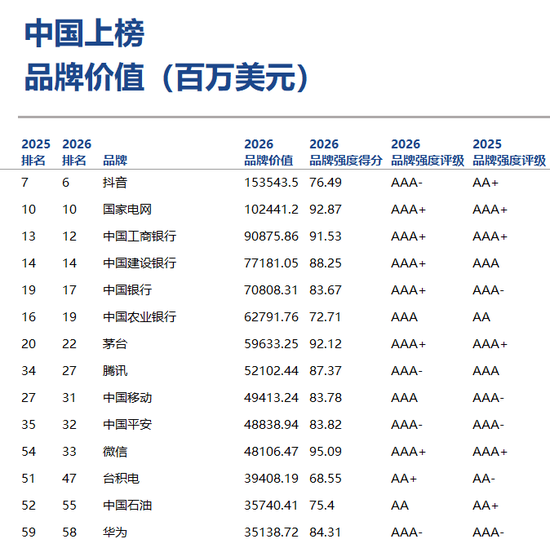
1月21日金融一线消息,当地时间1月20日,《Brand Finance 2026年全球品牌价值500强榜单报告》在瑞 士达沃斯正式发布。 《Brand Finance 2026年全球品牌价值500强榜单报告》显示,银行业凭借79个品牌,为总价值贡献了 12.5%。其中,13家中国银行品牌以4170亿美元总价值占据行业鳌头,同比增长1.4%。 中国工商银行在榜单中的排名为第12名,凭借908.8亿美元的品牌价值和91.5分的品牌强度指数稳居全球 银行品牌榜首,获得AAA+评级。 上榜的中国银行品牌还有中国建设银行(排名14)、中国银行(排名17)、中国农业银行(排名19)、 招商银行(排名74)、中信银行(排名128)、中国邮政储蓄银行(排名134)、交通银行(排名 167)、上海浦东发展银行(排名272)、兴业银行(排名274)、中国民生银行(排名404)、中国光大 银行(排名461)、恒生银行(排名462)。 | 2025 2026 | | | 2026 2026 | 2026 | 2025 | | --- | --- | --- | --- | --- | --- | | 排名 | 排名 品牌 | | ...



工商银行完成赎回300亿元二级资本债券
Zhi Tong Cai Jing· 2026-01-21 10:09
Core Viewpoint - Industrial and Commercial Bank of China (ICBC) issued a total of RMB 30 billion in subordinated capital bonds in the interbank bond market from January 19 to 21, 2021, and announced the completion of the issuance on January 21, 2021 [1] Group 1 - The bonds have an issuer call option, allowing ICBC to redeem the bonds at face value on the last day of the fifth interest period, which is January 21, 2026 [1] - As of the announcement date, ICBC has exercised its redemption right and fully redeemed the bonds [1]