
中国人民银行

Search documents
最新金融数据,央行发布
Zhong Guo Zheng Quan Bao· 2025-08-13 09:33
Core Insights - The People's Bank of China reported that as of the end of July, the social financing scale and M2 growth rate remained high, indicating a suitable monetary environment for the real economy and reflecting a moderately loose monetary policy stance [1][2] Summary by Sections Monetary Policy and Economic Support - In the first half of the year, the People's Bank implemented a series of monetary policies that effectively supported the recovery of the real economy, with expectations that the effects of these policies will continue to manifest [1][2] Loan and Financing Data - In the first seven months, RMB loans increased by 12.87 trillion yuan, with the total RMB loan balance reaching 268.51 trillion yuan by the end of July, reflecting a year-on-year growth of 6.9% [2][3] - The social financing scale stock was 431.26 trillion yuan at the end of July, with a year-on-year growth of 9% [2][7] - The cumulative increase in social financing scale for the first seven months was 23.99 trillion yuan, which is 5.12 trillion yuan more than the same period last year [2] Loan Growth Influences - Loan growth is influenced by the macroeconomic background of structural transformation and lighter funding needs, as well as the development of direct financing and diversified financing channels [3][6] - Factors such as local government debt replacement and the reform of small and medium-sized banks have significantly impacted loan growth, with estimates suggesting these factors have contributed over 1 percentage point to the current loan growth rate [3][6] Interest Rates and Financing Costs - Loan interest rates have been at low levels, with new corporate loan rates around 3.2% and new personal housing loan rates around 3.1%, both down approximately 45 and 30 basis points year-on-year, respectively [4][5] - The reduction in financing costs has positively impacted corporate profitability and demand expansion, with many companies now able to invest in new projects due to lower interest rates [5] Financing Structure and Trends - The growth rate of bond financing has outpaced that of credit financing, indicating an ongoing optimization of the financing structure in China [7][8] - By the end of July, M2 stood at 329.94 trillion yuan, with a year-on-year growth of 8.8%, while M1 was 111.06 trillion yuan, growing by 5.6% [7][8] Economic Outlook - The overall economic environment has shown steady improvement, with macroeconomic indicators performing better than expected, supporting the reasonable growth of monetary totals [8] - The continuity and stability of macro policies are expected to support employment, businesses, and market confidence, ensuring a smoother domestic economic cycle [8]
央行:7月末本外币贷款余额272.48万亿元 同比增长6.7%
Yang Shi Wang· 2025-08-13 09:15
Core Insights - The People's Bank of China reported a total loan balance of 272.48 trillion yuan by the end of July 2025, reflecting a year-on-year growth of 6.7% [1] - The yuan loan balance reached 268.51 trillion yuan, with a year-on-year increase of 6.9% [1] - In the first seven months of the year, new yuan loans increased by 12.87 trillion yuan [1] Loan Breakdown - Household loans increased by 680.7 billion yuan, with short-term loans decreasing by 383 billion yuan and medium to long-term loans increasing by 1.06 trillion yuan [1] - Corporate loans rose by 1.163 trillion yuan, with short-term loans increasing by 375 billion yuan, medium to long-term loans increasing by 691 billion yuan, and bill financing increasing by 824.7 billion yuan [1] - Non-bank financial institution loans increased by 235.7 billion yuan [1] Foreign Currency Loans - By the end of July, the foreign currency loan balance was 555.8 billion USD, showing a year-on-year decline of 8.1% [2] - In the first seven months, foreign currency loans increased by 13.7 billion USD [2]
中国人民银行:截至6月末不含个人住房贷款的全国住户消费贷款余额21.2万亿元
Xin Hua Cai Jing· 2025-08-13 07:16
Core Viewpoint - The People's Bank of China (PBOC) is implementing policies to enhance consumer credit and support service consumption, aiming to stimulate economic growth through increased financing in key service sectors [1][2]. Group 1: Policy Implementation - As of the end of June, the balance of household consumption loans, excluding personal housing loans, reached 21.2 trillion yuan, with loans in key service sectors amounting to 2.8 trillion yuan [1]. - The PBOC plans to collaborate with fiscal departments to ensure effective policy implementation, focusing on increasing credit support in the service consumption sector [1][2]. - The newly introduced personal consumption loan interest subsidy and service industry loan subsidy policies aim to boost financing support from both demand and supply sides [1]. Group 2: Financial Support Mechanisms - The interest subsidy policy will directly reduce financing costs for residents and businesses, alleviating financial burdens [2]. - The re-lending policy links incentives to banks' credit allocation in the consumption sector, encouraging banks to increase lending and pass on benefits to businesses [2]. - The consumer loan interest rates will be determined by banks based on market principles, with the subsidy provided by fiscal funds to support consumption while ensuring sustainable financial support for the real economy [2]. Group 3: Enhancing Consumer Financial Products - Financial institutions are encouraged to integrate online and offline consumption scenarios, offering personalized services and simplifying approval processes to enhance the attractiveness of consumer financial products [3]. - There will be a focus on improving pricing capabilities for consumer loans, innovating products based on customer needs and risk characteristics to ensure long-term sustainability of consumer financial services [3]. - The initiative aims to enhance payment services' convenience, focusing on various consumption scenarios such as food, housing, transportation, and tourism to provide efficient and convenient payment experiences for consumers [3].
中国人民银行:截至6月末,不含个人住房贷款的全国住户消费贷款余额21.2万亿元
Xin Hua Wang· 2025-08-13 06:28
【纠错】 【责任编辑:王佳宁】 8月13日,国务院新闻办公室举行新闻发布会,介绍个人消费贷款贴息政策和服务业经营主体贷款贴息 政策有关情况,并答记者问。中国人民银行信贷市场司负责人车士义表示,截至6月末,不含个人住房 贷款的全国住户消费贷款余额21.2万亿元,全国住宿餐饮、文体娱乐、教育、居民服务等服务消费重点 领域经营主体的贷款余额2.8万亿元。 新华社音视频部制作 ...
第四套人民币1角券:时代经济与文化的微缩印记
Sou Hu Cai Jing· 2025-08-13 06:28
Group 1 - The fourth set of RMB 1 jiao note plays a crucial role in daily small transactions, filling the gap in the circulation of jiao currency and facilitating retail consumption and convenience in change [1] - The design of the note incorporates traditional cultural elements and reflects the aesthetic of the era, becoming a familiar symbol of "small money" in people's lives [1] - The front of the note features the portraits of the Gaoshan and Manchu ethnic groups, symbolizing the concept of a "big family of the Chinese nation" and promoting values of equality, unity, and inclusiveness among different ethnicities [4] Group 2 - The reverse side of the note prominently displays the national emblem and includes inscriptions in various ethnic languages, showcasing the authority of RMB as the national legal currency and its respect for cultural diversity [4] - The 1 jiao note has deeply penetrated everyday life, serving as a key player in numerous small transactions and helping to activate grassroots economic vitality during the early market economy [5] - For many individuals born in the 70s and 80s, the 1 jiao note represents a significant part of their childhood memories, linking family consumption, school life, and local commerce [5] Group 3 - As the fifth set of RMB is gradually promoted, the 1 jiao note has gained new value dimensions in the collector's market, influenced by its condition, serial number, and unique features [8] - Although the circulation value of ordinary notes is relatively limited due to their large initial issuance, their historical and cultural significance makes them valuable for collectors and researchers [8] - The collection and exchange of the 1 jiao note have become a means of promoting currency culture and enhancing public interest in monetary history [8] Group 4 - The fourth set of RMB 1 jiao note reflects the evolution of multiple values, from an economic tool to a cultural symbol, encapsulating themes of national unity, economic change, and social life [9] - It serves as a tangible reference for understanding Chinese currency culture and social development, inviting further exploration and appreciation of its historical significance and value [9]


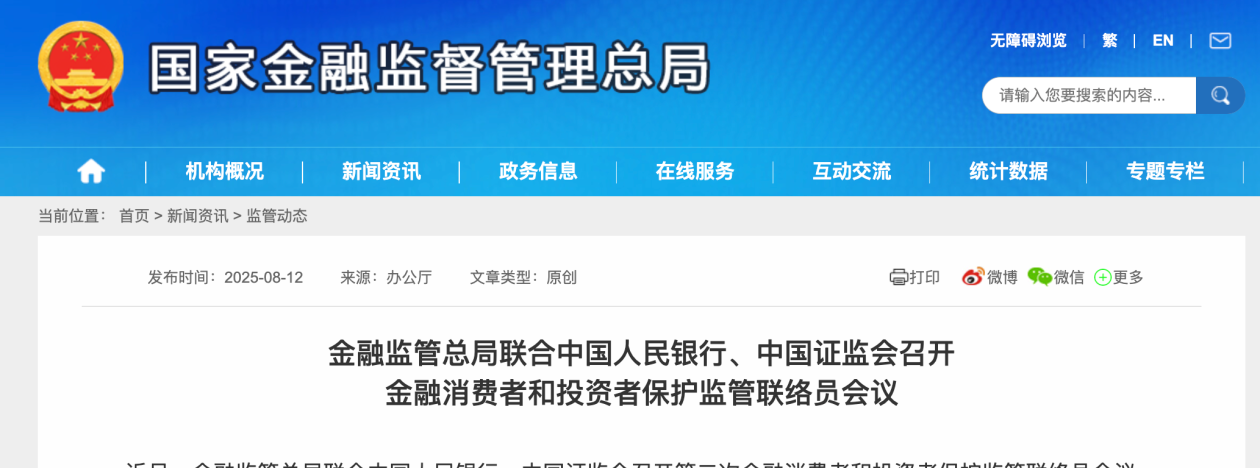
三部门召开会议,通报上半年金融消费投诉情况
Huan Qiu Wang· 2025-08-13 04:02
Group 1 - The meeting was held by the Financial Regulatory Administration in collaboration with the People's Bank of China and the China Securities Regulatory Commission to discuss financial consumer and investor protection [1][3] - The meeting reported on the financial consumer complaints situation for the first half of 2025 and discussed the governance of the financial consumption environment [3] - Emphasis was placed on a problem-oriented approach to address key issues raised by financial consumers, with a focus on collaborative governance and risk mitigation [3] Group 2 - The meeting highlighted the need for enhanced cooperation among relevant departments to strengthen the governance of the financial consumption environment and address issues harming consumer rights [3] - A financial education campaign is planned for September, aiming to improve public financial literacy and risk prevention capabilities [3] - The importance of information sharing and collaborative governance was underscored to ensure effective consumer and investor protection mechanisms [3]
人民银行车士义:截至6月末不含个人住房贷款的全国住户消费贷款余额21.2万亿元
Bei Jing Shang Bao· 2025-08-13 03:55
Group 1 - The core viewpoint of the article highlights the introduction of two financial support policies aimed at boosting consumer spending and supporting service industry loans [1] - The People's Bank of China has implemented various monetary policy tools to enhance the quality of economic development and has established a 500 billion yuan (approximately 70.5 billion USD) re-lending program for service consumption and elderly care [1] - As of the end of June, the balance of household consumption loans, excluding personal housing loans, reached 21.2 trillion yuan (approximately 3 trillion USD), while the loan balance for key service consumption sectors such as accommodation, catering, entertainment, education, and resident services was 2.8 trillion yuan (approximately 392 billion USD) [1]
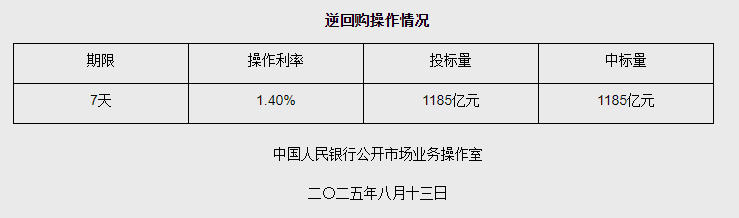
8月13日央行开展1185亿元7天期逆回购操作
Zhong Guo Xin Wen Wang· 2025-08-13 02:08
Core Viewpoint - The People's Bank of China conducted a reverse repurchase operation amounting to 118.5 billion yuan on August 13, 2025, at a fixed interest rate and through a quantity tendering method [1][2]. Group 1: Operation Details - The operation involved a 7-day term with an interest rate of 1.409% [2]. - The total bidding amount matched the winning amount, both being 118.5 billion yuan [2].
中国机构配置手册(2025版)之流动性与货币政策篇
2025-08-12 15:05
Summary of Key Points from the Conference Call Industry Overview - The conference call discusses the liquidity and monetary policy framework in China, focusing on the broad money supply (M2) and its implications for the banking sector and the economy as a whole [1][2][3]. Core Insights and Arguments - As of April 2025, China's broad money supply (M2) reached 325 trillion yuan, which includes M1, time deposits, and personal deposits, reflecting the purchasing power of society [1][4]. - The legal reserve requirement ratio (RRR) determines the amount of reserves that commercial banks must freeze, impacting their excess reserves and liquidity management [6][14]. - The People's Bank of China (PBOC) is shifting its monetary policy focus from the quantity of money supply to interest rates, with ongoing reforms to the Loan Prime Rate (LPR) [2][23]. - The relationship between M2 and the macroeconomy has weakened due to an increase in time and personal deposits, leading to a decrease in the velocity of money and reduced consumer and investment behavior [19]. - The PBOC has restarted government bond trading operations to manage liquidity more effectively, especially as the room for further RRR cuts is limited [18]. Important but Overlooked Content - The liquidity analysis of broad money considers various channels, including loan-derived deposits and the phenomenon of deposit outflows when residents purchase stocks or bonds, which do not count towards M2 [13]. - The phenomenon of "deposit disintermediation" is becoming more pronounced, with residents increasingly investing in low-risk financial products, which poses challenges for liquidity management in banks and the central bank [20][21]. - The behavior of bond fund managers can significantly impact market liquidity due to their similar investment strategies and regulatory requirements, leading to synchronized actions that affect the overall financial system [22]. - The current LPR reform is still evolving and aims to enhance the loan pricing mechanism, increasing transparency and market responsiveness [26]. This summary encapsulates the key points discussed in the conference call, providing insights into the current state of China's monetary policy and its implications for the banking sector and the broader economy.
三部门联手对金融消费者集中反映的重点领域问题开展协同治理
Bei Jing Shang Bao· 2025-08-12 10:41
Core Viewpoint - The meeting emphasized the importance of protecting financial consumers and investors, focusing on addressing complaints and enhancing financial literacy [1] Group 1: Financial Consumer Protection - The Financial Regulatory Bureau, along with the People's Bank of China and the China Securities Regulatory Commission, held a meeting to discuss financial consumer complaints for the first half of 2025 [1] - The meeting highlighted the need for a problem-oriented approach to address key issues raised by financial consumers [1] - There is a commitment to strengthen collaboration with relevant departments to tackle prominent issues affecting consumer rights [1] Group 2: Financial Education and Awareness - The meeting outlined plans for a financial education campaign in September, aiming to improve public financial literacy and risk prevention capabilities [1] - Effective methods for financial education and publicity will be employed to enhance the understanding of financial products among the public [1] - The importance of information sharing and collaborative governance in consumer protection efforts was stressed to ensure high-quality development in financial consumer and investor protection [1]