
宁波银行

Search documents
兴业国企改革混合A:2025年上半年利润138.38万元 净值增长率2.03%
Sou Hu Cai Jing· 2025-09-05 04:29
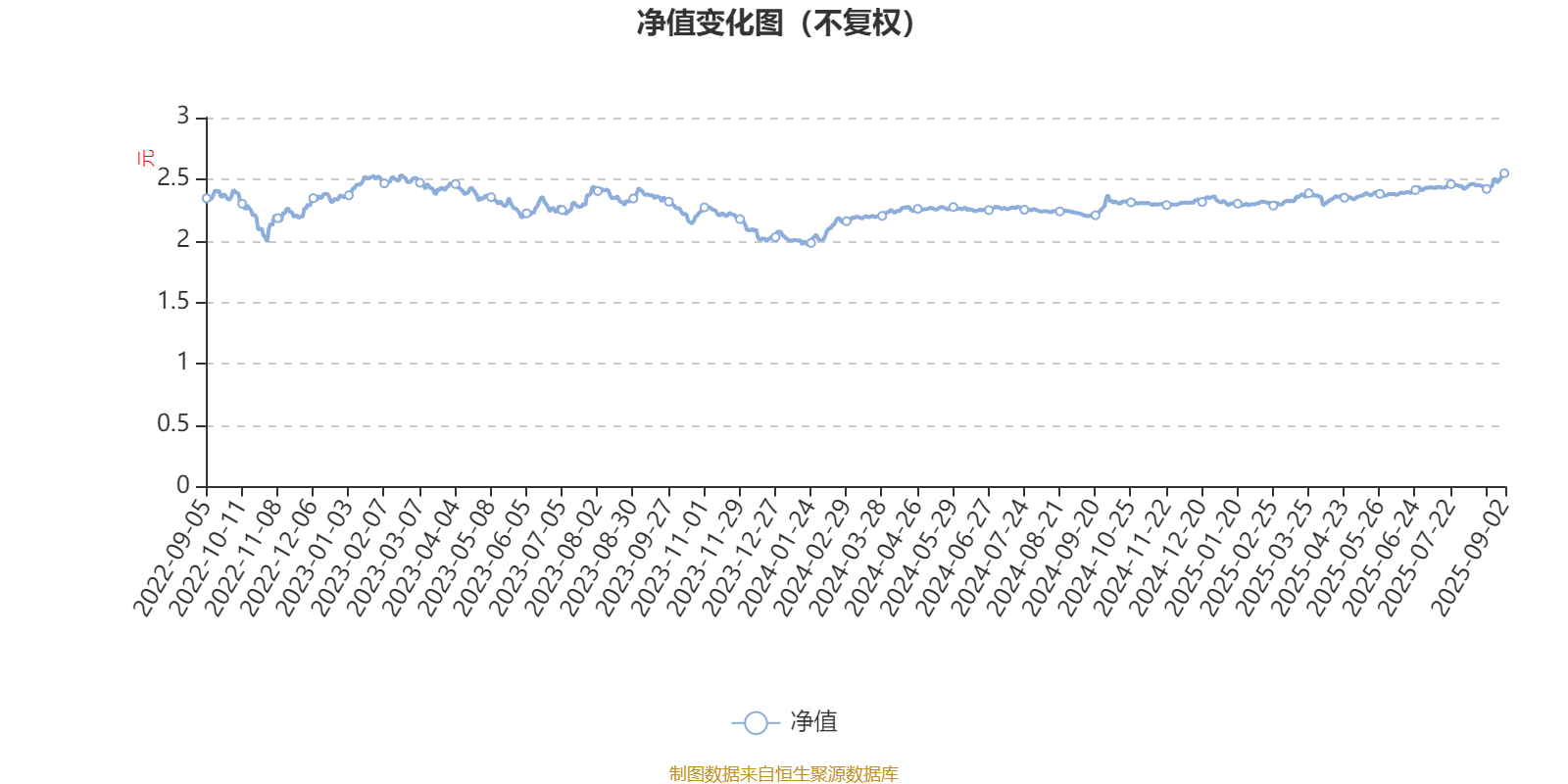
Core Viewpoint - The AI Fund Xingye State-Owned Enterprise Reform Mixed A (001623) reported a profit of 1.3838 million yuan for the first half of 2025, with a net value growth rate of 2.03% and a fund size of 156 million yuan as of the end of June 2025 [4] Fund Performance - As of September 2, 2025, the fund's unit net value was 2.548 yuan, with a near-term performance showing a 7.60% growth rate over the past three months, 11.07% over the past six months, and 14.31% over the past year [8][4] - The fund's three-year Sharpe ratio was 0.1271, ranking 327 out of 875 comparable funds, while the maximum drawdown over the same period was 22.4%, ranking 758 out of 861 [31][33] Fund Management and Strategy - The fund manager, Liu Fangxu, has successfully managed four funds with positive returns over the past year, with the highest growth rate of 40.19% for Xingye Ruijin Mixed A [4] - The fund aims to construct a portfolio by actively selecting high-quality listed companies, particularly state-owned enterprises, while controlling risks to provide stable returns [5] Market Context - The fund management noted that U.S. import tariffs on China have increased by over 30% this year, with expectations of further pressure on China's external demand in the second half of the year due to the ongoing trade tensions [4] - The central government emphasizes the need to deepen domestic market construction and enhance the attractiveness and inclusiveness of the domestic capital market [4] Valuation Metrics - As of June 30, 2025, the fund's weighted average price-to-earnings (P/E) ratio was approximately 10.07 times, significantly lower than the industry average of 15.75 times [14] - The weighted average price-to-book (P/B) ratio was about 1.25 times, compared to the industry average of 2.52 times [14] Shareholder Composition - As of June 30, 2025, the fund had 6,325 holders, with a total of 64.5619 million shares held. Institutional investors accounted for 25.39% of the holdings, while individual investors made up 74.61% [40]

这家上市银行公开选聘首席信息官!有这些要求
券商中国· 2025-09-05 02:56
Core Viewpoint - The recruitment announcement by Zhengzhou Bank highlights the increasing importance of the Chief Information Officer (CIO) role in driving the bank's digital transformation strategy, particularly in the context of emerging technologies like artificial intelligence [2][4]. Group 1: Recruitment Requirements - Zhengzhou Bank emphasizes the need for candidates to have a deep understanding of the bank's digital transformation strategy and to be proficient in various banking operations [3][4]. - Candidates are required to have at least 6 years of experience in information technology, including 4 years in senior management roles and 2 years in financial work [4]. - The bank seeks individuals with management experience in information technology at major state-owned banks, national joint-stock commercial banks, or leading city commercial banks [4]. Group 2: Digital Transformation and Technology - The role of the CIO is crucial for the digital transformation of banks, with a focus on leveraging technologies such as big data, cloud computing, artificial intelligence, and blockchain [6]. - The recruitment criteria include a strong insight into these technologies and successful practical implementation experience [6]. - The rise of digital finance has significantly enhanced banking efficiency, with AI becoming a key driver for transformation [6][7]. Group 3: Performance Metrics - As of mid-2025, Zhengzhou Bank reported 5,593 employees, with 339 in information technology, accounting for 5.54% of the workforce [5]. - The bank achieved a revenue of 6.69 billion yuan, a year-on-year increase of 4.64%, and a net profit of 1.63 billion yuan, up 2.10% [5]. - The total assets of Zhengzhou Bank reached 719.738 billion yuan, reflecting a growth of 6.41% compared to the previous year [5]. Group 4: Industry Trends - Many listed banks are prioritizing AI in their strategic transformation, with major banks like ICBC and Agricultural Bank of China leading the way in AI application [7][8]. - Smaller banks are also making strides in AI capabilities, with various initiatives to enhance their digital transformation efforts [7][8]. - The ability of commercial banks to effectively implement digital transformation will be critical to their future competitiveness [8].

揭秘银行薪酬: 24家银行上半年 人均月薪超3万元
Sou Hu Cai Jing· 2025-09-05 01:30
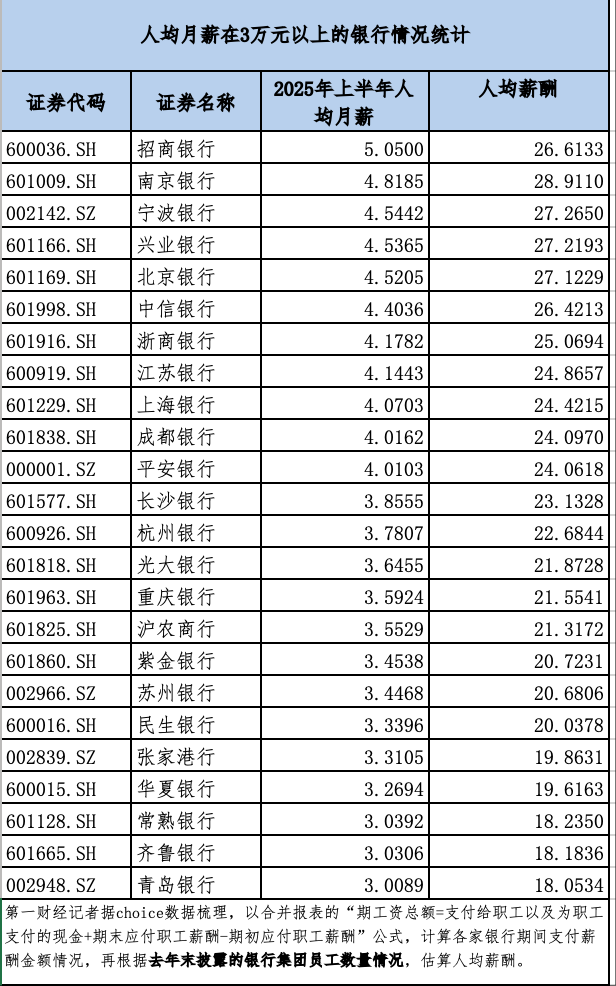
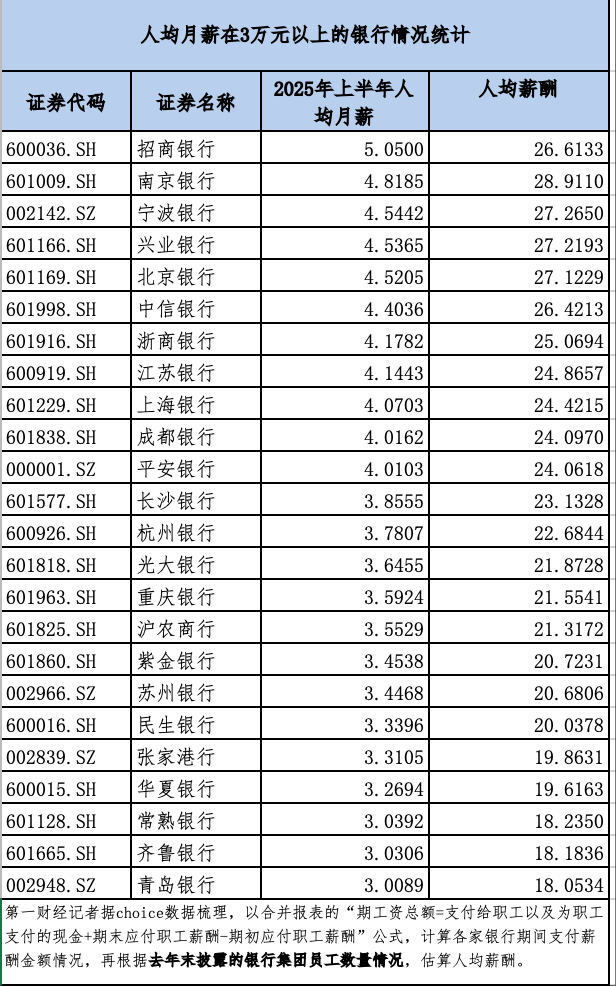
Core Viewpoint - The banking sector in A-shares has regained its position as the largest sector with a market value of 11.31 trillion yuan, surpassing the electronics sector, while the salary situation of banking employees has also drawn attention [1] Salary Overview - The average monthly salary in the banking industry for the first half of 2025 is 30,200 yuan, a slight increase of 1,300 yuan year-on-year, reversing a trend of a 5,300 yuan decrease in the same period last year [2][3] - The top tier of banks, including joint-stock banks and strong city commercial banks in eastern regions, have an average monthly salary exceeding 45,000 yuan, with specific banks like China Merchants Bank and Nanjing Bank reporting 50,500 yuan and 48,200 yuan respectively [2] Salary Distribution - The second tier consists of state-owned banks with average monthly salaries ranging from 25,000 to 30,000 yuan, with Bank of China at 28,200 yuan and China Construction Bank at 26,200 yuan [3] - The third tier includes some rural and city commercial banks in remote areas, with average salaries below 25,000 yuan, such as Zhengzhou Bank and Xi'an Bank at 24,700 yuan and 22,800 yuan respectively [3] Management Salary Trends - A notable trend is the decrease in salaries for key management personnel across many banks, with 33 out of 42 A-share listed banks reporting a year-on-year decline in management salaries, with the highest drop reaching 82.4% [5][6] - For instance, Zhengzhou Bank's management salary total fell from 103.88 million yuan to 59.57 million yuan year-on-year [5] Salary Structure Reform - Many banks are emphasizing salary structure reform, focusing on value creation and incentivizing young employees to work in grassroots positions [7] - The "reverse salary recovery" mechanism is being established to enhance performance-based pay and mitigate operational risks, with banks like Zhengzhou Bank and China Merchants Bank implementing measures to recover performance-related pay under certain conditions [8] Industry Salary Context - The salary levels of listed banks do not represent the overall banking industry, as there are over 4,000 banking institutions in China, with many smaller banks having significantly lower average salaries compared to listed banks [9]

揭秘银行薪酬:24家银行上半年人均月薪超3万,高管降薪成趋势
Di Yi Cai Jing· 2025-09-04 22:49
Core Viewpoint - The banking sector in A-shares has regained its position as the largest sector with a market value of 11.31 trillion yuan, surpassing the electronics sector, while the salary situation of banking employees has also drawn attention [1] Salary Overview - The average monthly salary in the banking industry for the first half of 2025 is 30,200 yuan, a slight increase of 1,300 yuan year-on-year, reversing a trend of a 5,300 yuan decrease in the same period last year [2][4] - The top tier of banks, including joint-stock banks and strong city commercial banks in eastern regions, have an average monthly salary exceeding 45,000 yuan, with specific banks like China Merchants Bank and Nanjing Bank reporting 50,500 yuan and 48,185 yuan respectively [2][3] Salary Distribution - The second tier consists of state-owned banks with average monthly salaries ranging from 25,000 to 30,000 yuan, with Bank of China at 28,200 yuan and China Construction Bank at 26,200 yuan [3] - The third tier includes some rural and city commercial banks in remote areas, with average salaries below 25,000 yuan, such as Zhengzhou Bank and Xi'an Bank at 24,700 yuan and 22,800 yuan respectively [4] Management Salary Trends - A significant trend in the banking industry is the reduction of executive salaries, with 33 out of 42 A-share listed banks reporting a decrease in management compensation, with the highest drop reaching 82.4% [5][6] - For instance, Zhengzhou Bank's key management compensation fell from 103.88 million yuan to 59.57 million yuan year-on-year [5] Salary Reform and Mechanisms - Many banks are emphasizing salary structure reforms, focusing on value creation and incentivizing younger employees to work in grassroots positions [6][7] - The implementation of a reverse salary mechanism is becoming more common, allowing banks to reclaim performance-related pay in cases of misconduct or excessive risk exposure [7] Industry Context - It is important to note that the salary levels of listed banks do not represent the overall banking industry, as many smaller banks and rural credit cooperatives have significantly lower average salaries due to various factors affecting their profitability [8]




24家银行上半年人均月薪超3万元
第一财经· 2025-09-04 16:10
Core Viewpoint - The banking sector in A-shares has regained its position as the largest sector with a market value of 11.31 trillion yuan, surpassing the electronics sector, and the salary situation of banking employees has become a focal point as 42 banks disclose their salary data for the first half of 2025 [2][3]. Salary Structure - The average monthly salary in the banking industry for the first half of 2025 is 30,200 yuan, a slight increase of 1,300 yuan year-on-year, reversing the trend of a 5,300 yuan decrease in the same period last year [5][6]. - The top tier of banks, including joint-stock banks and strong city commercial banks in eastern regions, have an average monthly salary exceeding 45,000 yuan, with specific banks like China Merchants Bank and Nanjing Bank reporting 50,500 yuan and 48,185 yuan respectively [5][6]. - The second tier consists of state-owned banks with average monthly salaries ranging from 25,000 to 30,000 yuan, while the third tier includes some rural and city commercial banks with salaries below 25,000 yuan [7]. Management Salary Trends - A notable trend is the decline in executive salaries across the banking sector, with 33 out of 42 A-share listed banks reporting a decrease in management compensation, with the highest drop reaching 82.4% [9][10]. - For instance, Zhengzhou Bank's key management salary total fell from 10,388 million yuan to 5,957 million yuan year-on-year [9]. - The emphasis on value creation and the adjustment of salary structures to favor grassroots employees are becoming key themes in many banks' compensation reforms [10][11]. Salary Reform Mechanisms - The implementation of a reverse salary reclamation mechanism is gaining traction, with banks establishing systems to withhold or reclaim performance-related pay in cases of misconduct or excessive risk exposure [11]. - For example, China Merchants Bank reported reclaiming over 100 million yuan in performance pay over the past two years due to such mechanisms [11]. - The overall trend indicates a shift towards aligning total compensation with bank performance, suggesting that if revenue and profits decline, salaries may also be affected [11][12].

投资者推介会:中国金融领域,什么将推动估值的下一波上涨-Investor Presentation_ China Financials_ What will drive the next leg up in valuation_
2025-09-04 15:08
Summary of Key Points from the Conference Call Industry Overview - **Industry**: China Financials - **Outlook**: Attractive investment opportunities in the financial sector, with a focus on banks, brokers, and insurance companies [2][5][6] Core Insights and Arguments - **New Era of Financial Development**: The financial market in China is transitioning to a more stable operating environment, moving away from boom-and-bust cycles [6][8] - **Credit Demand and Risk Reduction**: Expected moderate but steady credit demand and balance sheet growth, with a gradual reduction in financial sector risks [8][10] - **Profitability Rebound**: Anticipated modest rebound in profitability for financial firms, supported by stabilizing financial asset yields and bank net interest margins (NIMs) [8][27] - **High-Risk Asset Reduction**: High-risk financial assets are projected to decrease from Rmb21 trillion (4.9% of total financial assets) in 2025 to approximately Rmb15 trillion (3%) by the end of 2027 [9][10] - **Household Financial Assets Growth**: Strong growth in household financial assets, projected to reach Rmb430 trillion by 2030, providing liquidity for financial stock investments [49][50] Financial Sector Performance - **Profit Growth Expectations**: A bull case scenario predicts double-digit profit growth for China's financial sector, driven by improved loan yields and market-oriented financial policies [30][34][58] - **Valuation Recovery**: Financial sector valuations are expected to rebound due to lower risk-free rates and a narrowing valuation gap between financials and the broader market [39][46] - **NIM Stabilization**: Stabilizing NIM and smooth risk digestion processes are expected to support bank profits, with a recovery in NPAT growth anticipated for 2026 and 2027 [55][57] Investment Opportunities - **Top Investment Picks**: - **Banks**: Bank of Ningbo, Minsheng Bank - **Insurance**: Ping An Insurance - **Brokers**: Futu, CICC - **Fintech**: Qifu Technology [54][59][66][74] - **Sector-Specific Drivers**: - Brokers are expected to benefit from a recovery cycle, with strong institutional franchises driving differentiation in ROEs [71][73] - Insurers are addressing interest rate risks through pricing reforms, with healthy demand expected to continue [66][67] Additional Important Insights - **Regulatory Changes**: Recent regulations aimed at fair competition and timely payments to SMEs are expected to impact industrial investment and credit growth positively [17][18] - **Market Sentiment**: Improved market sentiment and corporate earnings growth are anticipated to support the recovery of the A-share market and overall financial sector performance [73][80] - **Digital Assets**: The potential for digital assets to contribute to revenue growth, particularly in the context of crypto trading, is highlighted as a structural growth driver [75][79] This summary encapsulates the key points discussed in the conference call regarding the outlook for the China financial sector, highlighting both opportunities and risks for investors.
“把脉”A股42家上市银行中期资产质量:对公贷款不良率持续向好,零售贷款仍处风险暴露期
Mei Ri Jing Ji Xin Wen· 2025-09-04 14:35
Group 1: Overall Asset Quality - As of August 31, 2023, the asset quality of 42 listed banks in A-shares shows a stable improvement, with some banks experiencing a slight increase in non-performing loan (NPL) ratios compared to the end of the previous year [1] - The overall NPL ratio for commercial banks was 1.49% at the end of Q2 2023, improving by 0.02 percentage points from the end of Q1 [3] - The provision coverage ratio for state-owned banks and rural commercial banks increased to 249.16% and 161.87%, respectively, while the ratios for joint-stock banks and city commercial banks decreased [4] Group 2: Non-Performing Loan Trends - The NPL ratio for corporate loans is improving, while the NPL ratio for retail loans is on the rise, indicating a structural change in asset quality [5][6] - For example, Industrial and Commercial Bank of China (ICBC) reported a decrease in corporate loan NPL ratio from 1.58% to 1.47%, while the personal loan NPL ratio increased from 1.15% to 1.35% [5] - The rise in retail loan NPLs is attributed to factors such as market conditions, increased flexible employment, and changes in industry environments affecting borrower income [6] Group 3: Real Estate Loan Performance - The real estate sector remains a significant source of NPLs, with some banks reporting an increase in real estate loan NPL ratios, while others have seen improvements [7][8] - For instance, Qingnong Commercial Bank's real estate NPL ratio rose to 21.32%, an increase of 14.15 percentage points from the end of the previous year [7] - The overall decline in real estate sales and the high leverage of real estate companies are fundamental reasons for the rising NPL ratios in this sector [8]





上半年银行新增15万高净值客户,“科学家”正在成为新宠?
Di Yi Cai Jing· 2025-09-04 13:04
Group 1 - The high-net-worth client segment is a focal point for retail banking, with significant competition among commercial banks to capture this valuable market [1][4] - As of June 2025, 15 banks reported private banking data, with a total client base exceeding 1.63 million, marking a growth of nearly 150,000 clients or over 10% since the beginning of the year [1] - The four major state-owned banks have crossed the 3 trillion yuan mark in assets under management (AUM), with Industrial Bank entering the "trillion club" for the first time [1][2] Group 2 - The four major state-owned banks collectively have 864,000 private banking clients, with Agricultural Bank leading in AUM at 3.5 trillion yuan, and a client base of over 279,000 [2] - China Construction Bank reported a remarkable AUM growth of 14.39% to 3.18 trillion yuan, with a client increase of 34,000, marking a 14.69% rise [2] - Postal Savings Bank, despite not disclosing AUM, saw a client growth of over 21%, reaching 41,400 clients, indicating a strong potential for future AUM increases [2] Group 3 - Joint-stock banks are experiencing a stark contrast in performance, with China Merchants Bank leading in client growth among joint-stock banks, while Ping An Bank reported a slight decline in AUM [3] - The AUM for CITIC Bank and Industrial Bank grew by 9.33% and 9.59%, respectively, indicating steady growth in the joint-stock sector [3] - Regional banks like Ningbo Bank and Beijing Bank demonstrated strong growth, with AUM increases of 17.62% and 17.06%, respectively [3] Group 4 - The private banking sector in China is characterized by a concentration of leading banks and differentiated competition, with smaller banks adopting unique strategies to capture market share [4] - The shift in client demographics is evident, with a growing number of new high-net-worth clients entering the market, while the growth of ultra-high-net-worth clients is slowing [5][6] Group 5 - The focus on new client segments, such as scientists and tech entrepreneurs, is reshaping the private banking landscape, with banks redefining their target client profiles [7] - Private banking is becoming a key driver for retail banking transformation, providing stability and high value-added services amid traditional retail banking challenges [7][8] - The demand for non-financial services among private banking clients is creating new opportunities for banks to enhance customer engagement and service offerings [8]


揭秘银行薪酬:24家银行上半年人均月薪超3万元,高管降薪成趋势
Di Yi Cai Jing· 2025-09-04 13:04
Core Insights - The banking sector's compensation reform has shifted from "controlling high" to a dual focus on "lowering" and "risk constraints" [1] - The average monthly salary for bank employees in the first half of 2025 was 30,200 yuan, a slight increase of 1,300 yuan year-on-year [2][5] - A total of 42 banks reported a decline in management salaries, with the highest drop reaching 82.4% [6][8] Salary Structure - The banking industry has formed a salary tier system, with leading joint-stock banks and strong city commercial banks in the first tier, averaging over 45,000 yuan per month [2][4] - Major state-owned banks fall into the second tier, with average monthly salaries ranging from 25,000 to 30,000 yuan [4][5] - Some rural and city commercial banks in remote areas are in the third tier, with average salaries below 25,000 yuan [5] Management Salary Trends - Key management salaries have seen significant reductions, with 33 out of 42 listed banks reporting a decrease in total management compensation [6][8] - For example, Zhengzhou Bank's management compensation dropped from 10,388 million yuan to 5,957 million yuan year-on-year [6] - The trend of management salary cuts is becoming a new norm in the industry, with banks emphasizing value creation and risk management in their compensation structures [7][8] Compensation Reform Mechanisms - Many banks are implementing reverse salary recovery mechanisms to enhance performance accountability [8] - For instance, Zhengzhou Bank has established a mechanism for deferred payment and performance salary recovery to mitigate operational risks [8] - The overall direction of salary distribution is shifting towards grassroots employees, reducing the previous "averaging" phenomenon [8][9] Industry Context - The salary levels of listed banks do not represent the overall banking industry's compensation situation, as many smaller banks have significantly lower average salaries [9] - The banking sector consists of over 4,000 financial institutions, with listed banks being a small fraction of the total [9]
国信证券(香港):银行板块业绩筑底 关注顺周期标的宁波银行等
Zhi Tong Cai Jing· 2025-09-04 09:15
Core Viewpoint - The report from Guosen Securities (Hong Kong) indicates that 2025 marks the end of the current downcycle for the banking sector, with expectations for improvement in the industry fundamentals next year, maintaining an "outperform" rating for the sector [1] Group 1: Overall Review - In the first half of 2025, listed banks reported total operating income of 2.92 trillion yuan, a year-on-year increase of 1.0%, and a net profit attributable to shareholders of 1.10 trillion yuan, up 0.8% year-on-year [1] - The growth in income and net profit accelerated compared to the first quarter, primarily due to a decline in market interest rates in the second quarter, which reduced the drag from bond investment losses and other non-interest income on net profit growth [1] Group 2: Net Interest Margin - The overall net interest margin for listed banks decreased by 14 basis points year-on-year to 1.41%, a decline similar to the 13 basis points drop in the first quarter, but narrower than the 17 basis points decline in 2024 [2] - On a quarterly basis, the net interest margin fell by 4 basis points from the first to the second quarter [2] - The outlook for the year suggests that the net interest margin will continue to narrow due to LPR cuts and weak credit demand, although the decline is expected to be slightly lessened by the drop in deposit rates in May [2] Group 3: Asset Quality - The pressure on asset quality is marginally increasing, characterized by rising overdue rates and an increase in the non-performing loan generation rate, primarily in the retail sector [3] - Provisioning efforts have intensified, with the ratio of loan loss provisions to non-performing loan generation rising to 106%, although this remains at a historically low level [3] Group 4: Asset Scale - As of the end of the second quarter of 2025, the total assets of listed banks grew by 9.6% year-on-year, with a notable rebound in growth rates from the six major banks and city commercial banks [4] Group 5: Non-Interest Income - After three years of adjustment, net fee income has rebounded in the first half of this year [5] - Other non-interest income saw a significant decline in growth in the first quarter due to rising market interest rates, but rebounded in the second quarter as market rates fell again [5] Group 6: Industry Outlook - The current banking fundamentals are under pressure, with net interest margin being the primary source of stress and a slight increase in asset quality pressure [6] - With policy support for net interest margins and the impact of the May deposit rate cuts, the decline in net interest margin is expected to narrow next year, and a turning point for retail loan non-performing generation may be seen in 2026 [6] - Overall, 2025 is viewed as a year of bottoming out, with potential for revenue and profit growth to turn upward in 2026 [6]