江阴银行

Search documents
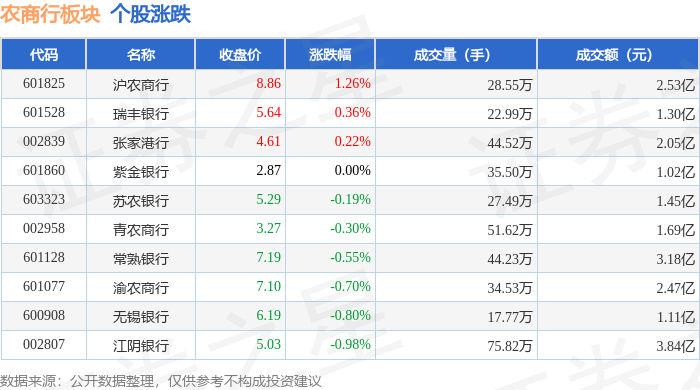
农商行板块11月5日涨0.09%,沪农商行领涨,主力资金净流出1974.75万元
Zheng Xing Xing Ye Ri Bao· 2025-11-05 08:55
Core Insights - The agricultural commercial bank sector experienced a slight increase of 0.09% on November 5, with Shanghai Agricultural Commercial Bank leading the gains [1] - The Shanghai Composite Index closed at 3969.25, up 0.23%, while the Shenzhen Component Index closed at 13223.56, up 0.37% [1] Stock Performance - Shanghai Agricultural Commercial Bank (601825) closed at 8.86, with a rise of 1.26% and a trading volume of 285,500 shares, amounting to a transaction value of 253 million yuan [1] - Other notable performances include: - Ruifeng Bank (601528) at 5.64, up 0.36% - Zhangjiagang Bank (002839) at 4.61, up 0.22% - Zijin Bank (601860) at 2.87, unchanged - Su Nong Bank (603323) at 5.29, down 0.19% [1] Capital Flow - The agricultural commercial bank sector saw a net outflow of 19.75 million yuan from institutional investors and 51.92 million yuan from speculative funds, while retail investors contributed a net inflow of 71.67 million yuan [1] - Detailed capital flow for specific banks includes: - Changshu Bank (601128) with a net inflow of 32.61 million yuan from institutional investors - Shanghai Agricultural Commercial Bank (601825) with a net inflow of 19.93 million yuan from institutional investors [2] - Jiangyin Bank (002807) had a net inflow of 2.13 million yuan from retail investors despite a net outflow from institutional and speculative funds [2]


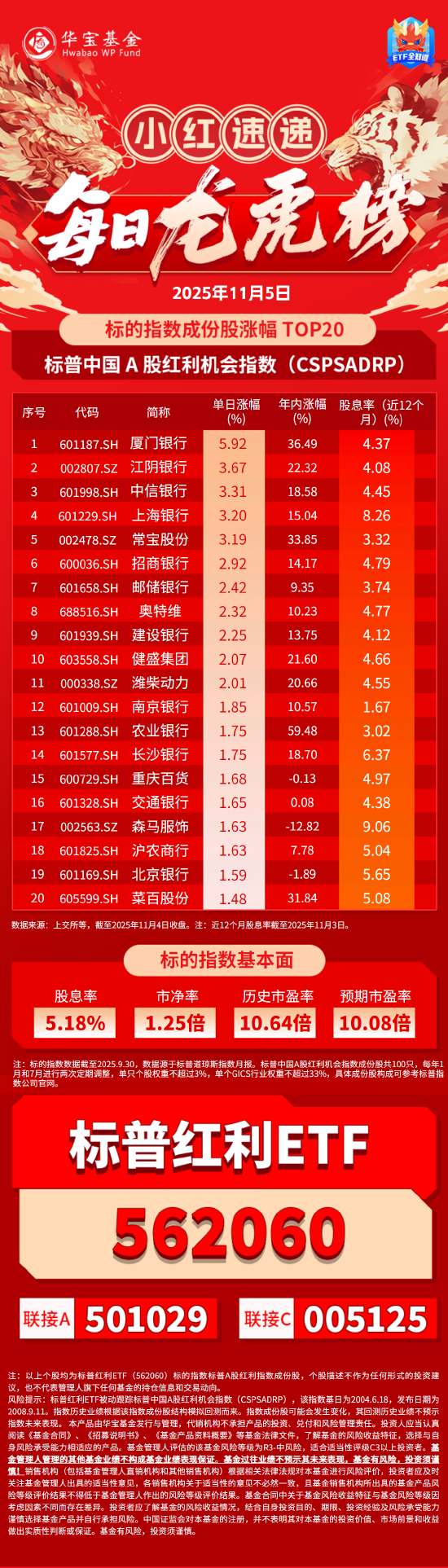
小红日报 | 银行再度领涨!标普红利ETF(562060)标的指数收跌0.06%显韧性
Xin Lang Ji Jin· 2025-11-05 00:50
Core Insights - The article highlights the top-performing stocks in the S&P China A-Share Dividend Opportunity Index, showcasing significant year-to-date gains and dividend yields for various companies [1]. Group 1: Stock Performance - Xiamen Bank (601187.SH) leads with a 5.92% increase in the latest trading session and a 36.49% year-to-date gain, along with a dividend yield of 4.37% [1]. - Jiangyin Bank (002807.SZ) follows with a 3.67% daily increase and a 22.32% year-to-date gain, offering a dividend yield of 4.08% [1]. - CITIC Bank (601998.SH) shows a 3.31% rise today and an 18.58% increase year-to-date, with a dividend yield of 4.45% [1]. - Shanghai Bank (601229.SH) has a daily increase of 3.20% and a year-to-date gain of 15.04%, boasting a high dividend yield of 8.26% [1]. - Other notable performers include Changbao Co. (002478.SZ) with a 3.19% daily increase and a 33.85% year-to-date gain, and China Merchants Bank (600036.SH) with a 2.92% daily rise and a 14.17% year-to-date increase [1]. Group 2: Dividend Yields - Shanghai Bank (601229.SH) offers the highest dividend yield at 8.26%, indicating strong returns for investors [1]. - Other companies with notable dividend yields include Semei Clothing (002563.SZ) at 9.06% and Changsha Bank (601577.SH) at 6.37% [1]. - The average dividend yield among the top 20 stocks reflects a trend towards higher returns for dividend-seeking investors [1].



江阴农商银行打造科创企业“雨林式”成长沃土
Xin Hua Ri Bao· 2025-11-04 22:05
Core Viewpoint - Jiangyin Rural Commercial Bank is focusing on building a comprehensive technology finance service system, promoting innovation and collaboration among government, business associations, and enterprises to create a supportive ecosystem for technological innovation [1] Group 1: Technology Finance Development - The bank has organized 14 events this year, including "Government-Bank-Enterprise Connection Meetings" and "Technology Innovation Roadshow Seasons," to support over 40 recognized high-tech enterprises [1] - Jiangyin's high-tech industry output value is projected to reach 291.92 billion yuan in 2024, accounting for 38.8% of the total industrial output, with a year-on-year growth of 9% [1] Group 2: Collaborative Innovation - The bank has established strategic cooperation with the Federation of Industry and Commerce and Jiangyin Campus of Nanjing University of Technology to align financial services with industry needs [2] - A comprehensive strategic partnership with Jiangyin High-tech Zone has been formed to enhance financing for private enterprises and support major projects [2] Group 3: Service Network Innovation - Jiangyin Rural Commercial Bank has set up a "High-tech Innovation Service Center" and a technology branch in Jiangyin High-tech Zone, creating a dual-track model for technology finance services [3] - The bank has implemented a new party-building model to cultivate a talent pool that understands technology, industry, and finance [3] Group 4: Comprehensive Service Innovation - The bank has introduced various loan products tailored for different stages of enterprise development, including "Technology Enterprise Loans" and "Talent Loans," focusing on technology potential and team strength rather than traditional financial metrics [4] - As of September, the bank has completed two "loan + equity" agreements to alleviate financial pressure on enterprises while maintaining control for core teams [4] Group 5: Process and Brand Innovation - The bank has streamlined processes to create a green channel for technology finance, reducing approval times by 60% compared to traditional methods [5] - The bank has launched a content matrix to promote technology enterprises' development stories, enhancing communication with capital and markets [5] Group 6: Overall Impact - By the end of September, the bank had provided financing services to 1,503 technology enterprises, with a total credit balance of 15.5 billion yuan [5] - The bank aims to continue refining its comprehensive service model to effectively support the transformation of technological achievements into productive forces [5]
银行业2025年三季报综述:业绩稳健性凸显,引领银行价值回归
Shenwan Hongyuan Securities· 2025-11-04 14:41
Investment Rating - The report maintains a positive outlook on the banking sector, indicating a potential return to a valuation of 1 times net asset value [4][7]. Core Insights - The banking sector has demonstrated steady performance, with a year-to-date revenue growth of 0.8% and a net profit growth of 1.5% for the first nine months of 2025, reflecting a stable regulatory environment supporting bank profitability [10][14]. - The report highlights a shift in focus from scale to balance in credit growth, with banks increasingly pursuing a "quantity-price balance" strategy [4][7]. - The cost of liabilities has improved more significantly than the decline in asset pricing, leading to a stabilization of net interest margins, which is expected to continue into the next year [4][7]. - Asset quality remains stable but shows signs of divergence, particularly with rising risks in small and micro businesses [4][7]. - The report suggests that the current dividend yield of the banking sector has returned to an attractive range, indicating a significant disconnect between stable earnings and stock holdings, which could lead to a value recovery [4][7]. Summary by Sections Performance Overview - The banking sector's performance has been characterized by a steady increase in revenue and profit, with state-owned banks showing better-than-expected stability and regional banks leading in performance [11][12][15]. - The report notes that the revenue growth of state-owned banks has turned positive, with non-interest income contributing significantly to this growth [12][15]. Credit Growth and Strategy - The report indicates a gradual abandonment of scale-driven growth, with banks focusing on achieving a balance between volume and pricing in their lending practices [4][7]. - The credit growth rate for listed banks decreased by 0.3 percentage points to 7.7% in Q3 2025, with state-owned banks maintaining a growth rate of approximately 8.5% [4][7]. Profitability and Asset Quality - The net interest margin for listed banks remained stable at 1.5%, with a slight quarter-on-quarter increase of 3 basis points in Q3 2025 [4][7]. - The overall non-performing loan ratio remained stable at 1.22%, indicating manageable risk levels across the sector [4][7]. Investment Recommendations - The report recommends focusing on leading banks and undervalued regional banks as key investment opportunities, suggesting that the recovery in valuations is supported by stable earnings and attractive dividend yields [4][7].



A股走弱,原因找到了
Guo Ji Jin Rong Bao· 2025-11-04 13:21
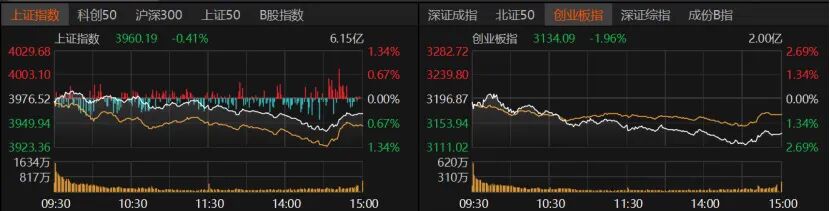
11月4日,A股出现"量价齐跌"态势,日成交额跌破2万亿元,创业板指跌近2%。有色金属、电力设备、医药生 物、电子等热门赛道领跌,而银行股则发挥护盘作用。市场共计3650只个股收跌。 受访人士表示,在10月制造业采购经理指数(PMI)不及预期、部分高估值板块持仓拥挤引发抛压,以及外围市 场的影响下,A股今日出现调整,但这属于正常的回调。短期内,市场预计仍将维持震荡态势。投资者在维持仓位基 本稳定的基础上,可对涨幅较高的品种适时动态止盈,锁定收益。 A股缩量回调 今日,A股市场整体表现低迷,沪指收跌0.41%报3960.19点,创业板指收跌1.96%报3134.09点,深证成指跌近 2%,科创50、沪深300跌约1%,北证50跌逾2%,上证50微跌。 与此同时,A股市场交易量能有所萎缩,日成交额未能突破2万亿元,仅为1.94万亿元。不过,在杠杆资金方面, 热度并未减退。截至11月3日,沪深京两融余额合计达到2.49万亿元。 传统周期股护盘,银行股领涨。其中,厦门银行涨近6%,江阴银行、中信银行、上海银行、重庆银行涨幅均超过 3%,招商银行、工商银行、兴业银行、邮储银行、建设银行均涨逾2%。黄金概念、电源设备、机 ...
A股尾盘反抽 跌幅明显收窄:银行股走强 两市成交不足2万亿元
Sou Hu Cai Jing· 2025-11-04 09:51
Market Overview - The A-share market experienced a collective decline on November 4, with the Shanghai Composite Index down 0.41% to 3960.19 points, the ChiNext Index down 1.96% to 3134.09 points, and the Shenzhen Component Index down 1.71% to 13175.22 points [1][2] - A total of 1627 stocks rose while 3646 stocks fell, with a trading volume of 19157 billion yuan, a decrease from the previous day's 21071 billion yuan [2][3] Sector Performance - Bank stocks showed resilience, with notable gains from Xiamen Bank (up over 5%) and several others rising over 2% [4] - The public utility sector also performed well, with stocks like Delong Huineng and Min Dong Power hitting the daily limit [4] - Conversely, the non-ferrous metals sector faced significant declines, with stocks like Guocheng Mining hitting the limit down [4][5] Investment Sentiment - Financial analysts suggest that the market is currently in a phase of consolidation, with reduced trading activity and a cautious approach from investors [6][10] - The "14th Five-Year Plan" emphasizes technological self-reliance and modern industrial system construction, providing a clear investment path for the market [9] - Analysts expect a slow bull market to continue, supported by favorable external conditions and domestic policy stability [9][10] Future Outlook - The market is anticipated to remain in a consolidation phase for the next 1-2 months, with potential for upward movement as new economic growth targets and policies are established [10] - There are structural opportunities in sectors like AI applications, commercial aerospace, and solid-state batteries, which may serve as catalysts for future market performance [8][9]
A股主要股指全线走低,银行板块拉升,电力股崛起
Zheng Quan Shi Bao· 2025-11-04 09:37
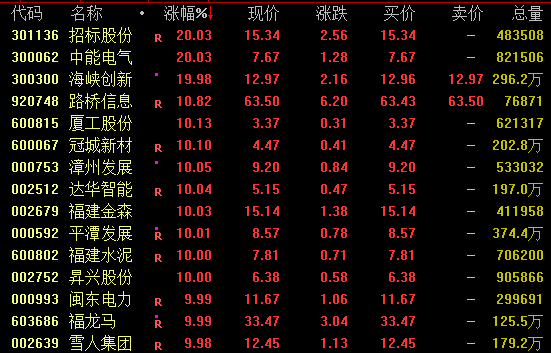
Market Overview - The Asia-Pacific stock markets mostly declined on November 4, with the Nikkei 225 index falling by 1.74% to 51497.2 points, the South Korean Composite Index down by 2.37% to 4121.74 points, and the Australian S&P 200 index decreasing by 0.78% to 8813.7 points [1] - A-shares saw all major indices drop, with the ChiNext Index briefly falling over 2%, and total trading volume in the A-share market shrinking below 2 trillion yuan [1] A-share Performance - The Shanghai Composite Index closed down 0.41% at 3960.19 points, the Shenzhen Component Index fell by 1.71% to 13175.22 points, and the ChiNext Index decreased by 1.96% to 3134.09 points [1] - The North Stock 50 Index dropped by 2.45%, with total trading volume in the Shanghai and Shenzhen markets combined at 193.86 billion yuan, a decrease of 19.45 billion yuan from the previous day [1] Sector Performance - Over 3600 stocks in the market were in the red, with the semiconductor sector experiencing significant declines, including a drop of over 9% for Baiwei Storage and over 5% for Demingli and Jiangbolong [2] - The pharmaceutical sector also fell, with Changshan Pharmaceutical hitting a 20% limit down at the close [2] - Conversely, the banking sector saw gains, with Xiamen Bank rising nearly 6% and other major banks like China Merchants Bank and Industrial and Commercial Bank of China increasing by about 3% [4] Concept Stocks - The cross-strait integration concept surged, with stocks like Pingtan Development hitting a 20% limit up, and others such as Haixia Innovation and Zhangzhou Development also reaching their daily limits [6] - The short drama game concept became active again, with Yue Media achieving three consecutive limit ups and Jishi Media securing two consecutive limit ups [2] - The smart grid concept saw a strong rise, with Zhongneng Electric and Shenma Electric both hitting their daily limits [10] Banking Sector Insights - The banking sector's performance was supported by stable third-quarter financial reports, showing a year-on-year revenue growth of 0.9% and a net profit growth of 1.5% [4] - Analysts expect continued improvement in revenue and profit growth for the year, with low valuations indicating significant value potential [4] Smart Grid Investment - The State Grid Corporation completed fixed asset investments exceeding 420 billion yuan from January to September, marking an 8.1% year-on-year increase [10] - Major projects in ultra-high voltage direct current engineering have been operational, with expectations for total annual investments to exceed 650 billion yuan [10][12] - The ultra-high voltage sector is anticipated to enter a new round of equipment bidding, with several projects expected to begin approval and bidding phases by the end of the year [12]
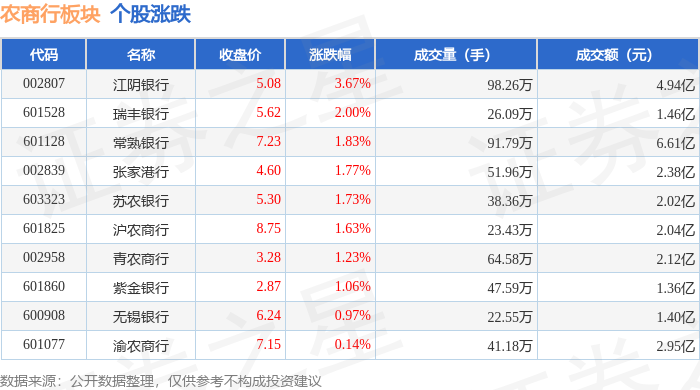
农商行板块11月4日涨1.31%,江阴银行领涨,主力资金净流出9791.62万元
Zheng Xing Xing Ye Ri Bao· 2025-11-04 08:48
Core Insights - The rural commercial bank sector experienced a rise of 1.31% on November 4, with Jiangyin Bank leading the gains [1] - The Shanghai Composite Index closed at 3960.19, down 0.41%, while the Shenzhen Component Index closed at 13175.22, down 1.71% [1] Stock Performance - Jiangyin Bank (002807) closed at 5.08, up 3.67% with a trading volume of 982,600 shares and a transaction value of 494 million [1] - Ruifeng Bank (601528) closed at 5.62, up 2.00% with a trading volume of 260,900 shares [1] - Changshu Bank (601128) closed at 7.23, up 1.83% with a trading volume of 917,900 shares [1] - Zhangjiagang Bank (002839) closed at 4.60, up 1.77% with a trading volume of 519,600 shares [1] - Sunong Bank (603323) closed at 5.30, up 1.73% with a trading volume of 383,600 shares [1] - Hunan Agricultural Commercial Bank (601825) closed at 8.75, up 1.63% with a trading volume of 234,300 shares [1] - Qingnong Bank (002958) closed at 3.28, up 1.23% with a trading volume of 645,800 shares [1] - Zijin Bank (601860) closed at 2.87, up 1.06% with a trading volume of 475,900 shares [1] - Wuxi Bank (600908) closed at 6.24, up 0.97% with a trading volume of 225,500 shares [1] - Chongqing Rural Commercial Bank (601077) closed at 7.15, up 0.14% with a trading volume of 411,800 shares [1] Capital Flow - The rural commercial bank sector saw a net outflow of 97.9162 million from institutional investors and 7.3315 million from retail investors, while retail investors had a net inflow of 105 million [1] - Jiangyin Bank experienced a net outflow of 29.0366 million from institutional investors, with a net inflow of 10.6027 million from retail investors [2] - Wuxi Bank had a significant net outflow of 24.3647 million from institutional investors, with a net inflow of 19.8965 million from retail investors [2] - Changshu Bank saw a net outflow of 33.9791 million from institutional investors, while retail investors had a net inflow of 46.5376 million [2]
银行板块逆势走强,银行ETF易方达(516310)助力低成本布局板块龙头
Mei Ri Jing Ji Xin Wen· 2025-11-04 06:52
Core Viewpoint - The A-share market is experiencing an overall adjustment, while the banking sector is showing strength, with the China Securities Banking Index rising by 1.7% as of 14:28. This indicates a shift from high-volatility growth stocks to undervalued, high-dividend value sectors, with banks positioned to benefit from this trend [1]. Summary by Category Market Performance - The China Securities Banking Index has increased by 1.7%, with notable gains from stocks such as Xiamen Bank (over 5%) and Jiangyin Bank (over 3%). Major banks like CITIC Bank, Industrial Bank, and China Merchants Bank have also seen increases of over 2% [1]. Investment Trends - Analysts suggest that after an extreme performance of small-cap growth stocks in the third quarter, the excess returns of small-cap growth relative to large-cap value have reached historical highs. This has led to a market shift towards low-valuation, high-dividend value sectors [1]. Valuation Metrics - The current price-to-book ratio of the China Securities Banking Index is approximately 0.7 times, which is at the 34th percentile since the index was launched in 2013. The current dividend yield is around 4%, with the spread over government bonds at a historically high level, indicating significant investment value [1].



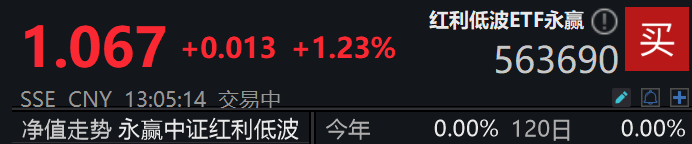
市场风格切换,红利低波ETF永赢(563690)涨幅超1.3%
Xin Lang Cai Jing· 2025-11-04 05:35
Core Viewpoint - High dividend assets continue to strengthen, with significant buying activity from insurance funds in the banking sector, indicating a shift towards stable dividend-paying stocks in a low-interest-rate environment [2] Group 1: Market Performance - As of November 4, 2025, the CSI Dividend Low Volatility Index (H30269) rose by 1.13%, with notable increases in constituent stocks such as Xiamen Bank (up 6.20%), Shanghai Bank (up 3.51%), and Jianfa Co. (up 2.86%) [1] - The Yongying Dividend Low Volatility ETF (563690) increased by 1.23%, with a cumulative rise of 0.38% over the past week as of November 3, 2025 [1] Group 2: Institutional Investment Trends - Insurance funds have been actively increasing their holdings in bank stocks, with China Life Insurance becoming a top ten shareholder in Industrial and Commercial Bank of China, holding 757 million shares (0.21% stake) as of September 30 [2] - Ping An Life Insurance entered the top ten shareholders of Agricultural Bank of China with 4.913 billion shares (1.4% stake) as of September 30 [2] - Other banks such as Wuxi Bank, Nanjing Bank, and Changshu Bank also saw new insurance capital entering their top ten shareholders during the third quarter [2] Group 3: Future Outlook - According to Zhongtai Securities, during Q3 2025, insurance funds focused on increasing their stakes in banking, telecommunications, and steel sectors, reflecting a strategy to enhance returns in a persistently low-interest-rate environment [2] - The fourth quarter of 2025 is anticipated to be a critical period for positioning in dividend stocks, as pessimistic expectations may have been fully priced in, highlighting the appeal of undervalued assets and the potential for increased capital allocation [2]