英诺赛科

Search documents
科技股大跌,消费股、保险股等逆市上涨
Zhong Guo Ji Jin Bao· 2025-12-15 11:06
Market Overview - The Hong Kong stock market experienced a collective decline on December 15, with the Hang Seng Index falling by 1.34% to close at 25,628.88 points, the Hang Seng China Enterprises Index down 1.78% to 8,917.70 points, and the Hang Seng Tech Index dropping 2.48% to 5,498.42 points [2] Technology Sector - Major technology stocks saw significant declines, with Baidu Group-SW down over 5%, Kuaishou-W down over 4%, SenseTime-W and Alibaba-W down over 3%, and Xiaomi Group-W and Tencent Holdings down over 2% [3] - Semiconductor stocks mostly fell, with InnoCare Pharma down over 9%, Hua Hong Semiconductor down over 6%, and SMIC down over 4% [3] Biotechnology Sector - Biotechnology stocks weakened, with BeiGene down over 8%, CanSino Biologics down over 6%, and WuXi Biologics down over 3% [3] Consumer Sector - Consumer stocks collectively rose, with Li Ning leading the blue-chip stocks with a gain of over 5%, closing at HKD 18.64 per share and a total market capitalization of HKD 48.2 billion [6] - The rise in consumer stocks is attributed to the opening of Li Ning's first "Dragon Store" and the launch of the new "Honor Gold Standard" product series, marking a significant milestone for the brand [6] Insurance Sector - Insurance stocks performed well against the market trend, with New China Life Insurance rising over 4%, China Pacific Insurance and Ping An Insurance both up over 2%, and China Life Insurance nearly 1% higher [7] - Ping An Insurance's A-shares and H-shares both reached four-year highs [7] - Recent regulatory changes by the National Financial Regulatory Administration have lowered risk factors for insurance companies, allowing for more long-term investment funds [9] - Market demand remains high, and the combination of stable interest rates and improved equity markets is expected to support investment returns [9]






半导体板块午后下跌
第一财经· 2025-12-15 06:05
Market Performance - The A-share semiconductor sector experienced a significant decline, with notable stocks such as Chipone Technology falling over 10% and Fuxin Technology and Zhongli Group dropping by 9% [1][2] - The semiconductor index (886063) decreased by 1.76%, closing at 7326.63, down 131.03 points [2] - In the Hong Kong market, the Hang Seng Technology Index fell by 2%, with Huahong Semiconductor down over 7% and SMIC down 4% [3][4] Stock Specifics - Chipone Technology (688521.SH) saw a decline of 10.49%, closing at 133.40 [2] - Fuxin Technology (688662.SH) dropped by 9.25%, closing at 53.54 [2] - Zhongli Group (002309.SZ) fell by 9%, closing at 3.64 [2] - Other notable declines included Shengke Communication (-8.22%), Guosheng Technology (-7.12%), and Canxin Technology (-6.24%) [2][3] Broader Industry Trends - The overall trend in the semiconductor industry indicates a bearish sentiment, with multiple companies experiencing significant stock price drops [1][3] - The decline in the semiconductor sector is reflected in both A-share and Hong Kong markets, suggesting a broader industry challenge [3][4]



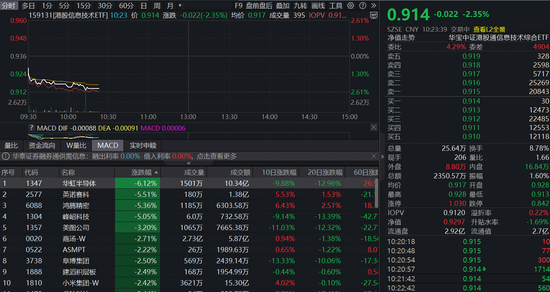
“港股芯片”产业链集体回调,华虹半导体大跌逾6%!港股信息技术ETF(159131)跌超2%盘中获净申购400万份
Xin Lang Ji Jin· 2025-12-15 02:45
Core Viewpoint - The Hong Kong stock market's semiconductor industry chain is experiencing a significant pullback, with major companies like Hua Hong Semiconductor and Xiaomi seeing notable declines, while a new ETF focused on this sector is attracting investor interest despite the downturn [1][3]. Group 1: Market Performance - On December 15, the Hong Kong stock market saw a decline in the semiconductor industry chain, with Hua Hong Semiconductor dropping over 6%, and other companies like InnoCare and Xiaomi also experiencing declines of over 5% and 2% respectively [1]. - The first ETF focusing on the Hong Kong semiconductor industry chain (159131) saw a price drop of 2.35%, with a trading volume exceeding 23.5 million CNY, indicating that investors are buying on dips, as evidenced by a net subscription of 4 million shares [1][3]. Group 2: ETF Details - The newly launched Hong Kong Information Technology ETF (159131) tracks an index composed of 70% hardware and 30% software, heavily investing in semiconductor and electronic companies, with notable weights for SMIC (20.48%), Xiaomi (9.53%), and Hua Hong Semiconductor (5.80%) [3]. - The ETF excludes major internet companies like Alibaba and Tencent, allowing for a sharper focus on the AI hard technology sector within the Hong Kong market [3]. Group 3: Industry Outlook - According to a report by Ping An Securities, there is a strong demand for AI computing power, with the global and Chinese AI server market projected to grow at CAGRs of 15.5% and 30.6% respectively from 2024 to 2028 [2]. - The trend towards self-sufficiency in AI computing chips in China is expected to accelerate, driven by supportive policies, strong downstream demand, and significant replacement opportunities, indicating a robust growth trajectory for domestic AI computing chip industry [2].
数字经济周报:OpenAI正式发布GPT-5.2-20251215
GUOTAI HAITONG SECURITIES· 2025-12-15 01:11
Semiconductor Sector Dynamics - AMD officially released the EPYC Embedded 2005 series processors, which can support up to 16 x86 cores and 64MB of shared L3 cache, with a TDP range of 45W to 75W, offering a 28% higher boost frequency and 35% higher base frequency compared to Intel Xeon 6503P-B2 at half the TDP[6] - DapuStor and ZTE are collaborating to build a green and efficient data center using immersion liquid cooling SSDs, marking a significant engineering application breakthrough in enterprise SSDs[8] - ASE Technology has integrated vacuum printing encapsulation and copper pillar transfer technology, significantly reducing product development time by up to 90% and cutting development costs by approximately 30%[10] Automotive Electronics Sector Dynamics - BAIC Group is partnering with Horizon Robotics to develop a full-scene urban NOA system, leveraging the Horizon Journey 6M chip to enhance computational capabilities for smart driving[12] - Innosilicon and United Power announced the successful installation of a new generation 6.6kW OBC system in Changan Automobile, achieving a 30% increase in power density and over 2% improvement in overall efficiency compared to similar products[14] - Ruijia received a development notification from a well-known flying car company, marking a significant milestone in expanding into the low-altitude economy[17] AI Sector Dynamics - OpenAI launched GPT-5.2, which outperformed previous models in professional knowledge tasks, achieving a 70.9% success rate in GDPval tests across 44 job tasks[19] - SenseTime introduced the upgraded "SenseTime Ark" platform, aiming to revolutionize visual AI production methods and enhance algorithm efficiency[22] - Zhiyuan officially launched and open-sourced the GLM-4.6V series multimodal models, reducing prices by 50% compared to the previous version, with API call costs as low as 1 RMB per million tokens[26] Metaverse Sector Dynamics - Cellid released two new AR glasses reference designs, targeting various applications from enterprise digital transformation to everyday consumer use[28] - Beijing Jishuitan Hospital successfully performed China's first "spatial computing + robotics" orthopedic surgery, marking a significant advancement in smart orthopedic technology[30] - Yunglight Technology completed a Series A financing round to accelerate the mass production of AR/VR technologies, with plans for a new 12-inch silicon-based OLED production line[34] Risk Warnings - There are risks of intensified market competition in semiconductor, automotive electronics, AI, and metaverse sectors due to rapid growth in participant numbers and capital investment[38] - Potential risks exist if technological advancements in these sectors do not meet expectations, which could hinder overall development[39] - Market demand growth may fall short of expectations in emerging sectors, impacting overall industry progress[40]
三代半产业运作模式演进方向
Xin Lang Cai Jing· 2025-12-12 14:19
Core Viewpoint - The article discusses the diversified operational models of domestic listed companies in the third-generation semiconductor materials, silicon carbide (SiC) and gallium nitride (GaN), as they are widely applied in electric vehicles, data centers, and consumer electronics [1][9]. Group 1: Main Operational Models - The IDM (Integrated Device Manufacturer) model dominates the core competition, covering the entire industry chain from chip design to wafer manufacturing and packaging testing, becoming the preferred model for leading companies [2][10]. - Eight companies primarily operate under the IDM model, with Huazhong Microelectronics and Wentai Technology being notable examples, focusing on applications in electric vehicles and data centers [2][10]. - Huazhong Microelectronics has achieved mass production of SiC JBS G3 and SiC MOS G2 products, while Wentai Technology has established a global capacity layout with its 1200V automotive-grade SiC MOSFET [2][10]. Group 2: Company-Specific Developments - InnoLux is the world's first GaN IDM company to achieve large-scale production of 8-inch wafers, with a product voltage range from 15V to 1200V, and has seen a 128% growth in automotive-grade chip deliveries [3][11]. - Sanan Optoelectronics has built a complete SiC industry chain, with a monthly capacity of 16,000 pieces for 6-inch SiC and is accelerating its 8-inch SiC project in partnership with STMicroelectronics [3][11]. - Jiejie Microelectronics focuses on SiC Schottky diodes for electric vehicles and renewable energy, achieving mass production while maintaining flexibility through outsourcing [3][11]. Group 3: Operational Model Variations - Companies like Yangjie Technology adopt a hybrid model of IDM and Fabless, balancing production capacity and R&D, while also collaborating with foundries to ensure capacity [4][13]. - Sinda Semiconductor is transitioning from a Fabless to an IDM model, establishing its own 6-inch SiC chip production line with an annual capacity of 60,000 automotive-grade SiC MOSFETs [5][14]. - The hybrid model allows companies to respond quickly to market demands while gradually mastering core processes, suitable for medium-sized enterprises aiming for high-end markets [6][14]. Group 4: Industry Trends and Future Directions - The current landscape of the third-generation semiconductor industry in China shows a trend of "IDM as the mainstream, with hybrid models as a supplement," driven by the explosive demand from electric vehicles and AI data centers [8][15]. - IDM companies are expanding their 12-inch SiC/GaN production lines, while hybrid model companies are increasing their self-production ratios to reduce reliance on external foundries [8][15]. - Future success in the industry will depend on technological R&D capabilities, production scale, and supply chain stability, pushing the industry towards high-quality development [8][15].

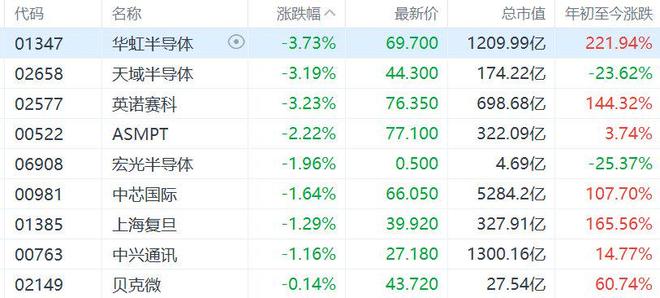
港股芯片股普跌,其中,华虹半导体、天域半导体、英诺赛科跌超3%
Mei Ri Jing Ji Xin Wen· 2025-12-12 02:21
(文章来源:每日经济新闻) 每经AI快讯,12月12日,港股芯片股普跌,其中,华虹半导体、天域半导体、英诺赛科跌超3%, ASMPT跌超2%,宏光半导体、中芯国际跌超1%。 ...


港股芯片股普跌,华虹半导体跌超3%
Xin Lang Cai Jing· 2025-12-12 02:04
Group 1 - The Hong Kong chip stocks experienced a general decline, with notable drops in companies such as Hua Hong Semiconductor, Tianyu Semiconductor, and InnoGrit, all falling over 3% [1] - ASMPT saw a decrease of over 2%, while Hongguang Semiconductor and SMIC dropped more than 1% [1] Group 2 - Hua Hong Semiconductor (01347) decreased by 3.73%, with a latest price of 69.700 and a total market value of 120.999 billion, showing a year-to-date increase of 221.94% [2] - Tianyu Semiconductor (02658) fell by 3.19%, with a latest price of 44.300 and a market value of 17.422 billion, reflecting a year-to-date decline of 23.62% [2] - InnoGrit (02577) dropped by 3.23%, with a latest price of 76.350 and a market value of 69.868 billion, showing a year-to-date increase of 144.32% [2] - ASMPT (00522) decreased by 2.22%, with a latest price of 77.100 and a market value of 32.209 billion, reflecting a year-to-date increase of 3.74% [2] - Hongguang Semiconductor (06908) fell by 1.96%, with a latest price of 0.500 and a market value of 0.0469 billion, showing a year-to-date decline of 25.37% [2] - SMIC (00981) decreased by 1.64%, with a latest price of 66.050 and a market value of 528.42 billion, reflecting a year-to-date increase of 107.70% [2] - Shanghai Fuzhi (01385) dropped by 1.29%, with a latest price of 39.920 and a market value of 32.791 billion, showing a year-to-date increase of 165.56% [2] - ZTE Corporation (00763) decreased by 1.16%, with a latest price of 27.180 and a market value of 130.016 billion, reflecting a year-to-date increase of 14.77% [2] - Beike Micro (02149) fell by 0.14%, with a latest price of 43.720 and a market value of 2.754 billion, showing a year-to-date increase of 60.74% [2]
德银深度研究:2026年科技硬件行业七大核心主题与投资机会
Zhi Tong Cai Jing· 2025-12-11 14:19
Group 1: Semiconductor Market Trends - Severe memory shortages are driving a reevaluation of semiconductor equipment targets, with DRAM spot prices soaring by 300%-400% in the past three months, reaching $17 per GB for DDR4 and $13-14 per GB for DDR5 [2] - NAND flash market is experiencing similar trends, with core benchmark products seeing a 200% price increase over the last three months, and contract prices rising by 20%-60% [2] - The memory shortage is expected to continue until at least 2027, leading to significant increases in wafer fab equipment spending, particularly benefiting companies like ASML, VAT Group, and SUSS MicroTec [3][4] Group 2: AI and Component Supply Challenges - AI investments are crowding out supply for non-AI components, leading to potential shortages in memory, passive components, and optical components, which could impact consumer electronics, smartphones, PCs, and automotive electronics [4] - The automotive electronics sector is less affected due to dedicated production lines for automotive-grade products [5] Group 3: Optical and Testing Innovations - AI data centers are driving a surge in bandwidth demand, leading to advancements in optical components and the transition to higher-speed pluggable optical devices [3] - The testing sector is undergoing a structural transformation due to increased chip complexity and rising failure costs, with companies like Technoprobe expanding testing coverage to improve quality [6] Group 4: GaN and Power Semiconductor Opportunities - The shift to 800V architecture in AI data centers, driven by Nvidia, is creating opportunities for GaN technology, similar to the impact of SiC in Tesla applications [8] - AI processor power consumption is projected to grow from 7GW in 2023 to over 70GW by 2030, creating significant market opportunities for suppliers addressing power challenges [9] Group 5: Edge AI and Local Processing - Edge AI is gaining traction, with companies like AMD noting its growth potential, although it remains in the experimental phase [10] - Ambarella anticipates that its defined "edge AI" market will account for 80% of its total revenue by 2025, covering various applications [10] Group 6: Localization of Semiconductor Production in China - There is a significant shift in China's semiconductor capabilities, with local manufacturers facing increased pressure for domestic procurement and improving their scale and quality [11] - The year 2026 is expected to be pivotal as the market recognizes the potential shrinkage of Western companies' market size in China [11][12]
天岳先进:半绝缘碳化硅衬底是GaN-on-SiC技术路线核心基础材料
Ju Chao Zi Xun· 2025-12-11 11:54
Core Viewpoint - Tianyue Advanced (688234.SH) is actively promoting industrial cooperation in the robotics field, emphasizing its commitment to deepening its layout in silicon carbide (SiC) materials and related applications [1][4]. Group 1: Technology and Product Development - SiC conductive devices have advantages in frequency and heat dissipation, making them suitable for high-performance applications [1]. - The company highlights the distinction between GaN-on-Si and GaN-on-SiC technologies, noting that GaN-on-Si is primarily used in consumer electronics and mid-to-low voltage power devices due to its cost advantages, while GaN-on-SiC combines high-frequency performance with superior thermal conductivity, suitable for high-end power applications [3]. - The core material for the GaN-on-SiC technology route is semi-insulating silicon carbide substrates, which are essential for high-frequency and high-power devices in 5G communications and radar applications [3]. Group 2: Market Opportunities and Applications - Emerging industries such as humanoid robots and low-altitude economy are increasing the demand for high-performance power devices, which may provide new growth opportunities for the company [3][4]. - The company is exploring more collaboration opportunities with high-end power and RF device customers to capitalize on market opportunities arising from the next round of technological upgrades and application expansions [4].

【太平洋科技-每日观点&资讯】(2025-12-12)
远峰电子· 2025-12-11 11:51
Market Performance - The main board saw significant gains with companies like Dream Network Technology (+10.02%), Liang Micro (+10.01%), and Guangxi Guangdian (+10.00%) leading the charge [1] - The ChiNext board was led by Tianmai Technology (+12.09%), Guangzhi Technology (+11.01%), and Kema Technology (+10.44%) [1] - The Sci-Tech Innovation board was dominated by Moore Thread-U (+28.04%), Fuxin Technology (+20.00%), and Zhenlei Technology (+17.40%) [1] - Active sub-industries included SW Semiconductor Materials (+0.30%) and SW Communication Cables and Accessories (+0.28%) [1] Domestic News - Tai Ling Micro announced collaboration with Google in smart home and audio sectors, expanding from remote control chip supply to a broader range of smart terminal scenarios [1] - Xingfu Electronics plans to acquire proprietary technology and equipment for photoinitiators from the affiliated Sanxia Laboratory for 46.27 million yuan, with nine invention patents currently under application [1] - United Power and Inno-Sec announced successful mass production of a new 6.6kW GaN onboard charging system for Changan Automobile, integrating OBC and DC-DC functions [1] - Unigroup Guowei reported that its automotive domain control chip THA6 has entered mass production, with plans to expand customer integration by 2026 [1] Company Announcements - Wanma Technology won a bid for the State Grid's 2025 joint procurement project in Central, North, and Northeast China, totaling 59.94 million yuan [2] - Dingjie Smart plans to issue 828 million yuan in convertible bonds for the development of a smart ecosystem platform [2] - Lens Technology signed an agreement to acquire 100% of Peimei Gao International Limited to enhance its server cabinet business and advanced liquid cooling system capabilities [2] - Haineng Industrial reported a share reduction by Zhou Hongjun, decreasing his stake to 5.27% [2] Overseas News - Mitsui Chemicals developed the world's first 12-inch optical resin wafer for AR glasses, enhancing user experience with wider viewing angles and improved safety [3] - Qualcomm acquired Ventana Micro Systems, focusing on RISC-V architecture for server CPUs, aiming to compete with Arm and x86 technologies [3] - Synopsys reported a surge in customized ASIC chip orders driven by strong demand in AI and HPC, projecting a 37.8% revenue increase to $2.26 billion for Q4 FY2025 [3] - CFM forecasts significant price increases in memory products, with Mobile eMMC/UFS expected to rise by 25%-30% in Q1 2026 [3]