Palantir Technologies Inc.

Search documents
S&P 500 and Nasdaq on pace for monthly declines, bitcoin tops $90K
Yahoo Finance· 2025-11-28 15:28
Welcome to Young Financ's flagship show, Morning Brief. I'm Julie Hyman. Let's get to the three things you need to know today.First up, it's the final trading day of November. The S&P 500 is on track for its first monthly drop in 6 months, while the Nasdaq may fall for the first time since March. Of course, tech is a big reason why.Super micro computer poised to be the worst performer in the S&P 500 for November. Other losers include Coinbase, Oracle, and Palanteer. Meanwhile, the Chicago Merkantail Exchang ...

S&P 500 and Nasdaq on pace for monthly declines, bitcoin tops $90K
Youtube· 2025-11-28 15:28
Market Overview - The S&P 500 is on track for its first monthly drop in six months, while the Nasdaq may fall for the first time since March, primarily due to weakness in the tech sector [1][5] - Super Micro Computer is poised to be the worst performer in the S&P 500 for November, alongside other losers like Coinbase, Oracle, and Palantir [2] Trading Operations - The Chicago Mercantile Exchange (CME) is restoring operations after a significant outage caused by a cooling issue at a data center provider, which disrupted trading across various markets [3][39] - Bitcoin has rebounded above $91,000 but is still on track for its worst month since February, with Bitcoin ETFs experiencing significant outflows [4] Sector Performance - The healthcare sector has emerged as a strong performer in the fourth quarter, while the tech sector has declined by 5.6% [7] - Small caps and micro caps have shown strong buying interest, indicating potential bullish momentum as they challenge previous highs [10][13] Gold and Commodities - Gold has increased by 24% over the last three months, driven by expectations of lower interest rates and central bank buying [14][16] - The gold to silver ratio has dropped to 78, indicating bullish potential for silver if it breaks down further [46] Retail Sector Insights - Retail spending is expected to increase this holiday season, reflecting a shift in consumer sentiment towards more optimistic spending [18][20] - Companies like Kohl's, Target, and Macy's have reached 52-week highs, indicating positive trends in the retail sector [20] Transportation Sector - The transportation sector has shown signs of recovery, with the IYT ETF regaining its position above the 50-day moving average [24] Technology Sector Analysis - The tech sector, particularly semiconductors, has faced challenges, with concerns about saturation and energy demand impacting future performance [27][28] - Despite recent corrections, major tech companies like Google are still viewed as having strong long-term potential [28] Cryptocurrency Market - Bitcoin's recent price movements suggest a potential bottom around $80,000, with a focus on maintaining support levels around $88,000 to $89,000 [35][36] - Other cryptocurrencies like Ethereum and Chainlink are being monitored for potential rebounds, with specific price levels identified as critical for future performance [37][38] Emerging Markets - India's economy has shown surprising growth, with a GDP increase of 8.2% for the quarter ended September, positioning it favorably among emerging markets [51][52]

5 ETFs Primed to Soar if the Fed Cuts Rates in December
ZACKS· 2025-11-28 15:16
Core Insights - Expectations for a December rate cut from the U.S. Federal Reserve have intensified, with major banks and market participants increasingly viewing it as the most likely scenario [1][2] - The CME FedWatch tool indicates an 85% probability of a quarter-point reduction in December, influenced by weak payroll and inflation data [2][3] - A cooling labor market and limited hiring are pressuring policymakers to stimulate growth, making a rate cut imminent to support the labor market and guard against economic downturns [3] Sectors Poised to Benefit From Lower Rates - **Technology Stocks**: Lower rates increase the present value of future profits, significantly boosting current valuations for high-growth technology companies [5] - **Small-Cap Stocks**: These companies are more sensitive to domestic economic conditions and benefit from reduced debt servicing costs and increased access to affordable capital [6] - **Financials**: Banks with diversified operations may see improved loan activity due to lower rates [6] - **Consumer Discretionary & Utilities**: Lower interest rates enhance consumer credit access and spending power, benefiting profit margins in consumer discretionary companies, while utilities benefit from reduced financing costs [7] ETFs to Consider - **Technology Select Sector SPDR ETF (XLK)**: AUM of $91.47 billion, exposure to 70 tech companies, top holdings include Nvidia (14.24%) and Apple (13.49%), has gained 22.6% year to date [9][10] - **iShares Russell 2000 ETF (IWM)**: AUM of $71.69 billion, exposure to 1,958 small-cap U.S. companies, has gained 12.8% year to date [11] - **Financial Select Sector SPDR ETF (XLF)**: AUM of $51.45 billion, exposure to 75 financial services companies, has risen 10.7% year to date [12][13] - **Consumer Discretionary Select Sector SPDR ETF (XLY)**: AUM of $23 billion, exposure to 49 consumer discretionary companies, has gained 5.4% year to date [14][15] - **Utilities Select Sector SPDR ETF (XLU)**: AUM of $22.07 billion, exposure to 31 utility companies, has surged 21.4% year to date [16][17]

Sanchez: The 2026 market roadmap does assume significant AI capex spending
CNBC Television· 2025-11-28 12:41
I wonder Gina, from a market participants perspective, how does this influence how you will approach today, trading or otherwise. >> Well, you've given us a range that goes from nothing to a lot. So, uh it's a it's a pretty wide range, but look, our 2026 road map um does assume that we continue to see significant capex spending into the infrastructure of AI.Um and we do think that that continues to support uh the kind of let's call it the picks and shovels uh of that uh ecosystem which includes Nvidia, it i ...



末日蓝线飙升46基点:华尔街狂欢、狼狗已噬喉,你的钱包可能血本无归!
美股研究社· 2025-11-28 11:06
Core Viewpoint - The article discusses historical market crashes and the strategies employed by various investors during these crises, highlighting the importance of timing, market sentiment, and the psychological aspects of trading. Group 1: Historical Market Crashes - The article references the 1929 market crash, where Joseph P. Kennedy sold all his stocks and only held a long position in a Cuban sugar company, indicating a strategic exit from the market when sentiment was overly bullish [6][8]. - Jesse Livermore, known as the "King of Speculation," made significant profits by shorting the market before the 1929 crash, earning $1 billion (equivalent to $20 billion today) [11][12]. - The 1987 crash is highlighted with the story of Mark Cook, who turned a $30,000 investment into $11 million by holding deep out-of-the-money puts on the S&P 500 [15][17]. Group 2: Investor Strategies and Lessons - Bill Lawton, CEO of Westgate Global Group, profited from the 1987 crash by betting on volatility, emphasizing that calmness is crucial during crises [33][34]. - John Paulson made a significant profit during the 2008 financial crisis by purchasing credit default swaps (CDS) against subprime mortgages, earning $10 billion from a $22 million investment [50][52]. - The article mentions the importance of being contrarian, as seen in the actions of various investors who thrived during market downturns by maintaining a clear strategy and not succumbing to panic [12][34][50]. Group 3: Current Market Indicators - The article notes that the cost of options to protect against a significant market downturn has risen to 46 basis points, the highest level since the sell-off in April [66]. - It suggests that investors are increasingly willing to pay for insurance against a potential 55% drop in the S&P 500 over the next five years, indicating heightened market anxiety [66][69].

亚马逊 2025 年表现疲软,是为2026年布局铺路
美股研究社· 2025-11-28 11:06
Core Viewpoint - Amazon's recent performance has lagged behind its peers, presenting a potential investment opportunity as analysts believe its fundamentals are strengthening, particularly in artificial intelligence [1][2]. Financial Performance - Amazon's Q3 revenue reached $180.17 billion, a year-over-year increase of 14.55%, with adjusted diluted EPS of $1.95, up 36.36%, exceeding market expectations [4]. - The company's EBIT could have reached $21 billion if not for FTC-related expenses and severance costs, with AWS's backlog at $200 billion and annual recurring revenue around $132 billion [4]. Artificial Intelligence Developments - Amazon is enhancing its AI capabilities with infrastructure like Trainium chips and partnerships with Nvidia, aiming to reduce reliance on third-party GPUs [6][7]. - The upcoming AWS re:Invent conference is expected to showcase significant updates, including the Trainium3 chip, which is anticipated to double the computing power of its predecessor [6][7]. Market Position and Strategy - Amazon's investment in AI and cloud services for government clients, with a planned $50 billion investment, could significantly alter its market narrative and valuation [8]. - The company is leveraging AI to improve operational efficiency, with reported savings of 700,000 hours of labor, equating to the annual workload of 335 developers [9]. Valuation and Future Outlook - Analysts project a target price of approximately $270.48 per share based on a forward P/E ratio of 30, indicating an upside potential of over 18% in the next 12 months [10]. - Amazon's return on invested capital (ROIC) has improved from about 3% in 2016 to 16.5%, supporting the stability of its current valuation [9]. Conclusion - Despite a forward P/E ratio exceeding 30 appearing risky, analysts believe Amazon's growth prospects and competitive advantages justify this premium, especially if it successfully expands into new markets like government services [14].


AI Is 'Classic Investment Bubble,' GMO Says. What to Buy Instead.
Business Insider· 2025-11-28 10:15
Core Viewpoint - GMO warns that the AI sector resembles a classic investment bubble characterized by high valuations and rampant speculation [1][2] Group 1: AI Bubble Concerns - GMO has consistently cautioned about an AI bubble, reiterating its bearish stance as market exuberance grows [1] - Quantum computing stocks have surged over 1200% in the past year, leading to valuations that appear excessive [2] - The current market environment is compared to the dot-com bubble of 2000, suggesting potential risks for investors [3] Group 2: Investment Opportunities - GMO identifies attractive investment opportunities in developed market value stocks and non-US small-cap value stocks, especially in Japan [4] - Investors can shift their portfolios away from the AI sector without sacrificing long-term expected returns, as other risk assets are trading at fair valuations [6] - Funds such as the Avantis International Small Cap Value ETF (AVDV) and the iShares MSCI Intl Value Factor ETF (IVLU) provide exposure to these alternative investments [6]
“大空头 vs 英伟达”论战继续,“大空头”逐条反驳英伟达回应:不敢相信这来自全球市值最高公司
3 6 Ke· 2025-11-28 10:14
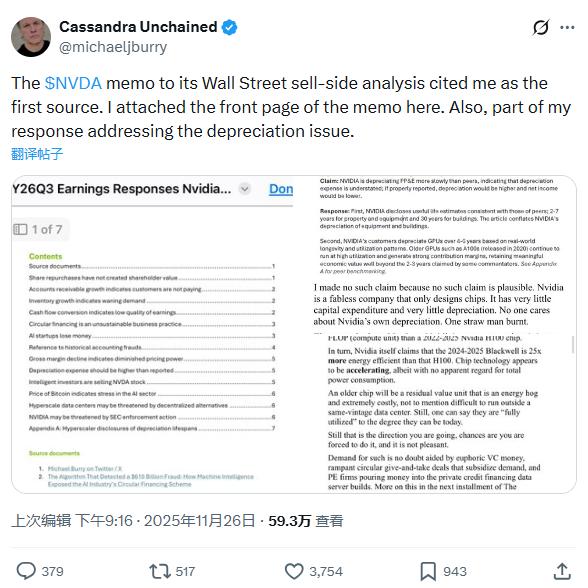
Core Viewpoint - The ongoing conflict between Michael Burry, known as the "Big Short," and Nvidia is intensifying, with Burry criticizing Nvidia's internal memo as disappointing and filled with "straw man arguments" [1][4]. Group 1: Burry's Critique - Burry expressed disbelief that a company of Nvidia's stature would respond to criticism with what he perceives as a misleading memo, which he described as reading "almost like a scam" [1]. - He continues to hold put options against Nvidia and Palantir, signaling his bearish outlook on these AI companies [3][9]. - Burry argues that Nvidia's memo misrepresents his criticisms, particularly regarding the depreciation policies of their fixed assets, which he claims are not the focus of his critique [4][6]. Group 2: Nvidia's Defense - Nvidia distributed a seven-page memo to Wall Street analysts to counter accusations of accounting fraud, circular financing, and an AI bubble, asserting that their financial reporting is robust and transparent [11]. - The company clarified that its customers typically depreciate GPUs over four to six years, countering claims that AI chips have a lifespan of only two to three years [11]. - Nvidia emphasized that its strategic investments in the third quarter were only $3.7 billion, a small fraction of its revenue, dismissing the notion of circular financing as unfounded [11]. Group 3: Market Reaction and Context - Following Burry's warnings and the release of earnings reports, Nvidia's stock has declined approximately 14% from its peak on November 3, indicating a shift in investor sentiment towards AI-related companies [2][10]. - Palantir's stock has also dropped 20% from recent highs, despite significant gains year-to-date, reflecting growing concerns about the sustainability of AI valuations [10].
Palantir's Co-Founder Just Dumped His Entire Nvidia Stake. Should Investors Follow Suit?
The Motley Fool· 2025-11-28 09:37
Core Insights - Peter Thiel, co-founder of Palantir, sold all his Nvidia shares in Q3 2025, raising concerns among Nvidia investors about the implications of this move [1][3][6] Company Overview - Nvidia has shown strong performance, reporting $57 billion in revenue for Q3, exceeding expectations of $54 billion, resulting in a 62% year-over-year growth rate, which is an acceleration from Q2's 56% [7][8] - The company is currently the largest by market capitalization, valued at approximately $4,380 billion [10] Market Position - Nvidia's gross margin stands at 70.05%, and it has a dividend yield of 0.02%, indicating a solid financial position [5] - Despite concerns about overvaluation, Nvidia's price-to-earnings ratio is competitive when compared to Microsoft and Apple, suggesting that its valuation aligns with other major tech companies considering future growth [9][12] Supply and Demand Dynamics - CEO Jensen Huang indicated that cloud GPUs are sold out, highlighting that supply is lagging behind demand, which positions Nvidia favorably for continued growth [8] - AI hyperscalers have announced increased capital expenditure expectations for 2026, further supporting Nvidia's growth trajectory [8] Investment Implications - Thiel's sale of Nvidia shares could indicate a shift in investment strategy, possibly towards new opportunities in AI or quantum computing, or a cautious outlook on the future of AI [6] - The strong performance and growth prospects of Nvidia suggest it remains a compelling investment opportunity despite Thiel's actions [12]
Dan Ives Says It Is 'Nvidia's World' And 'Everyone Else Is Paying Rent:' Predicts Massive Tech Rally Into 2026 - NVIDIA (NASDAQ:NVDA)
Benzinga· 2025-11-28 06:58
Core Viewpoint - The technology sector, particularly Nvidia Corp., is experiencing a significant AI-driven growth, with Nvidia being positioned as the dominant player in this space, according to Dan Ives from Wedbush Securities [1][2]. Group 1: Nvidia's Market Position - Nvidia's inventory is reportedly sold out through 2026, indicating strong demand and a supply-demand imbalance of 12-to-1 for its chips [2][3]. - Ives asserts that doubting Nvidia's dominance is a mistake, despite competition from companies like AMD and Google's TPU program [3]. Group 2: Market Outlook - Ives predicts that the current tech bull market will continue into 2026, with a "risk-on" market environment, dismissing concerns about the Federal Reserve's rate path [4]. - He metaphorically describes the ongoing AI cycle as a party that started at 9 p.m. and will last until 4 a.m., suggesting significant growth potential ahead [4]. Group 3: Investment Opportunities - Beyond Nvidia, Ives identifies other strong investment opportunities, including Palantir Technologies, which he believes could reach a $1 trillion market cap in two to three years, along with Microsoft, Oracle, and CrowdStrike as core holdings [5]. - On the consumer front, Tesla is highlighted with a projected $800 bull case, driven by its autonomous driving business valuation [6]. Group 4: Consumer AI Revolution - Ives forecasts a consumer AI revolution led by Apple, predicting an iPhone 17 supercycle that will ensure CEO Tim Cook's leadership for years [7]. Group 5: Nvidia's Stock Performance - Nvidia shares have increased by 30.33% year-to-date, outperforming the Nasdaq 100 index, which has returned 20.32% in the same period [8].