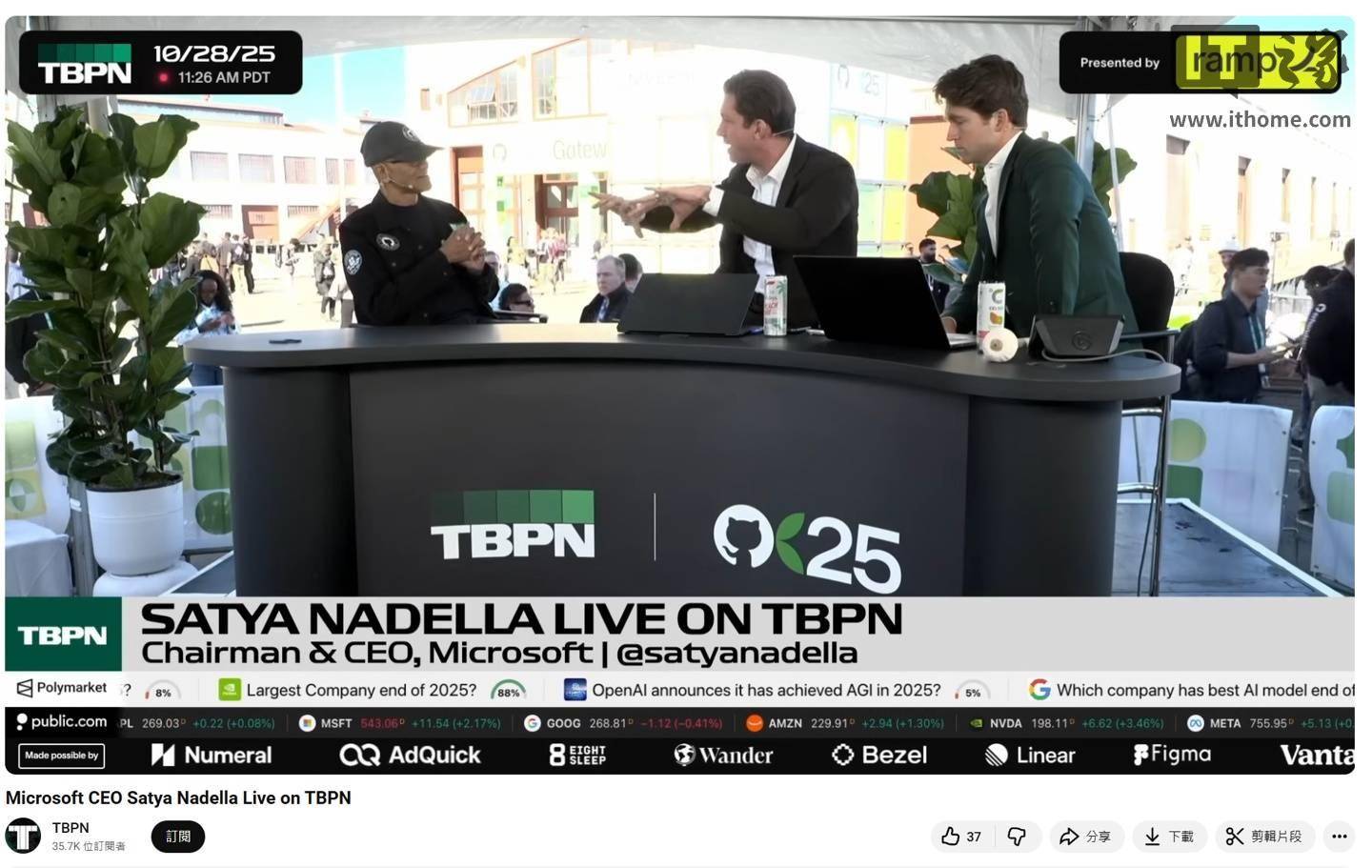
微软

Search documents
史上首家!英伟达市值破5万亿美元
Di Yi Cai Jing Zi Xun· 2025-10-29 13:44
Core Viewpoint - NVIDIA's stock price surged over 5% on October 29, 2023, reaching a market capitalization of $5.13 trillion, making it the first company in history to surpass a $5 trillion market cap [1] Company Developments - NVIDIA's CEO Jensen Huang indicated strong demand for AI, projecting that revenue from the Blackwell and Rubin architecture chips could exceed $500 billion from 20 million GPUs by 2026, which is five times the revenue expected from the Hopper architecture chips between 2023 and 2025 [2] - Huang showcased the next-generation Rubin superchip, which boasts a computing power of 100 PFlops, 100 times that of NVIDIA's first AI-specific computer, DGX-1, with production expected to begin by next year [3] - NVIDIA announced a $1 billion investment in Nokia to accelerate AI-RAN innovation, facilitating the transition from 5G to 6G, and introduced the Arc Aerial RAN Computer to support next-generation AI-native mobile networks [3] - In quantum computing, NVIDIA launched NVQLink, enabling hybrid simulation between QPUs and GPU supercomputers, with support from 17 different quantum computing companies [3] - NVIDIA introduced the NVIDIA BlueField-4 data processor, which will support AI factory operating systems and is part of the Rubin architecture products set to launch in 2026 [4] Financial Performance - For the second quarter of fiscal year 2026 ending July 27, 2025, NVIDIA reported revenue of $46.743 billion, a 56% year-over-year increase, slightly exceeding market expectations, with a net profit of $26.422 billion, up 59% year-over-year [5] - NVIDIA's data center revenue reached $41.1 billion, also a 56% year-over-year increase, but slightly below market expectations [5] Market Context - On October 28, 2023, NVIDIA, Microsoft, and Apple briefly entered the "4 trillion club," with Apple's market cap at $3.99 trillion and Microsoft's at $4.03 trillion, while on October 29, Apple's market cap rose to $4 trillion and Microsoft's to $4.04 trillion [5] - The surge in market capitalization among tech giants is driven by the ongoing global AI wave, although there are ongoing discussions about the potential for an AI bubble [5]


AI热潮高歌猛进,美股创纪录涨势暗藏风险
2 1 Shi Ji Jing Ji Bao Dao· 2025-10-29 13:22
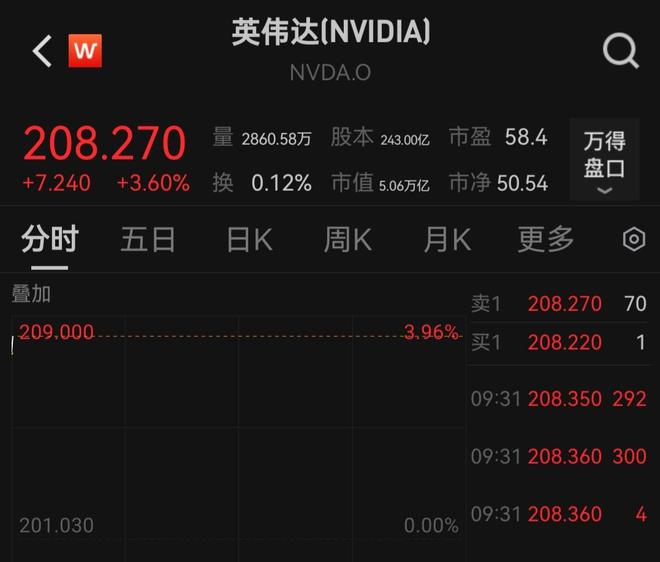
Group 1: Market Performance - The U.S. stock market indices reached new historical highs, with the Dow Jones Industrial Average rising 0.34% to 47,706.37 points, the S&P 500 increasing by 0.23% to 6,890.89 points, and the Nasdaq gaining 0.8% to 23,827.49 points [1] - Nvidia's CEO Jensen Huang announced new partnerships and downplayed concerns about an AI bubble, contributing to a 4.98% increase in Nvidia's stock price, reaching $201.03 and a market capitalization nearing $5 trillion [1][2] - Apple's market capitalization surpassed $4 trillion for the first time, following strong demand for the latest iPhone, alleviating concerns about its progress in the AI race [1] Group 2: AI Market Insights - Huang emphasized that AI models are robust enough for customers to pay for them, indicating a sustainable demand for AI technology [2] - Nvidia's latest chip shipment is projected to reach 20 million units, significantly higher than the previous generation's total of 4 million units, with business scale expected to reach $500 billion over the next six quarters [2] - The AI market is seen as being in a "virtuous cycle," with real enterprise demand driving growth, contrasting with the internet bubble of 2000 [5] Group 3: Economic Indicators - U.S. inflation data for September showed a lower-than-expected increase, with the CPI rising 0.3% month-over-month and 3% year-over-year, which supports a favorable environment for growth stocks [3] - As of October 28, 87% of S&P 500 companies that reported earnings exceeded expectations, indicating strong corporate profitability [3] - Consumer confidence fell to a six-month low of 94.6 in October, raising concerns about the economic outlook and potential implications for Federal Reserve policy [6][8] Group 4: Risks and Concerns - There are emerging concerns about the sustainability of the AI-driven market rally, with some analysts warning of potential market corrections due to high valuations and economic uncertainties [4][6] - The ongoing U.S. government shutdown has raised worries about consumer sentiment and economic stability, with historical comparisons indicating potential risks [6][8] - Analysts caution that the rise of AI may lead to job cuts in white-collar sectors, which could negatively impact consumer spending [7]
AI热潮高歌猛进,美股创纪录涨势暗藏风险|美股一线
2 1 Shi Ji Jing Ji Bao Dao· 2025-10-29 13:09
Core Viewpoint - The strong performance of large tech stocks has driven U.S. stock indices to new historical highs, with Nvidia playing a crucial role in alleviating concerns about an AI investment bubble [1][3][4]. Group 1: Market Performance - On October 28, the Dow Jones Industrial Average rose 0.34% to 47,706.37 points, the S&P 500 increased by 0.23% to 6,890.89 points, and the Nasdaq Composite climbed 0.8% to 23,827.49 points [1]. - Nvidia's stock surged by 4.98% to $201.03, reaching a market capitalization close to $5 trillion, while Apple became the third company to surpass a $4 trillion market cap [1]. Group 2: AI and Nvidia's Role - Nvidia's CEO Jensen Huang emphasized the strength of AI models and the willingness of customers to pay for them, suggesting that the investment in expensive computing infrastructure is justified [3]. - Huang predicted that Nvidia's latest chip shipments would reach 20 million units, significantly higher than the previous generation's total of 4 million units, with a projected business scale of $500 billion over the next six quarters [3]. Group 3: Economic Indicators - U.S. inflation data for September showed a lower-than-expected increase, with the CPI rising 0.3% month-over-month and 3% year-over-year, which supports the expectation of continued low interest rates [4]. - As of October 28, 87% of S&P 500 companies that reported earnings exceeded expectations, indicating strong corporate profitability [4]. Group 4: Market Sentiment and Future Outlook - The AI sector is seen as a key driver of market sentiment, with ongoing optimism about AI demand and significant capital expenditure plans from companies [4][6]. - Analysts suggest that the AI investment trend is distinct from the 2000 internet bubble due to real enterprise-level demand and healthy cash flows supporting capital expenditures [5][6]. Group 5: Risks and Concerns - Despite the positive market performance, there are emerging concerns, including a decline in consumer confidence to a six-month low of 94.6, which could influence Federal Reserve policy [7]. - The ongoing U.S. government shutdown has raised worries among consumers, with historical comparisons indicating potential risks to market stability [7]. - Analysts caution that while the current market appears strong, there are signs of a potential bear market, with high valuations and credit indicators showing weakness [8][9].
微软首席执行官纳德拉将于12月访问印度
Ge Long Hui A P P· 2025-10-29 13:08
Core Insights - Microsoft CEO Satya Nadella is scheduled to visit India in December to meet with senior government officials [1] - During the visit, Nadella will speak at two AI-related conferences in Bangalore and Mumbai, as well as at a meeting in New Delhi [1]

美股前瞻 | 三大股指期货齐涨,美联储利率决议来袭,微软、谷歌、Meta盘后公布财报
智通财经网· 2025-10-29 12:14
Market Overview - US stock index futures are all up, with Dow futures rising by 0.25%, S&P 500 futures up by 0.31%, and Nasdaq futures increasing by 0.47% [1] - European indices show mixed results, with Germany's DAX down by 0.02%, UK's FTSE 100 up by 0.80%, France's CAC40 up by 0.04%, and Europe's Stoxx 50 up by 0.43% [2] - WTI crude oil prices increased by 0.42% to $60.40 per barrel, while Brent crude rose by 0.38% to $64.07 per barrel [2] Federal Reserve Insights - The Federal Reserve is expected to lower interest rates by 25 basis points, with Chairman Powell likely to provide limited forward guidance due to increasing divisions among policymakers [3] - Recent CPI data indicated weaker-than-expected inflation, which may temporarily suppress hawkish sentiments within the Fed [3] Semiconductor Industry - SK Hynix reported a 62% increase in profits for Q3, achieving a record operating profit of 11.4 trillion KRW (approximately $8 billion), driven by surging demand for AI infrastructure [4] - The company has sold out its entire range of memory chip orders for next year, indicating a significant boost in industry demand [4] AI and Technology Sector - Concerns about a potential bubble in AI-driven stock market gains are alleviated by stronger-than-expected earnings from companies like SK Hynix and Advanced Micro Devices [5] - Major US tech giants, including Microsoft, Amazon, Apple, Alphabet, and Meta, are set to report earnings this week, which will provide insights into the capital expenditure trends in the AI sector [5] Inflation-Linked Securities - The US government shutdown has created a "data vacuum," affecting the pricing of inflation-linked securities as there is a lack of consumer price index (CPI) data [6] - Traders are resorting to emergency mechanisms embedded in legal documents for inflation-linked bonds and derivatives due to the absence of critical economic data [6] Banking Sector Performance - Deutsche Bank reported a 7% increase in Q3 profits, driven by strong performance in its investment banking division, with total revenue reaching €8.04 billion [14] - UBS also saw a 74% increase in net profit for Q3, attributed to significant growth in investment banking and stock trading revenues [14] Chip Equipment Manufacturing - ASM International's Q3 orders fell short of expectations, with a 17% year-over-year decline to €636.8 million (approximately $743 million), primarily due to decreased demand from advanced chip manufacturers and reduced orders from China [15] Healthcare Sector - GlaxoSmithKline raised its full-year earnings guidance due to strong demand for its HIV and immunology drugs, reporting Q3 revenue of £8.55 billion, a 4.9% year-over-year increase [13] Consumer Spending and Financial Services - Visa's Q4 revenue grew nearly 12% year-over-year to $10.7 billion, exceeding market expectations, with strong consumer spending noted in both luxury and essential goods [11] - Booking Holdings reported a 13% increase in sales for the quarter, reaching $9.01 billion, with an optimistic outlook for room night growth [12]

集体暴涨!特朗普,突发!
Zheng Quan Shi Bao Wang· 2025-10-29 11:38
Market Overview - Japanese stock market saw a significant rise, with the Nikkei 225 index increasing by over 1000 points, a gain of more than 2% [1][2] - South Korean stock market also surged, with the KOSPI index reaching a new high of 4084 points, closing up 1.76% [5] Company Highlights - Advantest Corporation's stock surged over 20%, reaching a new high, with a market capitalization nearing 17 trillion yen. The company raised its operating profit forecast for the fiscal year ending March 2026 by 25% to 374 billion yen, driven by demand for chip testing equipment in the AI sector [1][2] - SoftBank Group's shares rose by nearly 5%, reaching a historical high, following a restructuring agreement between OpenAI and Microsoft, which may pave the way for OpenAI's IPO and provide funding for ambitious projects [2][3] - SK Hynix's stock increased by over 7%, achieving a new high, with third-quarter operating profit surpassing 1 trillion won for the first time, driven by rising prices of DRAM and NAND flash memory, as well as strong demand from the AI server industry [1][5] Investment and Financial Performance - OpenAI's valuation has surged from 300 billion to 500 billion dollars following SoftBank's additional investment of 22.5 billion dollars, part of a total planned investment of 30 billion dollars [2][3] - SK Hynix reported a third-quarter operating profit of 11.38 trillion won, a year-on-year increase of 62%, and a net profit of 12.59 trillion won, more than doubling from the previous year [5] - The demand for high-bandwidth memory (HBM) and enterprise solid-state drives (SSDs) is expected to continue growing, driven by AI infrastructure development [6] Strategic Partnerships and Future Outlook - U.S. President Trump emphasized the importance of U.S.-South Korea economic relations and encouraged increased investment in U.S. industries during a speech at the APEC summit [1] - NVIDIA's CEO Jensen Huang expressed optimism about OpenAI's potential IPO, suggesting it could be one of the most successful public offerings in history [3][4] - Huang also indicated plans to announce significant news with South Korean companies during his visit, highlighting the strong partnerships within the Korean ecosystem [7]
集体暴涨!特朗普,突发!
券商中国· 2025-10-29 11:29
Group 1: Market Performance - Japanese stock market saw significant gains, with the Nikkei 225 index rising by 2.17%, surpassing 1000 points increase, reaching a new historical high [1][3] - South Korean stock market also experienced a surge, with the KOSPI index increasing by 1.76%, reaching a new historical high of 4084 points [6] Group 2: Company Highlights - Advantest Corporation's stock surged by over 20%, reaching a new high, with a market capitalization approaching 17 trillion yen, driven by increased demand for chip testing equipment due to AI investments [1][3] - SoftBank Group's stock rose nearly 5%, reaching a historical high, following the announcement of a restructuring agreement between OpenAI and Microsoft, which may facilitate OpenAI's potential IPO [1][3] - SK Hynix's stock increased by 7.10%, with the company reporting a third-quarter operating profit of 11.38 trillion won, a 62% year-on-year increase, attributed to rising prices of DRAM and NAND flash memory [6][7] Group 3: AI and Technology Developments - OpenAI's restructuring is part of its strategy to leverage generative AI technology, which is expected to transform the global economy, with significant interest from investors and partners [4][5] - NVIDIA's stock rose nearly 5%, with a market capitalization exceeding $4.88 trillion, driven by a reported $500 billion in orders for AI processors [5] - The demand for high-bandwidth memory (HBM) and enterprise SSDs is expected to continue growing due to AI projects, positively impacting companies like SK Hynix [7][8]

微软冲上4万亿市值苹果仅差一步,AI狂欢下的泡沫隐忧
Di Yi Cai Jing· 2025-10-29 09:55
Core Insights - The article highlights a historic moment in the U.S. stock market where Microsoft, Nvidia, and Apple briefly entered the "4 trillion club" in market capitalization, driven by the ongoing AI wave [1] - Nvidia leads with a market cap of $4.89 trillion, while Apple is at $3.99 trillion, and Microsoft has surpassed the $4 trillion mark, closing at $4.03 trillion [1] - The surge in valuations is attributed to breakthroughs in AI technology, which are reshaping industry dynamics and fueling high market expectations for growth potential among tech giants [1] Group 1: Market Performance - Nvidia's market cap is $4.89 trillion, just shy of the $5 trillion milestone [1] - Apple's market cap stands at $3.99 trillion, close to the $4 trillion threshold [1] - Microsoft has successfully crossed the $4 trillion market cap barrier, closing at $4.03 trillion [1] Group 2: AI Influence - The ongoing AI revolution is a key driver behind the soaring valuations of these tech giants, impacting everything from computational infrastructure to end-user applications [1] - There are concerns regarding whether the growth momentum can be sustained after a rapid increase in valuations [1] Group 3: Upcoming Earnings Reports - The upcoming earnings reports from major tech companies, including Microsoft, Google, Amazon, Meta, and Apple, are seen as critical indicators for the market [1] - These companies will need to address three key questions: the diminishing marginal returns of AI investments, the ability of cloud business growth to offset high capital expenditures, and the commercial performance of AI products [1] - The answers to these questions will significantly influence the valuation logic of tech giants and the future trajectory of the U.S. tech sector and the broader market [1]

微软冲上4万亿,苹果还差一步,AI 狂欢下的泡沫隐忧
Di Yi Cai Jing· 2025-10-29 09:03
Core Insights - The market capitalization of major tech companies like Microsoft, Nvidia, and Apple has surged, with Nvidia leading at $4.89 trillion, followed by Microsoft at $4.03 trillion and Apple at $3.99 trillion, driven by the ongoing AI wave [1][2] - Concerns remain about whether these tech giants can sustain their growth momentum and meet market expectations after a rapid increase in valuations [1][2] - Upcoming earnings reports from major tech firms will address critical questions regarding AI investment returns, cloud business growth, and the commercialization of AI products [1][2] Group 1: Nvidia's Growth and Strategy - Nvidia's market value has rapidly increased from $4 trillion to nearly $5 trillion in about three months, supported by chip architecture iterations and significant investments in companies like OpenAI and Intel [2][3] - The GTC conference highlighted Nvidia's potential revenue of over $500 billion from new chip architectures by 2026, driven by the sale of 20 million GPUs [2][3] - Nvidia's investments in Intel and Nokia aim to enhance its AI ecosystem and expand into telecommunications, showcasing its ambition beyond being a GPU supplier [3] Group 2: Microsoft's Position and Challenges - Microsoft's market capitalization has reached $4 trillion, bolstered by its strategic partnership with OpenAI and growth in Azure and AI-related businesses [4][8] - Microsoft has invested approximately $135 billion in OpenAI, securing rights to use its models until 2032, and has signed a $250 billion Azure service agreement with OpenAI [4][8] - Despite strong AI business growth, Microsoft faces challenges such as cost management, market regulation, and a need for organizational restructuring [7][8] Group 3: Apple's Performance and Market Dynamics - Apple's stock performance is driven by strong sales of the iPhone 17 series, which has seen a 14% increase in sales compared to the iPhone 16 series in the first ten days [5][9] - The iPhone 17's acceptance in China is notably high, with sales nearly double that of the iPhone 16, indicating a strong market response [5][9] - However, Apple's AI initiatives lag behind competitors, and its new products have not yet generated significant consumer interest, posing risks to its market position [9][10] Group 4: Market Sentiment and AI Bubble Debate - The rapid increase in valuations of tech giants has sparked debates about a potential AI bubble, with significant capital expenditures in AI infrastructure raising questions about future revenue generation [11][12] - Some investors argue that the current AI landscape is not a bubble, citing the necessity for large companies to adapt and the potential for long-term returns [12][13] - Concerns persist regarding the concentration of market gains among large tech stocks, with warnings about the sustainability of this trend [12][13]
微软CEO纳德拉:我们游戏业务最大竞争对手是TikTok
Sou Hu Cai Jing· 2025-10-29 08:57
Core Insights - Microsoft CEO Satya Nadella discussed the company's latest strategy in the gaming business, emphasizing its goal to make Microsoft's games as ubiquitous as Office, allowing players to access them anywhere [1][3] - Following the acquisition of Activision Blizzard, Microsoft has become the highest-grossing game publisher globally, with a focus on expanding its gaming presence across consoles, PCs, mobile devices, and cloud gaming [3] Group 1: Business Strategy - The primary focus of Microsoft's gaming strategy is to leverage the Windows platform, which has created a significant market for gaming through systems like Steam [3] - Nadella highlighted that the real competition in the entertainment sector is not just other gaming companies but also platforms like TikTok, indicating a shift in how user attention is contested across various media [5] Group 2: Innovation and Profitability - Nadella stressed the importance of continuous innovation in the gaming industry, stating that without it, the sector could face significant challenges [5] - He mentioned that maintaining healthy profit margins is crucial for driving innovation, as it provides the financial resources necessary for new developments [5] Group 3: Controversies and Reactions - Some players expressed concerns regarding Nadella's comments, pointing out the recent layoffs in Microsoft's gaming division while noting that his own compensation increased by 22% to $96.5 million [7]