
Paxos

Search documents
X @Token Terminal 📊
Token Terminal 📊· 2025-10-19 09:48
RT Token Terminal 📊 (@tokenterminal)Top 15 stablecoin issuers on @ethereum 👇1. @Tether_to2. @circle3. @ethena_labs4. @SkyEcosystem5. @PayPal6. @Paxos7. @Ripple8. @FirstDigitalHQ9. @usualmoney10. @worldlibertyfi11. @aave12. @tusdio13. @global_dollar14. @fraxfinance15. @capmoney_ https://t.co/fKEJyGPR0f ...
X @Token Terminal 📊
Token Terminal 📊· 2025-10-18 18:51
Top 15 stablecoin issuers on @ethereum 👇1. @Tether_to2. @circle3. @ethena_labs4. @SkyEcosystem5. @PayPal6. @Paxos7. @Ripple8. @FirstDigitalHQ9. @usualmoney10. @worldlibertyfi11. @aave12. @tusdio13. @global_dollar14. @fraxfinance15. @capmoney_ https://t.co/fKEJyGPR0f ...
史诗级乌龙!PayPal稳定币发行方误铸300万亿美元 稳定币市场警钟炸响
Hua Xia Shi Bao· 2025-10-18 01:30
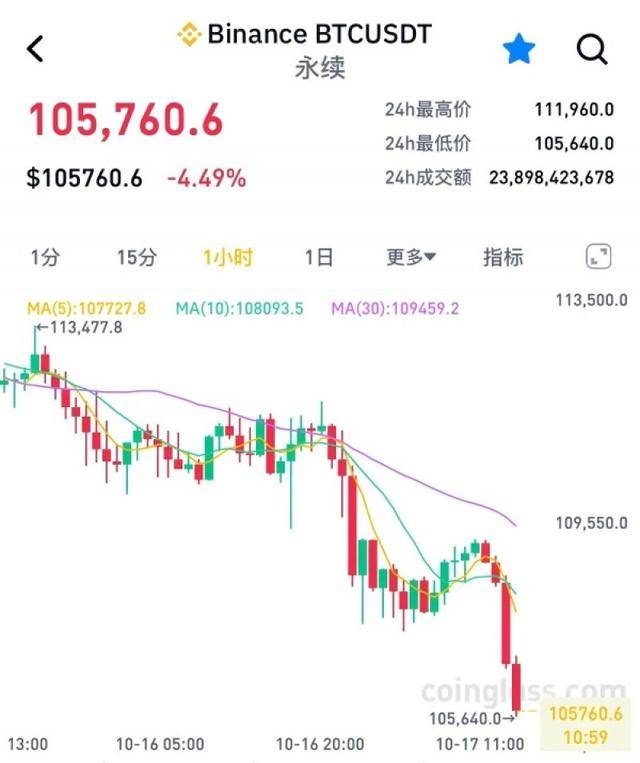
Core Insights - Paxos, the issuer of PayPal's stablecoin PYUSD, accidentally minted 300 trillion PYUSD, valued at over $300 trillion, which is more than twice the global GDP [2][4] - The incident highlights the need for enhanced risk management and technical security in the cryptocurrency industry, emphasizing the importance of smart contract safeguards and real-time monitoring [2][5] - The event led to a temporary freeze of PYUSD trading on the Aave lending protocol due to the sudden supply surge, indicating the interconnected risks within decentralized finance (DeFi) [4][6] Group 1 - The erroneous transaction amount exceeded the entire cryptocurrency market's size, with Tether's USDT valued at approximately $180.6 billion and the total crypto market at around $3.8 trillion [4] - Following the incident, PYUSD maintained its dollar peg, with only a brief price drop of about 0.5% [4] - Paxos stated that the minting error was due to an internal technical mistake and not a security breach, assuring that customer funds were safe [5][6] Group 2 - The incident set a record for the largest token burn in cryptocurrency history, with Paxos quickly destroying the erroneously minted tokens within about 30 minutes [5][6] - Experts noted that if the error had not been corrected swiftly, it could have led to significant market panic and questioned the stability of PYUSD's peg [6][8] - The transparency of blockchain technology allowed for real-time tracking of the incident, showcasing both the advantages and vulnerabilities of centralized stablecoin issuance [6][9] Group 3 - The event raised concerns about the centralized nature of stablecoin issuance, where operational errors can have amplified consequences [9][10] - Historical precedents of operational errors in the crypto space, such as Tether's $5 billion USDT misissue in 2019, underline the ongoing risks in the industry [8][9] - The cryptocurrency market experienced a downturn following the incident, with Bitcoin dropping below $106,000 and significant liquidation events occurring [10][11]

2000万亿!史无前例的泡沫破裂!
Sou Hu Cai Jing· 2025-10-18 00:26
Core Insights - Paxos, a stablecoin issuer, minted 300 trillion PYUSD stablecoins, which are pegged to the US dollar at a 1:1 ratio, and subsequently destroyed them due to an internal error [2][4] - The issuance of such a large amount of stablecoins raises concerns about the lack of regulation and potential risks in the cryptocurrency market [4][5] - The incident highlights the ease with which stablecoins can be created and the implications for larger stablecoins like USDT and USDC [5][8] Group 1: Stablecoin Issuance and Market Impact - Paxos minted 300 trillion PYUSD, equivalent to approximately 2130 trillion RMB, and later sent all tokens to an inaccessible wallet for destruction [2] - The total value of the minted tokens exceeds twice the GDP of all countries combined, raising questions about the implications of such a large issuance [4] - The incident reflects a broader issue in the stablecoin market, where significant amounts can be created without regulatory oversight [4][5] Group 2: Historical Context and Risks - Similar incidents have occurred in the past, such as OKX sending over 65 million OKB to an inaccessible address and the Bonk project destroying 1.7 trillion BONK tokens [5] - The ease of creating stablecoins without proper checks poses risks, especially for larger stablecoins like USDT and USDC [5][8] - The volatility and lack of stability in the stablecoin market raise concerns about the potential for significant financial losses for investors [7][9] Group 3: Blockchain Technology and Market Dynamics - Blockchain technology significantly reduces transaction costs and time in cross-border trade compared to traditional banking systems [12] - Emerging markets are increasingly adopting stablecoins, with usage rates in countries like Argentina and Turkey reaching 25%-30%, surpassing the global average [14] - The transaction volume of stablecoins in cross-border payments is projected to exceed that of traditional payment systems like Visa and Mastercard by 2024 [14][15]

PayPal's $300T stablecoin error
CNBC Television· 2025-10-17 16:04
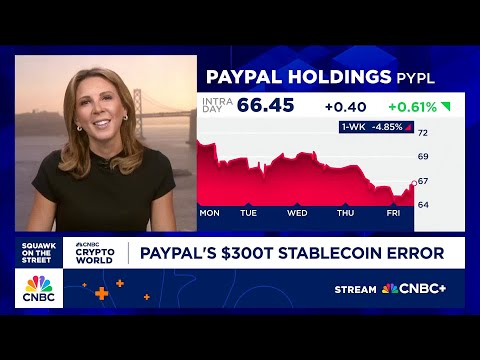
Where's that. >> Welcome back. Cryptocurrencies under pressure this morning again.This after a $300 trillion, yeah, you heard that right. $300 trillion mistake by a partner of PayPal, which sent shock waves across the industry yesterday. CNBC's Mackenzie Sagalos has the story for us.Can explain to us what exactly happened here, McKenzie. >> Hey, David. So, PayPal's big crypto bet is its dollar peg stable coin.It's called PYUSD. And as you said, it briefly created $300 trillion dollars out of thin air this w ...

PayPal's $300T stablecoin error
Youtube· 2025-10-17 16:04
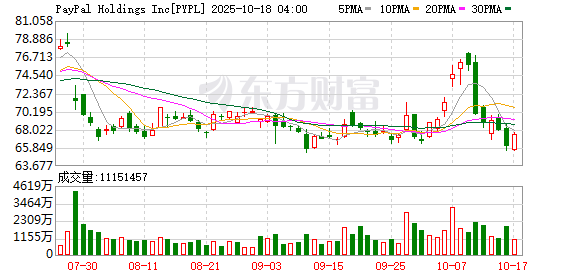
Core Insights - A significant incident occurred involving PayPal's stablecoin PYUSD, where a mistake by Paxos led to the creation of $300 trillion in tokens without reserves, raising concerns in the cryptocurrency industry [2][3][4]. Group 1: Incident Details - The error was due to an internal transfer by Paxos, the issuer of PYUSD, which resulted in the minting of an amount exceeding 100 times the total US cash in circulation [2][3]. - The mistake was publicly visible on the Ethereum blockchain and was reversed approximately 20 minutes later after being flagged by on-chain observers [3]. - This incident follows the passage of the Genius Act, the first US stablecoin law, prompting questions about its effectiveness in preventing such errors [4]. Group 2: Technical Issues - Analysts identified that the smart contract for PYUSD allowed a single wallet unlimited minting rights, lacking rate limits and multi-signature protections [4]. - Previous incidents of similar nature include Tether's accidental minting of $5 billion and Croup's erroneous transaction of $81 trillion [4]. Group 3: Market Impact - Following the incident, PYUSD briefly lost its dollar peg, leading to a major crypto lending platform freezing all PYUSD activities as a precaution [5]. - The overall cryptocurrency market experienced a sell-off, although Paxos confirmed that no customer funds were affected [5]. - New York's financial regulator is reviewing the incident and is in contact with both Paxos and PayPal, while PayPal's shares have seen a 5% decline since last week [5].

史诗级乌龙!PayPal稳定币发行方误铸300万亿美元,稳定币市场警钟炸响
Sou Hu Cai Jing· 2025-10-17 15:49
Core Insights - Paxos, the issuer of PayPal's stablecoin PYUSD, accidentally minted 300 trillion PYUSD, valued at over $300 trillion, which is more than twice the global GDP [2][4] - The incident highlights the need for enhanced risk management and technical security in the cryptocurrency industry, emphasizing the importance of smart contract safeguards and real-time monitoring [2][5] Incident Overview - The erroneous transaction exceeded the entire cryptocurrency market's size, with Tether's USDT valued at approximately $180.6 billion and the total crypto market at about $3.8 trillion [4] - Following the incident, PYUSD maintained its dollar peg, with only a brief price drop of about 0.5% [4] - DeFi protocols, such as Aave, reacted quickly by temporarily freezing PYUSD trading to mitigate risks [4] Response and Recovery - Paxos stated that the minting error was due to an internal transfer mistake and confirmed that customer funds were secure [5] - The company resolved the issue and resumed normal issuance, minting 300 million PYUSD shortly after the incident [5] Market Implications - The event raised concerns about the stability of the PYUSD peg and the potential for panic selling if the error had not been corrected swiftly [6] - The transparency of blockchain technology allowed for real-time tracking and verification of the incident, showcasing both the advantages and vulnerabilities of centralized stablecoin mechanisms [6][8] Structural Risks - The incident exposed the inherent risks in the centralized issuance of stablecoins, where operational errors can lead to significant market disruptions [7][8] - Historical precedents of operational errors in the crypto space, such as Tether's $5 billion misissue in 2019, underline the ongoing challenges in maintaining trust and security in the sector [7] Market Reaction - Following the incident, the cryptocurrency market experienced a downturn, with Bitcoin dropping below $106,000 and significant liquidations occurring across the market [9] - Over 270,000 traders faced liquidations totaling approximately $1.009 billion within 24 hours, indicating heightened volatility and risk aversion [9] Future Outlook - The incident may lead to a bifurcation in the cryptocurrency market, with one side moving closer to traditional finance through compliance and stability, while the other side explores innovative technologies [9] - The market is expected to place greater emphasis on risk management, transparency, and the practical application of products in the wake of this event [9]
一周热榜精选:黄金连破三大整数关口!市场押注超常规降息
Jin Shi Shu Ju· 2025-10-17 13:46
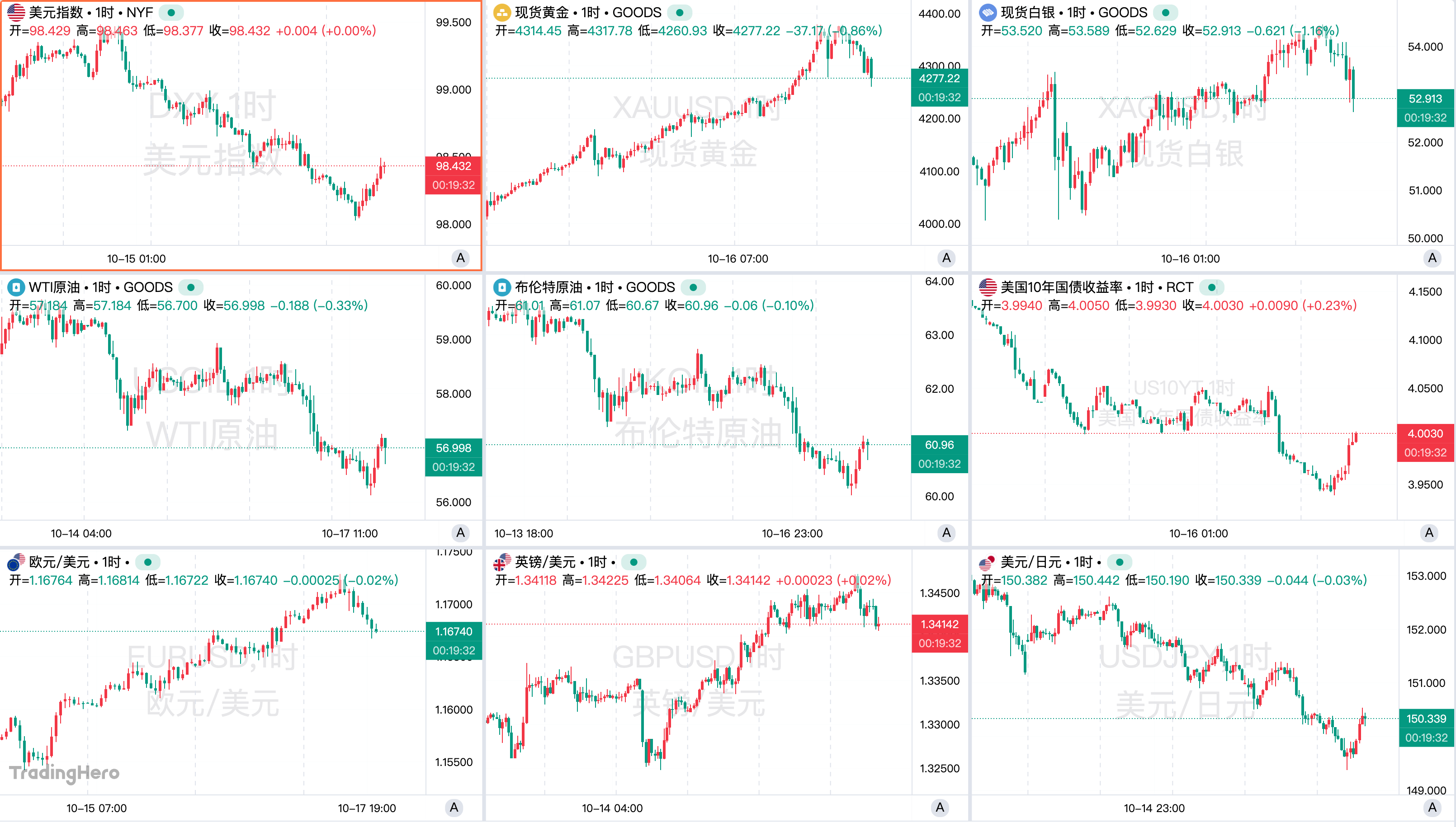
Market Overview - The US dollar index weakened overall this week, dropping to 98.42, with a significant decline following a brief return above 99 [1] - Gold prices reached a historic high, nearing $4380 per ounce, and closed at $4277 per ounce, while silver also surged past $54 per ounce [1] - Non-US currencies appreciated against the dollar due to its weakness, with the euro, pound, and yen all recording gains [1] - International oil prices continued to decline for the third consecutive week, with warnings of a severe global supply surplus by 2026 contributing to the downward trend [1] US Stock Market - The US stock market maintained high-level fluctuations, with a notable rally driven by technology stocks early in the week, but later showed signs of weakness [2] - Concerns over credit quality arose after two regional banks disclosed loan fraud and bad debt issues, leading to a 6.2% drop in the regional bank index and a loss of over $100 billion in market value [2] Investment Bank Insights - A survey by Bank of America indicated that going long on gold has become the most crowded trade, surpassing investments in major US tech stocks [5] - Several investment banks have raised their gold price forecasts, with ANZ predicting a peak of $4600 per ounce by June next year, and Bank of America increasing its forecast to $5000 per ounce [5] Federal Reserve and Economic Policy - Market expectations for significant rate cuts by the Federal Reserve have intensified, with traders betting on at least a 50 basis point cut by year-end [8] - Fed Chair Jerome Powell highlighted risks in the labor market and indicated that the Fed would adjust monetary policy based on economic outlook rather than a preset path [8][9] - The use of the Fed's standing repo facility surged to $6.75 billion, raising concerns about liquidity in the market [9] Banking Sector Concerns - The regional banking sector faced turmoil due to revelations of loan fraud, with significant market value losses and heightened investor concerns about credit quality [13] - Major banks have shown a mixed approach to provisioning for future bad debts, with some increasing reserves while others reported record low provisioning levels [13] Gold Market Regulation - The Shanghai Gold Exchange issued a risk warning regarding the volatility in gold prices, urging members to enhance risk management practices [14] International Relations and Trade - The White House is set to extend tariff exemptions on imported auto parts, providing relief to manufacturers [16][17] - Tensions between the US and India arose after Trump claimed that India would cease purchasing Russian oil, which India denied [22] Economic Recognition - The Nobel Prize in Economic Sciences was awarded to three economists for their contributions to understanding innovation-driven economic growth [25]

外卖平台将取消超时罚款,韩国股市创历史新高 | 财经日日评
吴晓波频道· 2025-10-17 03:36
Financial Data Summary - In September, China's new social financing amounted to 3.53 trillion yuan, with new RMB loans of 1.29 trillion yuan and new RMB deposits of 2.21 trillion yuan [2] - The cumulative increase in social financing for the first three quarters of 2025 reached 30.09 trillion yuan, an increase of 4.42 trillion yuan year-on-year [2] - The M2-M1 spread narrowed significantly to 1.2% at the end of September, indicating a shift of deposits from time deposits to demand deposits for investment or consumption [3] U.S. Federal Reserve Insights - The probability of a rate cut by the Federal Reserve in October has risen to 97.3%, with expectations for a 25 basis point cut [4] - Recent comments from Fed officials lean towards a dovish stance, focusing on employment risks rather than inflation changes [5] - Fed Chair Powell indicated a potential halt in the reduction of assets, suggesting a strategy of maintaining slight rate cuts while adjusting market liquidity through balance sheet management [6] Delivery Industry Developments - Major food delivery platforms, including JD.com, Meituan, and Ele.me, are moving to eliminate penalties for delivery delays, shifting to a service score management system [7][8] - This change aims to reduce pressure on delivery personnel and improve their working conditions, marking a shift towards a more humane and regulated industry [8] AI Infrastructure Investment - An investment group led by BlackRock and NVIDIA announced a $40 billion acquisition of Aligned data centers, which are crucial for AI infrastructure [9] - The deal is expected to be the largest data center transaction in history, highlighting the growing demand for AI-related infrastructure [9][10] Payment Industry Regulation - The People's Bank of China has canceled 11 payment licenses this year, indicating a tightening regulatory environment in the payment sector [11][12] - The number of licensed third-party payment institutions has decreased to 164, with a focus on eliminating smaller, less compliant players [12] Cryptocurrency Market Incident - Paxos mistakenly minted 300 trillion PYUSD stablecoins, marking the largest token burn in cryptocurrency history, although it did not result in actual financial loss [13] - This incident underscores the regulatory challenges and risks associated with stablecoin issuance and the potential for market disruption [14] South Korean Stock Market Performance - The KOSPI index in South Korea has surpassed 3700 points, marking a 56% increase year-to-date, driven by foreign investment and strong performances from major companies [15] - The market's growth is attributed to various factors, including AI infrastructure development and government measures to enhance market transparency [15][16] Market Trends and Outlook - The current market environment is characterized by a lack of clear direction, with many growth sectors experiencing volatility and a need for new catalysts to break out of the current trading range [17][18]



港股异动 | 加密货币概念股集体走低 比特币价格近期剧烈波动 美国稳定币圈惊现乌龙指
Zhi Tong Cai Jing· 2025-10-17 03:05
Group 1 - Cryptocurrency concept stocks collectively declined, with notable drops including Meituan Strategy down 4.36% to HKD 2.63, Xiong'an Technology down 4.3% to HKD 0.089, OSL Group down 3.99% to HKD 15.66, and OK Blockchain down 3.51% to HKD 0.275 [1] - Bitcoin futures on CME fell by 3.10% nearing USD 108,000, indicating a bearish trend in the market [1] - The Bitcoin market is facing dual pressures, with a surge in demand for put options as traders are willing to pay higher premiums to hedge against downside risks [1] Group 2 - A significant incident occurred in the cryptocurrency market where a stablecoin worth USD 300 trillion was mistakenly created by Paxos on the Ethereum blockchain, which was later corrected to USD 300 million [2] - The transaction records indicate that Paxos followed standard procedures to mint 300 million PYUSD, but an error led to the inflated figure of 300 trillion [2]