OPPO

Search documents
上半年营收、净利润同比双降 “非洲之王”传音控股:受市场竞争及供应链成本综合影响
Mei Ri Jing Ji Xin Wen· 2025-08-28 05:24
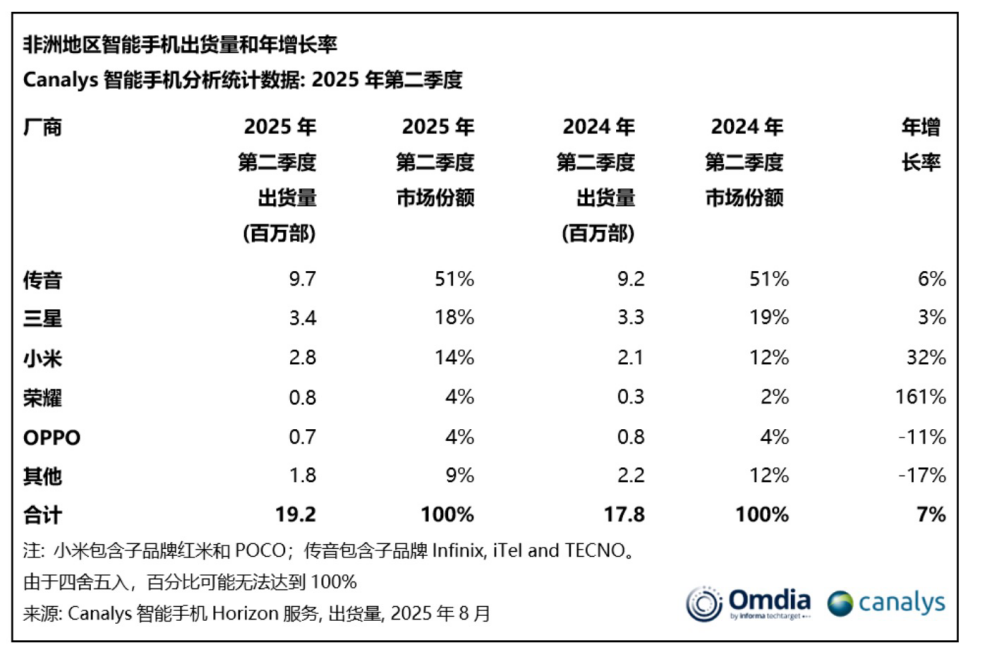
Core Viewpoint - Transsion Holdings reported a decline in both revenue and net profit for the first half of 2025, attributed to product launch timing, market competition, and supply chain costs [1] Group 1: Financial Performance - In the first half of 2025, the company achieved revenue of 29.077 billion yuan, a year-on-year decrease of 15.86% [1] - The net profit attributable to shareholders was 1.213 billion yuan, down 57.48% year-on-year [1] - The gross margin for the first half was approximately 20.1%, a decrease of 1.4 percentage points compared to the previous year [1] Group 2: Market Position and Competition - Transsion Holdings, known as the "King of Africa," has a significant market presence in emerging markets, particularly in Africa, South Asia, Southeast Asia, the Middle East, and Latin America [1] - The company held a 57% market share in Africa at one point, but is now facing increased competition from other smartphone manufacturers [1] - In Q2 2025, Transsion maintained its leading position in the African smartphone market with a shipment of 9.7 million units, a year-on-year increase of 6% [2] Group 3: Strategic Initiatives - The company aims to strengthen its competitive advantage in the African market through refined operations and differentiated brand building [3] - Transsion is focusing on digital investment, channel innovation, and retail store upgrades to enhance its local operations [3] - The company is also pursuing a multi-brand strategy to expand into new emerging markets while emphasizing sustainable development [3]

盈利腰斩、市值缩水,传音控股还能守住“王座”吗?
Zhong Guo Ji Jin Bao· 2025-08-28 05:20
Core Viewpoint - Transsion Holdings, once known as the "King of Africa," is facing significant challenges, including a sharp decline in net profit and market capitalization, raising questions about its ability to maintain its leading position in the African smartphone market [1]. Financial Performance - In the first half of 2025, Transsion reported revenue of 29.077 billion yuan, a year-on-year decline of 15.86%, and a net profit attributable to shareholders of 1.213 billion yuan, down 57.48% year-on-year [2]. - The company has experienced four consecutive quarters of declining performance since Q3 2024, with Q1 2025 net profit dropping by 69.87%, marking the largest quarterly decline since its IPO [4]. Market Position and Competition - Transsion's stock price has fluctuated significantly, with a market capitalization shrinking from nearly 200 billion yuan at its peak to below 100 billion yuan [3]. - Despite holding the largest share of the African smartphone market, Transsion's market share fell from 52% in Q1 2024 to 47% in Q1 2025, with shipments decreasing to 9 million units, making it the only brand among the top five to experience a decline [5]. - In Q2 2025, Transsion's market share rebounded to 51%, but competitors like Xiaomi and Honor saw significant growth in shipments, with Xiaomi increasing by 32% and Honor by 161% [6]. Profitability Challenges - The gross margin in Transsion's core African market has declined, with revenue from the region at 22.719 billion yuan in 2024 and a gross margin of 28.59%, indicating pressure on profitability from increasing competition [7]. Strategic Initiatives - Transsion is actively seeking new growth avenues through diversification and targeting the high-end market, launching AI smartphones, laptops, and smart glasses under its TECNO brand [9]. - The company is also exploring new business lines in emerging markets, including home appliances and mobile internet services, and has established a new division to enter the two-wheeled electric vehicle market [12]. Future Outlook - Despite the initiation of diversification and high-end strategies, Transsion's efforts are still in the early stages, and it remains uncertain whether these initiatives will translate into significant sales and profits [10][11].

Counterpoint:2025年Q2中东非地区智能手机出货量同比增长3%
智通财经网· 2025-08-28 02:45
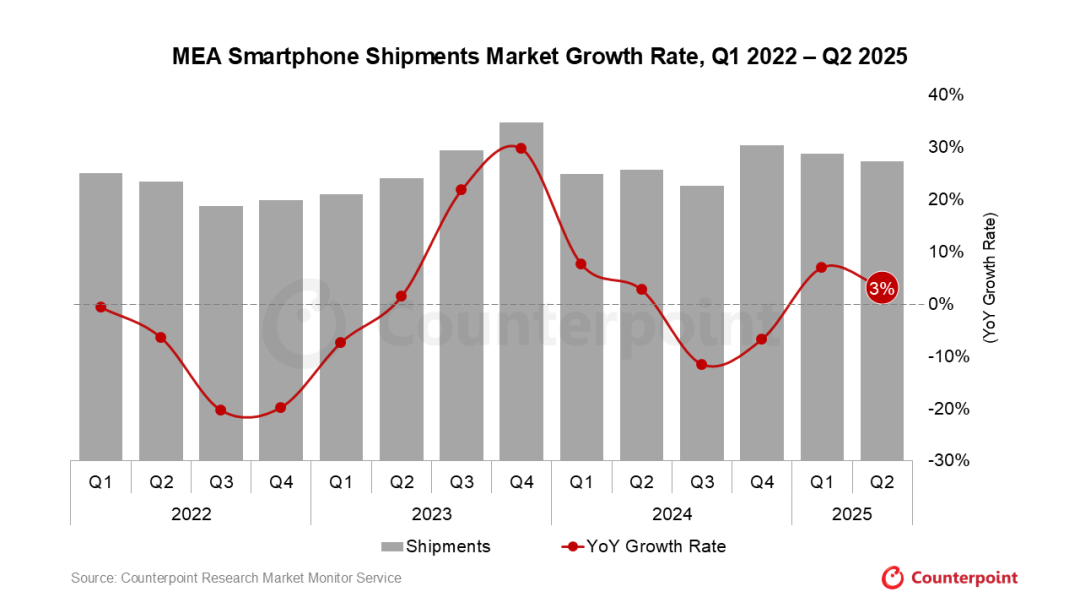
Core Insights - The smartphone shipment volume in the Middle East and Africa is projected to grow by 3% year-on-year in Q2 2025, marking the second consecutive quarter of growth driven by Eid al-Adha sales, regional economic improvement, and stronger consumer purchasing power supported by local currency [1][2] Industry Overview - The average selling price (ASP) of smartphones in the region increased by 7% year-on-year, indicating a shift towards higher-end models among consumers [2] - The market is experiencing accelerated consolidation, with smaller brands facing pressure while leading players strengthen their positions through differentiated products, ecosystem partnerships, and broader offline coverage [2] Market Trends - Demand is diversifying across different price segments, with the entry-level segment (under $100) expanding further and maintaining the largest market share due to increased supply, financing options, and the migration from feature phones to smartphones [2] - The $200–$299 price segment is losing market share to higher-priced models, which are experiencing the fastest growth [2] 5G Adoption - The penetration rate of 5G smartphones in the region reached 37% in Q2 2025, with strong demand for affordable 5G models under $100 from brands like TECNO, OPPO, and itel [7] - The $200–$599 price range also saw robust demand, accounting for 56% of the market share, driven by investments and economic initiatives in countries like South Africa, Egypt, and Kenya [7] Key Brand Performance - Transsion Group leads the market with a 26% share, primarily driven by TECNO, Infinix, and itel, with TECNO holding a 17% share due to effective marketing and strong distribution [10] - Samsung achieved a 1% year-on-year growth, benefiting from its A series and strategic partnerships, despite a significant reduction in its model offerings [10] - Xiaomi's shipment volume grew by 9%, but its reliance on low-cost models led to an 8% decline in ASP, indicating a cautious strategy amid aggressive competition [11] - Apple experienced a 28% year-on-year growth, supported by expanded channel penetration and strong demand for its iPhone 16e, particularly in the GCC market [11]
2025年Q2中东非智能手机出货量同比增长3%,由5G普及与高端需求驱动
Counterpoint Research· 2025-08-28 02:02
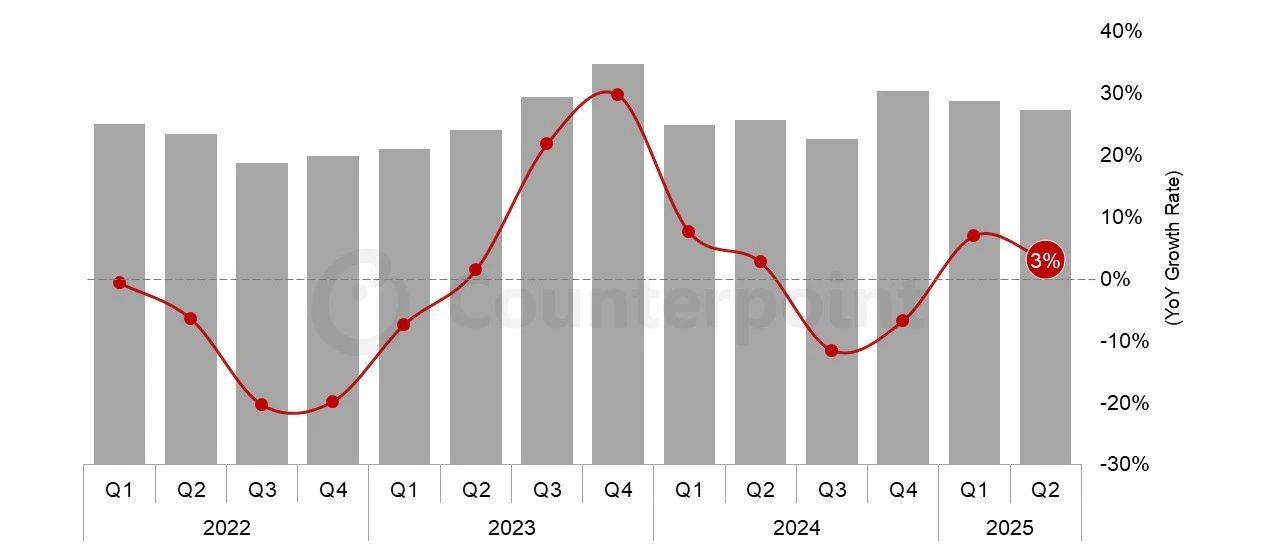
Core Insights - The smartphone market in the Middle East and Africa (MEA) experienced a 3% year-on-year growth in Q2 2025, marking the second consecutive quarter of growth driven by Eid al-Adha sales, economic recovery, and improved consumer purchasing power supported by stronger local currencies [4][7][8] - The average selling price (ASP) of smartphones increased by 7% year-on-year, indicating a shift towards higher-end models among consumers [5][7] - The market is witnessing consolidation, with smaller brands facing challenges while leading players strengthen their positions through differentiated products and broader offline coverage [5][12] Market Performance - The smartphone market in MEA saw a 3% year-on-year increase in Q2 2025, supported by channel activities and affordable 5G models [7][8] - The 5G penetration rate reached 37%, with demand for affordable models under $100 driving sales, particularly in Nigeria [8] - The $200–$599 price segment accounted for 56% of the market, reflecting strong demand in this range [8] Brand Analysis - Transsion Group led the market with a 26% share, driven by TECNO's strong distribution and effective marketing [12] - Samsung achieved a 1% year-on-year growth, benefiting from its A series and AI-driven marketing strategies [12][13] - Apple saw a significant 28% increase in shipments, driven by strong promotions for the iPhone 16e and high-end demand [13] Consumer Trends - Consumers are increasingly favoring models with advanced features such as AI translation, 5G connectivity, and high-refresh-rate displays [5][8] - The entry-level price segment (under $100) continues to expand, maintaining the largest market share due to increased supply and financing options [5][8] - Many consumers are waiting for festive discounts to secure better prices, indicating a price-sensitive market [5]
方邦股份2025年上半年净亏损同比扩大,但股价年内已翻倍
Mei Ri Jing Ji Xin Wen· 2025-08-27 17:17
Core Viewpoint - The company reported a year-on-year increase in revenue for the first half of 2025, but the net profit attributable to shareholders showed a larger loss compared to the previous year, indicating ongoing challenges in profitability despite revenue growth [1][2]. Financial Performance - The company achieved revenue of 172 million yuan in the first half of 2025, representing a year-on-year growth of 16.06% [2]. - The net profit attributable to shareholders was -23.86 million yuan, indicating an increase in losses compared to the same period last year [2]. - The net profit after deducting non-recurring items was -31.79 million yuan, which is a narrower loss compared to the previous year [2]. Business Segment Analysis - The sales of the electromagnetic shielding film business amounted to 86.35 million yuan, showing a decline compared to last year [2]. - The copper foil business generated revenue of 38.32 million yuan, reflecting a year-on-year increase of 6.04% [2]. - The flexible copper clad laminate business saw significant growth, with revenue reaching 13.75 million yuan, a year-on-year increase of 371.67% [2]. Market Position and Challenges - The company is recognized as a leading domestic player in the electromagnetic shielding film sector, having filled a gap in high-end products and breaking the monopoly of foreign companies [2]. - However, the core business of electromagnetic shielding film is facing challenges due to declining profit margins and a decrease in sales volume, attributed to the stagnation in smartphone terminal shipments and increased cost control by manufacturers [2][3]. Stock Performance - The company's stock price has increased by over 100% in 2025, benefiting from the high market demand for PCB-related companies [4]. - The stock price performance is linked to the overall positive sentiment in the PCB market, which has seen significant interest from investors [4]. Future Developments - The company is actively developing new copper foil products for high-speed cable shielding based on customer requirements and is working to stabilize product quality [5]. - There are plans for the company's flexible copper clad laminate products to enter the supply chains of major players like Pengding Holdings and Jingwang [5].

折叠屏手机之争持续升级
Zheng Quan Ri Bao· 2025-08-27 16:12
Core Insights - Huawei is set to launch a new tri-fold smartphone on September 4, marking a significant development in the foldable smartphone market [1] - The competition in the foldable smartphone sector is intensifying, with major players like Samsung and Apple also entering the fray, each adopting different folding designs [1][2] - The foldable smartphone market is transitioning from a luxury segment to a more mainstream consumer product, driven by competitive pricing and innovative features from various brands [2] Industry Trends - The foldable smartphone market is expected to see a shipment volume of 9.47 million units in China by 2025, with a year-on-year growth of 3.3% [3] - Huawei currently holds a 75% market share in China's foldable smartphone market, a record high [3] - The global foldable smartphone market is projected to exceed $40 billion by 2025, with China accounting for 45% of the global market share [3] Competitive Landscape - The competition is shifting from hardware to a comprehensive evaluation of form factors, software, and ecosystem integration [2] - Companies are increasingly focusing on core components like hinges and materials, leading to deeper collaborations between terminal manufacturers and supply chain companies [4] - Major suppliers, such as Jiangsu Jingyan Technology and Guangdong Lingyi Technology, are actively engaging in the foldable screen sector, providing essential components for leading brands [4] Market Outlook - The foldable smartphone market is entering a more mature phase, with increased user acceptance and a more refined supply chain [5] - Analysts predict that the introduction of multiple new foldable models by Huawei in the second half of the year will further stimulate market growth [5] - The ongoing innovation in product forms and components is expected to significantly boost the overall smartphone consumption market [5]
中国AI手机与电脑产业驶入发展快车道
Zheng Quan Ri Bao· 2025-08-27 16:12
Core Insights - The "Artificial Intelligence +" initiative has made significant progress with the release of the State Council's "Opinions on Deepening the Implementation of the 'Artificial Intelligence +' Action," which aims to promote intelligent terminals and develop a new generation of smart products [1][2] - The focus on AI smartphones and computers signifies a comprehensive implementation of the "Artificial Intelligence +" strategy at the terminal level, aiming to empower manufacturing through digital technology and foster new economic growth [2][3] - The introduction of AI into smartphones and computers is expected to transform traditional electronic manufacturing, creating new consumption scenarios and unlocking substantial market potential [2][3] Industry Developments - In 2023, over 100 AI terminals, including AI smartphones and PCs, have been launched, becoming a new growth driver for the economy [3] - IDC predicts that by 2025, the shipment volume of new generation AI smartphones in China will reach 118 million units, a year-on-year increase of 59.8%, capturing 40.7% of the overall market share [3] - The AI PC market is also expected to exceed 50 million units by 2025, accounting for 28% of total shipments, indicating a rapid growth trajectory [3] Corporate Strategies - Major companies like Huawei, Lenovo, and Vivo are actively expanding their presence in the AI smartphone and computer sectors, leveraging their strengths to drive industry clustering [5][6] - Lenovo has reported that its AI PC sales in China surpassed 1 million units in the last fiscal year, with the first quarter of the new fiscal year showing continued growth [5] - Other brands such as Xiaomi and OPPO are innovating in areas like multi-modal interaction and AI photography, contributing to a vibrant AI terminal market [6] Market Potential - The AI terminal market in China is projected to exceed 534.79 billion yuan by 2025, with a compound annual growth rate of over 140% [6] - The advancement of AI terminals relies on robust computing power and efficient algorithm models, with companies like Huawei and MediaTek developing AI-optimized processors [6] - The integration of AI into various terminal products is seen as a crucial step towards enhancing the digitalization of society, driven by the "Artificial Intelligence +" national strategy [7]

一切硬件皆有AI,这样的时代正在奔来
Di Yi Cai Jing· 2025-08-27 10:39
Group 1 - The core viewpoint of the articles is that the Chinese government has initiated a push towards the integration of artificial intelligence (AI) into various hardware sectors, aiming for over 70% of terminal devices to achieve smart upgrades within the next two years [1][2][3] - The "AI+" action plan outlines a clear timeline for the proliferation of new generation smart terminals, with expectations of over 90% adoption by 2030 and a complete transition to an intelligent economy by 2035 [1][2] - The AI transformation is expected to redefine human-computer interaction and reconstruct product value logic and industry ecosystems [1][3] Group 2 - The PC industry is experiencing a revival driven by AI, with IDC forecasting a global PC shipment of 262.7 million units in 2024, marking a 1% year-on-year growth, the first increase in three years [4] - Lenovo's AI PC sales have already reached one-third of total PC sales, surpassing previous expectations, indicating strong user engagement with AI features [4][5] - The smartphone sector is witnessing significant changes as AI redefines interaction methods and reshapes the industry ecosystem, with AI capabilities becoming standard in high-end devices [5][6] Group 3 - The integration of AI in household appliances is becoming mainstream, with traditional appliances like refrigerators and washing machines undergoing upgrades towards higher intelligence and personalization [7][8] - AI penetration rates in various appliance categories are notable, with 90% in robotic vacuums and air purifiers, and over 70% in AI televisions [8] - The smart home appliance market in China is projected to reach approximately 756 billion yuan in 2024, with a growth rate of 3% [8] Group 4 - The future of AI hardware may involve new forms beyond current PCs and smartphones, as existing devices may not meet the demands of next-generation AI [9][10] - The concept of AI as a personal assistant is evolving, with expectations for devices to understand user intent and interact more naturally [10][11] - Emerging technologies such as embodied AI and brain-computer interfaces are expected to drive the next wave of hardware innovation, leading to devices that are seamlessly integrated into daily life [11][12]
选华为还是苹果? 9月10日成旗舰机“决战日”
Xin Lang Cai Jing· 2025-08-27 09:25
Core Points - Apple's annual fall product launch event is scheduled for September 10, 2023, featuring the iPhone 17 series and updated Apple Watch models [2][3] - Huawei has announced its "Mate XTs Extraordinary Master and All-Scenario New Product Launch" event on September 4, 2023, five days before Apple's event, indicating a direct competition [7] - The iPhone 17 series will include four models: iPhone 17, iPhone 17 Air, iPhone 17 Pro, and iPhone 17 Pro Max, with the iPhone 17 Air being a new addition [3][5] - Pricing for the iPhone 17 series is expected to remain similar to the previous generation, with the standard version starting at approximately RMB 5999 [5] Market Competition - Huawei has regained the top position in the Chinese smartphone market with a shipment of 12.5 million units in Q2 2025, capturing 18.1% market share, while Apple shipped 9.6 million units, holding only 13.9% [8][10] - The overall smartphone market in China saw a decline of 4.1% year-on-year, with Huawei's performance standing out despite a 3.4% drop in shipments [8][10] - In the high-end smartphone market (priced above RMB 6000), Apple leads with a 65.81% market share, while Huawei follows with 24.38% [11][13] Strategic Intent - The simultaneous product launches by Huawei and Apple suggest a strategic intent by Huawei to challenge Apple directly in the high-end market [7][13] - Analysts indicate that the competition will focus on product experience and innovation rather than just pricing, emphasizing the need for compelling reasons for consumers to purchase [13]

国产手机围剿iPhone 17,2亿双摄+1万毫安大电池、手机里还要装“空调”…太离谱
3 6 Ke· 2025-08-27 03:09
Core Viewpoint - The article discusses the rapid advancements in the smartphone industry, particularly focusing on the upcoming features and technologies that Chinese manufacturers are planning to implement, such as 200 million pixel cameras, extreme durability, and significant battery capacity improvements. Group 1: Camera Technology - The competition in smartphone imaging has intensified, with manufacturers now aiming for 200 million pixel cameras, which are expected to become mainstream in upcoming flagship models [7][11][12] - The Xiaomi 15 Ultra has already demonstrated the capabilities of a 200 million pixel long-focus lens, showcasing its ability to capture fine details [14][18] - The trend indicates that multiple manufacturers will adopt dual 200 million pixel configurations, enhancing photography capabilities significantly [11][12] Group 2: Durability and Battery Life - Recent models, such as the Redmi Note 15, have showcased impressive durability, withstanding drops from 2 meters without damage [23][28] - The Honor X70 has been marketed with extreme durability claims, suggesting it could withstand bullets, utilizing advanced materials to enhance impact resistance [33][35] - Upcoming models are expected to feature batteries with capacities reaching 10,000 mAh, with several manufacturers already planning to introduce such models [38][41][46] Group 3: Cooling Technology - Active cooling systems are being integrated into smartphones, with Huawei's Mate 80 series expected to feature a built-in fan for enhanced thermal management [53][55] - Realme has also showcased a prototype with an internal cooling fan, indicating a trend towards better heat dissipation in smartphones [59][61] Group 4: Communication Technology - The Huawei Mate 80 series is set to introduce low Earth orbit satellite communication, allowing for connectivity in remote areas without traditional signal coverage [62][63] - The integration of eSIM technology is also anticipated, which could lead to more compact designs and potentially larger battery capacities in future smartphones [65][66] Group 5: Overall Industry Trends - The article highlights a significant shift in the smartphone industry, with Chinese manufacturers pushing the boundaries of technology, making high-end features accessible in mid-range devices [67] - The ongoing competition among manufacturers is expected to lead to continuous innovation, enhancing user experience without a clear winner in the market [67]