AI翻译

Search documents
60亿词翻译+5万岗位:技术向下如何支撑体验向上?
Xin Lang Cai Jing· 2026-02-26 09:52
Core Viewpoint - The inbound tourism market in China is expected to see significant recovery by 2025, driven by the expansion of visa-free policies and the restoration of international flight routes, although structural supply-side shortcomings have been exposed [1][15]. Group 1: Supply-Side Digital Transformation - Multiple companies are addressing the supply-side shortcomings in the inbound tourism market through various strategies, including payment system upgrades and enhanced overseas marketing [1][15]. - Ctrip has focused on supply-side digital infrastructure, localizing travel products in 16 languages for 8,000 merchants and deploying smart ticketing terminals in 241 scenic spots [1][15]. - Ctrip's AI translation engine, "Smart Translation Future," is expected to produce 6 billion words of translation annually, covering 25 languages and addressing long-standing language barriers in the tourism sector [2][16]. Group 2: Employment Generation - Ctrip's transformation of group tours into smaller, customized travel experiences has led to the creation of over 50,000 new jobs, with private tour business growing by over 20% in 2025 [7][21]. - The shift towards personalized travel experiences has resulted in an 80% increase in per capita spending, driven by both recovering international tourists and domestic travelers seeking unique experiences [7][21]. - The distribution of new jobs is changing, with over half of the new positions located in lower-tier cities, indicating a shift of resources towards regional service providers [9][23]. Group 3: Role Transition from Channel Providers to Service Providers - Ctrip has invested over 1 billion RMB in inbound tourism, facilitating the reception of 20 million inbound tourists and helping 70,000 merchants receive international orders [11][25]. - The company's financial data reveals a lower profit margin compared to international peers, attributed to high fixed costs associated with multilingual customer service and operational complexities [11][25]. - The transition from a channel-dependent model to a service-oriented approach is essential for the tourism industry, emphasizing the need for reliable service standards and cultural adaptability [14][28].


外语专业大退潮,曾经的王牌不香了
Xin Lang Cai Jing· 2026-02-14 14:34
Core Insights - The merging of language departments in universities reflects a significant decline in the demand for foreign language majors, impacting students' sense of belonging and career prospects [2][4][5] Group 1: Industry Trends - The popularity of foreign language majors surged after China's WTO accession and the Belt and Road Initiative, but recent years have seen a decline in job opportunities in this field due to a shrinking number of multinational positions and an oversupply of graduates [4][5] - According to a report by Mycos Research Institute, the employment rate for 2023 foreign language graduates is 84.5%, with an average monthly income of 5,695 yuan, which is below the overall level for bachelor's degree holders [4] - Between 2018 and 2022, 28 foreign language-related programs were discontinued across 109 universities, with 26 institutions eliminating Japanese programs and 21 eliminating English programs [4][5] Group 2: Student Experiences - Students like Xiao Cai and Jiang Jiang express feelings of loss and uncertainty as their majors are phased out, leading to a search for new career paths [5][8] - Many students are adapting by pursuing dual degrees or transitioning to other fields, recognizing that language skills alone are insufficient for job market success [11][16] - The shift in hiring practices emphasizes the need for candidates to possess a combination of language skills and other competencies, such as data analysis or programming [20][25] Group 3: Educational Responses - Some universities are reforming their curricula to integrate foreign language education with other disciplines, aiming to produce graduates with versatile skill sets that meet industry demands [25][27] - The focus is shifting from standalone foreign language programs to embedding language skills within broader educational frameworks, ensuring that language proficiency remains relevant in various professional contexts [25][28]

美股异动|多邻国跌4.7%,T-Mobile实时AI翻译服务再度引发市场担忧
Ge Long Hui· 2026-02-11 14:53
Core Viewpoint - Duolingo (DUOL.US) experienced a 4.7% decline, closing at $115.03, amid the announcement of T-Mobile's new real-time AI translation service integrated into its wireless network [1] Company Summary - Duolingo's stock price fell to $115.03, reflecting a 4.7% decrease [1] Industry Summary - T-Mobile launched a real-time AI translation service capable of translating over 50 languages during phone calls, which is embedded in its network infrastructure as a core service rather than an optional feature [1] - The translation service is available to users when at least one party in the call is connected to the T-Mobile network [1]

跨国沟通靠比划的时代结束了?LEION HEY2智能翻译眼镜实测
Xin Lang Cai Jing· 2026-01-30 06:31
Core Insights - The LEION HEY2 glasses provide real-time translation with subtitles displayed in front of the user, making cross-border communication more efficient and practical for travel and meetings [2] - The device supports a language library of 143 languages and features an app that automatically saves conversation records, which is particularly beneficial for content creators [2] - The price point of approximately 3500 yuan raises questions about its value proposition, whether it is seen as a smart investment or an unnecessary expense [2] Group 1 - The LEION HEY2 glasses enable face-to-face conversations with quick response times for everyday dialogue [2] - The technology still struggles with idiomatic expressions, revealing limitations in AI capabilities [2] - The built-in teleprompter function is highlighted as a significant advantage for social media influencers [2]
拉美人爱上看中国言情小说,阅文海外站增长最快的十个海外市场有九个是拉美国家
3 6 Ke· 2025-12-22 04:23
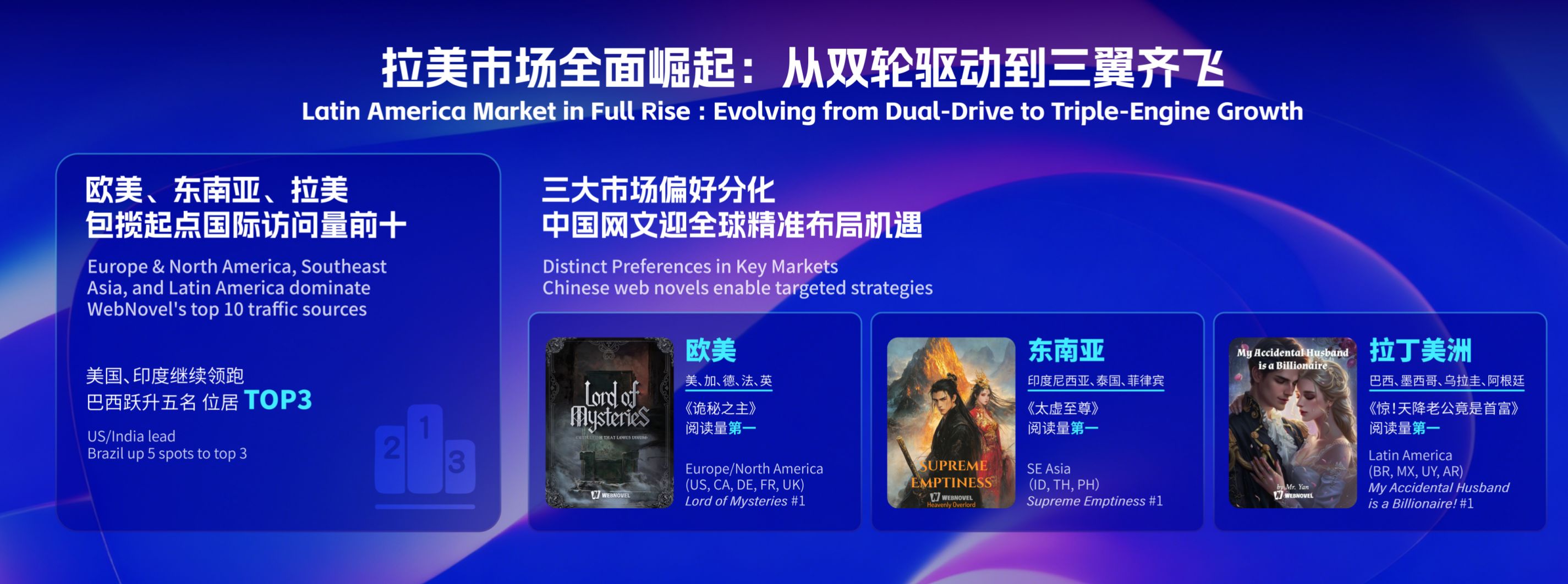
Core Insights - The article highlights the rapid growth of the overseas market for Chinese web literature, particularly in Latin America, where nine out of the top ten countries for global monthly active users are located [1][11] - The report indicates that the Chinese web literature market is projected to reach a revenue of 49.55 billion yuan in 2024, with a year-on-year growth of 29.37%, while the overseas market is expected to generate 4.815 billion yuan, growing by 10.68% [2][3] Group 1: Market Growth and Trends - The overseas web literature market is still in its early stages, with WebNovel hosting approximately 820,000 original works, a 20% increase year-on-year [2][3] - The proportion of post-2000 authors among WebNovel's signed creators has reached 50%, indicating a trend towards younger creators in the overseas market [3] - Latin American readers show a strong preference for Chinese web literature, with the fastest growth in monthly active users observed in Brazil, which saw a 779% increase [5][11] Group 2: Cultural Adaptation and Content Preferences - Different regions exhibit distinct preferences for web literature genres, with Western audiences favoring fantasy and sci-fi themes, while Latin American readers enjoy modern romance and traditional Chinese stories [5][8] - The report emphasizes that the core of a good story resonates universally, but the storytelling methods vary across cultures [8] Group 3: AI and Translation Efforts - AI has significantly enhanced the translation of web literature, with over 10,000 AI-translated works added in the past year, resulting in a 281% increase in total translated works [11][12] - The company has established a "cultural terminology database" to ensure accurate translations of unique concepts in Chinese web literature [11] Group 4: IP Development and Author Support - The company aims to cultivate more local authors in overseas markets, particularly in Latin America, where original works are nearing parity with translated ones [13] - A comprehensive training program for authors is in place, providing support from initial ideas to the final stages of IP commercialization [13] Group 5: Future Goals and Strategic Vision - The CEO of the company envisions replicating the success of its domestic model in international markets, focusing on translating stories, exporting creative models, and building a global creative ecosystem [14] - The company has made significant investments in the IP industry, including acquisitions and partnerships with major platforms to enhance its content offerings [14][15]
拉美人爱上看中国言情小说,这是阅文和西葡语写手共同的机会
36氪未来消费· 2025-12-21 11:51
Core Viewpoint - The article highlights the growth potential of the Chinese online literature industry, particularly in overseas markets, driven by younger creators and new regional interests [3][6][20]. Group 1: Market Growth and Trends - The Chinese online literature market is projected to reach a revenue of 49.55 billion yuan in 2024, marking a year-on-year growth of 29.37%, with the overseas market expected to generate 4.815 billion yuan, growing by 10.68% [6]. - The overseas platform WebNovel has cultivated nearly 530,000 writers and over 820,000 original works, with a 20% year-on-year increase in total works [6][7]. - The overseas user base is increasingly young, with 50% of signed authors being born in the 2000s, and the number of authors born after 2005 growing by 55.9% [7]. Group 2: Regional Preferences and Content - In the overseas markets, the most popular genres vary by region, with Western audiences favoring fantasy and sci-fi, while Southeast Asian readers prefer traditional Chinese cultural themes [10][11]. - Latin American countries dominate the growth in overseas user engagement, with Brazil leading at a 779% increase in monthly active users [11][14]. Group 3: AI and Translation - AI is being utilized to enhance translation efficiency, with WebNovel seeing a 281% increase in AI-translated works over the past year [14][17]. - The company maintains a "cultural terminology database" to ensure accurate translations of unique concepts in Chinese literature [14][17]. Group 4: IP Development and Future Goals - The company aims to replicate its domestic success in overseas markets by developing local authors and creating a global creative ecosystem [20][23]. - Plans include producing physical books, audiobooks, comics, animations, and films from foreign language works, with a focus on nurturing local talent in regions like Latin America [23]. - The company has established partnerships with major platforms like Amazon and Audible to support authors in monetizing their works [18][21].

市场韧性强!中国网络文学实现出海“三级跳”
Yang Shi Xin Wen Ke Hu Duan· 2025-12-21 06:18
Core Insights - The "14th Five-Year Plan" emphasizes the healthy development of online literature, games, and audiovisual content, encouraging cultural enterprises to promote Chinese culture globally [1] Group 1: Market Overview - By the end of 2024, the user base of Chinese online literature is projected to reach 575 million, accounting for 51.9% of internet users [2] - The number of overseas active users is approximately 200 million, with 30 million new registered users in 2024 [2] - Revenue from the overseas market is expected to reach 4.815 billion yuan, reflecting a year-on-year growth of 10.68%, indicating strong market resilience [2] Group 2: Technological Advancements - Technology is enhancing the international dissemination of online literature, with AI translation expected to produce over 10,000 new translated works by 2025, achieving a translation scale 3.5 times larger than last year [3] - AI-driven translation volume is increasing by nearly 300% annually, with translation efficiency improving by 100 times and costs decreasing by 90% [3] Group 3: Industry Development - The international dissemination of online literature has established a robust industrial ecosystem, with significant achievements in IP development across various formats such as audiobooks, comics, and animations [4] - The evolution of Chinese online literature's international presence has transitioned from "text export" to "IP export," and now to a comprehensive "ecological export" model [4] - The current stage of "going global" for Chinese online literature is marked by a shift from single content output to a full ecosystem approach, including creation, translation, IP derivatives, and local co-creation [4]
IP全产业链开发成效亮眼 中国网络文学圈粉海外用户市场韧性强
Yang Shi Wang· 2025-12-21 04:11
Core Insights - The "14th Five-Year Plan" emphasizes the healthy development of online literature, games, and audiovisual content, encouraging cultural enterprises to expand globally [1] - Chinese online literature has emerged as a unique narrative form in the digital age, enhancing the influence of Chinese civilization [1] User Growth and Market Resilience - By the end of 2024, the user base of Chinese online literature is projected to reach 575 million, accounting for 51.9% of internet users [2] - The number of overseas active users is approximately 200 million, with 30 million new registered users in 2024 [2] - Revenue from the overseas market is expected to reach 4.815 billion yuan, reflecting a year-on-year growth of 10.68% [2] Technological Advancements in Translation - AI technology is significantly improving the efficiency and cost-effectiveness of translating online literature [3] - By 2025, over 10,000 new AI-translated works are anticipated, with translation volume increasing nearly 300% compared to 2024 [3] - The efficiency of translation has improved by 100 times, while translation costs have decreased by 90% [3] Comprehensive Ecosystem for International Expansion - The international dissemination of Chinese online literature has developed a robust industry ecosystem, expanding into various derivative forms such as audiobooks, comics, and animations [4] - The transition from text export to a comprehensive ecosystem involving creation, translation, IP derivatives, and local co-creation marks a significant evolution in the industry [4] - AI translation has addressed efficiency bottlenecks, leading to a mature stage of overseas expansion characterized by a "three-tier leap" from content export to cultural export [4]
5.75亿人,48.15亿元!IP全产业链开发成效亮眼 中国网络文学圈粉海外用户市场韧性强
Yang Shi Wang· 2025-12-21 03:53
Group 1 - The core viewpoint of the article emphasizes the growth and international dissemination of Chinese online literature, which is seen as a new form of cultural expression in the digital age, enhancing the influence of Chinese civilization [1][19]. - The "14th Five-Year Plan" encourages the healthy development of online literature, games, and audiovisual content, aiming to promote more cultural enterprises and products globally [1]. - As of the end of 2024, the user base of Chinese online literature is projected to reach 575 million, accounting for 51.9% of internet users in China [7]. Group 2 - The number of overseas active users of Chinese online literature is approximately 200 million, with an increase of 30 million new registered users in 2024, and revenue from the overseas market is expected to reach 4.815 billion yuan, a year-on-year growth of 10.68% [9]. - AI technology has significantly improved the efficiency and cost-effectiveness of translating online literature, with translation volume increasing nearly 300% and costs reduced by 90% [11]. - The international dissemination of online literature has evolved into a comprehensive ecosystem, with significant achievements in IP development, including audiobooks, comics, and animations, creating a multi-dimensional communication model [15][19].

2025翻译硬件变局:讯飞绑定办公,有道潜入学习,时空壶攻占耳朵
3 6 Ke· 2025-12-20 01:50
Core Viewpoint - The translation hardware industry is evolving from a niche market to a more integrated capability within various devices, driven by advancements in AI translation technology, which allows translation to be abstracted from dedicated hardware to a functional capability that can be embedded in multiple products [1][22][24]. Group 1: Industry Challenges - Translation hardware has historically faced a paradox where manufacturers aim to create mass-market products, but users only utilize them in specific scenarios, leading to low repeat purchases [1][5]. - The core selling points of translation devices, such as accuracy and offline capabilities, have diminished due to the maturity of mobile translation apps, making it difficult for dedicated devices to justify their necessity [5][12]. Group 2: Product Evolution - By 2025, the translation hardware category is expected to undergo significant changes, not due to a surge in demand but rather through product upgrades that leverage AI advancements, resulting in a qualitative leap in translation quality [5][22]. - Companies like Youdao and iFlytek are focusing on embedding translation capabilities into broader AI systems rather than creating standalone products, emphasizing long-term utility over short-term trends [6][8]. Group 3: New Product Forms - The emergence of translation headphones, as exemplified by the product W4 from Shikonghu, illustrates a shift from dedicated devices to more frequently used wearable technology, enhancing user experience with minimal intrusion [8][11]. - Smart glasses are also entering the translation market, offering features like subtitle translation, although they face challenges such as latency and noise interference [11][12]. Group 4: AI Integration - The transition from machine translation to AI translation represents a fundamental shift, allowing devices to understand context and user intent, which is crucial for natural conversation flow [12][16]. - AI models are enabling translation devices to support real-time, bidirectional communication, enhancing the overall user experience and making conversations more fluid [16][18]. Group 5: Future Market Dynamics - The translation hardware market is not expected to see a dramatic increase in shipment volumes but is undergoing a critical transformation in how translation capabilities are perceived and integrated into various products [22][24]. - The future competition will focus on understanding real-world scenarios and refining translation details, with companies that invest in long-term improvements likely to succeed [22][24].