
平安银行

Search documents
个人消费贷贴息明日开闸,贷30万元最多可享贴息3000元
Mei Ri Jing Ji Xin Wen· 2025-08-31 08:23
Core Viewpoint - The personal consumption loan interest subsidy policy will officially start on September 1, 2025, allowing residents to benefit from interest subsidies on eligible loans used for consumption [1][2]. Group 1: Policy Implementation - The subsidy period is from September 1, 2025, to August 31, 2026, covering personal consumption loans issued by various financial institutions [1]. - The subsidy applies to loans used for specific consumption categories, including household vehicles, education, cultural tourism, and health care, with a maximum subsidy of 3,000 yuan for eligible loans [2][5]. Group 2: Subsidy Standards - The annual subsidy rate is set at 1% of the actual loan principal used for consumption, with a cap of 50% of the loan contract interest rate [2]. - Each borrower can receive a total subsidy of up to 3,000 yuan, corresponding to a cumulative consumption amount of 300,000 yuan, with a specific limit of 1,000 yuan for loans under 50,000 yuan [2]. Group 3: Bank Promotions and Preparations - Multiple banks, including Bank of China, China Construction Bank, and others, have begun promotional activities for their consumption loan products, utilizing social media and mobile banking platforms [3][5][6]. - Banks are optimizing their customer service channels to provide information about the subsidy, including dedicated sections in mobile banking apps and enhanced intelligent customer service responses [7][8]. Group 4: Application Process - The application process for the subsidy will be similar to standard loan applications, with banks able to automatically identify eligible transactions for subsidy processing [10]. - Customers must sign a supplementary agreement to authorize banks to access their transaction information for subsidy eligibility [10]. Group 5: Customer Eligibility and Funding - The subsidy is available to both new and existing customers, provided their loans meet the eligibility criteria during the subsidy period [11]. - Subsidy funds will be deducted directly from the interest charged on the loans, simplifying the process for customers [12].




个人消费贷贴息明日开闸!多家银行启动预热,五大热点答疑
Mei Ri Jing Ji Xin Wen· 2025-08-31 05:45
Core Viewpoint - The personal consumption loan interest subsidy policy will officially start on September 1, 2025, allowing residents to benefit from interest subsidies on eligible loans used for consumption [1][2]. Summary by Sections Policy Implementation - The subsidy policy will be in effect from September 1, 2025, to August 31, 2026, covering personal consumption loans issued by various banks, excluding credit card transactions [1][2]. - The subsidy applies to loans used for specific consumption categories, including household vehicles, education, healthcare, and electronics, with a maximum subsidy of 3,000 yuan for eligible loans [2][5]. Subsidy Standards - The annual subsidy rate is set at 1% of the eligible loan principal, capped at 50% of the loan contract interest rate [2]. - Each borrower can receive a total subsidy of up to 3,000 yuan, corresponding to a total consumption amount of 300,000 yuan, with a specific cap of 1,000 yuan for loans under 50,000 yuan [2]. Bank Promotions - Multiple banks, including China Bank, Construction Bank, and others, have begun promotional activities for their consumption loan products, utilizing social media and mobile banking platforms for outreach [2][5][6]. - Banks are offering various loan products that qualify for the subsidy, such as "E-loan" and "Quick Loan" from China Bank, and "iCar Loan" from Shanghai Pudong Development Bank [5][6][7]. Application Process - The application process for the subsidy is designed to be straightforward, with banks automatically identifying eligible transactions through their systems [9]. - Customers may need to sign a supplementary agreement to authorize banks to access their transaction information for subsidy eligibility [9]. Customer Eligibility - The subsidy is available to both new and existing customers, including those who applied for loans before the policy's implementation date, provided they meet the eligibility criteria [10]. - The subsidy will be applied directly to the interest payments, reducing the amount owed by the borrower [11]. Channels for Application - Customers are encouraged to apply for the subsidy through official channels such as bank branches and mobile banking apps, with no third-party intermediaries involved [12]. - No fees will be charged for processing the subsidy applications [12].


9家A股股份行半年报亮相!资产规模合计超71万亿元,营收增速放缓
Xin Lang Cai Jing· 2025-08-31 03:07
Core Insights - The performance of nine A-share joint-stock banks in the first half of 2025 is analyzed against a backdrop of a complex external economic environment and increasing industry competition [1] Financial Performance - As of the end of the first half of 2025, the total asset scale of the nine A-share joint-stock banks reached approximately 71.55 trillion yuan [1] - The combined revenue for the first half of the year amounted to about 763.2 billion yuan, while the net profit attributable to shareholders totaled approximately 274.3 billion yuan [1] Asset Quality - Four of the banks reported a decrease in non-performing loan ratios compared to the beginning of the year [1] Dividend Plans - Ping An Bank and Huaxia Bank announced mid-term dividend plans in their semi-annual reports to better reward investors [1] - Several other joint-stock banks indicated intentions to further increase their dividend payout ratios, with specific mid-term dividend plans to be announced later [1]
黄金价格突破1000元大关!2025年8月29日最新金价出炉,现在该买入还是观望?
Sou Hu Cai Jing· 2025-08-31 02:32
Group 1: Market Overview - The international gold price is currently fluctuating at a high of $3386.5 per ounce, attracting global market attention [1] - Domestic gold prices are closely following international trends, with a recent price of 778.6 yuan per gram, which has since risen to 789 yuan per gram [1] Group 2: Jewelry Pricing - Major jewelry brands such as Chow Tai Fook and Luk Fook are priced at 1009 yuan per gram, while Chow Sang Sang leads with a price of 1014 yuan per gram [1] - Other brands like Lao Feng Xiang and Lao Miao Jin are priced at 1013 yuan and 1012 yuan per gram respectively, indicating a competitive pricing landscape [1] Group 3: Gold Bar Pricing - Financial institutions offer gold bars at prices ranging from 795.1 yuan to 804.37 yuan per gram, with notable examples including Agricultural Bank's 803.17 yuan per gram [2] - Professional institutions show a wider price range, with the Shanghai Gold Exchange at 779 yuan per gram and China Gold Investment at 814 yuan per gram [2] Group 4: Investment Strategies - Investors are advised to adopt a phased buying strategy to mitigate risks associated with high gold prices [4] - For consumers with immediate needs, it is suggested to consider more affordable brands, while those with flexible timelines may wait for price corrections [5] Group 5: Investment Options - Various forms of gold investment include physical gold (bars, coins), paper gold (gold accounts), and gold ETFs, each with distinct advantages and considerations [6] - It is crucial for investors to choose reputable channels for purchasing gold to ensure quality and purity [6] Group 6: Key Considerations - Maintaining purchase receipts is essential for future liquidation or repurchase [7] - Investors should closely monitor international gold price trends and make informed decisions based on personal needs and market conditions [9][11]

银行高管思辨“反内卷”: 在规范市场中提高客服硬实力
Zheng Quan Shi Bao· 2025-08-30 16:46
Core Viewpoint - The banking industry is shifting towards a "de-involution" approach to combat irrational price competition, which is seen as detrimental to long-term growth and stability [1][2][4]. Group 1: Industry Perspectives - The 2024 Central Economic Work Conference and the 2025 Government Work Report emphasize the need to address "involutionary" competition in the banking sector [1]. - The Central Financial Committee's recent meeting highlighted the importance of regulating low-price, disorderly competition among enterprises [1]. - Bank executives, including Ping An Bank's president, have warned that prolonged unprofitable competition poses a significant risk to the industry [1]. Group 2: Impact on Banking Operations - The "de-involution" policy is expected to stabilize net interest margins in the banking sector, as indicated by multiple bank leaders [2]. - There has been a noticeable reduction in malicious competition in loan pricing over the past two months, which helps alleviate downward pressure on asset yields [2]. - Banks are encouraged to enhance their service capabilities and customer experience as competition shifts from price to meeting customer needs [2]. Group 3: Strategic Shifts - Banks like Huaxia Bank and Zhejiang Commercial Bank are focusing on transitioning from price-based competition to differentiated, comprehensive services [4]. - The emphasis is on providing value-driven services centered around customer needs, rather than engaging in price wars [4]. - The industry consensus on "de-involution" is becoming a practical action rather than just a slogan, as discussed in recent earnings presentations [3].




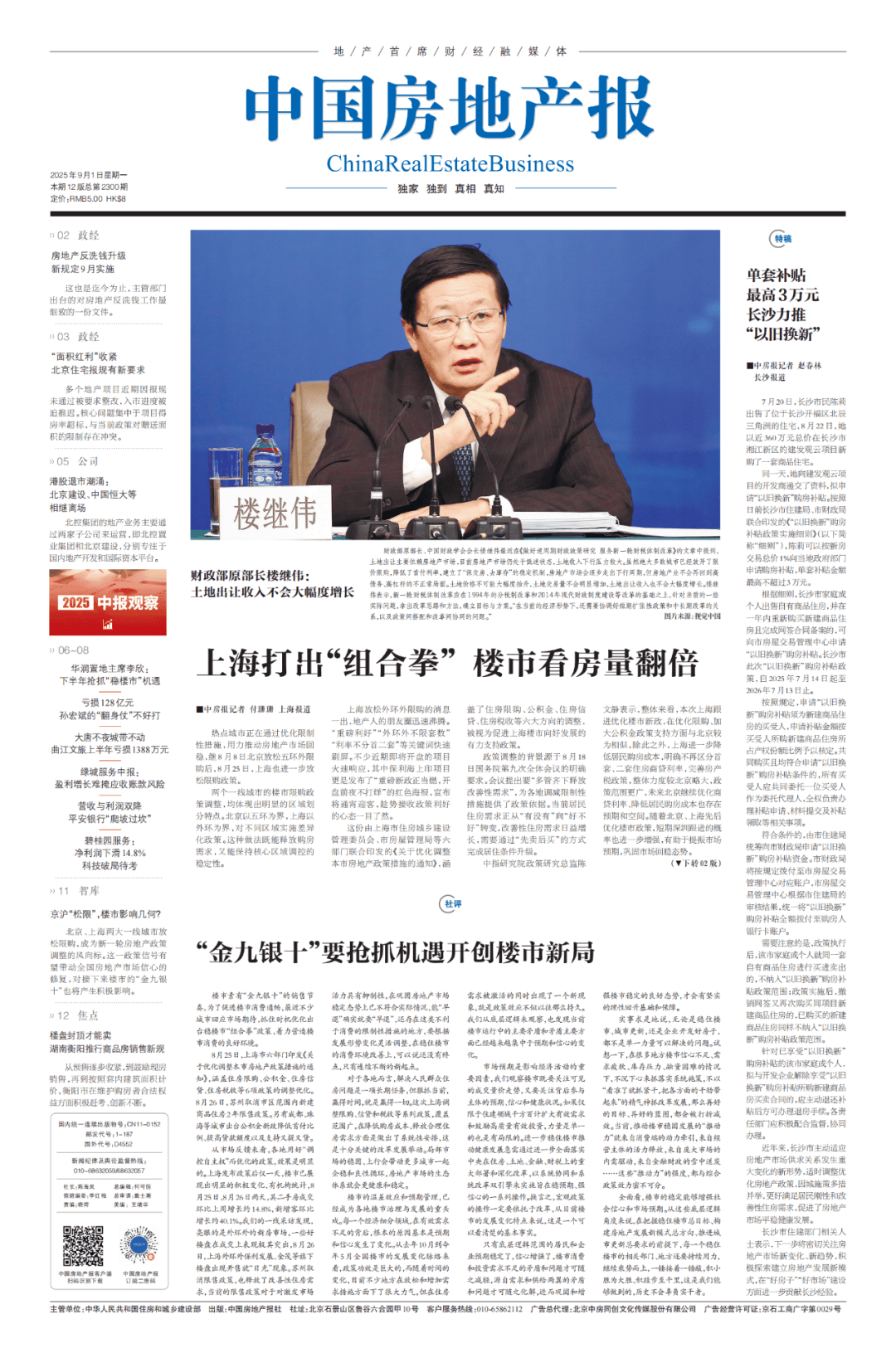
“金九银十”要抢抓机遇开创楼市新局丨社评
Sou Hu Cai Jing· 2025-08-30 05:34
Group 1: Real Estate Policy Changes - New anti-money laundering regulations for real estate will be implemented in September 2025, marking a detailed effort by authorities to enhance oversight in the sector [2] - Beijing has introduced new requirements for residential property regulations, leading to delays in project approvals due to issues with excessive usable area [3] - Shanghai and Beijing have relaxed purchase restrictions, signaling a shift in real estate policy that may boost market confidence and activity during the "golden September and silver October" sales period [7][15] Group 2: Market Reactions and Trends - Following the policy adjustments in Shanghai, there was a notable increase in market activity, with second-hand home transactions rising approximately 14.8% and new listings increasing about 40.1% within two days [16] - The adjustments in Shanghai's real estate policies are seen as a significant move to lower housing costs and stimulate reasonable housing demand, which is crucial for market stability [16] - The ongoing changes in housing demand dynamics reflect a shift from merely having housing to seeking quality housing, necessitating a more flexible approach to policy adjustments [8][17] Group 3: Financial Implications and Future Outlook - The former Minister of Finance indicated that land transfer revenues are unlikely to see significant growth due to the current sluggish state of the real estate market, despite some cities easing restrictions [6] - The overall sentiment in the real estate market is that effective demand and confidence are critical for recovery, with a focus on systemic reforms to stabilize expectations and enhance market conditions [18] - The "old for new" housing subsidy program in Changsha aims to stimulate the market by providing financial incentives for residents to upgrade their homes, reflecting a broader trend of localized policy adaptations to meet housing needs [11][12][13]
2025上半年A股上市银行:业绩分化,净息差“冰火”见真章
Sou Hu Cai Jing· 2025-08-30 04:25
Core Insights - The Chinese banking sector is experiencing structural adjustments and transformation opportunities, with a notable divergence in performance among different types of banks [3][9] Group 1: Overall Performance - In the first half of 2025, 42 A-share listed banks achieved a total operating income of 2.92 trillion yuan and a net profit attributable to shareholders of 1.1 trillion yuan, with over 60% of banks reporting both revenue and profit growth [3] - The four major state-owned banks (ICBC, CCB, ABC, and BOC) maintained strong performance, each surpassing 300 billion yuan in operating income and 100 billion yuan in net profit [4] Group 2: Major Banks' Performance - ICBC led with an operating income of 427.09 billion yuan and a net profit of 168.10 billion yuan, while CCB, ABC, and BOC followed with revenues of 394.27 billion yuan, 369.94 billion yuan, and 329.00 billion yuan respectively [4] - BOC recorded the fastest revenue growth among the four major banks at 3.76%, with a net profit increase of 3.49% [4] Group 3: Performance of Joint-Stock Banks - China Merchants Bank achieved an operating income of 169.97 billion yuan, becoming the only joint-stock bank in the top tier, despite a slight revenue decline of 1.72% [5] - Other joint-stock banks like Bank of Communications and Industrial Bank also performed well, with revenues exceeding 100 billion yuan and net profits of 46.02 billion yuan and 43.14 billion yuan respectively [5] Group 4: Regional Banks' Challenges - Some regional banks faced significant operational pressures, with six institutions, including Ping An Bank and Huaxia Bank, experiencing declines in both operating income and net profit [6] - Ping An Bank's revenue fell by 10% and net profit by 3.9%, while Guiyang Bank's revenue dropped by 12.22% and net profit by 7.2% due to market fluctuations [6] Group 5: Net Interest Margin Trends - The net interest margin (NIM) showed significant divergence, with 40 out of 42 listed banks experiencing a decrease, ranging from 1 to 34 basis points [7] - Notably, Xian Bank and Minsheng Bank reported increases in NIM, with Xian Bank's NIM rising by 49 basis points to 1.91% [8] Group 6: Future Outlook - The banking sector is adapting to a low-interest-rate environment, with banks like Xian Bank and Minsheng Bank demonstrating that optimizing asset-liability structures and enhancing pricing capabilities can lead to growth [9] - The overall resilience of the banking sector is evident, with major banks leveraging their scale and diversified services to maintain profitability amid challenges [9]

上海大消息!20多家银行宣布:调整
Zhong Guo Ji Jin Bao· 2025-08-30 01:53
Core Viewpoint - Shanghai's new housing policy has led to a reduction in mortgage rates for existing loans and a minimum rate of 3.09% for new second-home loans, aligning them with first-home rates [1][3]. Group 1: New Mortgage Rates - The new policy eliminates the distinction between first and second home mortgage rates in Shanghai, with the specific rate determined by the market rate pricing mechanism and individual bank conditions [2][10]. - The minimum mortgage rate for new second-home loans in Shanghai is set at 3.09%, which is consistent with the first-home loan rate [3][2]. Group 2: Existing Mortgage Adjustments - Existing mortgage rates can be adjusted for eligible borrowers, particularly if their current rate exceeds the national average by more than 30 basis points [4][11]. - For example, a second-home loan with a current rate of 3.45% could potentially be reduced to 3.36% [6][4]. - The adjustment process will not incur any fees and will begin on September 1, 2025 [7][14]. Group 3: Implementation and Communication - Banks in Shanghai, including major institutions like ICBC and Bank of China, have issued announcements regarding the new mortgage rate adjustments [1][9]. - Borrowers can check their eligibility for rate adjustments through their respective banks starting September 1, 2025 [12][13].




沪上银行集体调整房贷利率 9月1日起可进行线上查询
Huan Qiu Wang· 2025-08-30 00:49
Core Viewpoint - The new housing loan policy in Shanghai aims to optimize the pricing mechanism for commercial personal housing loans, impacting both new and existing loans [1][3] Group 1: Policy Adjustments - The first major adjustment is the elimination of the interest rate difference between first and second home loans, with future rates determined by the market rate pricing self-discipline mechanism in Shanghai [3] - The second adjustment expands the scope for interest rate adjustments on existing housing loans, allowing borrowers to apply for a reduction in the additional interest rate if it exceeds the average new loan rate by 30 basis points [3] Group 2: Implementation Details - The new policy will take effect from September 1, allowing borrowers to check their loan eligibility for interest rate reductions through online banking channels [3] - The People's Bank of China has set a reference benchmark, with the weighted average interest rate for new commercial personal housing loans at 3.09% for the second quarter of 2025 [3]



上海楼市新政银行层面配套执行细则公布
Zhong Guo Jin Rong Xin Xi Wang· 2025-08-30 00:44
Core Viewpoint - Shanghai's new real estate policy, effective from August 25, has led to banks announcing adjustments to their commercial housing loan interest rate pricing mechanisms, aiming to optimize the housing market [1][2]. Group 1: Policy Implementation - Major banks in Shanghai, including ICBC, Bank of China, and others, have released announcements regarding the adjustment of commercial housing loan interest rates [1]. - The new policy eliminates the distinction between first and second home loans, with interest rates determined based on the market rate pricing mechanism and individual bank conditions [2]. Group 2: Interest Rate Adjustments - Existing housing loan interest rates can also be adjusted for eligible borrowers, following the guidelines from last year's notification regarding the pricing mechanism [2]. - The adjustment rules state that if the existing loan interest rate exceeds the average new loan interest rate by more than 30 basis points, borrowers can apply for a rate adjustment [2]. - As of the second quarter of 2025, the weighted average interest rate for new commercial housing loans in China is reported to be 3.09% [2]. Group 3: Borrower Access - Starting September 1, borrowers can check their eligibility for interest rate reductions through the mobile banking channels of the respective banks [3].