
中国人民银行

Search documents
【西街观察】“不寻求汇率贬值优势”是对中国经济的自信
Bei Jing Shang Bao· 2025-07-15 11:36
Group 1 - The People's Bank of China emphasizes that it does not seek to gain international competitive advantage through currency devaluation, highlighting that a country's competitiveness relies on real strength rather than currency manipulation [1] - The contrast in performance between the US dollar and the Chinese yuan is notable, with the dollar index dropping 11% from above 109 to around 97, while the onshore yuan has appreciated over 1.8% against the dollar since the beginning of the year [1] - Historical evidence suggests that countries relying solely on devaluation to stimulate exports often fall into a vicious cycle of rising import costs and inflation, which ultimately diminishes purchasing power [1][2] Group 2 - China's commitment to not relying on devaluation for competitive advantage aligns with its transition towards high-quality development, focusing on industries like new energy vehicles and high-end equipment through R&D and industrial collaboration [2] - A stable exchange rate environment is essential for supporting imports, domestic demand, and technological exchanges, which are crucial for industrial upgrades in the context of the "dual circulation" development strategy [2] - The stability of the yuan is supported by strong domestic economic fundamentals, with a GDP growth of 5.4% in the first quarter and a net inflow of approximately $100 billion in cross-border funds over five months [3]
中国人民银行开展14000亿元买断式逆回购操作
news flash· 2025-07-15 07:39
Group 1 - The People's Bank of China (PBOC) conducted a reverse repurchase operation of 1.4 trillion yuan to maintain ample liquidity in the banking system [1] - This marks the second consecutive month that the PBOC has increased the scale of its operations [1] - The operation included 800 billion yuan for a 3-month (91 days) term and 600 billion yuan for a 6-month (182 days) term, utilizing a fixed quantity, interest rate bidding, and multiple price level bidding method [1]
人均存款10.5万!今年上半年我国存款余额突破162.02万亿元,专家:居民更倾向于储蓄【附银行业存款业务分析】
Sou Hu Cai Jing· 2025-07-15 03:33
Group 1 - The core viewpoint of the articles highlights a significant increase in household deposits in China, with a balance exceeding 162.02 trillion yuan in the first half of 2025, marking a surge of 10.77 trillion yuan and a growth rate of 7.42% compared to the beginning of the year [2] - The household loan balance increased by only 1.17 trillion yuan to 84 trillion yuan, resulting in a historical peak of "net deposits" reaching 78.02 trillion yuan [2] - The continuous growth of household savings is not a short-term phenomenon, as data shows that from 2017 to 2022, the deposit scale of major state-owned banks rose from 79.31 trillion yuan to 119.24 trillion yuan, with a compound annual growth rate of 8.5% [2] Group 2 - In contrast to the expanding deposit scale, China is experiencing a new round of declining deposit interest rates, with the benchmark interest rate for demand deposits at 0.35% and the three-year fixed deposit rate at 2.75% as of February 2023 [3] - Starting from May 20, 2025, many banks initiated a rate cut, reducing the demand deposit rate from 0.10% to 0.05%, a decrease of 50% [3] - The increase in household deposits, which accounted for nearly 60% of the total deposit increment, indicates a preference for saving over investment or consumption, reflecting a decline in risk appetite and an increase in precautionary savings [3][4] Group 3 - The rising proportion of household deposits and the declining proportion of non-financial corporate deposits are attributed to weakened consumer and housing purchase intentions, leading to an enhanced tendency to save [4] - The cautious behavior of households and the increase in precautionary savings are further emphasized by the decline in corporate revenues, resulting in weak deposit growth for enterprises [4]


适度宽松货币政策护航实体经济 重点领域政策落地显效
Jin Rong Shi Bao· 2025-07-15 01:46
Core Viewpoint - The People's Bank of China (PBOC) has implemented a series of monetary policies aimed at supporting the real economy, with significant effects observed in the first half of 2025. Group 1: Monetary Policy Implementation - The PBOC has adopted a supportive monetary policy stance, having cut the reserve requirement ratio (RRR) 12 times and policy interest rates 9 times since 2020, leading to a decrease in loan market rates by 115 basis points for 1-year loans and 130 basis points for loans over 5 years [2] - A comprehensive set of financial support measures was introduced in May, focusing on maintaining liquidity, adjusting interest rates, and enhancing support for key sectors such as consumption and technology innovation [2][4] Group 2: Financial Data and Economic Impact - In the first half of 2025, the average interest rate for new corporate loans was approximately 3.3%, down about 45 basis points year-on-year, while the rate for new personal housing loans was around 3.1%, down about 60 basis points [3] - The structure of credit has improved, with new loans primarily directed towards manufacturing and infrastructure, and significant growth in green, inclusive, and digital loans, with increases of 27.4%, 11.2%, and 9.5% respectively [3] Group 3: Future Monetary Policy Directions - The PBOC plans to continue its moderately loose monetary policy, focusing on maintaining liquidity and aligning monetary supply with economic growth and price stability [4] - Emphasis will be placed on supporting key areas such as technology innovation, consumption expansion, and small and micro enterprises, while ensuring effective transmission of monetary policy [4][10] Group 4: Support for Consumption and Innovation - The PBOC has established a 500 billion yuan fund for service consumption and elderly care to enhance financial support for sectors like hospitality, education, and healthcare, aiming to stimulate consumer demand [6] - As of May 2025, loans for technology innovation and transformation reached 1.7 trillion yuan, supporting 1.5 million small and medium-sized tech enterprises [7] Group 5: Market Stability and Risk Management - The Chinese financial market has shown resilience amid global uncertainties, with the RMB exchange rate stabilizing around 7.2 against the USD [12] - The bond market has remained stable, with banks increasing their bond holdings to manage risks and ensure sustainable support for the real economy [13]
上半年我国科技金融政策成效显著
Ke Ji Ri Bao· 2025-07-15 01:13
Core Insights - The effectiveness of China's technology finance policies in the first half of 2025 is highlighted, with significant growth in technology loans and innovative financial measures [1][2][3] Group 1: Technology Loan Growth - As of the end of May, the signed contracts for technology innovation and technological transformation loans reached 1.74 trillion yuan, with a year-on-year growth of 12%, surpassing the overall loan growth rate [1] - The total amount of technology innovation and technological transformation loans signed by banks and enterprises reached 1.7 trillion yuan, which is 1.9 times that of the end of 2024 [1] Group 2: Bond Market Innovations - The establishment of the "Technology Board" in the bond market is a key innovative measure, allowing financial institutions, technology enterprises, and equity investment institutions to issue technology innovation bonds [2] - By June 30, 288 entities had issued approximately 600 billion yuan in technology innovation bonds, with over 400 billion yuan issued in the interbank market [2] Group 3: Support for Equity Investment Institutions - The People's Bank of China has created a risk-sharing tool for technology innovation bonds, providing low-cost re-lending funds to support equity investment institutions in issuing bonds [2] - As of June 30, 27 equity investment institutions issued technology innovation bonds totaling 15.35 billion yuan, with five private equity institutions benefiting from the risk-sharing tool [2] Group 4: Overall Financial Support - The financial data from the first half of the year indicates a clear effect of monetary policy in supporting the real economy, with inclusive small and micro loans growing by 11.6% year-on-year and manufacturing medium to long-term loans increasing by 8.8% [3] - The People's Bank of China plans to continue utilizing the risk-sharing tool for technology innovation bonds to foster the development of the technology innovation bond market [3]
上半年金融成绩单出炉:金融总量合理增长,综合融资成本低位下行
Xin Jing Bao· 2025-07-14 23:26
Core Viewpoint - The People's Bank of China (PBOC) has reported significant growth in financial statistics for the first half of the year, indicating effective monetary policy support for the real economy and a low-cost financing environment [1][2]. Group 1: Financial Growth Metrics - As of June, the social financing scale increased by 8.9% year-on-year, while the broad money supply (M2) grew by 8.3% and the RMB loan balance rose by 7.1% [1]. - In the first half of the year, RMB loans increased by 12.92 trillion yuan, with corporate loans being the primary driver, accounting for 89.5% of total new loans [2]. - The weighted average interest rate for new corporate loans was approximately 3.3%, down about 45 basis points from the previous year, while the rate for new personal housing loans was around 3.1%, down about 60 basis points [3]. Group 2: Loan Structure and Sector Focus - Corporate loans increased by 11.57 trillion yuan, with medium- and long-term loans making up a significant portion, indicating stable funding for the real economy [2]. - The loan structure has been optimized, with new loans primarily directed towards key sectors such as manufacturing and infrastructure, with manufacturing medium- and long-term loans growing by 8.7% year-on-year [2]. - Seasonal consumer demand in June contributed to a rapid increase in credit, supported by promotional events and summer travel planning [4]. Group 3: Monetary Policy and Economic Support - The PBOC is committed to maintaining an appropriately accommodative monetary policy to support economic recovery, with various measures implemented to ensure liquidity and lower financing costs [6][7]. - The central bank has introduced targeted support for sectors like consumption, technology innovation, and small and micro enterprises, indicating a strategic focus on enhancing economic growth [6][7]. - The overall financing structure is improving, with direct financing through stocks and bonds growing rapidly, while the total funds flowing to the real economy remain at a high level [7].
上半年金融对实体经济的支持稳固有力
2 1 Shi Ji Jing Ji Bao Dao· 2025-07-14 22:32
Core Insights - The People's Bank of China (PBOC) has implemented a moderately accommodative monetary policy, which has positively impacted financial growth and structure, creating a conducive environment for high-quality economic development [1][5] - The financial data for the first half of 2025 shows a reasonable growth in total financing and RMB loans, with significant increases in social financing and loans compared to the previous year [1][2] Financial Data Overview - As of June, the broad money supply (M2) grew by 8.3% year-on-year, 2.1 percentage points higher than the same period last year, indicating ample market liquidity [1] - Social financing increased by 22.83 trillion yuan, an 8.9% year-on-year growth, with an additional 4.74 trillion yuan compared to the previous year [1] - RMB loans increased by 12.92 trillion yuan, a 7.1% year-on-year growth, although slightly lower than the previous year's increase [1][2] Loan Structure and Support - The majority of new RMB loans were contributed by corporate loans, which increased by 11.57 trillion yuan, accounting for 89.5% of total new loans [2] - The PBOC has utilized various structural monetary policy tools to support key sectors, with inclusive small and micro loans growing by 11.6% year-on-year [2] Financing Costs and Market Resilience - The overall financing costs have decreased significantly, with the average interest rate for new corporate loans at approximately 3.3%, down about 45 basis points from the previous year [3] - The financial market has shown resilience, maintaining stability in the face of external uncertainties, with the GDP growing by 5.4% year-on-year in the first quarter [3] Monetary Policy Framework - The monetary policy has shifted towards moderate easing, focusing on stabilizing asset prices and utilizing structural policy tools to maintain liquidity and reduce financing costs [4] - There is a need for further measures to stimulate the real estate market and enhance consumer spending through targeted financial support [4][6] Future Policy Directions - The PBOC plans to continue its accommodative monetary policy, with potential further reductions in the reserve requirement ratio and interest rates [5] - The bank aims to create a more open and inclusive policy environment to support various economic entities and residents [6]
央行:上半年新增贷款12.92万亿元
Sou Hu Cai Jing· 2025-07-14 20:01
Group 1 - The core viewpoint of the articles highlights the robust support of the financial system for the real economy through increased lending and targeted monetary policies [1][2] - In the first half of the year, the total new loans in RMB amounted to 12.92 trillion yuan, indicating a high level of credit support for the real economy [1] - By the end of June, the balance of RMB loans from financial institutions reached 268.56 trillion yuan, reflecting a year-on-year growth of 7.1% [1] Group 2 - Corporate loans were the main driver of credit growth, with an increase of 11.57 trillion yuan, accounting for 89.5% of all new loans [1] - New loans were primarily directed towards key sectors such as manufacturing and infrastructure, with manufacturing medium and long-term loans increasing by 8.7% year-on-year [1] - The People's Bank of China (PBOC) has implemented a series of monetary policy measures to enhance market confidence and stabilize expectations [2] Group 3 - The PBOC plans to maintain an appropriately accommodative monetary policy and ensure the effective implementation of existing measures to enhance financial services for the real economy [2] - The focus will be on supporting key areas such as technological innovation, consumption expansion, and small and micro enterprises [2] - There is an emphasis on improving the market-based interest rate adjustment mechanism and optimizing the monetary policy tool system to better serve high-quality development [3]
货币市场日报:7月14日
Xin Hua Cai Jing· 2025-07-14 14:48
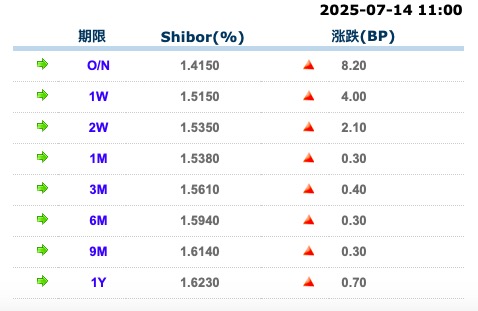
Core Viewpoint - The People's Bank of China (PBOC) conducted a 7-day reverse repurchase operation of 226.2 billion yuan at an interest rate of 1.40%, maintaining the previous rate, resulting in a net injection of 119.7 billion yuan into the market after accounting for 106.5 billion yuan of reverse repos maturing on the same day [1]. Group 1: Market Rates - The Shanghai Interbank Offered Rate (Shibor) showed a slight increase, with overnight Shibor rising by 8.20 basis points to 1.4150%, 7-day Shibor up by 4.00 basis points to 1.5150%, and 14-day Shibor increasing by 2.10 basis points to 1.5350% [2][3]. - In the interbank pledged repo market, overnight rates rose slightly above 1.4%, with DR001 and R001 weighted average rates increasing by 8.1 basis points and 8.0 basis points, respectively, to 1.424% and 1.4837% [4]. Group 2: Funding Conditions - The funding environment on July 14 was characterized as balanced but slightly tight, with increased borrowing demand from banking institutions compared to the previous week. Overnight rates for collateralized deposits were around 1.50%, while 7-day rates were near 1.53% [10]. - By the end of the day, the overnight collateralized deposit rates stabilized around 1.55%, with 7-day rates climbing to between 1.55% and 1.58% [10]. Group 3: Interbank Certificates of Deposit - On July 14, there were 96 interbank certificates of deposit issued, with a total issuance amount of 177.94 billion yuan. The trading sentiment was less active than expected due to tax periods and market expectations [11]. - The secondary market for certificates of deposit maintained an upward trend, with the 1-year large bank deposit rate stabilizing around 1.6375% by the end of the day [11]. Group 4: Monetary Supply and Financing - As of the end of June, the broad money supply (M2) stood at 330.29 trillion yuan, reflecting a year-on-year growth of 8.3%. The narrow money supply (M1) was 113.95 trillion yuan, up 4.6% year-on-year [13]. - The total social financing scale for the first half of 2025 reached 22.83 trillion yuan, an increase of 4.74 trillion yuan compared to the same period last year [13].
中国经济半年报丨金融总量合理增长 信贷结构持续优化——透视上半年金融数据
Xin Hua Wang· 2025-07-14 14:21
Core Viewpoint - The financial data for the first half of the year indicates a reasonable growth in total financial volume and a continuous optimization of credit structure, supported by a moderately loose monetary policy [1][2]. Group 1: Financial Data Overview - As of the end of June, the balance of RMB loans reached 268.56 trillion yuan, a year-on-year increase of 7.1% [1]. - The total social financing scale was 430.22 trillion yuan, growing by 8.9% year-on-year [1]. - The broad money supply (M2) stood at 330.29 trillion yuan, with an annual growth of 8.3% [1]. Group 2: Credit Structure and Allocation - In the first half of the year, new loans totaled 12.92 trillion yuan, with loans to enterprises accounting for 89.5% of all new loans, an increase of 6.6 percentage points compared to the same period last year [2]. - Medium and long-term loans increased by 7.17 trillion yuan, indicating stable funding support for the real economy [2]. - Loans to the manufacturing sector saw a year-on-year growth of 8.7%, with an increase of 920.7 billion yuan in the first half [2]. - Loans to infrastructure also grew, with a year-on-year increase of 7.4% and an addition of 2.18 trillion yuan [2]. Group 3: Bond Market and Financing Costs - The bond market has shown steady growth, with a total issuance of various bonds reaching 44.3 trillion yuan in the first half of 2025, a year-on-year increase of 16% [3]. - The net financing from bonds was 8.8 trillion yuan, accounting for 38.6% of the increase in social financing scale [3]. - The average interest rate for newly issued corporate loans was approximately 3.3%, down by about 45 basis points from the previous year [4]. - The average interest rate for new personal housing loans was around 3.1%, a decrease of 60 basis points year-on-year [4].