
青岛银行

Search documents
今日聚焦!交通银行蛇年国有行跌幅第1 进A股42只银行股跌幅前5
Zhong Guo Jing Ji Wang· 2026-02-25 01:09
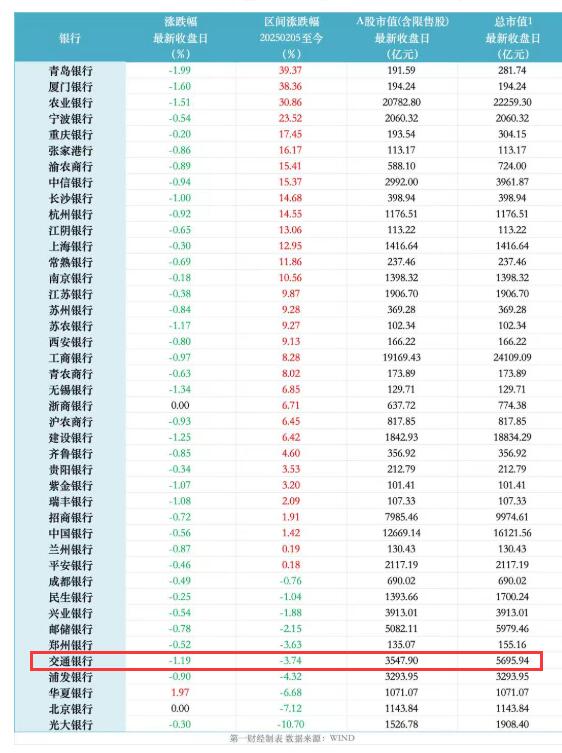
文章称,从个股表现来看,2025蛇年共有32只银行股飘红,涨幅TOP3为青岛银行、厦门银行、农 业银行,涨幅均在30%以上;涨幅垫底的是光大银行、北京银行、华夏银行,最大跌幅超过10%。 (责任编辑:关婧) 标签: 交通 交通银行 市值 华夏银行 北京银行 【资料图】 中国经济网北京2月25日讯 第一财经近日发布文章《蛇年收官!银行股14万亿市值背后几家欢喜几 家愁》。文章称,2025蛇年,共有10只银行股飘绿。聚焦国有大行,虽然板块轮动背景下各大行股价均 有不同程度回调,但全年有4只飘红,邮储银行、交通银行收跌。 图表显示,交通银行蛇年股价跌幅3.74%,居国有行跌幅第一,居A股42只银行股跌幅第五。 ...



交通银行蛇年国有行跌幅第1 进A股42只银行股跌幅前5
Zhong Guo Jing Ji Wang· 2026-02-24 23:11
| | 漆肤味 | 区间涨跌幅 | △酸市值(含限售股) | 总市值1 | | --- | --- | --- | --- | --- | | 银行 | 最新收盘日 | 20250205 至今 | 最新收盘日 | 最新收盘日 | | | (%) | (%) | (亿元) | (亿元) | | 青岛银行 | -1.99 | 39.37 | 191.59 | 281.74 | | 厦门银行 | -1.60 | 38.36 | 194.24 | 194.24 | | 农业银行 | -1.51 | 30.86 | 20782,80 | 22259.30 | | 宁波银行 | -0.54 | 23.52 | 2060.32 | 2060.32 | | 重庆银行 | -0.20 | 17.45 | 193.54 | 304.15 | | 张家港行 | -0.86 | 16.17 | 113.17 | 113.17 | | 渝农商行 | -0.89 | 15.41 | 588.10 | 724.00 | | 中信银行 | -0.94 | 15.37 | 2992.00 | 3961.87 | | 长沙银行 | -1.00 ...
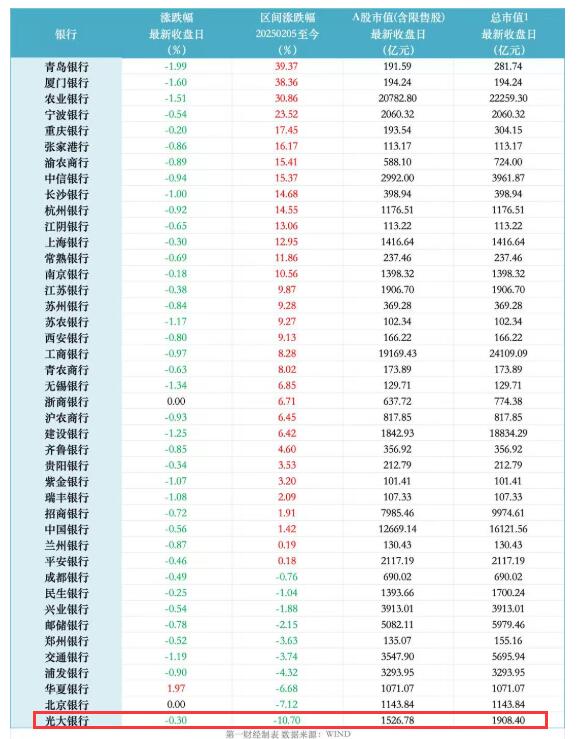
光大银行蛇年股价跌10.7% 夺A股42只银行股跌幅第1名
Zhong Guo Jing Ji Wang· 2026-02-24 23:11
(责任编辑:关婧) 中国经济网北京2月25日讯 第一财经近日发布文章《蛇年收官!银行股14万亿市值背后几家欢喜几 家愁》。文章称,2025蛇年,共有10只银行股飘绿,其中光大银行以10.7%跌幅垫底,北京银行 (-7.12%)、华夏银行(-6.68%)跌幅也均超过5%。 从个股表现来看,2025蛇年共有32只银行股飘红,涨幅TOP3为青岛银行、厦门银行、农业银行, 涨幅均在30%以上;涨幅垫底的是光大银行、北京银行、华夏银行,最大跌幅超过10%。 ...

银行股马年开局遇冷
Di Yi Cai Jing Zi Xun· 2026-02-24 12:31
Core Viewpoint - The A-share market experienced a positive start to the year, but bank stocks continued to be underperformers, reflecting ongoing concerns about credit quality and lending dynamics in the context of stable LPR rates and lower-than-expected credit growth [2][3][4]. Market Performance - On the first trading day of the year, the Shanghai Composite Index rose by 0.87% to 4117.41 points, while the Shenzhen Component increased by 1.36% and the ChiNext Index by 0.99% [3]. - The banking sector saw a decline of 0.24%, with more stocks falling than rising, indicating a divergence in performance compared to other sectors [3]. - The China Securities Banking Index has retreated nearly 16% from its peak in July 2022, contrasting with an 18% rise in the broader market during the same period [3]. Credit and Lending Dynamics - The latest financial data revealed that new RMB loans in January amounted to 4.71 trillion yuan, lower than the 5.13 trillion yuan recorded in January 2022, indicating a year-on-year decrease in credit growth [3][4]. - The social financing scale increased by 7.22 trillion yuan in January, with a notable decline in loans to the real economy, which increased by 4.9 trillion yuan, down by 317.8 billion yuan year-on-year [3][4]. Institutional Research Focus - Institutional interest in bank research has decreased compared to previous years, with 16 banks undergoing 63 institutional surveys in 2023, involving 467 institutions, compared to 20 banks and 92 surveys in the same period last year [6]. - Key areas of focus during these surveys included credit quality, liability management under margin pressure, capital replenishment plans, and asset quality outlook [6][7]. Future Outlook and Strategies - Analysts predict that the trend of prioritizing credit quality over quantity will become more pronounced in 2023, with significant attention on post-Spring Festival operational rhythms and consumer spending [4][5]. - Banks are expected to enhance their non-interest income sources, with strategies including the promotion of wealth management products and diversified capital replenishment channels to address ongoing profitability pressures [8][9].

银行经营周期如何定价各类资产?
GF SECURITIES· 2026-02-24 12:04
Investment Rating - The report assigns a "Buy" rating for the banking sector, indicating an expectation of stock performance exceeding the market by more than 10% over the next 12 months [58]. Core Insights - In 2025, the banking sector's asset growth is projected to be 8.01%, an increase from 6.52% in 2024, driven by factors such as fiscal stimulus, cross-border capital inflows, and the activation of maturing deposits [5][13]. - The report identifies two key cycles affecting asset pricing in banking: the bank expansion cycle and the interest margin cycle, suggesting a comprehensive analysis of these cycles [5][13]. - The debt cycle is characterized as a fundamental aspect of the bank expansion cycle, with a model proposed by Dalio outlining seven stages of a typical debt cycle, which can be influenced by external debt reliance [16][19]. - The report anticipates limited upward space for the debt cycle in 2026, with government leverage expected to increase by 5.89%, lower than the 7.6% projected for 2025 [35][36]. - The banking interest margin cycle is expected to stabilize in 2025, following two complete cycles since 2010, with a correlation observed between bank interest margins and the 30Y-10Y government bond spread [41][45]. Summary by Sections Bank Expansion Cycle - The asset growth rates for different types of banks in 2025 are projected as follows: state-owned banks at 11%, joint-stock banks at 4.74%, city commercial banks at 9.68%, and rural commercial banks at 5.17%, all exceeding the average growth rate [5][13]. - The report emphasizes the importance of understanding the relationship between bank assets and liabilities, highlighting that credit and debt expansion are cyclical and self-reinforcing [15][16]. Debt Cycle Analysis - The report outlines that the current debt cycle, which began in 2022, has lasted 16 quarters, surpassing previous cycles, and indicates a shift in leverage dynamics among enterprises, government, and households [35][36]. - The analysis includes a comparison of deflationary and inflationary debt cycles, noting that the U.S. faces greater inflationary pressures due to higher external debt reliance compared to China [21][19]. Interest Margin Cycle - The report notes that the banking interest margin has experienced significant fluctuations since 2010, with a stabilization phase expected to begin in 2025 [41][45]. - It highlights the impact of loan repricing cycles on interest margins, with a notable decline in loan rates observed in recent years [49][50].




银行股马年开局遇冷,机构调研透露几大隐忧
Di Yi Cai Jing· 2026-02-24 12:01
Core Viewpoint - The enthusiasm for institutional research on banks has declined compared to previous years, with a focus on credit quality and the impact of interest rate spreads on profitability [1][6]. Group 1: Market Performance - On the first trading day of the Year of the Horse, the A-share market saw a rise, with the Shanghai Composite Index up 0.87% and the Shenzhen Component Index up 1.36%, while the banking sector fell by 0.24% [2]. - The banking sector has experienced a divergence in performance, with state-owned banks declining while some regional banks have shown improvement [2]. - The China Securities Banking Index has retreated nearly 16% from its peak in July 2022, while the broader market has increased by nearly 18% during the same period [2]. Group 2: Credit and Monetary Policy - The latest LPR remained unchanged for both the 1-year and 5-year terms, marking a period of stability in interest rates [3]. - In January, new RMB loans totaled 4.71 trillion yuan, lower than the 5.13 trillion yuan in January 2022, indicating a slowdown in credit growth [2][3]. - The People's Bank of China (PBOC) is expected to maintain liquidity support through MLF operations, with a net injection of 300 billion yuan in February [3][4]. Group 3: Institutional Research Focus - Institutional research has shown a preference for banks in economically promising regions, with a significant number of surveys conducted on smaller banks in the Yangtze River Delta [6]. - Key areas of focus during institutional surveys include credit demand, interest margin pressures, capital adequacy, and asset quality outlook [6][7]. - The trend of "deposit migration" towards equity markets is noted, with banks expected to enhance their wealth management and middle-income sources [4][7]. Group 4: Profitability and Capital Management - Banks are under pressure regarding profitability, with institutions increasingly inquiring about capital adequacy and internal capital replenishment strategies [8]. - Several banks plan to explore diverse capital replenishment channels, including issuing capital-boosting bonds and optimizing business structures to enhance capital efficiency [8].




再融资结构性松绑,银行业盈利改善
HTSC· 2026-02-24 05:10
Investment Rating - The report maintains an "Overweight" rating for the securities and banking sectors [9]. Core Insights - The report highlights the structural relaxation of refinancing policies, which is expected to improve profitability in the banking sector. The central bank's Q4 monetary policy report emphasizes the implementation of personal credit repair measures, supporting micro-entities [1][28]. - The report identifies investment opportunities in the order of securities > insurance > banking, with a focus on the potential for marginal improvements in the brokerage business due to the recent refinancing policy adjustments [12][24]. Summary by Sections Securities Sector - The optimization of refinancing measures announced by the exchanges is expected to lead to marginal improvements in the brokerage business, with leading firms likely to solidify their advantages through professional capabilities. The Chinese brokerage index performed better than the Hang Seng index during the holiday period, increasing by 0.20% [2][13]. - Recommended stocks include leading brokerages such as CITIC Securities, Guotai Junan, and GF Securities, as well as quality regional firms like Guoyuan Securities [3][12]. Insurance Sector - The report notes a mixed performance in the insurance sector, with property insurance companies showing gains while life insurance companies mostly declined. China Property & Casualty Insurance rose by 5%, while China Taiping fell by 4% [24][25]. - Investors are advised to focus on quality leaders in the insurance sector, with a preference for defensive stocks like China Ping An and China Life Insurance for conservative investors [24][25]. Banking Sector - The banking sector is experiencing a recovery in performance, with Q4 profits improving and net interest margins stabilizing. The report indicates a year-on-year increase in social financing, primarily due to the pre-positioning of government bonds and a rebound in off-balance-sheet financing [28][37]. - Recommended stocks include quality regional banks such as Nanjing Bank and Chengdu Bank, which are expected to perform well due to their strong fundamentals [3][28].





存款利率1.8%,银行股息冲上4.4%!闭眼买银行股的时代回来了?
Sou Hu Cai Jing· 2026-02-24 04:25
Core Viewpoint - The opportunity cost of investing in bank stocks remains low, with a current 10-year Treasury yield of 1.80% and bank dividends close to 4.4%, providing a premium of 2.6 percentage points over the Treasury yield [2][13]. Group 1: Bank Performance and Profitability - The net profit of commercial banks is recovering significantly, as evidenced by recent earnings reports from over 10 banks, with 12 listed banks reporting their 2025 earnings, showing positive growth except for Huaxia Bank, which saw a decline of 1.72% [2][4]. - Among the banks reporting, Qingdao Bank's net profit increased by over 20%, while Qilu Bank, Hangzhou Bank, and Shanghai Pudong Development Bank all reported growth exceeding 10% [2][4]. - In the first three quarters of 2025, commercial banks achieved a cumulative net profit of 1.87 trillion yuan, a slight decline of 0.02% year-on-year, with state-owned banks and city commercial banks showing positive growth rates of 2.27% and 1.73%, respectively [2][6]. Group 2: Stock Price Trends - Despite improvements in the industry fundamentals, there is significant divergence in bank stock prices, with 24 out of 42 A-share listed banks experiencing declines since the beginning of the year, particularly among state-owned and national joint-stock banks [3][12]. - The top-performing banks in terms of stock price increase include Qingdao Bank, Ningbo Bank, and Chongqing Rural Commercial Bank, with increases of 21%, 11%, and 6%, respectively [3][9]. - Qingdao Bank's stock price rose from 4.3 yuan per share to 5.43 yuan per share between January 20 and February 13, 2026, marking a significant increase [9]. Group 3: Future Outlook and Investment Strategy - Analysts predict that the banking sector's net interest margin will stabilize, with expectations of a slight decline of 4 basis points in 2026, while net interest income growth is anticipated to turn positive [7][14]. - The average price-to-book ratio of A-share banks has dropped to 0.54, indicating a favorable valuation compared to historical averages, while the dividend yield remains attractive [13]. - Investment strategies should focus on banks with high earnings growth and return on equity (ROE), as the market shifts from high dividend yields to valuing banks based on their fundamentals [13][14].



银行&保险业春节后投资展望:金融股又到春播时?
EBSCN· 2026-02-24 01:24
2026 年 2 月 24 日 分析师:董文欣 执业证书编号:S0930521090001 010-57378035 dongwx@ebscn.com ——银行&保险业春节后投资展望 银行业 买入(维持) 作者 分析师:王一峰 行业研究 金融股又到"春播"时? 执业证书编号:S0930519050002 010-57378038 wangyf@ebscn.com 分析师:黄怡婷 执业证书编号:S0930524070003 010-57378023 huangyiting@ebscn.com 分析师:赵晨阳 执业证书编号:S0930524070005 010-57378030 zhaochenyang@ebscn.com 行业与沪深 300 指数对比图 资料来源:Wind 相关研报 1 月贷款同比少增,稳定需求仍需政策加力 — — 2026 年 1 月 份 金 融 数 据 点 评 (2026-2-14) 息差保持稳定,盈利增速回升——2025 年四 季 度 商 业 银 行 主 要 监 管 指 标 点 评 (2026-2-13) 要点 事项: 年初以来(截至 2 月 13 日),A、H 金融股表现分化,涨跌互现, ...
银行业周度追踪2026年第6周:商业银行四季度利润增速回升-20260224
Changjiang Securities· 2026-02-23 23:30
Investment Rating - The industry investment rating is "Positive" and maintained [11] Core Insights - The banking index fell by 1.3% this week, underperforming the CSI 300 and ChiNext indices by 1.6% and 2.5% respectively, indicating a short-term style switch in the market [6][19] - H-shares of banks led the gains, while most A-shares declined, with notable performances from Huaxia Bank and Shanghai Bank due to improved earnings and strong expectations for convertible bond conversions [6][19] - The price-to-book (PB) ratio and return on equity (ROE) of bank stocks remain undervalued, with a continued recommendation for high-quality city commercial banks in Zhejiang, Jiangsu, and Shandong provinces, including Hangzhou Bank, Ningbo Bank, Jiangsu Bank, Nanjing Bank, Qingdao Bank, Qilu Bank, and Suzhou Bank [6][19] - The report also suggests focusing on low-valuation, high-dividend, and convertible bond opportunities, particularly in Industrial Bank [6][19] Summary by Sections Market Performance - The banking sector's trading activity has decreased, with turnover rates falling, although the transaction volume share for state-owned and rural commercial banks has rebounded [8][39] - The average dividend yield for the six major state-owned banks in A-shares is 4.28%, with a spread of 249 basis points over the 10-year government bond yield, while H-shares yield 5.21% [7][29] Profit Growth and Net Interest Margin - The overall asset growth rate for commercial banks reached 9.0% year-on-year by the end of Q4 2025, with major state-owned banks seeing a growth rate of 10.8% [9][44] - The net profit growth for commercial banks was 2.3% year-on-year, indicating a positive trend, particularly among city and rural commercial banks [9][44] - The net interest margin for 2025 is projected at 1.42%, with a marginal stabilization observed, and a further narrowing of the decline expected in 2026 [9][46] Asset Quality - The non-performing loan (NPL) ratios across various banks are stable or improving, attributed to increased write-off efforts, while the provision coverage ratio continues to decline [10][49] - Capital adequacy ratios remain stable, with attention on the potential impact of the second round of fiscal injections for state-owned banks and refinancing for smaller banks in 2026 [10][49]

