鸿腾精密

Search documents
国证国际港股晨报-20260116
国投证券国际· 2026-01-16 12:26
Group 1: Market Overview - The Hong Kong stock market experienced a decline, with the Hang Seng Index falling by 0.28%, the Hang Seng China Enterprises Index down by 0.52%, and the Hang Seng Tech Index decreasing by 1.35% [2] - The total market turnover was HKD 290.455 billion, with short selling amounting to HKD 35.078 billion, representing 13.62% of the total turnover [2] - Southbound capital saw a net outflow of HKD 1.515 billion, with Alibaba, Tencent, and SMIC being the most bought stocks, while China Mobile, Xiaomi, and CNOOC faced the most selling pressure [2] Group 2: Sector Performance - The AI healthcare and internet healthcare sectors faced adjustments, with notable declines in stocks such as Jingtai Holdings down 10.74% and Alibaba Health down 7.84% [2] - The OTA platform Trip.com Group saw a significant drop of 19.23% due to an investigation by the State Administration for Market Regulation for alleged monopolistic behavior [3] - The optical communication sector performed well, with stocks like Huiju Technology rising by 8.89% and Cambridge Technology increasing by 7.75% [3] Group 3: Monetary Policy and Economic Measures - The People's Bank of China announced a series of targeted monetary easing measures, including a structural interest rate cut of 0.25 percentage points, aimed at reducing financing costs in specific sectors [4] - A total of CNY 1 trillion was allocated to support private enterprises, with an additional CNY 500 billion specifically for small and medium-sized private companies [4] - The bank also increased the quota for technology innovation and technical transformation loans by CNY 400 billion, bringing the total to CNY 1.2 trillion [4] Group 4: Company Analysis - 361 Degrees - 361 Degrees reported better-than-expected performance with offline retail growth of approximately 10% for both its main brand and children's clothing [7] - The company continues to see strong growth in e-commerce, achieving high double-digit growth rates [7] - The launch of new products across various categories, including running, basketball, and outdoor gear, reflects the company's commitment to innovation and brand development [8] Group 5: Investment Outlook for 361 Degrees - The company is expected to benefit from the introduction of new store formats, which will contribute positively to its performance [9] - The forecast for EPS from 2025 to 2027 is projected at CNY 0.60, CNY 0.69, and CNY 0.76, respectively, with a target price of HKD 7.6 based on a 10x PE ratio for 2026 [9]
每日投资策略-20260107
Zhao Yin Guo Ji· 2026-01-07 03:27
Global Market Overview - The Hang Seng Index closed at 26,710, up 1.38% for the day and 4.21% year-to-date [1] - The Shanghai Composite Index rose by 1.50% to close at 4,084, with a year-to-date increase of 2.89% [1] - The US markets also saw gains, with the Dow Jones up 0.99% and the S&P 500 up 0.62% [1] Hong Kong Stock Performance - The Hang Seng Financial Index increased by 2.19%, while the Hang Seng Real Estate Index rose by 2.01% [2] - The Hang Seng Industrial Index saw a gain of 0.93%, reflecting a positive trend in the sector [2] Chinese Market Insights - Chinese stocks have been on a continuous rise, with significant net buying from southbound funds amounting to HKD 2.879 billion [3] - Key stocks such as China Ping An, Alibaba, and China Life saw the highest net inflows, while China Mobile and Tencent experienced the most significant net outflows [3] Monetary Policy and Economic Development - The People's Bank of China emphasized the importance of promoting high-quality economic development and reasonable price recovery in its monetary policy [3] - The central bank plans to enhance counter-cyclical and cross-cyclical adjustments, utilizing various policy tools such as reserve requirement ratio cuts and interest rate reductions [3] Technology Sector Insights - The 2026 International Consumer Electronics Show (CES) highlighted advancements in AI servers and AI PCs, with Nvidia's Vera Rubin platform ahead of schedule for production [4] - The penetration rate of AI PCs is expected to rise rapidly between 2026 and 2027, driven by new processors from Qualcomm, Intel, and AMD [4] - Key beneficiaries in the AI server and AI PC supply chain include companies like Hon Teng Precision, Luxshare Precision, and BYD Electronics [4]
ETF盘中资讯 | “GPU芯片第二股”暴涨700%!国产芯片午后异动,159131冲高1.7%
Jin Rong Jie· 2025-12-22 21:28
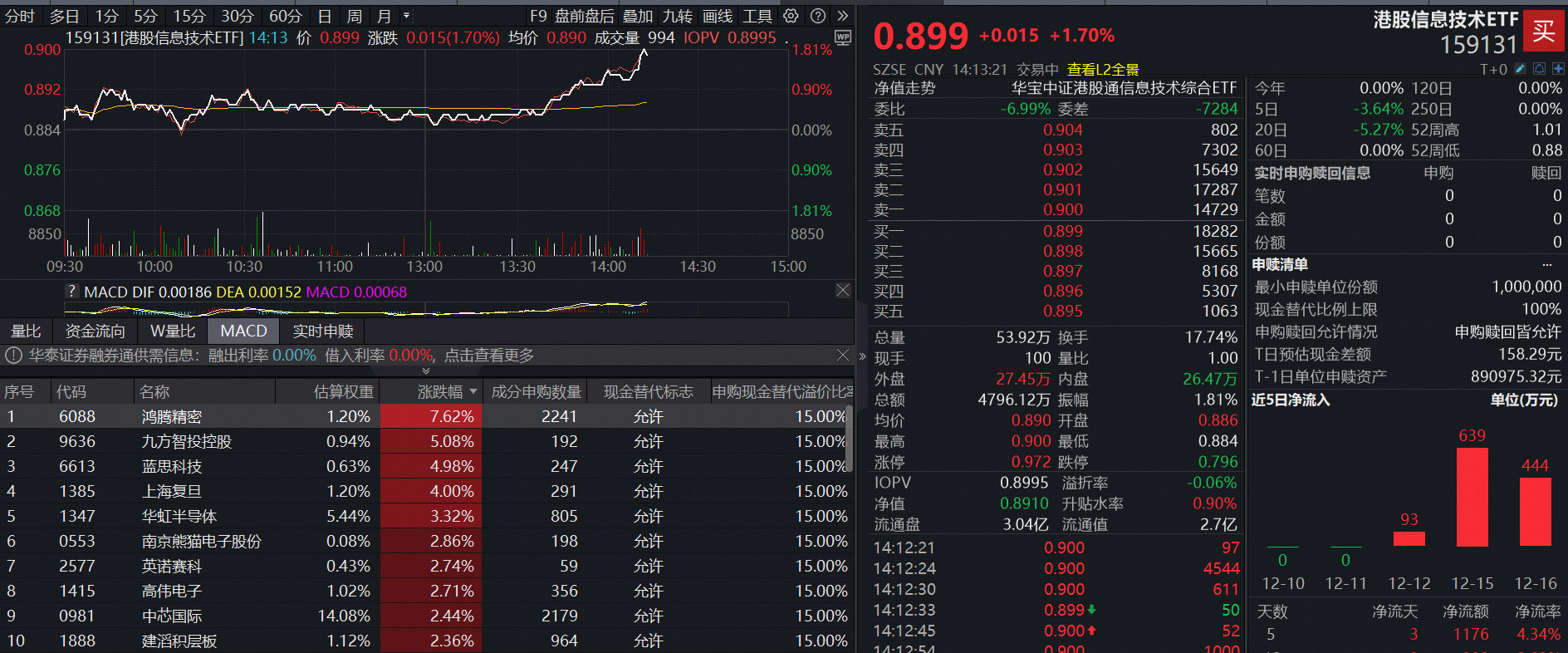
Core Viewpoint - The Hong Kong stock market is experiencing a surge in the semiconductor industry, with significant gains in various companies, indicating a strong interest and potential growth in the sector [1][4]. Group 1: Market Performance - Hong Teng Precision saw a rise of over 7%, while Lens Technology and Shanghai Fudan increased by over 4%, and Huahong Semiconductor and SMIC rose by over 2% [1]. - The first ETF focusing on the Hong Kong semiconductor industry, tracking the index composed of 70% hardware and 30% software, has been launched, indicating a strategic move to capitalize on the growing demand for AI computing power [4][5]. Group 2: IPO Activity - The recent IPO of Muxi Co., known as the "second GPU chip stock," saw its share price surge over 700%, with a market capitalization exceeding 330 billion yuan, highlighting the rapid growth and investor interest in domestic AI chip companies [3][4]. Group 3: Industry Outlook - According to Ping An Securities, the demand for intelligent computing power is robust, and the domestic AI chip market is expected to continue its rapid development due to strong policy support and significant growth in downstream demand [4]. - The domestic AI computing chip industry is positioned for growth, driven by a combination of favorable policies, strong demand, and substantial replacement opportunities [4].

ETF盘中资讯 | 光计算芯片重磅突破!商汤-W大涨7%,中芯国际涨近6%,首只“港股芯片链”ETF涨近 1.7%
Jin Rong Jie· 2025-12-22 06:09
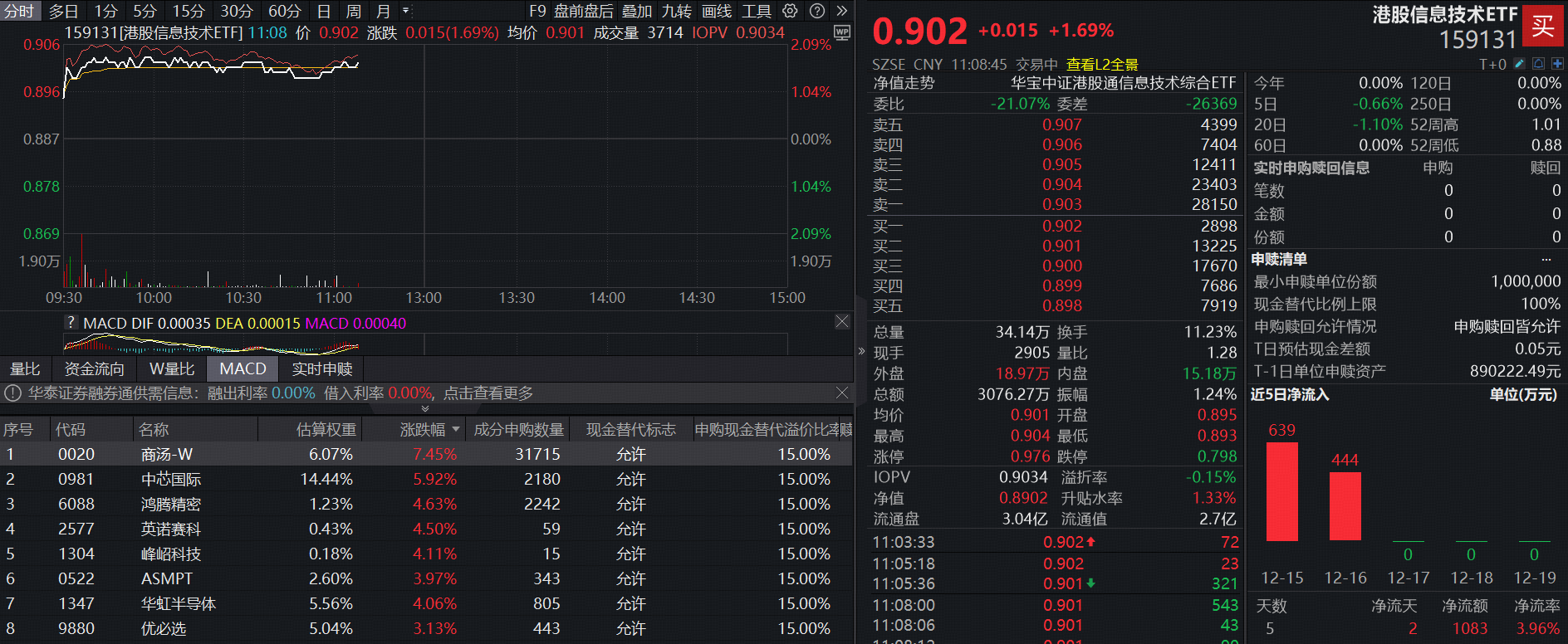
据悉,上海交通大学科研人员近日在新一代光计算芯片领域取得突破,首次实现支持大规模语义媒体生成模型的全光计算芯片,相关成果发表在国际重量级 期刊《科学》杂志。 12月22日早盘, A+H芯片半导体产业链走强,港股方面,商汤-W大涨超7%,中芯国际涨近6%,鸿腾精密涨近5%,华虹半导体涨超4%。全市场首只聚 焦"港股芯片"产业链的港股信息技术ETF(159131)场内价格现涨1.69%,实时成交额超3000万元。 风险提示:港股通信息技术ETF被动跟踪中证港股通信息技术综合指数,该指数基日为2014.11.14,发布于2017.6.23。材料中指数成份股仅作展示,个股描 述不作为任何形式的投资建议,也不代表管理人旗下任何基金的持仓信息和交易动向。本产品由华宝基金发行与管理,代销机构不承担产品的投资、兑付和 风险管理责任。投资人应当认真阅读《基金合同》、《招募说明书》、《基金产品资料概要》等基金法律文件,了解基金的风险收益特征,选择与自身风险 承受能力相适应的产品。基金过往业绩并不预示其未来表现,基金管理人管理的其他基金的业绩并不构成基金业绩表现的保证,基金投资须谨慎!基金管理 人评估的该基金风险等级为R4-中高风 ...

每日投资策略-20251219
Zhao Yin Guo Ji· 2025-12-19 03:55
Core Insights - The report highlights that the macroeconomic environment in 2026 will be influenced by U.S. midterm election pressures, defense demands in Europe and Japan, and China's focus on stable growth, leading to continued policy easing in the first half of the year [2] - The AI boom is expected to enhance efficiency and stock valuations but may also exacerbate job losses and economic K-shaped divergence [2] - The report suggests that the second half of 2026 may see a rebound in inflation due to global liquidity easing, a weaker dollar, and China's anti-involution efforts, potentially causing volatility in high-valuation assets [2] Industry Outlook Chinese Internet Software - 2026 is seen as a critical year for competing for user attention in the AI era, with a focus on lowering usage barriers, enhancing decision-making efficiency, and creating real value [2] - Companies with stable cash flows supporting AI investments and strong operational capabilities are expected to have higher long-term investment value [5] Semiconductor - The report maintains four core investment themes for 2026: AI-driven structural growth, China's semiconductor self-sufficiency trend, high-yield defensive allocations, and industry consolidation [7] - The global semiconductor market is projected to grow by 26% to $975 billion in 2026, with AI-related segments leading the growth [7] Technology - The global tech industry is expected to experience demand differentiation and accelerated AI innovation, with a focus on AI computing infrastructure and end-user AI products [8] - Key companies to watch include Apple, which is anticipated to have a year of innovation with new AI products [8] Consumer Sectors Essential Consumption - The report identifies three main investment themes: deepening consumption stratification, focusing on essential survival needs, and leveraging overseas expansion to hedge against domestic uncertainties [10][20] - Companies in the food and beverage sector, such as Nongfu Spring and China Resources Beverages, are recommended due to their stable demand and attractive valuations [21] Discretionary Consumption - The outlook for the discretionary consumption sector is cautious, with expected retail sales growth of about 3.5% in 2026, slightly down from 4% in 2025 [11] - The report suggests a focus on survival-type consumption and low-cost emotional comfort products, with recommendations for companies like Luckin Coffee and Bosideng [11][21] Automotive - The Chinese automotive industry is expected to show resilience despite pressures from subsidy reductions and tax incentives, with retail sales of passenger vehicles projected to remain stable [12] - Key trends include intensified competition and the introduction of new models, particularly in the new energy vehicle segment [12] Pharmaceuticals - The innovative drug sector has seen significant growth driven by overseas licensing deals, but future catalysts are expected to shift from upfront payments to milestone achievements [13] - The CXO industry is anticipated to continue its recovery in 2026, supported by a rebound in domestic R&D demand [13] Real Estate - The report forecasts a continued contraction in the real estate market, with total residential sales expected to decline by 8% in 2026 [16][17] - Investment themes include focusing on stock market service providers and companies with strong operational capabilities in commercial assets [18][19]





浪涌潮退
Zhao Yin Guo Ji· 2025-12-18 11:06
Macro Economic Outlook - In 2026, the U.S. midterm elections, Japan and Europe’s defense spending demands, and China's growth stabilization will lead to continued policy easing in the first half of the year. However, the actual space for macro policy is limited due to high inflation, rising government debt, and previous policy overreach [7] - The AI boom is expected to enhance efficiency and market valuations but may also exacerbate job losses and economic K-shaped divergence. Global liquidity easing and a weaker dollar may lead to rising inflation in the second half of the year, potentially causing volatility in high-valuation assets [7] Chinese Internet Software Sector - 2026 is seen as a critical year for capturing user mindshare in the AI era, focusing on lowering usage barriers and enhancing decision-making efficiency. Companies with stable cash flows supporting AI investments and strong operational capabilities are expected to have higher long-term investment value [8] - Recommended stocks include Tencent, Alibaba, and Kuaishou for AI-driven growth, and NetEase and Trip.com for stable earnings growth [8] Overseas Internet Software Sector - The competition in the large model industry is expected to intensify, with AI application monetization continuing to grow. Companies like Microsoft, Google, Amazon, and Palantir are recommended for their potential in AI revenue generation [9] Chinese Semiconductor Sector - The sector is expected to focus on AI-driven structural growth, self-sufficiency trends, high-yield defensive allocations, and industry consolidation. The global semiconductor market is projected to grow by 26% to $975 billion in 2026, with AI-related segments leading the growth [10] Chinese Technology Sector - The global tech industry will experience demand differentiation and accelerated AI innovation. The expansion of computing power and the introduction of AI products are expected to drive growth, with a focus on AI infrastructure and end-user AI products [11] Chinese Essential Consumer Sector - The core constraint on consumer spending in 2026 is expected to be asset shrinkage and slow income recovery. Investment themes include the deepening of consumer stratification and a focus on essential survival needs [12] Chinese Discretionary Consumer Sector - The overall retail sales growth is projected to slow to about 3.5% in 2026. Investment strategies should focus on survival-type consumption, compensatory consumption, and defensive stocks [13] Chinese Automotive Sector - Despite pressures from subsidy reductions, the automotive industry is expected to show resilience, with retail sales of passenger vehicles projected to remain stable. Key trends include intensified competition and the growth of plug-in hybrid vehicles [14] Chinese Pharmaceutical Sector - The innovative drug sector has seen significant growth driven by overseas licensing deals. Future catalysts are expected to shift from upfront payments to milestone payments as clinical progress is made [15] Chinese Equipment Manufacturing Sector - The mining machinery sector is anticipated to be a major growth area, driven by high capital expenditures from global mining companies. Companies like Zoomlion and Sany Heavy Industry are expected to benefit [16] Natural Uranium Sector - The global supply of natural uranium is expected to remain tight, supporting a rising price trend. Demand may exceed expectations due to the recovery of U.S. nuclear power plants [17] Chinese Insurance Sector - The life insurance sector is undergoing a transformation towards dividend insurance, with expectations of improved profitability and valuation recovery. Companies like Ping An and China Life are recommended for their strong growth potential [18] Chinese Real Estate and Property Management Sector - The real estate market is expected to face continued sales declines, with a focus on stock market-related opportunities and resilient property management companies. Recommendations include China Resources and Beike [19]



领益智造赴港IPO:大客户依赖下增收不增利 多元化布局成效寥寥 此次递表恰逢“果链”估值回调期
Xin Lang Cai Jing· 2025-12-17 09:51
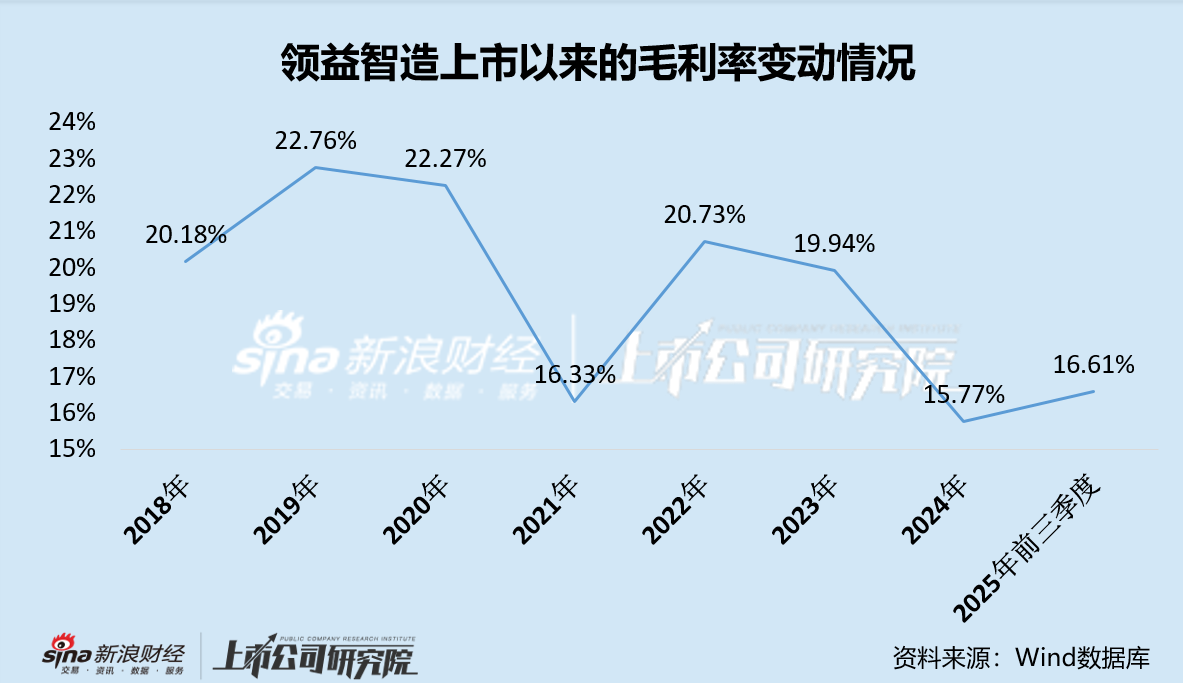
Core Viewpoint - Lingyi Technology is seeking a dual listing on the Hong Kong Stock Exchange, positioning itself as a global core AI hardware precision manufacturing platform, despite its business structure remaining largely unchanged [1]. Group 1: Company Overview - Lingyi Technology was established in 2006 and initially entered the consumer electronics market through die-cutting technology, later becoming part of Apple's supply chain in 2008 [2]. - The company achieved a significant revenue increase from 22.5 billion yuan in 2018 to 44.2 billion yuan in 2024, effectively doubling its revenue [2]. - The reliance on major clients has increased, with revenue from the top five clients rising from 44.26% in 2020 to 56.04% in the first three quarters of 2025 [2]. Group 2: Financial Performance - Despite doubling revenue, the net profit attributable to shareholders has fluctuated, decreasing from 1.894 billion yuan in 2019 to 1.753 billion yuan in 2024, with a peak of no more than 2.3 billion yuan [3]. - The gross margin has declined from over 22% in 2019-2020 to around 15% in recent years, with 2024's gross margin at 15.77% and the first three quarters of 2025 at 16.61% [3]. Group 3: Market Challenges - The company has faced significant impacts from shifts in downstream customer procurement needs, particularly in 2021 and 2024, leading to a drop in overall gross margin [5]. - The performance and stock price of Lingyi Technology are heavily influenced by its major clients, a common issue among "fruit chain" companies [6]. Group 4: Diversification Efforts - To mitigate reliance on Apple, Lingyi Technology is pursuing diversification through acquisitions and investments, targeting automotive and intelligent robotics sectors [12]. - Recent acquisitions include a 95% stake in Zhejiang Jintai for 38 million yuan and stakes in Jiangsu Keda and Zhejiang Xianglong for 3.32 billion yuan and 2.404 billion yuan, respectively [13]. - The automotive business, while growing rapidly, accounted for only 5% of total revenue in the first half of 2025, indicating a slow diversification process [15]. Group 5: Business Structure and Revenue Breakdown - In 2024, the revenue from AI terminal products reached 40.731 billion yuan, while automotive and low-altitude economy segments generated 2.117 billion yuan [14]. - The automotive sector's gross margin is significantly lower than traditional business lines, with 2024's gross margin at only 1.71% [15].

“GPU芯片第二股”暴涨700%!国产芯片午后异动, 159131冲高1.7%
Xin Lang Ji Jin· 2025-12-17 06:39
Group 1 - The core viewpoint of the news highlights the significant movements in the A+H chip industry chain, with various stocks experiencing notable gains, indicating a bullish sentiment in the market [1][3] - The first ETF focusing on the "Hong Kong stock chip" industry chain (159131) has been launched, which tracks a composite index consisting of 70% hardware and 30% software, targeting semiconductor, electronics, and computer software sectors [3][4] - The ETF includes 42 Hong Kong hard tech companies, with notable weightings for SMIC at 20.48%, Xiaomi Group-W at 9.53%, and Hua Hong Semiconductor at 5.80%, excluding major internet firms like Alibaba and Tencent [3][4] Group 2 - The demand for AI computing power is robust, with both global and Chinese AI computing markets maintaining high growth, driven by strong downstream demand and policy support [3] - The listing of Mu Xi Co., dubbed the "second GPU chip stock," on the STAR Market saw its stock price surge over 700%, reflecting investor enthusiasm for domestic AI chip companies [1][3] - The domestic AI computing chip industry is expected to continue its rapid development, supported by favorable policies and significant market opportunities [3]
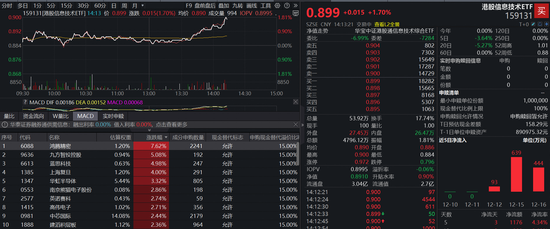
“港股芯片”产业链集体回调,华虹半导体大跌逾6%!港股信息技术ETF(159131)跌超2%盘中获净申购400万份
Xin Lang Ji Jin· 2025-12-15 02:45
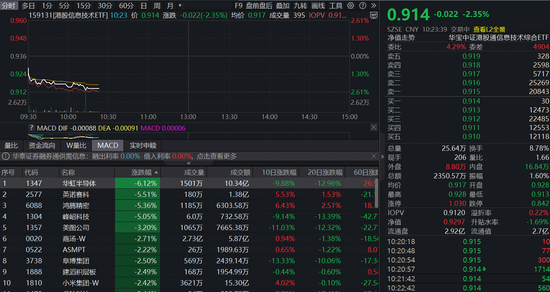
Core Viewpoint - The Hong Kong stock market's semiconductor industry chain is experiencing a significant pullback, with major companies like Hua Hong Semiconductor and Xiaomi seeing notable declines, while a new ETF focused on this sector is attracting investor interest despite the downturn [1][3]. Group 1: Market Performance - On December 15, the Hong Kong stock market saw a decline in the semiconductor industry chain, with Hua Hong Semiconductor dropping over 6%, and other companies like InnoCare and Xiaomi also experiencing declines of over 5% and 2% respectively [1]. - The first ETF focusing on the Hong Kong semiconductor industry chain (159131) saw a price drop of 2.35%, with a trading volume exceeding 23.5 million CNY, indicating that investors are buying on dips, as evidenced by a net subscription of 4 million shares [1][3]. Group 2: ETF Details - The newly launched Hong Kong Information Technology ETF (159131) tracks an index composed of 70% hardware and 30% software, heavily investing in semiconductor and electronic companies, with notable weights for SMIC (20.48%), Xiaomi (9.53%), and Hua Hong Semiconductor (5.80%) [3]. - The ETF excludes major internet companies like Alibaba and Tencent, allowing for a sharper focus on the AI hard technology sector within the Hong Kong market [3]. Group 3: Industry Outlook - According to a report by Ping An Securities, there is a strong demand for AI computing power, with the global and Chinese AI server market projected to grow at CAGRs of 15.5% and 30.6% respectively from 2024 to 2028 [2]. - The trend towards self-sufficiency in AI computing chips in China is expected to accelerate, driven by supportive policies, strong downstream demand, and significant replacement opportunities, indicating a robust growth trajectory for domestic AI computing chip industry [2].
2025年半导体营收将站上8000亿美元!首只聚焦“港股芯片”产业链的港股信息技术ETF(15...
Xin Lang Cai Jing· 2025-12-12 05:47
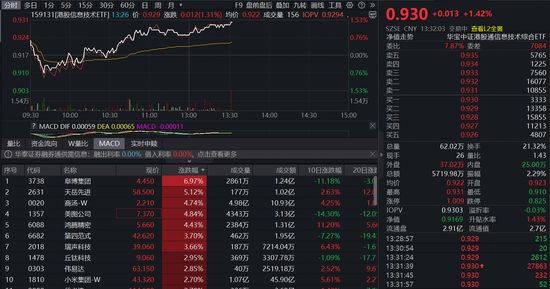
Group 1 - The Hong Kong stock market's chip industry chain showed strong performance, with notable gains from companies such as Fubo Group (+6%), Tianyue Advanced (+5%), SenseTime-W, Meitu, and Hong Teng Precision (+4%) [1] - The first ETF focusing on the Hong Kong chip industry chain (159131) experienced a price increase of 1.42%, with real-time transaction volume exceeding 57 million yuan [1][2] - According to Omdia's latest research, the semiconductor industry is projected to reach revenues of $216.3 billion in Q3 2025, marking a 14.5% quarter-over-quarter growth, with annual revenues expected to surpass $800 billion [1][3] Group 2 - The newly launched Hong Kong Information Technology ETF (159131) tracks an index composed of 70% hardware and 30% software, heavily investing in semiconductor, electronics, and computer software sectors, including major companies like SMIC (20.48% weight) and Xiaomi Group-W (9.53% weight) [3] - The ETF excludes large-cap internet companies such as Alibaba, Tencent, and Meituan, allowing for a sharper focus on the AI hard technology sector in Hong Kong [3]