
Tokyo Electron

Search documents
Japan Stocks Soar as Takaichi Secures Historic Mandate | The Asia Trade 2/9/2026
Bloomberg Television· 2026-02-09 04:10
>> THIS IS THE ASIA TRADE. I AM SHERY AHN IN TOKYO. >> I AM AVRIL HONG IN SINGAPORE. YOUR TOP STORIES THIS HOUR. ASIAN STOCKS SET FOR A POSITIVE START TO THE WEEK AFTER WALL STREET'S BEST DAY SINCE MAY. INVESTORS IN THIS REGION ALSO ASSESSING ELECTION VICTORIES TO RULING PARTIES IN JAPAN AND THAILAND. THE YEN IN FOCUS WITH JAPAN'S LBP SECURING A SUPER MAJORITY, SETTING THE STAGE FOR FURTHER FISCAL STIMULUS FROM PRIME MINISTERS. WE WILL GET REACTION ON THE BUSINESS AND POLITICAL IMPACT. THE ASIA GROUP AND A ...


“公司终局是纯 AI、纯机器人!”马斯克酒后激进预言:让机器人造机器人,未来要靠AI留着人类智能
AI前线· 2026-02-07 05:33
Core Insights - The core argument presented is that relocating computational power to space is not primarily about cost savings on electricity, but rather about addressing the limitations of terrestrial energy production, which cannot keep pace with the exponential growth of chip computing power [2][5][6]. Group 1: Space Data Centers and Energy Challenges - Musk emphasizes that the main issue is energy supply, as global electricity generation outside of China is stagnating, while chip computing power is growing exponentially [6][10]. - He argues that building solar power plants on Earth faces significant regulatory hurdles, making space a more viable option for energy generation [8][10]. - In space, solar energy efficiency is projected to be five times greater than on Earth, eliminating the need for battery storage, thus making it a more cost-effective solution for AI deployment [8][9][16]. Group 2: AI Deployment and Future Predictions - Musk predicts that within five years, the amount of AI deployed and operational in space will exceed the cumulative total on Earth, with annual AI capacity in space potentially reaching hundreds of gigawatts [24][26]. - He asserts that the future of the strongest companies will be a closed loop of pure AI and robotics, minimizing human involvement in processes to enhance efficiency [3][24]. Group 3: Manufacturing and Supply Chain Bottlenecks - The discussion highlights that manufacturing capabilities, particularly for critical components like turbine blades, are significant bottlenecks in scaling energy production [12][13][20]. - Musk indicates that SpaceX and Tesla are working towards achieving a solar power capacity of 100 gigawatts, emphasizing the need for a complete supply chain from silicon to solar panels [14][15][16]. Group 4: SpaceX's Business Model and IPO Considerations - Musk discusses the potential for SpaceX to become a major supplier of computational power in space, likening it to a cloud service provider [25][29]. - He notes that the public market offers significantly more capital than private markets, which may necessitate an IPO to fund future expansions [31][32][36]. Group 5: AI and Human Interaction - Musk expresses concerns about the future relationship between humans and AI, suggesting that as AI intelligence surpasses human intelligence, the focus should be on ensuring AI values support the continuation of human civilization [54][55][61]. - He argues that the ultimate goal should be to maximize the range and longevity of consciousness and intelligence, which includes the preservation of human civilization [55][60].


X @Bloomberg
Bloomberg· 2026-02-06 08:11
Tokyo Electron raised its full-year outlook even after its quarterly profit missed estimates and said it sees a surge in spending by chipmakers https://t.co/kZrr8SUUnv ...
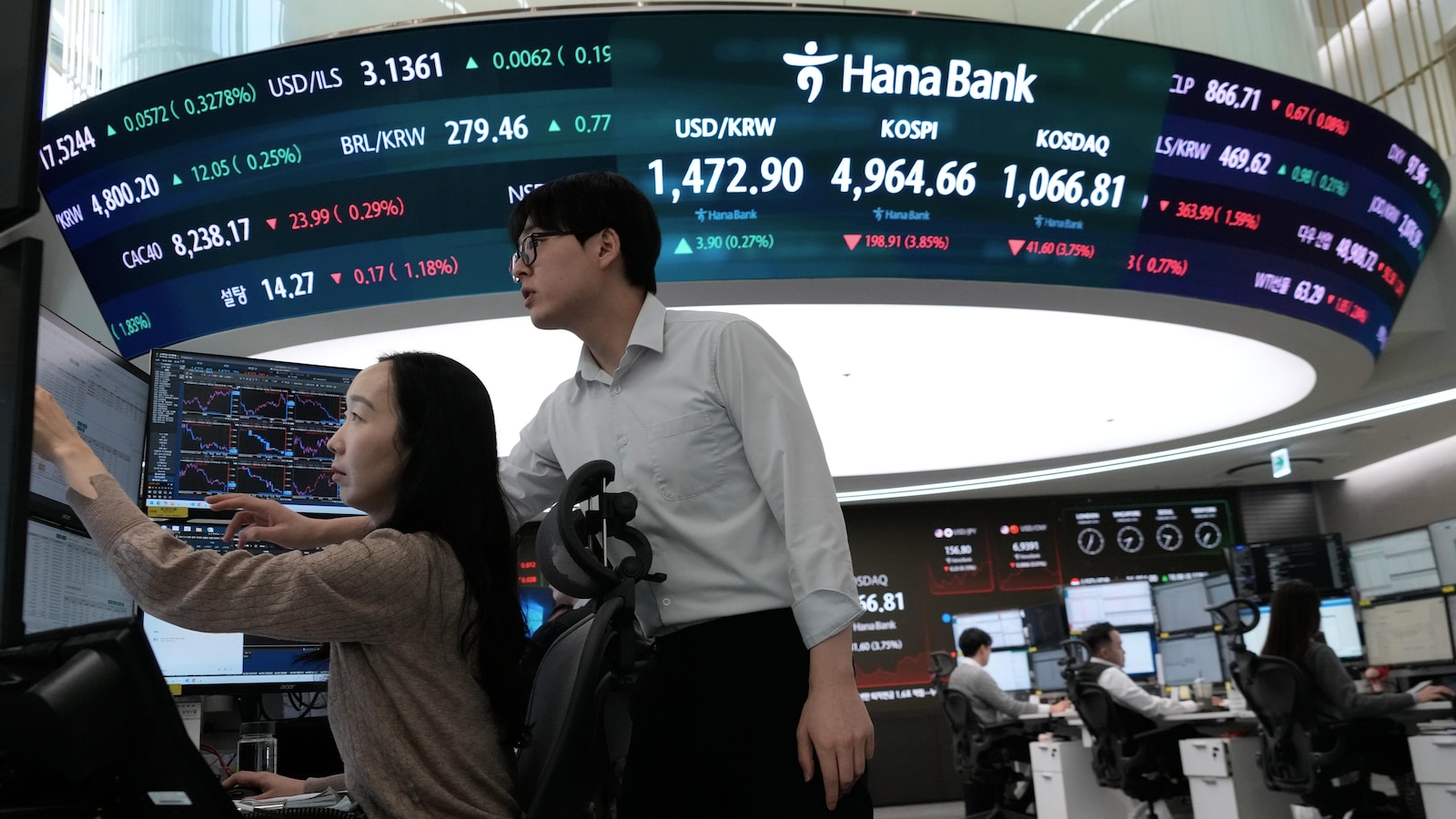
Bitcoin falls 8% and Asian shares mostly slip after Wall Street is hit by tech stock losses
ABC News· 2026-02-06 07:57
Market Overview - Asian shares traded mostly lower, following Wall Street's losses driven by technology stocks [1] - The S&P 500 fell 1.2% to 6,798.40, marking its sixth loss in seven days, while the Dow Jones Industrial Average also dropped 1.2% to 48,908.72 [5] Technology Sector - Technology stocks were significantly impacted, with Qualcomm sinking 8.5% despite better-than-expected quarterly revenues, and Alphabet losing 0.5% due to concerns over its AI spending [5] - Amazon's shares fell 11% in after-hours trading after announcing plans to increase capital spending by over 50% to $200 billion in AI and other areas [6] - The sell-off in technology stocks was exacerbated by new AI tools from American startup Anthropic, which raised concerns about the disruption of traditional software services [6] Cryptocurrency - Bitcoin's price dropped to just under $65,000, down approximately 8% and giving back all gains since President Trump's re-election, with a peak of over $124,000 in October [4] - The cryptocurrency experienced a significant decline, briefly sinking over 12% to below $64,000 [4] Automotive Industry - Shares of Toyota Motor rose 2% following the announcement that CEO Koji Sato will step down in April, to be replaced by CFO Kenta Kon [3] Commodity Prices - Gold prices fell 0.6% to $4,858.60 per ounce after nearing $5,600 last week, while silver prices dropped 5.5% to $72.52 per ounce [7] - U.S. benchmark crude oil gained 35 cents to $63.64 a barrel, and Brent crude rose 36 cents to $67.91 a barrel [8]

台积电熊本改产3纳米,日本供应链厚度增加
日经中文网· 2026-02-06 02:52
Group 1 - TSMC is constructing a new factory in Kumamoto, Japan, aimed at producing cutting-edge chips for artificial intelligence (AI) [2] - Rapidus plans to mass-produce 2nm products in Hokkaido, enhancing Japan's semiconductor supply chain with stable AI semiconductor production from both northern and southern bases [2] - The Japanese semiconductor equipment and materials sectors are expected to benefit significantly from these developments, as Japan holds a substantial market share in these areas [2] Group 2 - TSMC's CEO, Wei Zhejia, is considering adjustments to the production plan for the Kumamoto factory to manufacture 3nm semiconductors, which may increase the originally estimated investment of $12.2 billion [4] - The 3nm semiconductors will be utilized in NVIDIA's GPUs, highlighting the importance of ensuring a stable supply of advanced semiconductors as new data centers for AI are established in Japan [4] - Japan's semiconductor equipment market holds approximately 30% of the global share, while the materials sector accounts for about 50%, indicating a strong domestic capability to support advanced semiconductor production [4] Group 3 - Tokyo Electron plans to invest 700 billion yen in equipment over the next five years, with a new facility in Kumamoto set to begin operations in spring 2026, increasing development capacity by four times [5] - Canon is investing 50 billion yen by September 2025 to establish a new facility for photolithography equipment used in AI semiconductor assembly [6] - Ibiden plans to invest 500 billion yen over three years starting in 2026 to expand production capacity for packaging substrates used in AI server chips, expected to increase by 2.5 times by 2028 [6] Group 4 - The Japanese government aims to support the semiconductor and AI sectors with over 10 trillion yen by 2030, accelerating the establishment of a cutting-edge semiconductor supply chain [6] - Japan has provided approximately 1.2 trillion yen in subsidies to TSMC's factories and about 2.9 trillion yen to Rapidus, with conditions for TSMC to increase semiconductor production during supply shortages [6] - The competitive landscape for attracting investment in advanced semiconductor manufacturing is intensifying globally, necessitating a comprehensive approach to develop the domestic semiconductor industry, including equipment, materials, and design engineering [6]

Asian Markets Mixed As AI Fears Hammer Software Stocks
RTTNews· 2026-02-04 08:44
Market Overview - Asian stocks ended mixed, with software stocks declining due to concerns over artificial intelligence impacting future growth [1] - Gold prices increased nearly 3 percent to $5,080 an ounce, while oil prices extended gains following a U.S. Navy incident involving an Iranian drone [2] - The Shanghai Composite index rose 0.85 percent to 4,102.20, driven by a surge in solar shares after visits from SpaceX and Tesla [2] Regional Indices Performance - Hong Kong's Hang Seng index marginally increased to 26,847.32, supported by gains in precious metals [3] - The Nikkei average fell 0.78 percent to 54,293.36, with software stocks leading the decline due to new AI developments [3] - The Kospi index in Seoul surged 1.57 percent to 5,371.10, bolstered by strong institutional buying and promises of capital market reforms [4] Company-Specific Movements - IT service management company TIS saw a significant drop of 15.8 percent, while NS Solutions and Trend Micro both fell by 7.4 percent [4] - Chip-related companies like Advantest and Tokyo Electron experienced declines of over 2 percent each [4] - Australian markets advanced, with the S&P/ASX 200 climbing 0.80 percent to 8,927.80, driven by a rebound in copper and gold prices [5] U.S. Market Impact - U.S. stocks experienced a decline from near-record levels, with the tech-heavy Nasdaq Composite dropping 1.4 percent, the S&P 500 down 0.8 percent, and the Dow decreasing by 0.3 percent [6]

全球存储市场NAND闪存演变、创新与展望
2026-01-26 02:49
Summary of J.P. Morgan's Long-Term NAND Market Dynamics Industry Overview - The report focuses on the **NAND Flash Memory** sector within the **semiconductors** industry, highlighting its evolution, current innovations, and future outlook [3][10][11]. Key Insights Long-Term Market Dynamics - The **Total Addressable Market (TAM)** for NAND is expected to grow at a **CAGR of 34%** over the next three years, driven by a **20% CAGR in bit demand** and a **low-teens percentage increase in ASP** [3][18]. - Historical trends show that NAND bit demand growth has decelerated due to maturing end markets like smartphones and PCs, but the introduction of **eSSD** has shifted growth dynamics [3][14][17]. Demand Drivers - **eSSD** demand is projected to grow significantly, with a **CAGR of 49%** from 2025 to 2028, driven by AI applications and data center needs [3][17]. - As of 2024, **SSDs account for 54%** of NAND bit demand, while smartphones represent approximately **30%** [17][90]. Pricing and Revenue Trends - NAND revenue per Kwfpm is forecasted to increase from **US$55k in 2025** to **US$102k by 2027** [3]. - The ASP for NAND has historically been under pressure but is expected to rise due to strategic production cuts and strong demand from AI-driven data centers [3][40]. Comparison with DRAM - NAND is viewed as less attractive compared to DRAM due to market fragmentation and lower exposure to AI applications. However, the **AI NAND TAM** is expected to reach **US$70 billion** by 2028, compared to **US$220 billion** for AI DRAM [3][37]. - The capital intensity for NAND is projected to average **16%** from 2025 to 2027, compared to **26%** for DRAM, indicating stricter capex discipline among NAND suppliers [3][37]. Technology and Capacity Trends - The transition to **3D NAND technology** has allowed for increased storage capacity without a proportional rise in cost, supporting ASPs [39]. - The industry is experiencing a **capacity shrink** due to technology migration, which may impact future production capabilities [4][39]. Additional Insights - The NAND industry has not seen the same level of consolidation as DRAM due to its diverse applications and technological differentiation, allowing smaller players to thrive [87][88]. - The report emphasizes the importance of **AI** in shaping future demand, with AI memory expected to account for nearly half of the global memory TAM by 2027, growing at an **80% CAGR** during 2024-2027 [59][60]. Conclusion - The NAND Flash Memory market is poised for significant growth driven by technological advancements, particularly in eSSD applications and AI integration. The competitive landscape remains dynamic, with opportunities for both established and emerging players in the sector.
Asian stocks today: Markets climb as Trump eases EU tariff threats over Greenland; gold and silver fall
The Times Of India· 2026-01-22 07:02
(AP)Asian markets were broadly higher, with Tokyo’s Nikkei 225 rising 1.9 percent to 53,760.85, while Hong Kong’s Hang Seng and Shanghai’s Composite each gained 0.2 percent, closing at 26,630.21 and 4,123.69 respectively, reported AFP.The market swings came after Trump had warned that Germany, France, Britain, and Denmark could face levies for opposing his Greenland plan. The threat had raised fears of a trade war, with French President Emmanuel Macron hinting at the possible use of a previously unused econ ...

中国晶圆厂设备进口追踪(2025 年 12 月):2025 年总进口额 392 亿美元,同比 + 3%;12 月光刻机进口创纪录-China WFE Import Tracker (Dec 2025) 2025 total import $39.2bn,+3% YoY; record high Litho import in Dec
2026-01-22 02:44
Summary of the Conference Call on Global Semiconductor Capital Equipment Industry Overview - The focus is on the **Wafer Fabrication Equipment (WFE)** market, particularly imports to **China**. - In **2025**, total WFE imports to China reached **$39.2 billion**, representing a **3% year-over-year (YoY)** increase, despite a **13% YoY** decline in December imports due to a high base effect from December 2024 [2][26][37]. Key Insights - **December 2025** saw WFE imports of **$4.5 billion**, marking the highest monthly figure for the year, with a **MoM increase of 84%** [2][3][26]. - **Lithography imports** hit a record high in December at **$2.3 billion**, primarily driven by demand from **Shanghai** and **Beijing** [3][27][35]. - The overall demand for WFE in China remains robust, particularly for **AI chip and memory production**, indicating a continued push for local production capabilities [3][68]. Company-Specific Insights ASML - ASML's China sales are projected to reach **EUR 3.14 billion** in Q4 2025, reflecting a **35% QoQ** and **64% YoY** increase, driven by high lithography imports [4][68][70]. - China is expected to account for **42%** of ASML's total system sales in Q4 2025, significantly higher than previous guidance [68][79]. Lam Research (LRCX) - December revenues for LRCX are expected to decline by **42% QoQ**, with China exposure estimated at **25%** of total revenues [6][90]. - The company anticipates that its China revenue exposure will fall below **30%** in 2026 [6][90]. Applied Materials (AMAT) - AMAT's January quarter revenues are projected to increase by **4% QoQ**, with China exposure remaining around **30%** [7][87]. Other Companies - **Tokyo Electron (TEL)** and **Kokusai** are also expected to see growth, with TEL benefiting from competitive pricing and Kokusai from increased adoption of batch ALD technology [17][20]. - **Screen** and **Advantest** are projected to experience declines in China revenue, with Screen's expected to drop **43% YoY** [11][12]. Import Trends - The **US, Singapore, and Malaysia** combined accounted for **35%** of WFE imports to China in 2025, while Japan's share decreased to **23%** [43][50]. - The share of lithography imports from the Netherlands has increased significantly since 2023, indicating a shift in sourcing strategies among global vendors [43][65]. Investment Implications - **NAURA**, **AMEC**, and **Piotech** are highlighted as outperformers in the domestic WFE market, benefiting from local demand and technological advancements [14][15][16]. - **ASML**, **LRCX**, and **AMAT** are also rated as outperformers, with strong growth prospects driven by ongoing demand in the semiconductor sector [19][20][21]. Conclusion - The WFE market in China is showing signs of resilience and growth, particularly in lithography, despite some expected declines in revenue for certain companies. The ongoing investments in local production capabilities for advanced technologies like AI chips and memory are likely to sustain demand in the coming years.



半导体-投资者反馈:多数看涨(尤其前端 SPE),但也警惕短期风险收益比_ Semiconductors_ Investor feedback_ Many bullish, especially on front-end SPE, but caution also on near-term risk-reward
2026-01-19 02:29
Summary of Conference Call on Japan Technology: Semiconductors Industry Overview - The focus of the conference call was on the semiconductor industry, particularly front-end and back-end equipment manufacturers, as well as NAND memory producers [1][2]. Key Points Discussed Front-End Equipment - Investor sentiment is bullish on front-end semiconductor equipment (SPE) makers, with expectations for double-digit growth (over 10%) in the wafer fabrication equipment (WFE) market for both calendar years 2026 and 2027 [2]. - The outlook for the WFE market has improved significantly, with previous expectations for CY26 growth being in the mid-single-digit range [2]. - Investors are showing considerable interest in small- and mid-cap stocks like Ulvac and JEOL, which are currently lagging behind larger companies [2]. Back-End Equipment - Demand for AI-related equipment remains strong, particularly for Advantest, but investor expectations for FY3/27 are already high, aligning closely with estimates [3]. - For Disco, there is skepticism regarding significant increases in shipment levels from the current quarterly level of approximately ¥110 billion, leading to lower expectations for FY3/27 earnings [3]. - Interest in Tokyo Seimitsu is noted, but many investors believe that substantial margin improvements are necessary for the share price to rise further [3]. NAND Market - Many investors are optimistic about Kioxia Holdings, despite the Neutral rating, with expectations for a sharp price increase in Q4 FY3/26 due to rising server demand amid limited supply [4]. Investment Ratings and Price Targets - **Tokyo Electron**: Buy, with a target price of ¥43,000, driven by growth prospects in DRAM investment [8]. - **Disco**: Buy, target price of ¥64,000, based on multiple growth drivers [9]. - **Ebara**: Buy, target price of ¥5,200, expecting CMP-led earnings growth [9]. - **Ulvac**: Buy, target price of ¥8,400, with expectations for orders to exceed forecasts [9]. - **Advantest**: Neutral, with a target price of ¥22,800, facing high investor expectations [9]. - **Kioxia Holdings**: Neutral, target price of ¥11,400, with volatile capacity utilization trends [9]. - **Tokyo Seimitsu**: Sell, target price of ¥8,700, requiring significant semiconductor order growth for price improvement [9]. Risks and Considerations - Risks for companies include potential slowdowns in AI-related demand, tightening of export controls, and fluctuations in customer capital expenditure appetite [9]. - The semiconductor industry faces challenges such as prolonged inventory adjustments and competitive pressures from Chinese manufacturers [9]. Conclusion - The semiconductor industry is experiencing a positive shift in investor sentiment, particularly for front-end equipment manufacturers, while caution remains regarding valuations and potential risks in the back-end and NAND markets [1][2][4].