
五粮液

Search documents
未知机构:迎驾总经理交流要点1行业周期目前需求量下降和消费降级趋势看-20260213
未知机构· 2026-02-13 02:50
迎驾总经理交流要点 1、行业周期:目前需求量下降和消费降级趋势,看房地产和股市能否企稳。 高端价格受影响更大(预计年后茅五价格仍有压力),100-500元价格相对稳。 长期行业预计平稳发展,格局进一步集中。 长期行业预计平稳发展,格局进一步集中。 2、春节动销:禁酒令常态化,目前公务人员正常吃喝没问题,同比仍下滑。 2、春节动销:禁酒令常态化,目前公务人员正常吃喝没问题,同比仍下滑。 回款目前还不可同比,看春节期间需求情况。 迎驾总经理交流要点 1、行业周期:目前需求量下降和消费降级趋势,看房地产和股市能否企稳。 高端价格受影响更大(预计年后茅五价格仍有压力),100-500元价格相对稳。 4、分区域:合六淮核心区域以外,#皖北(蚌埠、宿州、淮北)培育较好、开始挤压当地其他酒份额,皖南(芜 湖、宣城、黄山等)接受度逐渐突破。 六安大本营政务占比较高受政策影响大、同时古井渠道利润高在攻击,公司在链接企业、提升服务质量上下功 夫。 5、分产品:洞69全省内势能提升,合肥洞16占有率也在提升,#100-300元大众消费有扩容空间,做好产品基础、 渠道精耕、会员体系、数字管理。 #100元以下往光瓶酒(类似玻汾)和散 ...

i茅台春节不打烊!吃喝板块逆市走高,茅台五粮液大涨超1%!机构:白酒行业底部愈发清晰
Xin Lang Cai Jing· 2026-02-13 02:48
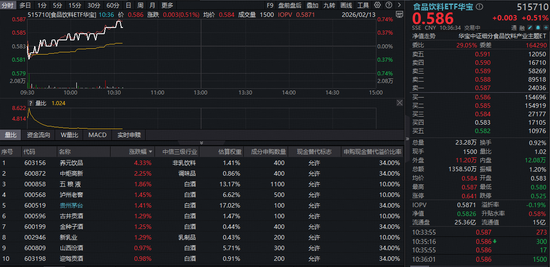
Core Viewpoint - The food and beverage sector is experiencing a counter-trend rally, with the Huabao Food and Beverage ETF (515710) showing a price increase of 0.51% as of the latest update, driven by strong performances from leading liquor stocks like Kweichow Moutai and Wuliangye [1][7]. Group 1: Market Performance - The Huabao Food and Beverage ETF (515710) opened higher and is currently up by 0.51% [1][7]. - Major liquor stocks such as Kweichow Moutai, Wuliangye, and Luzhou Laojiao have seen gains exceeding 1% [1][7]. Group 2: Consumer Behavior and Logistics - The "i Moutai" app will remain operational during the Spring Festival, allowing consumers to place orders, with adjustments made to logistics and in-store services due to the holiday [3][9]. - The effective period for in-store pickup orders has been extended to March 2, and express delivery for certain products will be paused from February 12 to 21, resuming on February 22 [3][9]. Group 3: Valuation and Investment Opportunities - The food and beverage sector is currently at a historical low in terms of valuation, with the price-to-earnings ratio of the underlying index for the Huabao ETF at 20.32, which is in the 8.02% percentile of the last decade [10]. - This low valuation presents a favorable opportunity for medium to long-term investment in the sector [10]. Group 4: Future Outlook - Analysts predict that liquor companies are entering a phase of rapid performance recovery, with demand expected to show weak recovery as policy pressures ease [11]. - The industry is currently characterized by low valuations and fully priced pessimistic expectations, indicating a clearer direction for future performance [11]. - The Huabao Food and Beverage ETF is recommended for investors looking to allocate capital to core assets in the food and beverage sector, with a significant portion of its holdings in leading liquor brands [11].






临近春节白酒动销逐步升温,消费ETF嘉实(512600)一键布局消费复苏行情
Xin Lang Cai Jing· 2026-02-13 02:45
Group 1 - The core viewpoint of the articles highlights a positive trend in the consumer sector, particularly in the food and beverage industry, driven by seasonal consumption patterns related to the upcoming Spring Festival [1][2] - The main consumption index has shown a slight recovery in January 2026, with significant increases in sub-sectors such as prepared foods, snacks, and alcoholic beverages, indicating a strong influence of holiday consumption on market dynamics [1] - The white wine sector is expected to perform better than market expectations during the Spring Festival, with increasing sales momentum as the holiday approaches, supported by resilient consumer spending [1] Group 2 - The consumption ETF managed by Harvest (512600) tracks the major consumer index, which includes leading A-share companies across various sectors, with white wine being the largest segment, accounting for over 38% of the index [2] - Investors can also access the consumption recovery trend through the consumption ETF linked fund (009180), providing an additional avenue for investment in the sector [3]
多家上市公司春节前现金分红
Jin Rong Shi Bao· 2026-02-13 02:32
Core Viewpoint - The article highlights the trend of A-share listed companies implementing cash dividends ahead of the Spring Festival, indicating a shift towards a "return-focused" market environment driven by regulatory policies and improved corporate governance [2][6]. Group 1: Cash Dividends Overview - As of February 11, 57 A-share listed companies have implemented cash dividends totaling 409.11 billion yuan since February [2]. - Notable companies such as Changjiang Electric Power and Darentang have announced significant cash dividends, with Changjiang Electric Power distributing over 51 billion yuan [3][4]. - From December 1, 2025, to February 11, 2026, 289 A-share companies have distributed cash dividends amounting to 3,896.83 billion yuan, reflecting a year-on-year growth of approximately 13% [4]. Group 2: Industry Insights - The financial and consumer sectors continue to dominate cash dividends, with banks accounting for 8 out of the top 10 companies by total dividend amount [4]. - The total cash dividends from 19 listed banks reached 2,627.34 billion yuan, representing 67% of the total dividends during the specified period [4]. - In the food and beverage sector, 23 listed companies have distributed cash dividends totaling 494.84 billion yuan, with leading firms like Kweichow Moutai and Wuliangye contributing significantly [5]. Group 3: Regulatory Influence - Recent policies, including the new "National Nine Articles," have emphasized the importance of cash dividends, encouraging companies to enhance dividend stability and predictability [6][7]. - The China Securities Regulatory Commission has advocated for multiple dividends per year and pre-dividend announcements to improve investor returns [6]. - The Shanghai and Shenzhen Stock Exchanges are promoting initiatives to enhance cash dividend policies and increase the frequency of cash distributions [7].




跟踪-地产酒经销商电话会
2026-02-13 02:17
Summary of the Conference Call on Real Estate Wine Distributors Industry Overview - The conference call focused on the real estate wine distribution industry, particularly the performance of various brands during the January 2026 period and the impact of the economic environment on sales. Key Points and Arguments Company Performance - **Jinhui Wine**: January order volume exceeded expectations, with the soft series growing approximately 10% year-on-year, while the star series showed weak performance, leading to an expected annual sales decline [2][5] - **Sales Trends**: High-end products like Jinhui 18 and 28 years performed well, while lower-tier products like Hongchuan faced significant declines [6][19] - **Sales Environment**: Overall white wine sales during the Spring Festival were lower than the previous year, attributed to a poor economic environment rather than the impact of alcohol bans [11][12] Competitive Landscape - **Price Adjustments**: Moutai and Wuliangye reduced prices, stimulating sales, while Jinhui maintained stable pricing despite market fluctuations [7][10] - **Market Share**: Competitors like Hongchuan and Jinxiu Longnan did not significantly capture market share, while Binhai saw an increase in sales due to enhanced user engagement and promotional efforts [15] Regional Insights - **Gansu Region**: The impact of the alcohol ban has diminished, but economic conditions remain a significant factor affecting sales [11][22] - **Jiangsu Region**: Distributors reported high inventory levels and a 20% decline in overall signing volume compared to the previous year, indicating a lack of market confidence [27][32] Consumer Behavior - **Purchasing Trends**: Consumers showed reduced purchasing enthusiasm, with many opting for lower quantities of high-end products compared to previous years [12][30] - **Profit Margins**: Low channel profits are leading to decreased willingness to stock products, with some distributors only making around 5 yuan profit per bottle [31] Future Outlook - **Market Recovery**: Expectations for a market recovery are set for April 2026, with potential growth in high-end brands like Moutai and Wuliangye, although overall economic conditions may limit growth potential [42][44] - **Brand Performance**: Jinhui and Binhai are expected to have growth potential, but they must navigate challenges posed by the economic environment [19][40] Additional Insights - **Promotional Strategies**: Manufacturers have reduced promotional spending but continue to hold tasting events, indicating a shift in marketing strategy [14] - **Inventory Management**: Distributors are managing inventory carefully, with a current cycle of 4-5 months compared to 3 months last year, reflecting cautious purchasing behavior [25] Conclusion The conference highlighted the challenges faced by the real estate wine distribution industry, including economic pressures, competitive pricing strategies, and changing consumer behaviors. While some brands show potential for growth, the overall market remains cautious, with expectations for recovery in the coming months.
新消费研究-即时零售应需而生-酒类品牌或迎新机遇
2026-02-13 02:17
Summary of Conference Call on Instant Retail and Alcohol Industry Industry Overview - The instant retail market in China is projected to reach 1 trillion yuan by 2025 and 2 trillion yuan by 2030, with the alcohol category experiencing rapid growth, particularly after increased investment from internet platforms [2][3][20] - Instant retail is divided into platform models and self-operated models, with the platform model integrating supermarkets and chain stores, while the self-operated model is controlled by the platform [2][5] Key Insights - The rapid expansion of Meituan's Yaimasongjiu, which adopts a franchise model, aims to cover third-tier cities, although most stores are still in the ramp-up phase [2][5] - Beer accounts for the highest sales proportion in Yaimasongjiu's store structure, with profits mainly derived from craft products, while profits from white liquor are thinner [2][6] - The average monthly revenue per store is approximately 200,000 yuan, with a net profit margin of 10%, benefiting from a low-cost operational model [2][6] Market Dynamics - The shift in consumer behavior towards instant consumption, increased subsidies from e-commerce platforms, and innovative marketing strategies from emerging brands are driving the rapid development of instant drinking, especially for white beer [3][7] - The white liquor industry has seen a channel model adjustment since 2022, with accelerated development of online and instant retail channels [8][9] Sales and Revenue Projections - By 2030, the market size for alcohol in instant retail is expected to exceed 90 billion yuan, maintaining a double-digit compound annual growth rate [4] - The penetration rate of instant retail in the white liquor market is currently low at 2%, compared to 15%-20% for online channels, indicating significant growth potential [4] Operational Insights - Yaimasongjiu's sales structure shows that white liquor accounts for 15%-20% of sales, while beer SKUs make up 60%-70% [6] - The gross margin for craft beer products is around 50%, while white liquor operates on a consignment model with lower margins [6] Competitive Landscape - The white liquor market is becoming increasingly concentrated, with the top 10 brands accounting for nearly 60% of revenue by 2024 [9] - Major brands like Moutai and Wuliangye have established strong consumer recognition, reducing the need for extensive channel education [9][19] Impact of Instant Retail - Instant retail is enhancing the operational efficiency of white liquor chain stores, allowing for a lighter asset operation model [11] - The collaboration between alcohol companies and instant retail platforms is crucial for brand strength and market penetration [17][19] Future Outlook - The overall online channel currently accounts for 15%-20% of the total distribution scale, with instant retail being a smaller fraction [20] - Companies that strategically position themselves in this evolving market are expected to enjoy longer operational cycles and brand longevity [20] Investment Recommendations - Positive outlook on companies such as Luzhou Laojiao, Shanxi Fenjiu, Guizhou Moutai, and Yanjing Beer due to their proactive strategies in the instant retail space [20]
酒价内参2月13日价格发布 洋河梦之蓝M6小幅回落2元/瓶
Xin Lang Cai Jing· 2026-02-13 01:30
Core Viewpoint - The "Wine Price Reference" by Sina Finance has launched, providing real-time data on the retail prices of major Chinese liquor brands, indicating a structurally differentiated price trend in the market as of February 13, 2026 [1][8]. Price Trends - The average retail price of the top ten liquor products is 9,189 yuan, showing a slight increase of 3 yuan from the previous day [1][8]. - Among the top ten products, four saw price increases while six experienced declines, highlighting significant price differentiation [4][10]. Specific Product Price Changes - Guizhou Moutai (Flying Moutai) increased by 32 yuan to 1,790 yuan per bottle, reaching a one-month high due to tight supply and limited availability [4][10]. - Other products with price increases include: - Ancient Well Tribute Wine 20: up 3 yuan to 538 yuan [4][10] - Crystal Jian Nan Chun: up 3 yuan to 406 yuan [3][10] - Qinghua Fen 20: up 1 yuan to 384 yuan [4][10] - Products with price declines include: - Qinghua Lang: down 12 yuan to 698 yuan [4][10] - Boutique Moutai: down 9 yuan to 2,415 yuan [4][10] - Wuliangye Pu 58: down 7 yuan to 808 yuan [4][10] - Guojiao 1573: down 5 yuan to 885 yuan [4][10] - Yanghe Dream Blue M6+: down 2 yuan to 613 yuan [4][10] - Xijiu Junpin: down 1 yuan to 652 yuan [4][10] Market Analysis - The data for "Wine Price Reference" is sourced from approximately 200 collection points across major regions, including designated distributors and retail outlets, ensuring objective and traceable pricing information [5][11]. - A recent report from招商证券 indicates a double-digit decline in liquor sales before the Spring Festival, aligning with expectations. Guizhou Moutai shows strong performance with a price recovery to the range of 1,600 to 1,700 yuan, while other brands like Luzhou Laojiao and Shanxi Fenjiu are experiencing varying degrees of sales decline [6][11].
酒价内参2月13日价格发布 习酒君品小幅回落1元/瓶
Xin Lang Cai Jing· 2026-02-13 01:30
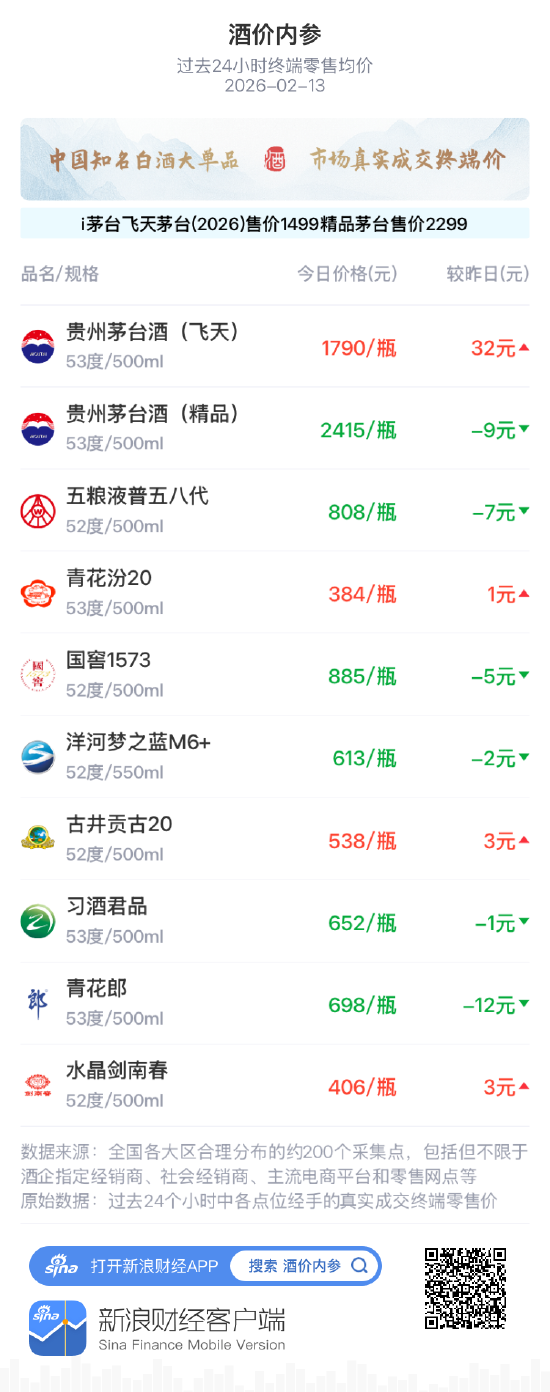
Core Viewpoint - The "Wine Price Reference" by Sina Finance has launched, providing real-time data on the retail prices of major Chinese liquor brands, indicating a structurally differentiated price trend in the market as of February 13, 2026 [1][8]. Price Trends - The average retail price of the top ten liquor products is 9,189 yuan, showing a slight increase of 3 yuan from the previous day [1][8]. - Among the top ten products, four saw price increases while six experienced declines, highlighting significant price differentiation [4][10]. Specific Product Price Changes - Guizhou Moutai (Flying Moutai) increased by 32 yuan to 1,790 yuan per bottle, reaching a one-month high due to tight supply and limited availability [4][10]. - Other products with price increases include: - Ancient Well Tribute Wine 20: up 3 yuan to 538 yuan [4][10] - Crystal Jian Nan Chun: up 3 yuan to 406 yuan [4][10] - Qinghua Fen 20: up 1 yuan to 384 yuan [4][10] - Products with price declines include: - Qinghua Lang: down 12 yuan to 698 yuan [4][10] - Boutique Moutai: down 9 yuan to 2,415 yuan [4][10] - Wuliangye Pu 58: down 7 yuan to 808 yuan [4][10] - Guojiao 1573: down 5 yuan to 885 yuan [4][10] - Yanghe Dream Blue M6+: down 2 yuan to 613 yuan [4][10] - Xijiu Junpin: down 1 yuan to 652 yuan [4][10]. Market Analysis - A recent report from招商证券 indicates that the liquor industry is experiencing a double-digit decline in sales leading up to the Spring Festival, which aligns with expectations [6][11]. - Guizhou Moutai is showing strong performance with a significant increase in sales volume and price recovery, while other brands like Luzhou Laojiao and Shanxi Fenjiu are facing varying degrees of decline [6][11]. - The report suggests that the liquor sector may see a recovery in both performance and valuation as cyclical constraints gradually diminish [6][11].
酒价内参2月13日价格发布 青花汾20小幅上涨1元/瓶
Xin Lang Cai Jing· 2026-02-13 01:24
Core Insights - The article highlights the launch of "Wine Price Reference" by Sina Finance, which provides real-time data on the retail prices of major Chinese liquor brands, indicating a structurally differentiated price trend in the market as of February 13, 2026 [1][8]. Price Trends - The average retail price of the top ten liquor products in China is reported at 9,189 yuan, showing a slight increase of 3 yuan from the previous day [1][8]. - Among the top ten products, four saw price increases while six experienced declines, indicating a clear price differentiation [4][10]. Specific Product Price Changes - Notable price changes include: - Guizhou Moutai (Flying Moutai) increased by 32 yuan to 1,790 yuan per bottle, reaching a one-month high due to tight supply and limited availability [4][10]. - Other products that increased include: - Gujing Gongjiu 20: up 3 yuan to 538 yuan [4][10]. - Shuijing Jian Nan Chun: up 3 yuan to 406 yuan [10]. - Qinghua Fen 20: up 1 yuan to 384 yuan [4][10]. - Products that decreased include: - Qinghua Lang: down 12 yuan to 698 yuan, marking a significant drop over three consecutive days [4][10]. - Boutique Moutai: down 9 yuan to 2,415 yuan [4][10]. - Wuliangye and Guojiao 1573: down 7 yuan to 808 yuan and 5 yuan to 885 yuan respectively [4][10]. Market Analysis - The data for "Wine Price Reference" is sourced from approximately 200 collection points across various regions, including designated distributors and major retail platforms, ensuring a comprehensive and objective price tracking [5][11]. - A recent report from招商证券 indicates a double-digit decline in liquor sales leading up to the Spring Festival, with Guizhou Moutai showing strong performance and a price recovery in the range of 1,600 to 1,700 yuan [6][11]. - The report also notes that the proportion of mass consumption has increased to 20%, and a supply-demand imbalance is expected to persist in the first quarter [6][11].
酒价内参2月13日价格发布 贵州茅台飞天大涨逼近1800元
Xin Lang Cai Jing· 2026-02-13 01:19
Core Viewpoint - The "Wine Price Reference" by Sina Finance has launched, providing real-time data on the retail prices of major Chinese liquor brands, indicating a structurally differentiated price trend in the market as of February 13, 2026, with a slight overall increase in prices [1][8]. Price Trends - The average retail price of the top ten liquor products is 9,189 yuan, reflecting a minor increase of 3 yuan from the previous day [1][8]. - Among the top ten products, four saw price increases while six experienced declines, showcasing significant price differentiation [4][10]. Specific Product Price Changes - Notable price increases include: - Guizhou Moutai (Flying Moutai) rose by 32 yuan to 1,790 yuan per bottle, reaching a one-month high due to tight supply and limited availability [4][10]. - Ancient Well Tribute Wine and Crystal Jian Nan Chun both increased by 3 yuan, while Qinghua Fen 20 saw a slight rise of 1 yuan [4][10]. - Price declines were observed in: - Qinghua Lang dropped by 12 yuan, marking a significant three-day decline [4][10]. - Boutique Moutai decreased by 9 yuan, following a peak price in the previous 30 days [4][10]. - Other declines included Wuliangye and Guojiao 1573, which fell by 7 yuan and 5 yuan respectively, while Yanghe Dream Blue M6+ and Xijiu Junpin decreased by 2 yuan and 1 yuan [4][10]. Market Analysis - The data for "Wine Price Reference" is sourced from approximately 200 collection points across various regions, including designated distributors and major retail platforms, aiming to provide an objective and traceable market price reference [5][11]. - A recent report from招商证券 indicates a double-digit decline in liquor sales leading up to the Spring Festival, with Guizhou Moutai showing strong performance and a price rebound in the 1,600 to 1,700 yuan range, while other brands like Luzhou Laojiao and Shanxi Fenjiu experienced varying degrees of sales decline [6][11].