剑南春

Search documents
食品饮料行业周报20260323-20260327:春糖反馈头部企业通过压力测试战略战术愈加清晰-20260328
Shenwan Hongyuan Securities· 2026-03-28 14:30
Investment Rating - The report maintains a positive outlook on the food and beverage sector for 2026, particularly favoring cyclical opportunities in the liquor and restaurant supply chain [3][7]. Core Insights - The report concludes that the most challenging period for the liquor industry has passed, with leading companies clarifying their long-term strategies and shifting from passive to proactive tactics. There is no longer a need for pessimism regarding the industry, as focus shifts to how outstanding companies can realize their alpha capabilities [3][7]. - The liquor sector is expected to stabilize, with Moutai prices maintaining above 1500 yuan, indicating a turning point in the current cycle. The industry is anticipated to experience a recovery, albeit at an uncertain rate [3][8]. - The report highlights a structural improvement in the mass consumer goods sector, with competition shifting from price to quality, and a gradual balance in supply and demand. Companies with cyclical attributes and long-term growth potential are expected to see recovery [3][9]. Summary by Sections 1. Weekly Perspective on Food and Beverage - The food and beverage sector saw a decline of 0.99% last week, with liquor down 1.79%. The sector outperformed the Shanghai Composite Index by 0.10 percentage points [6][22]. 2. Market Performance of Food and Beverage Segments - The report indicates that the food processing and seasoning segments outperformed the market, while the liquor segment lagged behind. Notably, the seasoning segment outperformed the market by 3.87 percentage points [22][24]. 3. Liquor Sector Insights - Moutai's price for loose bottles was 1540 yuan, down 20 yuan week-on-week, while the price for boxed bottles rose by 5 yuan to 1645 yuan. The report confirms that the worst pressure on the liquor industry has passed, with leading brands performing better than market expectations during the recent Spring Festival [8][12]. 4. Mass Consumer Goods Sector Insights - The mass consumer goods sector is showing structural improvements, with a focus on the restaurant supply chain, seasoning products, and frozen foods. The report recommends companies such as Anjijia Foods and Haitian Flavoring [9][10]. 5. Key Recommendations - For the liquor sector, the report recommends investing in Guizhou Moutai, Luzhou Laojiao, Shanxi Fenjiu, and Wuliangye, while suggesting attention to Jinhuijiu. In the mass consumer goods sector, it recommends Anjijia Foods, Haitian Flavoring, and Yili Group, among others [3][9].






预调酒专家-安徽河南江苏综合白酒大商交流
2026-03-22 14:35
Summary of Conference Call Records Company and Industry Overview - **Company**: 百润股份 (Bairun Co., Ltd.) - **Industry**: Alcoholic Beverages, specifically focusing on pre-mixed cocktails and whiskey, as well as traditional Chinese liquor (Baijiu) Key Points and Arguments Sales Performance - **Q1 2026 Sales**: Sales progress is slightly slower than planned, with an expected pre-tax sales of approximately 700 million yuan, roughly flat compared to the same period in 2025 [1][3] - **Sales Channels**: Traditional "夫妻老婆店" (small family-owned stores) now account for over 30% of sales, down from 60%, while convenience stores and snack systems are seeing significant growth [1][4] - **Whiskey Sales**: The whiskey business aims for a growth target of 70%-80% in 2026, with sales in January-February around 20-30 million yuan [1][7] Product Lines and Marketing Strategies - **Core Products**: The "强爽" (Qiangshuang) series will be the main product focus for 2026, with nationwide promotion starting in late April [1][6] - **New Products**: The company plans to launch new products in the "果冻酒" (Jelly Wine) and "清享" (Qingxiang) series, with distribution strategies targeting specific channels [5][6] - **Promotional Activities**: The "2元乐享" (2 Yuan Enjoyment) campaign for the Qiangshuang series has shown positive results in test markets, leading to a nationwide rollout [6] Market Dynamics - **Post-Festival Sales**: Sales performance post-Chinese New Year has been stable, but brand differentiation is increasing, with some brands like Moutai and Wuliangye showing positive growth while others like Yanghe and Laojiao are experiencing declines [1][2] - **Regional Competition**: In the Anhui market, the "迎驾洞藏" (Yingjia Cave Aged) series is significantly impacting the sales of "古井原浆" (Gu Jing Yuan Jiang) [2][13] Channel Adjustments and Future Goals - **Channel Strategy**: The company is adjusting its channel strategy, focusing on high-growth areas while managing costs associated with new channels [4][3] - **Future Goals**: The aim is to optimize logistics and reduce costs through direct warehouse deliveries, which could save approximately 1.5 yuan per box in logistics costs [4] Financial Performance and Projections - **Sales Targets**: The sales target for March 2026 is set at 350 million yuan, with current performance at over 200 million yuan, indicating a gap to meet the target [3] - **Profitability Concerns**: Increased investments in new channels are impacting overall net profit levels, despite growth in certain areas [2][4] Brand-Specific Insights - **Yanghe's Transformation**: Yanghe is undergoing significant changes, shifting from a market-oriented to an inventory-oriented strategy, which may lead to improved sales dynamics by May 2026 [2][13][14] - **Moutai's Pricing Strategy**: Moutai is implementing a consignment model for non-standard products, which is expected to enhance price control and reduce capital occupation by distributors [15][17] Market Trends and Consumer Behavior - **Consumer Preferences**: There is a noticeable shift in consumer preferences towards higher-end products, impacting the sales of mid-range offerings [13][30] - **Inventory Management**: Many distributors are currently holding back on payments due to unclear future policies, which is affecting market dynamics and pricing [19][26] Conclusion - The company is navigating a complex market landscape with strategic adjustments in product focus, channel management, and promotional activities. The overall outlook for 2026 remains cautiously optimistic, with significant growth potential in the whiskey segment and ongoing challenges in traditional liquor sales.
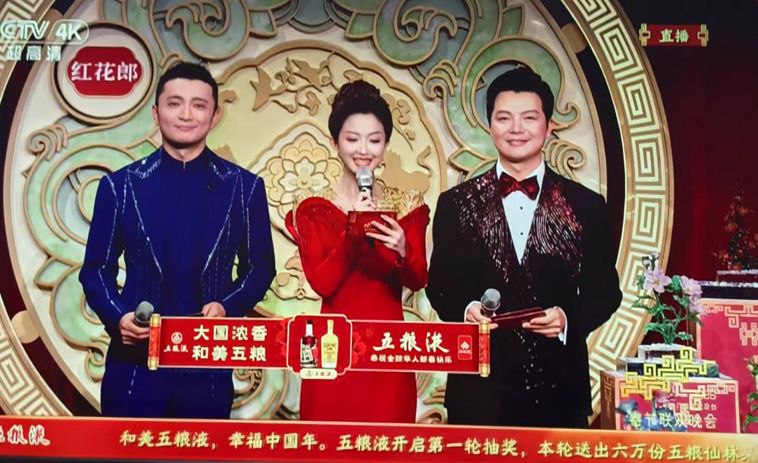
“含酒量”大缩水!马年总台春晚仅4家白酒赞助品牌亮相 酒企正转战短剧短视频新阵地?
Mei Ri Jing Ji Xin Wen· 2026-02-25 09:42
Core Insights - The number of liquor brands sponsoring the CCTV Spring Festival Gala has decreased significantly, from 9 in 2024 and 7 in 2025 to only 4 in 2026, indicating a shift in marketing strategies among liquor companies [1][2][6] - Major liquor brands that remain as sponsors are long-term partners of the gala, focusing on differentiated positioning and interactive collaborations [2][6] - The reduction in sponsorship is attributed to a more rational and diversified approach to marketing, with brands opting for softer product placements rather than traditional sponsorships [5][6][15] Industry Trends - The liquor industry is experiencing a cyclical adjustment, yet the Spring Festival remains a crucial sales period, prompting companies to explore various marketing channels beyond traditional sponsorships [1][6] - Brands are increasingly investing in short videos, micro-dramas, and variety shows as new marketing battlegrounds, reflecting a shift towards more engaging and consumer-centric strategies [9][12][14] - The trend indicates a move from broad exposure strategies to precision marketing, focusing on direct consumer engagement and sales conversion [15][16] Marketing Strategies - Major liquor brands are utilizing innovative marketing techniques, such as integrating products into popular media formats like micro-dramas and short videos, to reach younger audiences [9][12][14] - The collaboration with platforms like Douyin (TikTok) and various streaming services has become a common practice, allowing brands to leverage storytelling to enhance consumer connection [12][14] - The industry's focus is shifting towards creating immersive experiences and interactive content, moving away from mere logo placements to deeper brand integration within entertainment [5][15]

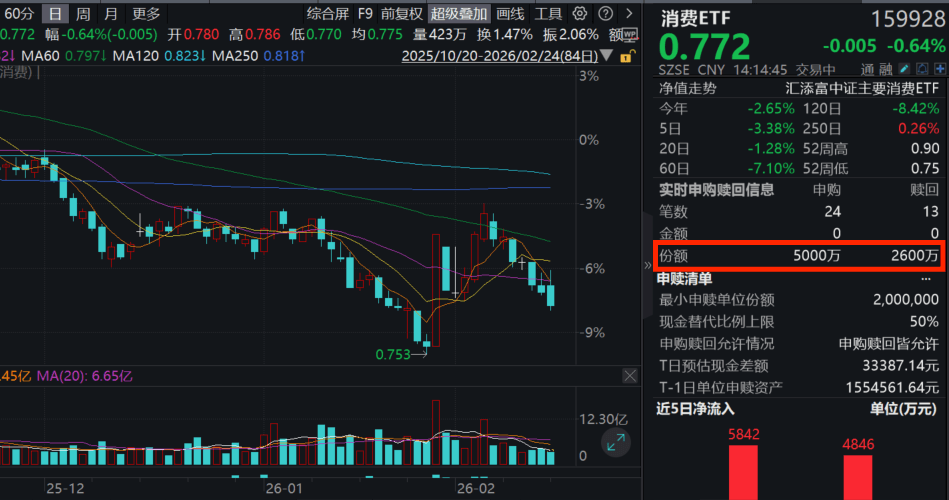
春节消费开门红!消费ETF(159928)冲高回落,盘中获2400万份净申购!机构:春节白酒反馈略好于预期
Xin Lang Cai Jing· 2026-02-24 06:57
Core Viewpoint - The consumer sector experienced a strong start during the Spring Festival, with significant growth in consumption demand, particularly in services and travel, despite some weaknesses in the film box office [3][6][9]. Group 1: Market Performance - The leading consumer ETF (159928) initially rose over 1% but later fell by 0.64%, with a trading volume exceeding 360 million yuan and a net subscription of 24 million shares during the day [1]. - The consumer ETF's latest scale surpassed 22.3 billion yuan, maintaining a leading position among its peers [1]. Group 2: Consumption Trends - The Spring Festival saw a notable increase in travel and service consumption, with a record number of cross-regional movements expected to reach 9.5 billion people, marking a historical high [6][7]. - Restaurant bookings for the New Year's Eve dinner increased by 105% year-on-year, with significant growth in demand from lower-tier cities [7]. - The demand for pre-packaged food is accelerating, driven by new national standards and retail channel transformations [8]. Group 3: Alcohol Consumption Insights - High-end liquor brands, particularly Moutai, showed better-than-expected performance, with sales expected to increase by 10-20% year-on-year during January and February [9][10]. - The overall liquor market is experiencing a recovery, with high-end brands gaining market share while lower-tier brands face challenges [10]. Group 4: Policy and Economic Environment - The government is implementing zero-tariff measures for 53 African countries and enhancing support for rural enterprises to access multi-level capital markets [3]. - The market is expected to see a positive start post-Spring Festival, with historical trends indicating a strong "Spring Festival effect" in A-shares [3].

大美四川赋
Xin Lang Cai Jing· 2026-02-23 20:39
Group 1 - The article highlights the beauty and cultural richness of Sichuan, describing it as a paradise for both tourism and living, with a unique blend of natural landscapes and human heritage [1][2][3] - Sichuan is characterized by its diverse geography, including mountains, rivers, and unique natural phenomena, making it a desirable destination for travelers [2][4] - The region's cultural heritage is emphasized through historical references and notable figures, showcasing its deep-rooted traditions and contributions to Chinese civilization [3][4] Group 2 - Sichuan cuisine is celebrated for its variety and flavor, with famous dishes like Mapo Tofu and Kung Pao Chicken, reflecting the local culinary culture [4][5] - The article mentions the significance of local beverages, including Sichuan wine and tea, which are integral to the region's identity and hospitality [4][5] - The economic potential of Sichuan is highlighted through its thriving tourism and culinary industries, which are interconnected and contribute to the local economy [4][5]
【“春雷”行动】兰州市市场监督管理局曝光酒类商品违法经营典型案例(第六批)
Zhong Guo Zhi Liang Xin Wen Wang· 2026-02-14 04:35
Core Viewpoint - The article emphasizes the importance of regulating the liquor market to ensure product quality and consumer safety, highlighting the enforcement actions taken against businesses violating trademark and food safety laws [2]. Group 1: Regulatory Actions - The Lanzhou market supervision department is intensifying efforts to crack down on illegal liquor sales and ensure compliance with relevant laws [2]. - A total of ten typical cases of trademark infringement and food safety violations have been publicly exposed, showcasing the department's commitment to a "zero tolerance" policy [2]. Group 2: Case Summaries - Case 1: Yuzhong *he Trading Company was fined 50,000 yuan for selling trademark-infringing liquor, including "Flying Moutai" and "Wuliangye" [3]. - Case 2: Qilihe District *Hui Jin Convenience Store was fined 23,919 yuan for selling trademark-infringing "Fenjiu" and other brands [4]. - Case 3: Qilihe District *Ma Convenience Store was fined 7,500 yuan for selling trademark-infringing "Wuliangye" [5]. - Case 4: Chengguan District *Li Comprehensive Store was fined 7,380 yuan for selling trademark-infringing "Wuliangye" [6]. - Case 5: Qilihe District *Pin Tobacco and Alcohol Retail Store was fined 5,148 yuan for selling trademark-infringing "Rouhe Jinhui" [6]. - Case 6: Qilihe District *Duhao Convenience Store was fined 3,408 yuan for selling trademark-infringing "Jianan Chun" [6]. - Case 7: Gaolan *Ge Convenience Store was fined 2,088 yuan for selling trademark-infringing "Fenjiu" [6]. - Case 8: Gansu *Xiong Trading Company was fined 6,080 yuan for selling "Tianchi Huangjiu" with incorrect alcohol content labeling [7]. - Case 9: Chengguan District *Jiang Liquor Business was fined 5,080 yuan for selling "Shuanggou Daqu" with incorrect alcohol content labeling [7]. - Case 10: Chengguan District *Tan Liquor Store was fined 2,285 yuan for selling bulk liquor that did not meet food safety standards [7].
跟踪-地产酒经销商电话会
2026-02-13 02:17
Summary of the Conference Call on Real Estate Wine Distributors Industry Overview - The conference call focused on the real estate wine distribution industry, particularly the performance of various brands during the January 2026 period and the impact of the economic environment on sales. Key Points and Arguments Company Performance - **Jinhui Wine**: January order volume exceeded expectations, with the soft series growing approximately 10% year-on-year, while the star series showed weak performance, leading to an expected annual sales decline [2][5] - **Sales Trends**: High-end products like Jinhui 18 and 28 years performed well, while lower-tier products like Hongchuan faced significant declines [6][19] - **Sales Environment**: Overall white wine sales during the Spring Festival were lower than the previous year, attributed to a poor economic environment rather than the impact of alcohol bans [11][12] Competitive Landscape - **Price Adjustments**: Moutai and Wuliangye reduced prices, stimulating sales, while Jinhui maintained stable pricing despite market fluctuations [7][10] - **Market Share**: Competitors like Hongchuan and Jinxiu Longnan did not significantly capture market share, while Binhai saw an increase in sales due to enhanced user engagement and promotional efforts [15] Regional Insights - **Gansu Region**: The impact of the alcohol ban has diminished, but economic conditions remain a significant factor affecting sales [11][22] - **Jiangsu Region**: Distributors reported high inventory levels and a 20% decline in overall signing volume compared to the previous year, indicating a lack of market confidence [27][32] Consumer Behavior - **Purchasing Trends**: Consumers showed reduced purchasing enthusiasm, with many opting for lower quantities of high-end products compared to previous years [12][30] - **Profit Margins**: Low channel profits are leading to decreased willingness to stock products, with some distributors only making around 5 yuan profit per bottle [31] Future Outlook - **Market Recovery**: Expectations for a market recovery are set for April 2026, with potential growth in high-end brands like Moutai and Wuliangye, although overall economic conditions may limit growth potential [42][44] - **Brand Performance**: Jinhui and Binhai are expected to have growth potential, but they must navigate challenges posed by the economic environment [19][40] Additional Insights - **Promotional Strategies**: Manufacturers have reduced promotional spending but continue to hold tasting events, indicating a shift in marketing strategy [14] - **Inventory Management**: Distributors are managing inventory carefully, with a current cycle of 4-5 months compared to 3 months last year, reflecting cautious purchasing behavior [25] Conclusion The conference highlighted the challenges faced by the real estate wine distribution industry, including economic pressures, competitive pricing strategies, and changing consumer behaviors. While some brands show potential for growth, the overall market remains cautious, with expectations for recovery in the coming months.
白酒四川区域反馈
Xin Lang Cai Jing· 2026-02-12 06:16
Core Viewpoint - The overall sales of liquor during the Spring Festival period are expected to decline by 8%, which is better than previous pessimistic forecasts, with varying performance across different consumption categories [1]. Group 1: Consumption Environment - The Spring Festival sales have fully commenced, with an overall expected decline of 8% in liquor sales during this period [1]. - Gift consumption (mass premium) is expected to see slight growth, while business consumption is projected to decline by 20% [1]. - Residential consumption is expected to remain flat with slight growth, and government consumption is anticipated to drop by 90% [1]. Group 2: Company Performance - **Kweichow Moutai**: The return of funds for the March flying Moutai is not fully completed, with zero inventory and low channel stocking willingness, focusing more on turnover rates. The post-holiday price is expected to stabilize at 1550 yuan [1]. - **Wuliangye**: Current shipments are up by 30% year-on-year, with sales performance showing a 10% increase compared to the previous year [1]. - **Luzhou Laojiao**: The current return progress for Guojiao 1573 is at 35%, with approximately three months of inventory. However, both shipment and sales are down by over 30% and 25% respectively, despite stable pricing [1]. - **Honghua Lang**: Currently, sales are up by 9% year-on-year [2]. - **Jian Nan Chun**: Sales are flat year-on-year [2]. - **Shede and Shui Jing Fang**: Both brands have seen slight declines despite low base comparisons [2].


2026元春白酒动销更新
2026-02-05 02:21
Summary of Conference Call Records Industry Overview: High-End Baijiu Market Key Points - The high-end baijiu market is experiencing an overall decline, but leading brands like Moutai and Wuliangye are gaining market share due to price adjustments and stable gifting demand, with consumer choices becoming more concentrated [1][7] - Business consumption has significantly decreased, with a reported drop of 30%-40% in formal business segments [6] - The overall sentiment in the baijiu market is cautious, yet there remains a rigid demand for gifting [2] Company-Specific Insights Moutai - Moutai's current price is around 1,650 yuan, with low inventory levels; the company expects to clear most of its historical inventory before the Spring Festival [3] - A new 1×4 specification product was launched to cater to price-sensitive consumers amid economic downturns, with expected demand peaking around the Spring Festival [8] - Post-Spring Festival, Moutai's price is anticipated to fluctuate between 1,500 and 1,600 yuan, depending on supply dynamics [9] Wuliangye - Wuliangye has achieved a 60% collection rate, with a 30% increase in contracts compared to the previous year, and a stable wholesale price around 790 yuan [3][20] - The company has implemented strategies such as adjusting payment and delivery methods to stabilize prices and improve sales performance [11][12] - In the Chengdu region, Wuliangye's sales have increased by 30%-40% due to streamlined operations and focused distribution [13] Guojiao 1573 - Guojiao 1573 is facing significant sales pressure, particularly in the Chengdu market, with a reported decline of 32%-33% year-on-year [3][21] - The company is struggling with slow collection rates and high inventory levels, leading to potential adjustments in market strategy [1][16] Other Brands - Secondary high-end brands like Jian Nan Chun and Hong Hua Lang have shown mixed performance, with Jian Nan Chun remaining stable while others like She De and Shui Jing Fang have seen declines [4][5] - The overall performance of mid-range baijiu brands remains stable, but there is a noticeable decline in demand for business event wines [8] Market Dynamics - The gifting market for high-end baijiu remains stable, accounting for 60%-70% of the gifting market share, despite a general decline in overall consumption [15] - The non-standard product segment is experiencing a decline of about 30%, primarily due to reduced product offerings [10] - The competitive landscape in the 1,000 yuan price segment is primarily dominated by Wuliangye, with Moutai's 1,935 product impacting market dynamics [45] Future Outlook - The high-end baijiu market is expected to stabilize, with potential growth in specific segments like Moutai and premium products, especially if market activities increase post-Spring Festival [46][48] - The trend of concentrating premium Moutai products among large distributors is likely to enhance market stability and pricing structures [49] This summary encapsulates the key insights from the conference call records, highlighting the current state and future expectations of the high-end baijiu market and its leading companies.
万里同春,徽聚未来丨2025凤凰网安徽企业家思享荟圆满落幕
凤凰网财经· 2025-12-30 12:43
Core Viewpoint - The event "万里同春·徽聚未来——2025安徽企业家思享荟" held in Hefei, Anhui, aimed to empower regional businesses by analyzing capital market dynamics and exploring opportunities for industrial upgrades [1][3]. Group 1: Economic Trends and Investment Strategies - The global macroeconomic environment is undergoing profound structural adjustments, with China's economic development now driven by innovation, emphasizing "new quality productivity" as a core engine for future growth [4]. - The "14th Five-Year Plan" is a critical phase for transformation, requiring a balance between consolidating traditional industry advantages and actively building systemic competitiveness in new sectors such as technological innovation and green low-carbon initiatives [4]. - The construction of a forward-looking and defensive wealth management framework has become essential for both family asset appreciation and corporate capital strategic allocation [4]. - Key factors defining China's long-term economic development include the green transition represented by new energy and technological breakthroughs [4][6]. Group 2: Insights from Industry Experts - Notable economist Shao Yu emphasized that significant technological advancements in history are often driven by "bubbles," particularly the current wave of artificial intelligence, which must transition from the virtual to the real economy to effect meaningful change [6]. - Shao Yu identified potential disruptive products for the next decade, such as smart devices that combine hardware and software, including robots and autonomous vehicles, which could lead a new industrial revolution [6]. - The automotive industry, particularly in the context of electric vehicles, faces challenges such as overcapacity, necessitating a search for differentiated breakthroughs in new areas like solid-state batteries and hydrogen energy [7]. - Economist Fu Peng highlighted that the core factors influencing the stock market are efficiency, which stems from productivity improvements, changes in production relations, and institutional adjustments [7]. Group 3: Regional Development and Strategic Positioning - Anhui's unique geographical advantages, positioned at the intersection of major national strategies, are transforming into developmental strengths, making it a key node for collaborative innovation and emerging industries [8]. - The urbanization process in China has room for improvement, with projections indicating that it will peak by 2035, providing ongoing development opportunities for regions like Anhui that are early adopters of technological industrialization [8]. - Fu Peng noted that the current global economic suspense revolves around whether the technological revolution represented by AI can successfully transform production relations and significantly enhance productivity [8][9]. Group 4: Cultural and Brand Significance - The event served as a platform for high-level dialogue and resource linkage, with the brand Jian Nan Chun embodying a spirit of "craftsmanship and innovation," aiming to deepen cooperation across various dimensions [13][14]. - Jian Nan Chun's historical significance as a royal court wine and its commitment to cultural heritage were highlighted, emphasizing the importance of values in constructing future worth [15][14]. - The event facilitated discussions on investment strategies, risk management, and industry collaboration, fostering a shared understanding among participants [18][24].