Canva

Search documents
全球AI失业大逃杀:25年已裁94000人!微软高管:被裁可用AI管理情绪
具身智能之心· 2025-07-06 11:54
Core Viewpoint - The article highlights the alarming trend of mass layoffs in the tech industry, driven primarily by the integration of AI technologies, which is leading to significant job losses and a restructuring of workforce dynamics [3][50]. Group 1: Layoffs and AI Impact - Microsoft recently announced a new round of layoffs, cutting 9,000 jobs, contributing to a total of 94,000 tech workers laid off in the U.S. in 2025 alone [5][6]. - The layoffs are not merely cost-cutting measures; they reflect a strategic shift towards AI, with companies reallocating resources to AI projects and infrastructure [6][50]. - The layoffs are occurring despite strong financial performance, as evidenced by Microsoft's Q1 2025 revenue of $70.1 billion, a 13% year-over-year increase [58]. Group 2: Specific Job Losses - Certain job roles are at higher risk of being eliminated due to AI advancements, including software engineers, HR positions, customer service roles, content creation, data analysis, and middle management [52][54][56][57]. - In recent layoffs, 40% of the affected employees at Microsoft were developers, indicating a significant impact on software engineering roles [53]. Group 3: Corporate Responses and Reactions - A controversial suggestion from a Microsoft Xbox executive advised laid-off employees to use AI tools for emotional support and career planning, which sparked backlash from the public [10][11][18]. - The article also shares the story of a former Microsoft employee who experienced multiple layoffs, illustrating the uncertainty and instability faced by workers in the tech industry [30][36].



前摇滚歌手、投行家Kim Jackson,要做“澳洲的巴菲特”
Sou Hu Cai Jing· 2025-07-06 00:22
Core Perspective - Kim Jackson aims to establish Skip Capital as Australia's equivalent to Warren Buffett's Berkshire Hathaway, positioning it as a significant player in both startup investments and large-scale infrastructure projects [3][4]. Company Overview - Skip Capital, co-founded by Kim Jackson and her husband Scott Farquhar, has gained attention for its substantial investments in notable companies like Canva, Airwallex, and SafetyCulture [3][4]. - The family wealth of Jackson and Farquhar is approximately AUD 23 billion, making them the fourth richest family in Australia [4]. Investment Strategy - Jackson emphasizes that Skip Capital operates more like an institutional investor rather than a traditional venture capital firm, focusing on larger transactions and investment expertise [4]. - The firm recently partnered with KKR to bid AUD 3 billion for a majority stake in Queensland Airports, showcasing its capability in significant deals [4]. Personal Background - Kim Jackson has a diverse background, having been a member of a signed band and working in various roles, including in an aluminum smelter, before transitioning to investment banking [5][8]. - She has a strong educational background, having graduated as a top student and received a scholarship in systems engineering and finance from the Australian National University [5]. Investment Philosophy - Jackson's investment philosophy is characterized by a long-term approach, allowing for flexibility in market downturns without the pressure to exit investments quickly [12]. - She is known for her hands-on involvement in the companies she invests in, providing operational insights and support to entrepreneurs [12][14]. Gender Dynamics - Jackson has expressed a desire to be recognized for her own achievements rather than being identified solely as Scott Farquhar's wife, highlighting the challenges women face in gaining recognition in the investment field [15]. - She actively supports female founders, offering assistance during personal challenges, which reflects her commitment to fostering diversity in entrepreneurship [14].

连续2年荣登胡润全球独角兽榜,创鑫尽显行业领跑实力
Sou Hu Cai Jing· 2025-07-01 07:21
Core Insights - The article discusses the release of the "Global Unicorn Index 2025" by Hurun Research Institute, highlighting the growth of unicorn companies globally, particularly in Shenzhen, China [6][9] - Shenzhen has 37 unicorn companies listed, ranking sixth among global cities, with a notable presence in the Bao'an district [6][9] Company Highlights - Chuangxin Laser, established in 2004, ranks 1104th with a valuation of 8 billion yuan, specializing in industrial equipment [6][7] - The company is recognized as one of the largest fiber laser companies in China and the second largest globally, with a focus on vertical integration of core technologies [9] - Chuangxin Laser is involved in the construction of the Bao'an Intelligent Manufacturing Laser Valley project, with a total investment of 2 billion yuan, aimed at becoming a global laser industry hub [7][9] Industry Context - The global unicorn count has reached 1523, with the United States leading with 758 companies and China following with 343 [6] - The article emphasizes the role of unicorns in industrial transformation and economic development, with Chuangxin Laser contributing to the advancement of laser technology [9]

2025 ToC AI产品:仅有3%用户愿意付费,29%的父母每天使用
Founder Park· 2025-06-30 11:47
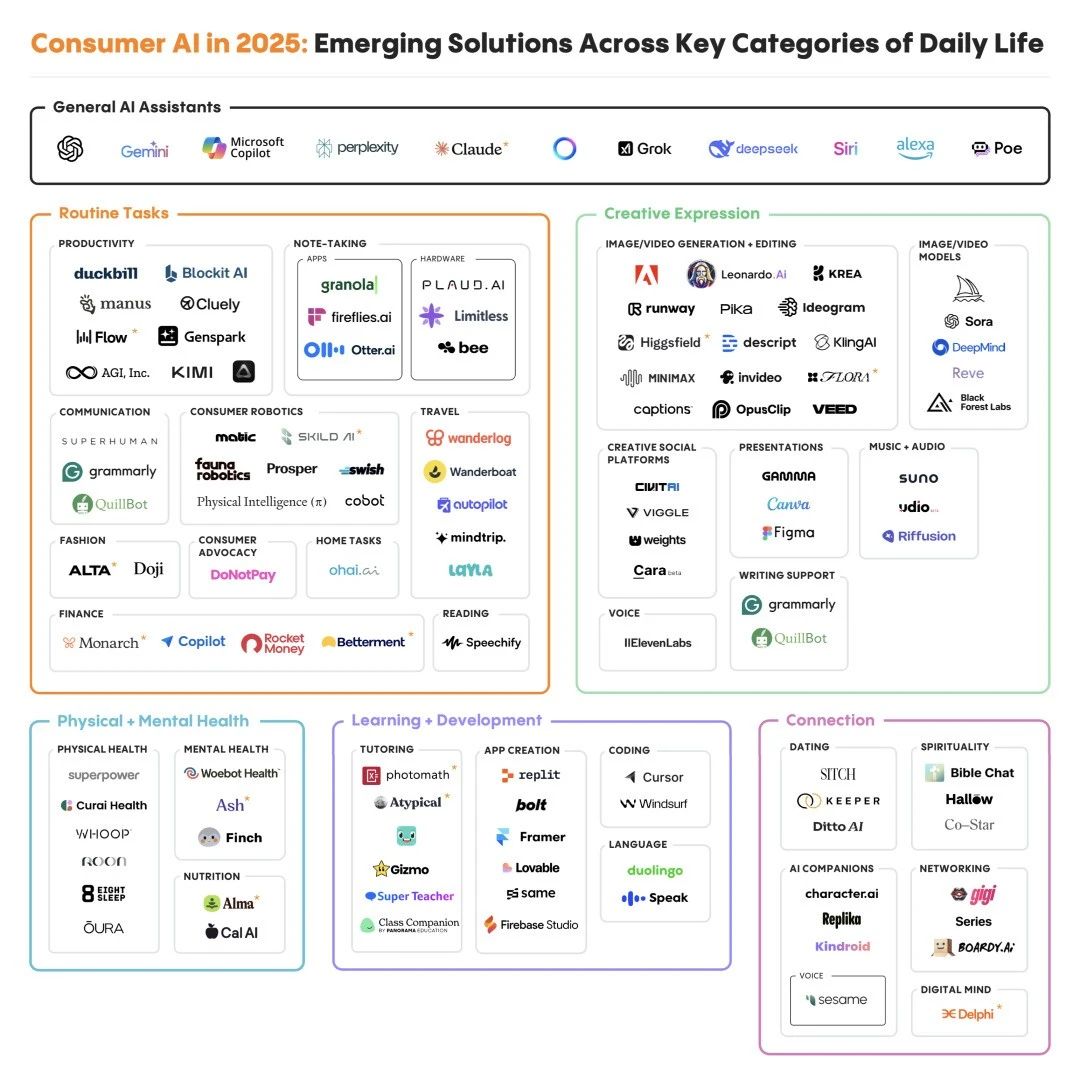
Core Insights - The report by Menlo Ventures reveals that over 61% of American adults have used AI in the past six months, indicating a significant shift in consumer behavior towards AI integration in daily life [5][6][10] - Despite the high usage rates, only 3% of users are willing to pay for AI services, leaving a substantial market gap of $420 billion [6][13] - The report identifies key opportunities in personalized scenarios where AI penetration is still low, suggesting a focus for entrepreneurs [3][9] Market Overview - The consumer AI market has grown to a $12 billion industry within just two and a half years since the launch of ChatGPT [10][13] - With an estimated 1.7 to 1.8 billion global users, the market potential is vast, but the current revenue generation is significantly lagging behind potential [6][13] - The report highlights that 81% of the revenue in the consumer AI market is captured by general AI assistants, with ChatGPT alone accounting for approximately 70% of consumer spending [41][43] User Demographics - The report reveals unexpected user demographics, with millennials (ages 29-44) being the heaviest users of AI, contrary to the assumption that younger generations would dominate [16][19] - Parents are identified as "super users," with 79% having used AI, and 29% using it daily, significantly higher than non-parents [25][30] - High-income households show a higher AI usage rate, with 74% of families earning over $100,000 using AI compared to 53% of those earning under $50,000 [20][21] Usage Patterns - AI is predominantly used for routine tasks, with email writing being the most common application at 19% of users, followed by task management and research [50][51] - The report indicates that while AI is widely used, the depth of adoption in specific tasks remains shallow, suggesting that there is room for growth in specialized applications [52][55] - AI's role in creative expression is significant, with over 51% of creators using AI for writing, and 38% for presentations, indicating a strong market for creative AI tools [59][63] Opportunities for Growth - The report identifies five key areas where AI can create value: routine tasks, health management, learning and development, interpersonal connections, and creative expression [44][46] - There is a notable gap in AI adoption in health management, with only 20% of those seeking health information using AI, highlighting a potential market opportunity [71][72] - The report emphasizes the need for AI tools that can effectively address high-friction, high-trust tasks, as these areas present significant opportunities for specialized AI solutions [76][80] Future Trends - The report predicts a shift towards professional tools becoming mainstream, moving away from general assistants [86] - It anticipates that AI will evolve from task-oriented tools to comprehensive workflow automation, enhancing user experience [86] - The emergence of voice AI and physical AI in homes is expected to further integrate AI into daily life, creating new market opportunities [86]


Navan Files to Go Public and Canva Pulls the Brakes: Why and What Happens?
20VC with Harry Stebbings· 2025-06-26 14:13
Rory O’Driscoll is a General Partner @ Scale where he has led investments in category leaders such as Bill.com (BILL), Box (BOX), DocuSign (DOCU), and WalkMe (WKME), among others. Jason Lemkin is one of the leading SaaS investors of the last decade with a portfolio including the likes of Algolia, Talkdesk, Owner, RevenueCat, Saleloft and more. ----------------------------------------------- In Today’s Episode We Discuss: 00:00 Intro 00:58 The Meta Acquisition Bombshell: Nat Friedman & Daniel Gross Join Face ...

华丽的demo唾手可得,好的AI产品来之不易 | Jinqiu Select
锦秋集· 2025-06-25 15:24
Core Insights - The article discusses the rapid growth of AI startups, emphasizing that achieving a 10x annual growth rate has become the new standard, surpassing traditional SaaS benchmarks [2][21] - It highlights the importance of transitioning from flashy demos to solid products, as the complexity of real-world applications creates a significant gap between demonstration and actual product functionality [1][5][8] Group 1: Growth Dynamics - AI companies are achieving faster growth rates than traditional software companies, with some reaching over 10x year-on-year growth [21] - The shift in enterprise purchasing behavior has led to a more proactive approach in seeking AI solutions, significantly shortening sales cycles [22][23] - The cost of creating AI applications has drastically decreased, enabling the development of previously unfeasible long-tail tools [26][30] Group 2: Product Development Challenges - Creating a compelling AI product is more challenging than producing a demo, as real-world user behavior is unpredictable and requires sophisticated model orchestration [6][10][12] - Companies must invest heavily in understanding specific business environments to ensure their AI products are effectively integrated [14][15] Group 3: Competitive Advantages - Speed and early momentum are crucial for establishing brand dominance and customer loyalty in the AI sector [3][34] - Building a strong moat involves becoming a core record system for clients, creating workflow lock-in, deep vertical integration, and maintaining trust-based relationships [36][37][40][44]

辞职后爆肝300天开发AI工具,投入2万美元,却换来0用户、0收入,程序员血亏警示录
3 6 Ke· 2025-06-25 00:52
Core Insights - The article discusses the challenges faced by a former high-salary architect who transitioned to an AI entrepreneur, ultimately leading to a failed startup experience with zero users and revenue [1][5][6] - It highlights the common pitfalls in the AI startup space, emphasizing the importance of understanding user needs and market demand rather than solely focusing on technical perfection [6][10][18] Group 1: Entrepreneur's Background and Product Development - The entrepreneur, known as Sorry-Bat-9609, has over 15 years of software engineering experience and previously worked for major companies like Walmart, Visa, and Target [2] - Motivated by the arrival of the AI era and dissatisfaction with existing design tools, he developed InfographsAI, an AI-driven platform aimed at generating unique infographics without templates [2][4] - InfographsAI boasts features such as instant generation of designs based on various content types, automatic fact-checking, and support for over 35 languages [3][4] Group 2: Challenges and Failures - After nearly 10 months of development, the product launched but failed to attract any users or generate revenue, leading to a realization of the disconnect between product quality and market need [5][6][7] - The entrepreneur identified key mistakes, including lack of demand validation, excessive feature accumulation, and a belief that quality alone would attract users [7][9][10] Group 3: Lessons Learned and Future Directions - The experience led to a shift in mindset, recognizing the need for early user engagement and market awareness rather than focusing solely on product perfection [10][12][13] - Future strategies include validating ideas with potential users before development, launching a minimum viable product (MVP) quickly, and prioritizing user feedback [13][14][16] - The entrepreneur aims to position InfographsAI as a competitor to Canva, emphasizing ease of use and the elimination of manual design processes [19][20]
Main Street meets AI
CNBC Television· 2025-06-24 16:44
AI Adoption in Small Businesses - Only 24% of small business owners are currently utilizing AI technologies like Chat GPT, Canva, and C-Pilot [1] - AI implementation varies significantly based on company size, with 21% adoption in firms with single-digit employees and nearly 50% in firms with 50 or more employees [4] Impact of AI on Employment - Almost all small businesses using AI report that it has not impacted the number of employees at their firm [2] - AI platforms like Harvey can significantly reduce the time required for tasks, potentially leveling the playing field [2][3]

澳洲年度富豪榜最新变化!看看富豪们的财富都来自于哪些行业?
Sou Hu Cai Jing· 2025-06-19 02:25
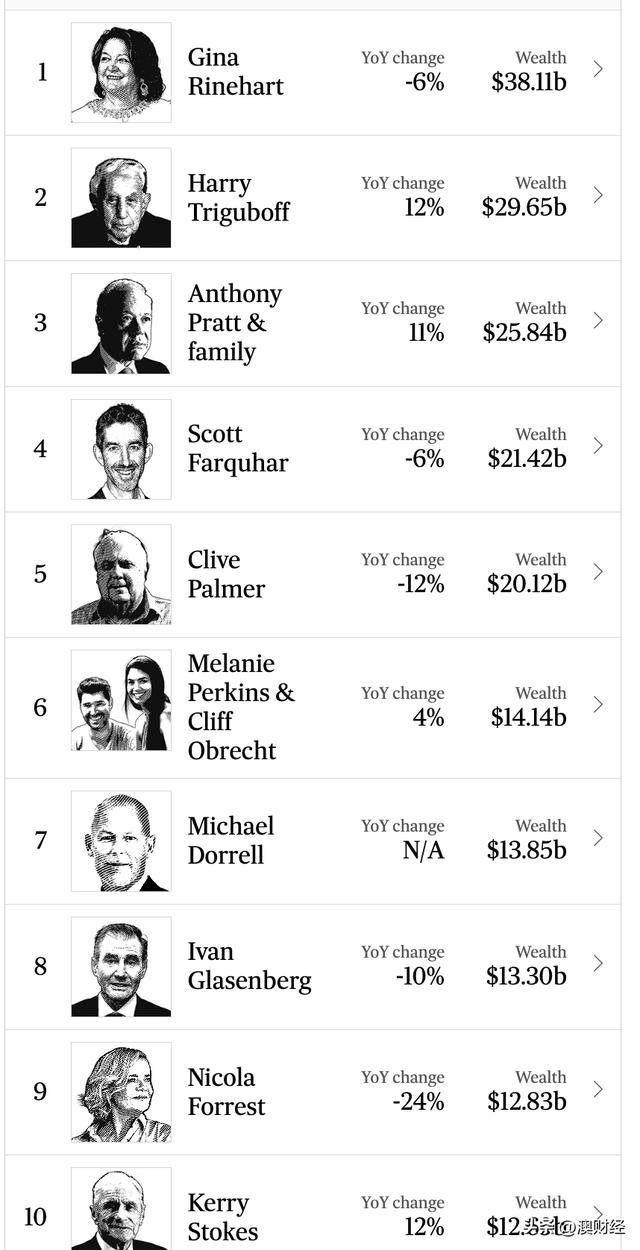
Summary of the 2025 Australian Rich List Core Insights - The total wealth of Australia's top 200 billionaires increased by 6.9% to AUD 667.8 billion despite a challenging economic environment. The top ten billionaires hold a combined wealth of AUD 202 billion, representing 11% of Australia's GDP [1]. Group 1: Wealth Distribution and Industry Representation - The threshold to enter the top 200 list reached a record high of AUD 747 million, with ten newcomers, of which only one inherited wealth [3]. - The mining and resources sector remains dominant, with 24 billionaires in this field, accumulating AUD 141.3 billion, although this represents a 4.6% decline from the previous year [4]. - The top ten billionaires include four from the mining sector, with Gina Rinehart leading at AUD 38.1 billion, while others like Clive Palmer and Ivan Glasenberg saw significant wealth reductions due to falling commodity prices [4]. Group 2: Emerging Industries - The technology sector is rapidly becoming a new wealth engine, with 22 billionaires and a total valuation of AUD 105.9 billion, ranking third among industries [6]. - Notable tech figures include Melanie Perkins and Cliff Obrecht of Canva, who rose to sixth place with AUD 14.1 billion, and Scott Farquhar of Atlassian, who ranked fourth with AUD 21.4 billion [7]. Group 3: Real Estate Sector - The real estate sector has the highest number of billionaires at 48, contributing AUD 125.8 billion, with Harry Triguboff of Meriton Group ranking second overall with AUD 29.65 billion [9][12]. - Triguboff's company is recognized for its significant contributions to high-density residential development in Australia [12]. Group 4: Newcomers and Notable Investments - Michael Dorrell, co-founder of Stonepeak, entered the list at seventh place with AUD 13.85 billion, marking the highest valuation for a newcomer in the list's history [13]. - Stonepeak's recent investments in energy infrastructure, including a significant stake in LNG facilities, highlight the growing importance of energy investments [13]. Group 5: Manufacturing and Diversified Businesses - Anthony Pratt, ranked third, has a wealth of AUD 25.85 billion from Visy Industries and Pratt Industries, focusing on sustainable products and significant investments in the U.S. manufacturing sector [16]. - Kerry Stokes, with a diversified business empire through Seven Group Holdings, returned to the top ten with a net worth of AUD 12.69 billion, despite challenges in energy and media sectors [18].
澳洲最强独角兽Canva冲刺上市,估值直逼500亿
Sou Hu Cai Jing· 2025-06-18 13:55
Core Viewpoint - Canva, one of Australia's most successful startups, is preparing to test its AUD 49 billion (approximately USD 32 billion) valuation through a highly anticipated equity transfer transaction, likely representing its last round of private share sales before going public [1][3]. Group 1: Equity Transfer and Valuation - Canva's co-founders are discussing an internal share transfer plan with a few key shareholders, aiming to provide a platform for early employees to sell some shares before Christmas this year [3]. - The transaction is still in preliminary stages, with the scale yet to be determined and broader shareholders not yet informed [3]. - Last year, Canva engaged Goldman Sachs and Morgan Stanley to facilitate a share transfer for early shareholders and employees, which totaled USD 1.6 billion at a valuation of USD 26 billion, significantly lower than its pre-rate hike peak of USD 40 billion [3][4]. Group 2: Future IPO and Market Position - In October of last year, Canva showcased a valuation of USD 32 billion based on an undisclosed share transfer, which did not raise new capital [4]. - The co-founders are expected to push for a sale at a valuation higher than USD 32 billion, likely marking the last round of financing as a private company before an anticipated IPO in the U.S. by 2026 [4]. - Canva's potential IPO would align it with another Australian software success, Atlassian, which went public on NASDAQ ten years ago [4]. Group 3: Strategic Growth and Acquisitions - Canva has expanded its product line through strategic acquisitions, including the purchase of London-based data visualization platform Flourish, Austrian background removal tool company Kaleido, and product display generation tool Smartmockups [5]. - The company made its largest acquisition to date by purchasing UK software company Serif for USD 1 billion, whose Affinity products directly compete with Adobe's photo editing software [5]. - Initially, Canva grew organically by providing better tools for small businesses and professional designers compared to traditional software like Adobe [5].