XREAL

Search documents
研报掘金丨东吴证券:维持晶盛机电“买入”评级,AR眼镜催化不断
Ge Long Hui A P P· 2025-08-20 06:15
Core Viewpoint - The report from Dongwu Securities indicates that the material leader Jing Sheng Ji Dian is expected to benefit significantly from the ongoing catalysis of AR glasses, particularly through partnerships with Zhejiang University-affiliated AR companies [1] Company Summary - Jing Sheng Ji Dian has partnered with AR companies Longqi, XREAL, and Kunyou Optoelectronics to develop silicon carbide substrates for AR glasses, with 8-inch substrates already in shipment and 12-inch cost-reduction models having completed research and production [1] - The company is leveraging its strong technical foundation and self-manufactured equipment to accelerate the cost-effective industrialization of silicon carbide, which is expected to benefit from economies of scale [1] Production Capacity - Domestic capacity: The company currently has a crystal pulling capacity of 300,000 pieces, and after the new 600,000 pieces of 8-inch capacity is established in 2025, the total capacity will reach 900,000 pieces [1] - Overseas capacity: The subsidiary Zhejiang Jingrui SuperSiC recently held a groundbreaking ceremony in Penang, Malaysia, where the first phase of the project is expected to achieve an efficient production capacity of 240,000 pieces per year for 8-inch silicon carbide substrates [1]


36氪2025AI百业大会8月27日北京举行,金山办公等企业出席
3 6 Ke· 2025-08-20 05:49
Group 1 - The event "2025 AI Partner Conference" will take place on August 27 in Beijing, focusing on the development of the AI industry and showcasing "Chinese solutions" [1][2][10] - Industry leaders from various companies, including Kingsoft Office, Cyborg Robotics, and others, will gather to witness the growth of the AI sector [1][2][10] - The conference is organized in collaboration with CEIBS (China Europe International Business School) [2][6][15] Group 2 - The venue for the conference is located at Zhongguancun Software Park, specifically at No. 20 Building, Northeast Wangxi Road, Haidian District, Beijing [2][10][18] - The event aims to highlight the significance of AI solutions tailored for the Chinese market [1][14][27]



2025上半年AR智能眼镜出货量显著:雷鸟创新、XREAL、星纪魅族前三
Feng Huang Wang· 2025-08-20 02:50
Core Insights - The online retail volume of smart devices in Chinese living rooms is projected to reach 35.231 million units in the first half of 2025, representing a year-on-year increase of 8.4% [1] - The total retail sales value is expected to hit 52.98 billion yuan, reflecting a year-on-year growth of 12.2% [1] Market Performance - Demand for large-screen devices, specifically smart projectors and smart TVs, is currently weak [1] - The VR market is experiencing sluggish consumption due to technological limitations and a lack of content, while AR products have shown significant improvements in portability, practicality, and cost-effectiveness [1] - The AR market is led by companies such as Thunder Innovation, XREAL, Starry Sky Meizu, VITURE, and Rokid [1] Product Launches - Xiaomi has officially launched its highly anticipated AI glasses on June 26, with the electrochromic model selling out quickly, and projected sales for 2025 are estimated at 300,000 units [1]
机构预测:2025年国内消费级XR整体销量同比增长6.5% 主要受AR设备带动
Feng Huang Wang· 2025-08-19 09:47
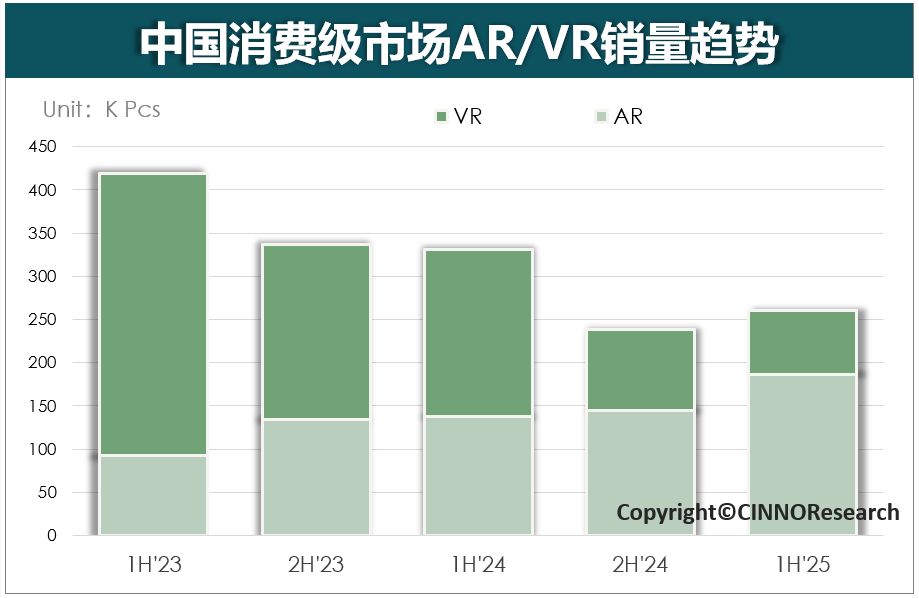
Core Insights - The domestic XR consumer market in China is experiencing a significant divergence, with VR device sales declining while AR device sales are growing rapidly [1] VR Market - In the first half of 2025, domestic consumer-grade VR device sales reached only 75,000 units, marking the lowest sales for the same period in nearly three years [2] - The decline is attributed to insufficient investment in the domestic VR content ecosystem and a lack of major new product releases [2] - The market share is relatively stable, with PICO leading at 46%, followed by Meta at 28%, and Goovis at 7% [2] - Major VR manufacturers are focusing on cost control and ecosystem integration to maintain their core market shares [2] - Fast LCD screens regained an 87% market share in VR devices, while Micro OLED screens remain primarily in high-end products [2] AR Market - In contrast to VR, domestic consumer-grade AR device sales reached 186,000 units in the first half of 2025, showing a year-on-year growth of 35% and a quarter-on-quarter growth of 28% [3] - This growth is driven by the continuous release of new AR glasses and government subsidies combined with promotional events like the "618" e-commerce festival [3] - The AR market is becoming increasingly competitive, with Thunder Innovation leading at 35% market share, followed by XREAL at 22% and Xingji Meizu in third place [3] - Micro OLED screens dominate the AR device market with an 87% share, while domestic screen manufacturer Visionary Technology has increased its market share by 30 percentage points through partnerships [3] - The market share for waveguide technology remains stable at 13%, with companies like Kunyou Optoelectronics and Zhige Technology reducing costs and enhancing product features [3] Annual Forecast - CINNO Research predicts that the overall sales of domestic consumer-grade XR devices will reach 606,000 units in 2025, representing a year-on-year growth of 6.5%, primarily driven by the continued strength of AR devices [4]
1H’25国内消费级XR市场销量26.1万台,全年预期同比增长6.5%
CINNO Research· 2025-08-19 06:37
Core Viewpoint - The Chinese consumer-grade XR market is experiencing structural differentiation in the first half of 2025, with the AR market continuing to grow while the VR market remains in a prolonged slump due to a lack of content ecosystem and new product releases [2][5]. Market Performance - In the first half of 2025, the overall sales volume of the domestic XR consumer market reached 261,000 units, representing a 9% increase quarter-on-quarter but a 21% decline year-on-year [5]. - The domestic consumer-grade VR market is in a downturn, with VR device sales at 75,000 units, marking a three-year low, primarily due to insufficient investment in VR content and no major new product launches in the first half of the year [5]. - In contrast, the domestic consumer-grade AR device sales reached 186,000 units, showing a 35% year-on-year increase and a 28% quarter-on-quarter increase, driven by new AR glasses releases, government subsidies, and promotional events [5]. - The forecast for the entire year predicts a total of 606,000 units sold in the domestic consumer-grade XR market, a 6.5% increase compared to the previous year, mainly propelled by AR devices [5]. Brand Trends - In the VR device market, the brand landscape remains stable, with PICO holding a 46% market share, followed by Meta at 28% and Goovis at 7%. Despite the market downturn, leading manufacturers maintain their shares through cost control and ecosystem integration [6]. - The AR device market is becoming increasingly competitive, with Thunderbird Innovation leading with a 35% market share, followed by XREAL at 22%. The success of these brands is attributed to multi-dimensional strategic layouts [6][7]. Technology Trends - In the VR device market, Fast LCD screen sales share has rebounded to 87%, while Micro OLED screens remain primarily in high-end products [8]. - In the AR device market, Micro OLED screen sales share is at 87%, with Sony dominating the market. Domestic screen manufacturers like Visionary Technology have seen a 30 percentage point increase in sales share due to deep collaborations with brands like Thunderbird [8]. - Waveguide technology maintains a stable sales share of 13%, with significant technological breakthroughs allowing manufacturers to reduce costs by 40% and introduce products with a field of view exceeding 50 degrees [8]. Investment and Financing Situation - In the first half of 2025, there were 37 financing deals globally in the XR sector, amounting to 44.5 billion yuan, a decrease of 34 deals compared to the previous year but an increase of 33.5 billion yuan in total amount, indicating a trend of capital concentration towards leading projects [9]. - The investment and financing landscape in AR/VR is characterized by four major trends: capital centralization, core technology focus, ecological scene development, and regional clustering [9]. - The shift in capital from speculative concepts to substantial technological breakthroughs and commercialization is evident, with domestic breakthroughs in core components like Micro LED and silicon-based OLED expected to reshape the global supply chain [9].

CINNO Research:上半年中国XR消费级市场整体销量达26.1万台 环比增长9%
智通财经网· 2025-08-19 06:29
Core Insights - The Chinese consumer-grade XR market is experiencing structural differentiation in the first half of 2025, with the AR market continuing to grow while the VR market remains sluggish due to a lack of content ecosystem and new product releases [1] XR Market Overview - In the first half of 2025, the overall XR sales reached 261,000 units, representing a 9% quarter-on-quarter growth, primarily driven by the launch of new AR glasses [1] - The domestic consumer-grade VR market is in a downturn, with VR device sales at 75,000 units, marking a three-year low, attributed to insufficient investment in VR content and no major new product launches [3] - Conversely, the domestic consumer-grade AR device sales reached 186,000 units, showing a 35% year-on-year increase and a 28% quarter-on-quarter increase, supported by new product launches and government subsidies [3] - The forecast for the entire year predicts a total of 606,000 units sold in the domestic consumer-grade XR market, a 6.5% increase compared to the previous year, mainly driven by AR devices [3] Brand Trends - In the VR device market, the brand landscape remains stable, with PICO holding a 46% market share, followed by Meta at 28% and Goovis at 7%. Despite market challenges, leading manufacturers maintain their shares through cost control and ecosystem integration [4] - In the AR device market, competition is intensifying, with Thunderbird Innovation leading at 35% market share, followed by XREAL at 22%. Starry Sky Meizu ranks third due to effective policy adaptation and a comprehensive marketing strategy [4] Technology Trends - In the VR device market, Fast LCD screen sales share has rebounded to 87%, while Micro OLED screens remain focused on high-end products [5] - In the AR device market, Micro OLED screens account for 87% of sales, with Sony dominating the market. Domestic manufacturers like Visionary Technology have seen a 30 percentage point increase in market share through deep collaborations [5] - Waveguide technology maintains a stable 13% sales share, with significant breakthroughs allowing manufacturers to reduce costs by 40% and introduce products with a field of view exceeding 50 degrees [5] Investment and Financing Situation - In the first half of 2025, there were 37 global XR financing deals amounting to 44.5 billion yuan, a decrease of 34 deals compared to the previous year, but with an increase of 33.5 billion yuan in total funding, indicating a trend of capital concentration towards leading projects [7] - The AR/VR investment landscape is characterized by four trends: capital centralization, core technology focus, ecological scene development, and regional clustering [7] - The shift from speculative investment to substantial technological breakthroughs and commercialization is evident, with domestic advancements in Micro LED and silicon-based OLED becoming key factors in reshaping the global supply chain [7]
新技术支撑智能终端加快普及
Jing Ji Ri Bao· 2025-08-17 01:24
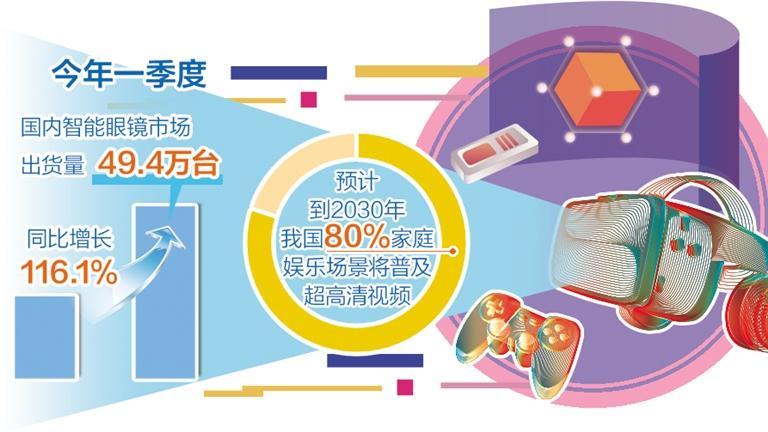
Group 1 - The Ministry of Industry and Information Technology is promoting the development and application of technologies such as artificial intelligence, ultra-high-definition video, and smart wearables to enhance consumer goods supply and demand adaptability [1] - The number of AI-enabled devices, including AI smartphones, AI computers, and AI glasses, has exceeded 100, becoming a new growth point for economic development [1] - The domestic smart glasses market saw a shipment volume of 494,000 units in Q1 this year, representing a year-on-year growth of 116.1% [1] Group 2 - XREAL, a smart glasses brand, ranks among the top two in the global AR/VR industry, with expectations that smart glasses will become a key mobile terminal in the AI era [2] - The AR/VR market's shipment volume reached 135,000 units in Q1, showing a year-on-year increase of 25.2% [1][2] - The ultra-high-definition video industry in China is experiencing stable growth, with a well-established industry chain spanning video production, network transmission, terminal presentation, and industry applications [2] Group 3 - By 2030, it is predicted that 80% of households in China will adopt ultra-high-definition video, driving demand for technologies such as 8K high refresh rates and wide color gamut displays [3] - Companies like TCL Huaxing are focusing on transforming ultra-high-definition technology into user value and promoting a new ecosystem in the display industry [3] - Recommendations include supporting the replacement of old consumer goods, accelerating the promotion of 4K/8K TVs, AI smartphones, and virtual reality terminals, and enhancing infrastructure for ultra-high-definition video development [3]
增强消费品供需适配性 新技术支撑智能终端加快普及
Jing Ji Ri Bao· 2025-08-16 23:22
Group 1 - The Ministry of Industry and Information Technology proposed an action plan to enhance the adaptability of supply and demand for consumer goods, accelerating the development and application of technologies such as artificial intelligence terminals, ultra-high-definition video, and smart wearables [2] - The application of AI technology is expected to create new business models and industries, with over a hundred AI terminals like AI smartphones and AI computers contributing to economic growth [2][3] - The domestic smart glasses market saw a shipment volume of 494,000 units in Q1 this year, representing a year-on-year growth of 116.1%, while the AR/VR market had a shipment volume of 135,000 units, growing by 25.2% [2][3] Group 2 - XREAL, a smart glasses brand, ranks among the top two in the global AR/VR industry, with the CEO stating that smart glasses are poised to become a key mobile terminal in the AI era [3] - The ultra-high-definition video industry in China is experiencing stable growth, with a well-established industrial chain spanning video production, network transmission, terminal presentation, and industry applications [3][4] - By 2030, it is predicted that 80% of households in China will adopt ultra-high-definition entertainment scenarios, driving demand for technologies like 8K high refresh rates and Mini LED displays [4] Group 3 - Recommendations include supporting the replacement of old consumer goods and accelerating the promotion of 4K/8K televisions, AI smartphones, and virtual reality terminals [5] - There is a call for enhancing infrastructure capabilities such as network bandwidth and transmission speed to support the development of the ultra-high-definition video industry [5] - Collaboration between academia, research institutions, and enterprises is encouraged to jointly develop new technologies, products, and applications in the ultra-high-definition video sector [5]
增强消费品供需适配性—— 新技术支撑智能终端加快普及
Jing Ji Ri Bao· 2025-08-16 21:44
Group 1 - The Ministry of Industry and Information Technology proposed a plan to enhance the adaptability of consumer goods supply and demand, accelerating the development and application of technologies such as artificial intelligence terminals, ultra-high-definition video, and smart wearables [1] - The application of AI technology is expected to create new business models and industries, with over a hundred AI terminals like AI phones, AI computers, and AI glasses emerging as new growth points for economic development [1] - The domestic smart glasses market saw a shipment volume of 494,000 units in Q1 this year, representing a year-on-year growth of 116.1%, while the AR/VR market had a shipment volume of 135,000 units, growing by 25.2% [1][2] Group 2 - XREAL, a smart glasses brand, ranked among the top two in the global AR/VR industry, with the CEO stating that smart glasses are poised to become a key mobile terminal in the AI era [2] - The ultra-high-definition video industry in China is experiencing stable growth, with a well-established industry chain encompassing video production, network transmission, terminal presentation, and industry applications across various sectors [2][3] - By 2030, it is predicted that 80% of households in China will adopt ultra-high-definition entertainment scenarios, driving demand for technologies like 8K high refresh rates and wide color gamut displays [3]
第一批买AI眼镜的人,已退货
虎嗅APP· 2025-08-16 13:54
Core Viewpoint - The rapid rise and subsequent decline of AI glasses in the market highlight the gap between consumer expectations and actual product performance, leading to significant return rates and negative feedback from users [5][12][28]. Group 1: Market Performance - Xiaomi AI glasses sold nearly 50,000 units within three days of launch, indicating strong initial demand [14]. - The overall market for smart glasses in China is projected to reach 2.907 million units in 2023, with multiple brands entering the competition [14]. - Despite the initial sales success, a wave of returns has emerged due to poor user experiences, with some estimates suggesting return rates could be as high as 40% to 50% [28][30]. Group 2: User Experience Issues - Users reported significant issues with the AI glasses, including connectivity problems, subpar audio and video quality, and heavy weight, leading to discomfort [8][14][15]. - Specific complaints included delayed translation features, poor photo quality, and awkward design that caused discomfort during extended use [10][11][15]. - The AI glasses' functionality, such as smart recognition and translation, often failed to meet user expectations, resulting in frustration and dissatisfaction [11][15]. Group 3: Competitive Landscape - Major tech companies like Huawei, Alibaba, and Baidu are entering the AI glasses market, intensifying competition [12][22]. - The market has seen a surge in new products, with over ten new models launched in the first half of the year, but many have faced similar criticism regarding performance [12][14]. - The entry of companies like Flash Technology, which offered a lower-priced model, did not prevent negative feedback regarding product quality and functionality [22][23]. Group 4: Historical Context - The history of smart glasses dates back to Google's launch of Google Glass in 2012, which ultimately failed due to high costs and privacy concerns [18][20]. - The market saw a resurgence in 2023 with Meta's collaboration with Ray-Ban, which successfully integrated AI features while focusing on style and comfort [21][22]. - The current landscape is characterized by a rush of companies attempting to capitalize on the AI glasses trend, but many are struggling with product quality and consumer acceptance [28].