
会稽山

Search documents
不在办公室就在烧烤摊,年销2万吨啤酒,他的方法是什么?|千商访谈
Sou Hu Cai Jing· 2025-11-22 04:43
Core Insights - The article highlights the entrepreneurial journey of Bai Xuejun, who has over 40 years of experience in the liquor industry, emphasizing the importance of practical action, market presence, and strategic thinking in achieving success [3][5][16] Group 1: Entrepreneurial Journey - Bai Xuejun started from a poor background and faced significant challenges, including dropping out of school due to financial constraints, but he persevered and gradually built a successful liquor business [7][8] - His initial foray into the market involved selling low-cost beverages and later transitioning to logistics for breweries, which laid the foundation for his future success in the liquor industry [7][8] - Bai's innovative approach to business included recycling beer bottles and establishing a supply chain, which allowed him to become a key supplier for local breweries [7][11] Group 2: Market Strategy - Bai Xuejun's strategy involved direct engagement with the market, where he visited stores and built relationships with local business owners to understand their needs and drive product sales [9][10] - He implemented a successful promotional campaign by offering free tastings of his products, which significantly boosted sales and market penetration in his region [10][11] - His company, Bai's Liquor Store, became the largest beer distributor in the Linyi area, selling approximately 20,000 tons of Qingdao beer annually, and was recognized as a benchmark case by Qingdao Beer at national distributor conferences [11][12] Group 3: Industry Insights - Bai Xuejun has shown a keen ability to identify market trends, such as the rising popularity of yellow wine among younger consumers, and has secured new agency contracts to capitalize on this growth [12][13] - His understanding of the liquor market's dynamics, including the importance of supply chain management and sales strategies, has positioned his business favorably amidst industry changes [11][16] - Bai's unique approach, termed "Bai's Military Strategy," combines supply chain management, market presence, and trend forecasting, serving as a practical model for other liquor businesses facing industry challenges [16]



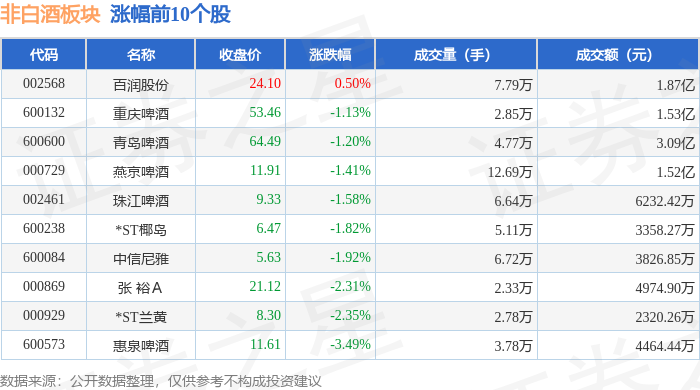
非白酒板块11月21日跌1.81%,会稽山领跌,主力资金净流出1.55亿元
Zheng Xing Xing Ye Ri Bao· 2025-11-21 09:33
Market Overview - The non-liquor sector experienced a decline of 1.81% on November 21, with Kuaijishan leading the drop [1] - The Shanghai Composite Index closed at 3834.89, down 2.45%, while the Shenzhen Component Index closed at 12538.07, down 3.41% [1] Stock Performance - Kuaijishan (601579) saw a significant drop of 5.97%, closing at 20.94 with a trading volume of 169,100 shares and a turnover of 368 million yuan [2] - Other notable declines include: - Caogao Co. (600543) down 5.81% to 6.00 - ST Xifa (000752) down 4.99% to 11.61 - Weilang Co. (603779) down 4.18% to 6.87 [2] Capital Flow - The non-liquor sector experienced a net outflow of 155 million yuan from institutional investors, while retail investors saw a net inflow of 116 million yuan [2] - The capital flow for specific stocks includes: - Zhongxin Niya (600084) with a net inflow of 2.65 million yuan from retail investors [3] - Zhang Yu A (000869) with a net outflow of 3.54 million yuan from retail investors [3] - Kuaijishan (601579) had a significant net outflow of 799.52 million yuan from institutional investors [3]

产品、营销玩法频出 跨界混搭能成黄酒出圈正解吗
Bei Jing Shang Bao· 2025-11-20 13:45
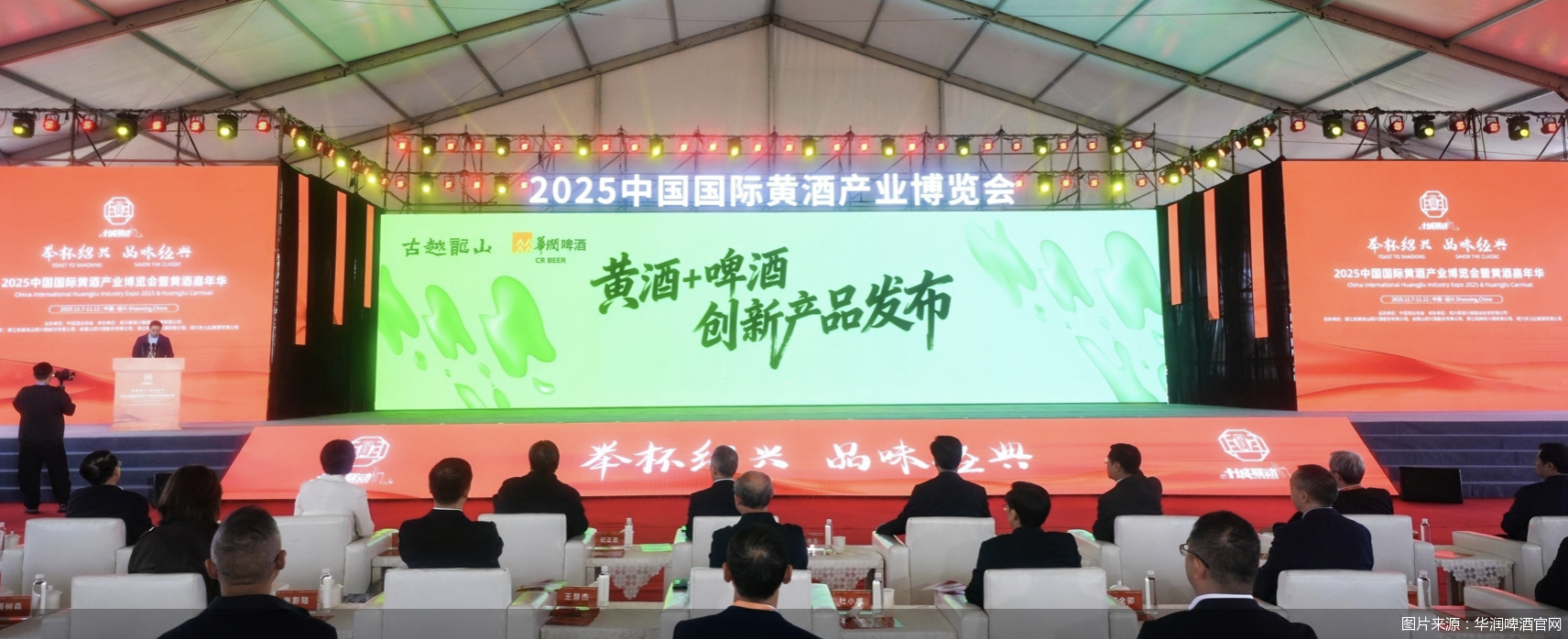
Core Insights - The traditional yellow wine industry is at a transformative crossroads, with leading brands exploring cross-industry collaborations to expand their consumer market [1][3] - The industry faces multiple challenges, including limited consumption regions and scenarios, prompting companies to seek new growth opportunities through innovative partnerships [1][6] Group 1: Industry Trends - Major yellow wine brands like Guyue Longshan and Kuaijishan are actively engaging in cross-industry collaborations, such as the launch of "Yue Xiao Pi" in partnership with China Resources Beer [3][4] - Guyue Longshan has introduced various innovative products, including coffee-infused yellow wine and a whiskey variant, indicating a shift towards younger consumer preferences [4][10] - The yellow wine market is experiencing a trend towards diversification, with brands exploring new consumption scenarios beyond traditional settings [4][9] Group 2: Market Dynamics - The yellow wine market is highly concentrated, with the Jiangsu, Zhejiang, and Shanghai regions accounting for over 70% of sales, leading to intense competition [6][7] - Financial reports reveal that Guyue Longshan and Kuaijishan derive a significant portion of their revenue from these regions, highlighting the geographical limitations of the market [6][7] - Despite the challenges, the yellow wine industry is projected to grow, with sales expected to exceed 300 billion yuan by 2025, driven by a shift in consumer preferences towards lower-alcohol beverages [9][10] Group 3: Consumer Engagement - Marketing experts suggest that yellow wine brands should enhance their appeal to younger consumers through innovative marketing strategies, including social media and influencer collaborations [5][11] - The emergence of "slow bars" and other experiential venues is seen as a way to engage consumers and gather valuable data on preferences and behaviors [10][11] - The industry must address the perception issues surrounding yellow wine, which has been labeled as "cooking wine," to improve brand recognition and value [7][8]

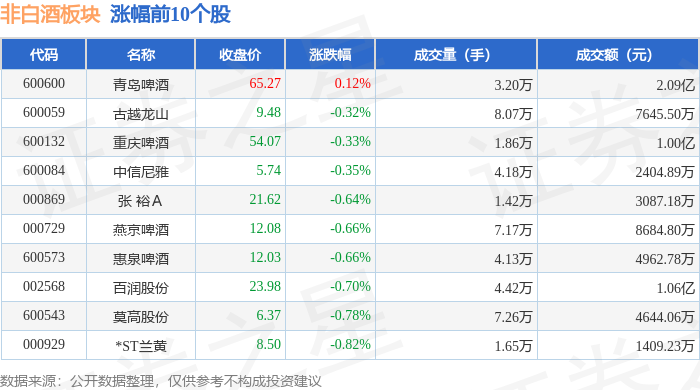
非白酒板块11月20日跌0.59%,会稽山领跌,主力资金净流出7488.33万元
Zheng Xing Xing Ye Ri Bao· 2025-11-20 09:09
Core Points - The non-liquor sector experienced a decline of 0.59% on the trading day, with Kuaijishan leading the drop [1] - The Shanghai Composite Index closed at 3931.05, down 0.4%, while the Shenzhen Component Index closed at 12980.82, down 0.76% [1] Non-Liquor Sector Summary - Kuaijishan (601579) closed at 22.27, down 2.15%, with a trading volume of 99,600 shares and a transaction value of 222 million yuan [2] - Other notable declines include ST Xifa (000752) down 2.00% and ST Yedao (600238) down 1.49% [2] - The overall net capital flow for the non-liquor sector showed a net outflow of 74.88 million yuan from main funds, while retail investors saw a net inflow of 78.72 million yuan [2]
非白酒板块11月19日跌0.33%,*ST椰岛领跌,主力资金净流出1298.75万元
Zheng Xing Xing Ye Ri Bao· 2025-11-19 08:52
Market Overview - The non-liquor sector experienced a decline of 0.33% on the previous trading day, with *ST Yedao leading the drop [1] - The Shanghai Composite Index closed at 3946.74, up 0.18%, while the Shenzhen Component Index closed at 13080.09, unchanged [1] Stock Performance - Key stocks in the non-liquor sector showed varied performance, with Kuaijishan (601579) rising by 1.47% to a closing price of 22.76, while *ST Yedao (600238) fell by 3.60% to 6.69 [1][2] - Other notable movements included ST Xifa (000752) increasing by 1.22% and Zhangyu A (000869) rising by 0.28% [1] Trading Volume and Value - Kuaijishan recorded a trading volume of 174,100 shares, with a transaction value of approximately 3.95 million yuan [1] - The total net outflow of main funds in the non-liquor sector was 12.99 million yuan, while retail investors saw a net inflow of 9.51 million yuan [2][3] Fund Flow Analysis - Main funds showed a net outflow in several stocks, including Kuaijishan with a net outflow of 23.57 million yuan, while Zhangyu A had a net inflow of 7.98 million yuan [3] - Retail investors contributed positively to the fund flow in stocks like 百润股份 (002568), which saw a net inflow of 20.47 million yuan despite a main fund outflow [3]


东方财富证券:食品饮料加速出清 板块投资价值有望提升
智通财经网· 2025-11-19 08:11
Core Viewpoint - The report from Dongfang Caifu Securities indicates that the supply-demand mismatch in 2024 will lead to deteriorating industry operations, but as companies gradually lower growth targets to adapt to demand in 2025, this will alleviate supply-demand conflicts and enhance investment value in the sector. The expectation is for positive growth in financial statements by the second or third quarter of next year [1]. Group 1: Industry Overview - In Q1-Q3 2025, under weak demand, industry revenue showed slight growth while profits were under pressure, with the food and beverage sector experiencing a revenue decline of -4.9% and a net profit drop of -14.6% in Q3 2025 [1]. - Traditional consumption is hindered by slow recovery in consumption scenarios, with the liquor sector, particularly baijiu, facing accelerated clearance and weak performance in beer demand [1]. - Sectors like snacks and beverages that have opportunities for new product launches and channel expansion continue to show positive momentum, with products like konjac experiencing rapid growth since 2024 [1]. Group 2: Category Analysis and Outlook - **Baijiu**: The industry is accelerating clearance with clearer turning points. In Q3 2025, overall revenue and net profit declined by -18.4% and -22.2% respectively, but demand is expected to improve, stabilizing prices and leading to better financial performance by Q2 2026 [2]. - **Low-Alcohol Beverages and Beer**: Beer revenue and net profit grew by +2.0% and +11.8% respectively in Q3 2025, with cost advantages continuing. Demand recovery is anticipated in 2026, influenced by changes in retail channels [3]. - **Dairy Products**: The raw milk sector is gradually bottoming out, with demand expected to stabilize and prices recover. The low-temperature fresh milk segment is projected to grow, replacing some ambient milk [4]. - **Snacks**: Categories like konjac and oats are expected to maintain high growth, with a shift towards emerging channels and significant growth in instant retail [4]. Group 3: Investment Recommendations - **Baijiu**: Focus on companies that are clearing inventory early and have strong brand momentum, such as Gujing Gongjiu and Luzhou Laojiao, as well as those with strong product matrices and channel capabilities like Moutai and Wuliangye [5]. - **Low-Alcohol Beverages**: Highlighting head companies like Kweichow Moutai and Qingdao Beer, which are expected to benefit from demand recovery [5]. - **Dairy and Snacks**: Emphasizing the potential for recovery in the raw milk sector and recommending companies like Yili and Mengniu, as well as snack companies that can leverage product and channel adjustments [6].

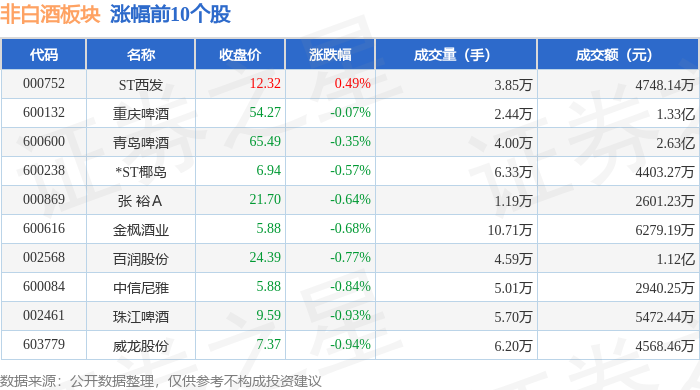
非白酒板块11月18日跌0.95%,燕京啤酒领跌,主力资金净流出1.09亿元
Zheng Xing Xing Ye Ri Bao· 2025-11-18 08:04
Market Overview - The non-liquor sector experienced a decline of 0.95% on November 18, with Yanjing Beer leading the drop [1] - The Shanghai Composite Index closed at 3939.81, down 0.81%, while the Shenzhen Component Index closed at 13080.49, down 0.92% [1] Stock Performance - Key stocks in the non-liquor sector showed varied performance, with ST Xifa closing at 12.32, up 0.49%, while other notable declines included Caijing Beer down 2.41% to 12.14 and Huichuan Beer down 2.41% to 12.15 [2] - The trading volume and turnover for selected stocks indicated significant activity, with Chongqing Beer recording a turnover of 1.33 billion and ST Xifa at 47.48 million [1][2] Capital Flow - The non-liquor sector saw a net outflow of 109 million from major funds, while retail investors contributed a net inflow of 115 million [2] - Detailed capital flow data showed that ST Xifa had a net inflow of 671,900 from major funds, while other stocks like ST Yedao experienced significant outflows [3]


非白酒板块11月17日跌0.64%,会稽山领跌,主力资金净流出1.55亿元
Zheng Xing Xing Ye Ri Bao· 2025-11-17 08:49
Market Overview - The non-baijiu sector experienced a decline of 0.64% on the trading day, with Kuaijishan leading the drop [1] - The Shanghai Composite Index closed at 3972.03, down 0.46%, while the Shenzhen Component Index closed at 13202.0, down 0.11% [1] Stock Performance - Notable gainers included: - *ST Yedao: Closed at 6.98, up 3.25% with a trading volume of 101,700 shares and a turnover of 70.11 million yuan [1] - Huichuan Beer: Closed at 12.45, up 1.30% with a trading volume of 57,300 shares and a turnover of 70.97 million yuan [1] - Significant decliners included: - Kuaijishan: Closed at 22.89, down 1.97% with a trading volume of 148,900 shares and a turnover of 342 million yuan [2] - Fick Beer: Closed at 12.44, down 1.74% with a trading volume of 198,400 shares and a turnover of 248 million yuan [2] Capital Flow - The non-baijiu sector saw a net outflow of 155 million yuan from institutional investors, while retail investors contributed a net inflow of 163 million yuan [2] - The capital flow for specific stocks showed: - *ST Lanhua: Net inflow from retail investors was 121,770 yuan, while institutional investors had a net outflow of 292,560 yuan [3] - Kuaijishan: Retail investors had a net inflow of 725,900 yuan, while institutional investors faced a net outflow of 216,510 yuan [3]

从三季报看中国经济:新消费潜力迸发
Jing Ji Ri Bao· 2025-11-17 00:03
Core Viewpoint - The third-quarter reports of listed companies reflect the resilience and vitality of China's consumer market, indicating a structural adjustment period in the consumption sector with both challenges and opportunities [1] Overall Recovery - The consumer sector shows a steady recovery overall, but there is uneven performance across different segments. Essential consumption remains stable, while discretionary consumption is experiencing a divide [2] - Essential consumption sectors like food and beverages are performing well due to their necessity, with leading companies showing stable revenue and profit growth [2] - The liquor industry, representing traditional high-end consumption, is under pressure, with major companies like Wuliangye and Luzhou Laojiao reporting significant declines in revenue and profit [2] - In contrast, the new energy vehicle industry is thriving, benefiting from policy support and product upgrades, becoming a key growth driver in the consumer sector [2] Channel Transformation - Traditional retail companies are accelerating their online transformation, integrating online and offline channels to capture market changes, with those embracing digitalization seeing growth [3] Cost Pressures - Global commodity prices remain high, putting pressure on raw material and logistics costs, which challenges the gross margins of mid-to-low-end consumer companies [4] - Companies that optimize product structures and improve supply chain efficiency are demonstrating stronger profitability and market competitiveness [4] Structural Highlights - A number of structural highlights are emerging, driving high-quality development in consumer-related listed companies through innovation in technology, business models, and consumer scenarios [5] - In the smart home sector, companies like Ecovacs and Haier are experiencing significant profit growth, with Ecovacs reporting a 131% increase in net profit [5] - The traditional consumption sector is exploring new business models, with companies like Kweichow Moutai and Mercury Home Textiles achieving double-digit growth through innovative product offerings [6] New Consumption Scenarios - Companies are actively transforming to capture new consumption trends, with firms like Golden Dragon Fish and Miaokelando reporting substantial profit increases due to cost improvements and channel optimization [8] - The consumer market is becoming increasingly segmented, with new brands focusing on specific demographics and scenarios, such as new-style tea drinks and pet economy products [8] - Domestic brands are gaining market share and showing strong performance in sectors like sportswear and beauty products, driven by cultural confidence and supply chain advantages [8] Market Dynamics - The consumer market is undergoing structural upgrades, with recovery being uneven due to factors like income expectations and regional disparities [9] - Companies with strong brand barriers and unique market advantages are favored by capital, while those embracing new trends and product iterations can still find growth opportunities [9] - The competition is shifting from traditional versus new consumption to the operational efficiency and strategic vision of different companies within the same industry [9] High-Quality Development - The recovery trend in China's consumer market is moving from total growth to structural optimization, with companies encouraged to focus on high-quality development through innovation [10]





新消费潜力迸发
Jing Ji Ri Bao· 2025-11-16 21:52
Core Insights - The third-quarter reports of listed companies reflect the resilience and vitality of China's consumer market, indicating a structural adjustment period with both challenges and opportunities [1] Overall Recovery - The consumer sector shows a steady recovery overall, but there is uneven performance across different segments. Essential consumption remains stable, while discretionary consumption is experiencing a divide [2] - Essential consumption sectors like food and beverages are performing well due to their necessity, with leading companies showing stable revenue and profit growth. For instance, Wuliangye reported a 52.66% year-on-year decline in Q3 revenue to 8.174 billion yuan, and a 65.62% drop in net profit to 2.019 billion yuan [2] - In contrast, the new energy vehicle industry is thriving, benefiting from policy support and product upgrades, becoming a key growth driver in the consumer sector [2] Channel Transformation - Traditional retail companies are accelerating their online transformation, integrating online and offline channels. Companies that embrace digitalization are capturing the benefits of this channel transformation [3] Cost Pressures - Global commodity prices remain high, putting pressure on raw material and logistics costs, which challenges the gross margins of mid-to-low-end consumer companies. Companies that optimize product structures and improve supply chain efficiency are showing stronger profitability [4] Structural Highlights - A number of structural highlights are emerging, driving high-quality development in consumer-related listed companies through innovation in technology, business models, and consumer scenarios [5] - In the smart home sector, companies like Ecovacs and Haier are experiencing significant profit growth, with Ecovacs reporting a 131% year-on-year increase in net profit [5] Innovation in Business Models - Traditional consumption sectors are exploring new business models, with companies like Kweichow Moutai and Water Mercury Home Textiles achieving double-digit growth through innovative product offerings and marketing strategies [6] New Consumption Scenarios - Companies are actively transforming to capture new consumption trends, with firms like Golden Dragon Fish and Miaokelando reporting significant profit increases due to cost improvements and channel optimization [8] - The rise of domestic brands is notable, with many achieving excellent performance in revenue growth and market share, particularly in sectors like sportswear and beauty products [8] Market Dynamics - The consumer market is undergoing structural upgrades, with disparities in recovery driven by factors such as income expectations and consumer confidence. Companies with strong brand barriers and unique market advantages are favored by capital [9] - The competition is intensifying among quality sectors, with a focus on operational efficiency and strategic vision. Companies that adapt to new trends and innovate their product offerings are likely to find growth opportunities [10]