
吉利汽车

Search documents
吉利汽车:2025年业绩符合预期,单车表现逐季提升-20260319
ZHONGTAI SECURITIES· 2026-03-19 13:25
Investment Rating - The investment rating for Geely Automobile is "Buy" (maintained) [2][8] Core Views - The company is expected to achieve a revenue of 345.2 billion yuan in 2025, with a year-on-year growth of 25.1% [5] - The core net profit for 2025 is projected to be 144.1 billion yuan, reflecting a year-on-year increase of 35.9% [5] - The company aims to sell 3.45 million vehicles in 2026, representing a 14% increase year-on-year, with significant contributions from exports and high-end models [5] Financial Projections - Revenue Forecast: - 2024A: 240.2 billion yuan - 2025A: 345.2 billion yuan - 2026E: 482.3 billion yuan - 2027E: 551.0 billion yuan - 2028E: 615.5 billion yuan - Year-on-year growth rates: 34%, 44%, 40%, 14%, 12% [2][7] - Net Profit Forecast: - 2024A: 16.5 billion yuan - 2025A: 16.9 billion yuan - 2026E: 20.4 billion yuan - 2027E: 26.1 billion yuan - 2028E: 31.8 billion yuan - Year-on-year growth rates: 219%, 2%, 21%, 28%, 22% [2][7] - Earnings Per Share (EPS): - 2024A: 1.52 yuan - 2025A: 1.56 yuan - 2026E: 1.88 yuan - 2027E: 2.41 yuan - 2028E: 2.93 yuan [2][7] Market Performance - The company achieved a total vehicle sales of 854,000 units in Q4 2025, with a quarter-on-quarter increase of 9.3% [5] - The average selling price (ASP) per vehicle in Q4 2025 was approximately 124,000 yuan, showing a steady increase [5] - The company’s market capitalization is approximately 198.6 billion HKD [3]

吉利汽车营收首破3400亿元、销量突破300万辆,全固态电池推出在即
Hua Xia Shi Bao· 2026-03-19 13:17
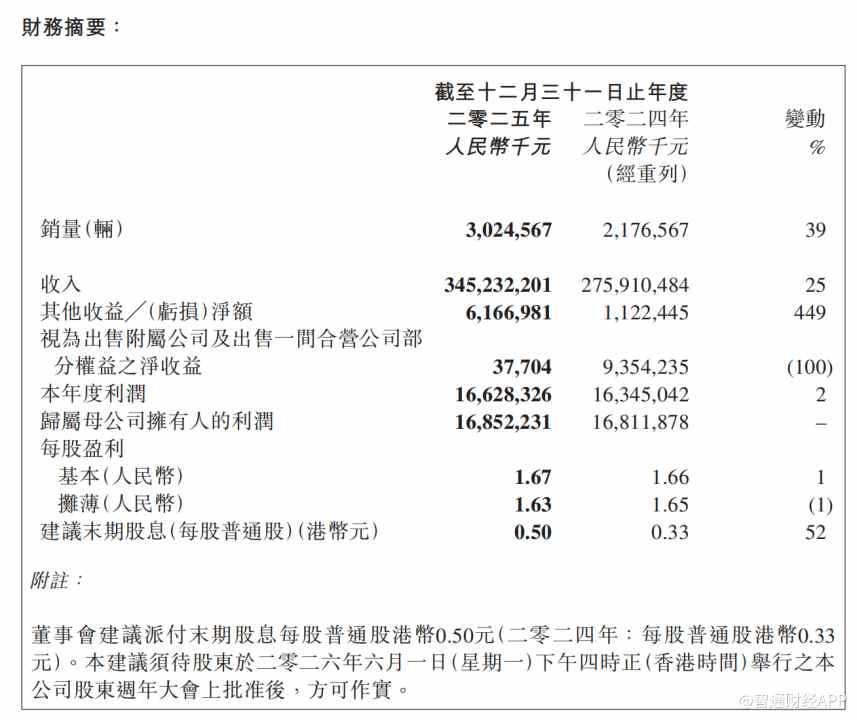
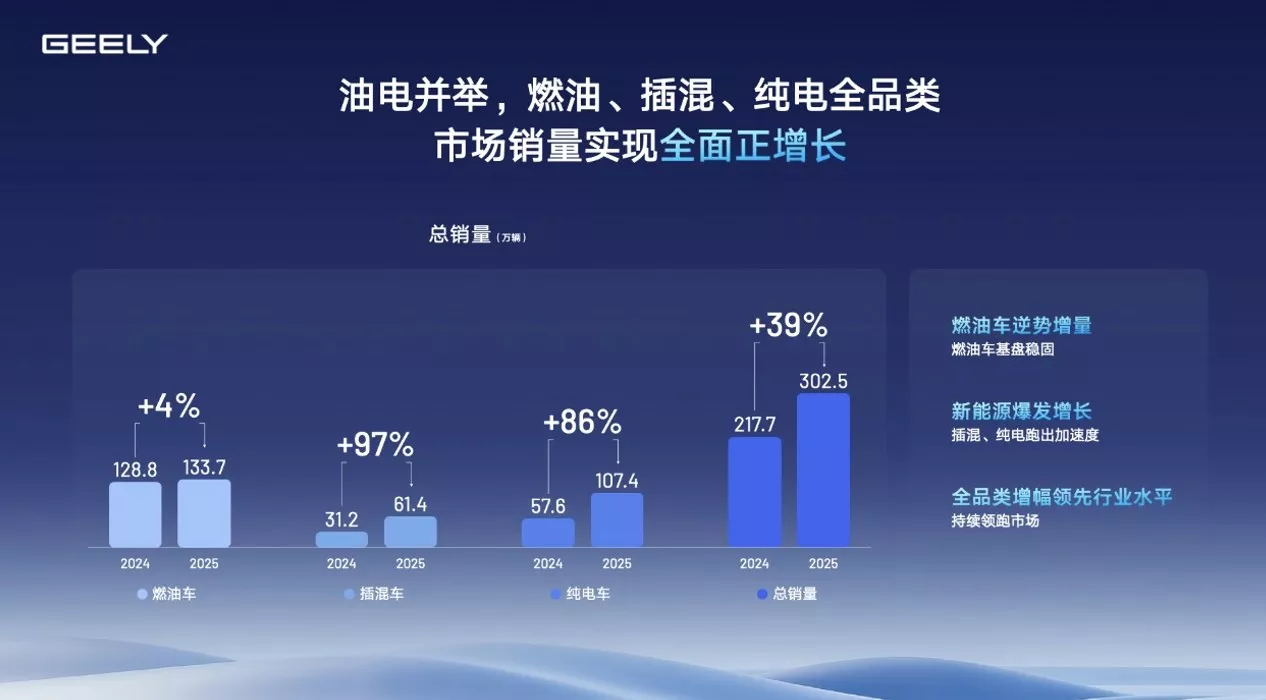
Core Insights - Geely Automobile Holdings Limited reported a record revenue of 345.23 billion yuan for 2025, marking a 25% year-on-year increase, while net profit attributable to shareholders was 16.85 billion yuan, remaining stable year-on-year [3][4] - The company achieved a total sales volume of 3.02 million vehicles, a 39% increase year-on-year, with new energy vehicles (NEVs) accounting for 56% of total sales, reflecting a significant growth of 90% in NEV sales [3][4] Financial Performance - The overall gross profit reached approximately 57.3 billion yuan, a 25% increase compared to the previous year, maintaining stability [5] - Cash reserves at the end of the year stood at 68.2 billion yuan, a 46% increase, providing a solid foundation for future business development [5] Sales and Market Performance - The Galaxy series sold around 1.24 million units, a substantial increase of about 150% year-on-year, contributing significantly to the growth in NEV sales [4] - Geely's export sales reached approximately 420,000 units, a notable increase, with a rising proportion of NEV models, indicating a growing presence in international markets [4][6] Research and Development - R&D expenses for the company reached 17.62 billion yuan, a 28.75% increase, focusing on advanced intelligent driving, automotive-grade chips, and solid-state batteries [7] - The company plans to launch its self-developed solid-state battery at the Beijing Auto Show in April, with expectations for electric vehicle ranges to exceed 1,000 kilometers [7] Strategic Positioning - Geely is adapting to a saturated domestic market by leveraging multi-brand strategies and expanding into overseas markets, entering over 80 countries and regions [6][7] - The company is enhancing its product competitiveness by increasing the self-sufficiency rate of key components, thereby reducing reliance on external supply chains [5][7]

吉利汽车(00175):2025年业绩符合预期,单车表现逐季提升
ZHONGTAI SECURITIES· 2026-03-19 12:44
Investment Rating - The investment rating for Geely Automobile is "Buy" (maintained) [2][8] Core Views - The company is expected to achieve a revenue of 345.2 billion yuan in 2025, with a year-on-year growth of 25.1% [5] - The core net profit for 2025 is projected to be 144.1 billion yuan, reflecting a year-on-year increase of 35.9% [5] - The company aims to sell 3.45 million vehicles in 2026, representing a year-on-year growth of 14% [5] Financial Performance Summary - Revenue Forecast: - 2024A: 240.2 billion yuan - 2025A: 345.2 billion yuan - 2026E: 482.3 billion yuan - 2027E: 551.0 billion yuan - 2028E: 615.5 billion yuan - Year-on-year growth rates: 34%, 44%, 40%, 14%, 12% [2] - Net Profit Forecast: - 2024A: 16.5 billion yuan - 2025A: 16.9 billion yuan - 2026E: 20.4 billion yuan - 2027E: 26.1 billion yuan - 2028E: 31.8 billion yuan - Year-on-year growth rates: 219%, 2%, 21%, 28%, 22% [2] - Earnings Per Share (EPS): - 2024A: 1.52 yuan - 2025A: 1.56 yuan - 2026E: 1.88 yuan - 2027E: 2.41 yuan - 2028E: 2.93 yuan [2] - Price-to-Earnings (P/E) Ratio: - 2024A: 10.6 - 2025A: 10.4 - 2026E: 8.6 - 2027E: 6.7 - 2028E: 5.5 [2] Market Position and Strategy - The company is focusing on high-end vehicle offerings and expanding its export capabilities, with a target of 640,000 units for exports in 2026, a year-on-year increase of 52.7% [5] - The introduction of new models, such as the Galaxy M7 and Zeekr 9X, is expected to drive sales and profitability [5] - The average selling price (ASP) of vehicles is steadily increasing, with the ASP for Q4 2025 reaching approximately 124,000 yuan [5]
直击吉利汽车2025年业绩会:规模效应遇上利润释放,吉利“下半场”怎么打?
Xin Lang Cai Jing· 2026-03-19 12:06
Core Viewpoint - Geely Auto has demonstrated strong financial performance in 2025, achieving significant revenue and profit growth amidst a competitive automotive market, marking its "high-quality development year" [1][6]. Financial Performance - Geely Auto reported a revenue of 345.2 billion yuan, a 25% increase year-on-year, and a core net profit of 14.41 billion yuan, up 36% year-on-year, indicating a robust financial position [1][6]. - The company exceeded its sales target with over 3.02 million vehicles sold, achieving an overall gross margin of 16.7% and a total gross profit of 57.3 billion yuan [1][6]. - Total cash levels rose to 68.2 billion yuan, a 46% increase year-on-year, with a low debt-to-asset ratio compared to industry standards [1][6]. Shareholder Returns - Geely's board proposed a 51.5% increase in dividends to 0.5 HKD per share, totaling 5.39 billion HKD, setting a new historical high for shareholder returns [2][6]. Strategic Integration - The company's strategic integration, guided by the "Taizhou Declaration," has led to clearer brand positioning and reduced operational costs through shared technology and joint procurement [2][7]. - Geely completed a significant stock swap between its U.S. and Hong Kong shares in just over 200 days, enhancing brand synergy among its various divisions [2][7]. Research and Development - Geely's R&D investment reached 21.8 billion yuan, an 8.3% increase, with improved efficiency due to shared AI technology across its brands, avoiding redundancy in development [3][8]. - The profitability of the Zeekr brand, which sold over 224,000 units, has positively impacted Geely's overall profit margins, with the average transaction price exceeding 530,000 yuan [3][8]. Technological Advancements - Geely aims to achieve a level of intelligent driving comparable to Tesla's Full Self-Driving (FSD) by 2026, having received EU certification for its advanced driving assistance system [4][9]. - The company is collaborating with Nvidia to define the next generation of smart mobility technology, enhancing its competitive edge in the market [4][9]. International Expansion - Geely's overseas sales reached 420,000 units in 2025, with a 240% increase in new energy vehicle exports, indicating a shift from trade-based to localized international operations [5][10]. - The company plans to prioritize resources for international business, targeting 640,000 units in 2026, with a focus on establishing significant markets in Europe, Eastern Europe, and ASEAN [5][10].
吉利汽车(00175):“一个吉利”驱动业绩新高,新能源、高端、全球化全面进击
智通财经网· 2026-03-19 10:37
Core Viewpoint - In 2025, Geely Auto successfully navigated a challenging market characterized by price wars by implementing the "One Geely" strategy, which focuses on resource integration, technology sharing, streamlined channels, and brand collaboration, demonstrating that profitability can be achieved without engaging in price competition [1][12]. Financial Performance - Geely Auto reported a total revenue of 345.2 billion RMB in 2025, marking a 25% year-on-year increase, with sales reaching 3.025 million units, a 39% increase, and a market share exceeding 10% for the first time [2][3]. - The core net profit attributable to shareholders was 14.41 billion RMB, reflecting a 36% increase, significantly outpacing revenue growth [2][3]. - The company proposed a final dividend of 0.5 HKD per share, a 52% increase compared to the previous year [2][3]. Sales and Product Structure - In 2025, sales of new energy vehicles reached 1.688 million units, a 90% increase, with a penetration rate exceeding 55%, becoming the main growth driver [4]. - Traditional fuel vehicle sales remained strong, with the Geely China Star fuel series selling 1.214 million units, maintaining the top position in sales for self-owned fuel vehicles for nine consecutive years [4]. Operational Efficiency - The "One Geely" strategy led to a significant reduction in administrative expenses, R&D investment ratio, and sales expenses by 17.1%, 13.5%, and 0.7% respectively, enhancing profitability without merely cutting costs [6][5]. - R&D investment totaled 21.8 billion RMB, an 8.3% increase, with shared technology across four brands improving efficiency [7]. Brand and Market Positioning - The average transaction price for the Zeekr brand exceeded 300,000 RMB, with flagship models achieving prices above 530,000 RMB, indicating a successful penetration into the high-value market segment [9]. - Geely's global sales reached 420,000 units in 2025, with significant performance in Europe and ASEAN markets, marking a transition to high-quality growth in international operations [10]. Future Outlook - For 2026, Geely Auto set a sales target of 3.45 million units, with an overseas sales goal of 640,000 units, supported by new product launches and enhanced global operations [11].
跨国车企,正拱手把电动车市场让给比亚迪们
Di Yi Cai Jing· 2026-03-19 09:47
Core Insights - Major multinational automakers have collectively announced a pause in their electrification transitions due to disappointing growth, resulting in nearly 500 billion yuan in losses for companies like Stellantis, Ford, General Motors, Honda, and Porsche by 2025 [2] - Despite the setbacks, the global automotive industry is moving towards electrification and smart technology, with the penetration rate of new energy vehicles expected to rise from 13% in 2022 to 23.5% by 2025 [2] - The automotive market is experiencing significant regional disparities, with China's new energy vehicle penetration expected to reach 45.5% by 2025, while the U.S. and Europe lag behind at 9.7% and 23.4%, respectively [3] Group 1: Market Dynamics - The U.S. market, despite being the third largest for new energy vehicles, has a low penetration rate due to weak policy support and limited infrastructure [3] - Changes in U.S. policy, such as rejoining the Paris Agreement, have influenced the strategies of major automakers like Honda and Ford, which primarily rely on the North American market [4] - The withdrawal of favorable policies under the Trump administration and the EU's abandonment of aggressive plans to ban gasoline and diesel cars have further complicated the situation for multinational automakers [4] Group 2: Competitive Landscape - By 2025, Honda's global electrification penetration is projected to be below 9%, while Ford's electric models have seen significant sales declines [4] - The imbalance between the pace of electric vehicle scaling and substantial R&D investments has led to increasing losses for multinational automakers, forcing them to revert to traditional combustion engine vehicles [4] - The market for hybrid electric vehicles (HEVs) remains strong, allowing traditional automakers to leverage their existing strengths in engine and transmission technology [4] Group 3: Future Challenges - The global penetration rate of new energy vehicles is projected to reach 23.6% by 2025, with significant growth in Europe and North America [5] - Multinational automakers face increasing competition from Chinese companies, which have advanced in battery technology and are expected to dominate the global market [5] - Chinese automakers have rapidly expanded their new energy vehicle offerings and are increasing exports, with projections showing a rise from 1.203 million units in 2023 to 2.615 million units by 2025 [6] Group 4: Strategic Responses - In response to competitive pressures, multinational automakers are seeking partnerships with Chinese companies to accelerate their electrification and smart technology initiatives [6] - Companies like Ford have acknowledged the competitive edge of Chinese manufacturers in terms of cost control and vehicle quality, indicating a potential shift in strategy [6] - The competitive landscape is shifting, with companies like BYD and Geely making significant strides in global sales rankings, highlighting the urgency for multinational automakers to adapt [7]



Malaysia vehicle sales fall 19% in February
Yahoo Finance· 2026-03-19 09:36
Market Overview - Malaysia's new vehicle market declined by over 19% to 52,414 units in February 2026 from 65,052 units in the same month last year, according to the Malaysian Automotive Association (MAA) [1] - The decline in February followed a 27% surge in January, attributed to fewer working days due to the timing of the Lunar New Year holidays [2] - In the first two months of 2026, the vehicle market increased slightly to 116,712 units, up from 115,501 units in the same period last year [2] Economic Context - Consumer sentiment has strengthened, reflected in a pickup in economic growth to 6.3% year-on-year in Q4 2025, up from 5.4% in Q3 2025, driven by stronger domestic consumption, investment, and exports [3] - The economy expanded by 5.2% in 2025, slightly up from 5.1% in 2024 [3] Vehicle Sales Performance - Light passenger vehicle sales rose by 1% to 109,117 units in the first two months of 2026 from 108,339 units a year earlier, while commercial vehicle sales increased by 6% to 7,595 units from 7,162 units [4] - Battery electric vehicle (BEV) sales surged by 154% to 9,870 units in this period from 3,850 units a year earlier, led by the Proton eMas 5 with 4,630 units [4] Production and Forecast - Vehicle production in Malaysia fell by 7% to 110,607 units in the first two months of the year, down from 119,540 units a year earlier [5] - The vehicle market is expected to rebound in March, but full-year sales are projected to weaken, with GlobalData forecasting a nearly 6% drop in light vehicle sales to 779,000 units in 2026 [5] Company-Specific Performance - Market leader Perodua's sales fell by 9% to 49,703 units in the first two months of 2026, despite launching the new Traz compact SUV and its first BEV model [6] - Proton reported a 58% increase in global vehicle sales to 33,399 units year-to-date, with the Saga being its best-selling model [6] - Toyota registrations rose by 13% to 13,591 units in the two-month period, aided by the introduction of new models [7]
吉利汽车2025年全年营收3452亿元
Cai Jing Wang· 2026-03-19 09:17
Core Insights - Geely Automobile Holdings Limited reported a record total revenue of 345.2 billion yuan for the year 2025, representing a 25% year-on-year increase [1] - The core net profit attributable to shareholders reached 14.41 billion yuan, up 36% year-on-year, after excluding foreign exchange and other non-core items [1] Financial Performance - Gross profit increased to 57.3 billion yuan, a 25% year-on-year rise [3] - Total cash level rose by 46% to 68.2 billion yuan by the end of 2025 [3] Sales Performance - Total sales volume for Geely reached 3.025 million units, a 39% increase year-on-year, exceeding annual targets [3] - New energy vehicle sales surpassed 1.68 million units, marking a 90% year-on-year growth [3] - In the first two months of 2026, Geely's sales reached 476,000 units [3] Strategic Developments - Geely deepened its "One Geely" strategy, integrating Zeekr and forming a brand layout covering mainstream, high-end, and luxury markets [3] - Zeekr brand sales exceeded 224,000 units, with December sales surpassing 30,000 units for the first time [3] - Lynk & Co. achieved annual sales of 350,000 units, a 23% increase, with Lynk 900 delivering over 50,000 units in six months [3] - Geely Galaxy brand saw a 150% year-on-year increase in sales, totaling 1.24 million units [3] Technological Advancements - Geely launched the industry's first comprehensive AI technology system, with a 2.0 version iteration planned for CES 2026 [3] - In the assisted driving sector, Geely's G-ASD technology is among the industry leaders, with L4 RoboTaxi 2.0 demonstration operations initiated in Hangzhou [4] - The new generation AI cockpit operating system, Flyme Auto 2, has been released, with 2.26 million units equipped with the previous version [4] International Expansion - Geely's overseas sales reached 420,000 units, with over 120,000 new energy vehicles exported [6] - The brand entered 13 new markets, including the UK and Italy, expanding its network to over 1,200 locations in 88 countries and regions by the end of 2025 [6] - Zeekr brand is now present in over 50 countries and regions, while Lynk & Co. operates over 860 stores globally, including more than 200 overseas [6] Future Outlook - Geely aims to launch multiple new models in 2026, with a sales target of 3.45 million units for the year [6]
【快讯】每日快讯(2026年3月19日)
乘联分会· 2026-03-19 08:38
Domestic News - Jiangsu plans to support over 300 typical application scenarios for urban models and intelligent agents by 2030, focusing on digital transformation of infrastructure and smart city applications [7] - In Shaanxi, the industrial added value above designated size grew by 4.1% year-on-year in the first two months of the year, with fixed asset investment increasing by 1.9% [8] - Shanghai has recognized 30 new regional headquarters of multinational companies and 15 foreign-funded R&D centers, primarily in key industries such as biomedicine and high-end equipment [9] - Chery Automobile's solid-state battery is expected to achieve a range of over 1500 km, with plans for vehicle validation by 2027 [10] - Zhiji released the IM Ultra Agent, the first super intelligent agent in the industry, which integrates advanced AI capabilities into vehicles [11] - Geely's CFO stated that the impact of rising upstream commodity prices is manageable, and the company aims to achieve autonomous driving capabilities comparable to Tesla's within the year [13] - Xiaomi's ultra-strong steel has won a national innovation award, with applications in new vehicle models [14] - Pony.ai and Ruqi Mobility have established a Robotaxi fleet, with over 100 vehicles delivered and operational in major cities [15] International News - Germany plans to double its general data center computing power by 2030, with AI-specific computing power expected to increase fourfold [16] - Japan's exports to the U.S. have declined for three consecutive months, with a notable drop in automotive exports [17] - Hyundai Motor Group has launched an autonomous taxi service in Las Vegas in partnership with Uber, utilizing the IONIQ 5 model [18] - Vietnam's fuel vehicle sales have significantly decreased, while hybrid vehicle sales have increased, indicating a shift in consumer preferences [19] Commercial Vehicles - Shenzhen has announced restrictions on diesel trucks starting April 6, 2026, to improve air quality [22] - Jiangling Motors has been awarded the title of National Excellent Intelligent Factory, recognizing its advancements in smart manufacturing [23] - Dongfeng and Cummins have signed a memorandum of cooperation to enhance their strategic partnership and focus on sustainable development in commercial vehicles [24] - Yuanmeng and Anbang have signed a strategic agreement to launch a methanol electric super VAN for security transport, emphasizing green and intelligent innovations [25]

跨国车企,正拱手把电动车市场让给比亚迪们|琳机一动
Di Yi Cai Jing Zi Xun· 2026-03-19 07:06
Core Insights - Major multinational automakers have collectively announced a pause in their electrification transitions due to disappointing growth, resulting in significant financial losses totaling nearly 500 billion yuan for companies like Stellantis, Ford, General Motors, Honda, and Porsche by 2025 [1] - Despite the setbacks, the shift towards electrification and smart technology remains an irreversible trend in the global automotive industry, with the penetration rate of new energy vehicles (NEVs) expected to rise from 13% in 2022 to 23.5% by 2025 [1] - The disparity in NEV penetration rates across regions is stark, with China projected to reach 45.5% by 2025, while the U.S. and Europe lag at 9.7% and 23.4%, respectively, highlighting the impact of regional policies [1] Group 1: Market Dynamics - The U.S. market, despite being the third-largest for NEVs, has a low penetration rate due to weak policy support, inadequate infrastructure, and limited model availability, with only 59 NEV models sold in 2020 compared to 300 in China and 180 in Europe [2] - Changes in U.S. policy, such as rejoining the Paris Agreement and subsequent incentives for NEVs, initially benefited automakers like Honda and Ford, but the reversal of these policies has hindered their strategic progress [2] - By 2025, Honda's global electrification penetration is expected to be below 9%, while Ford's F-150 Lightning and Mustang Mach-E have seen sales drop by over 70% and 50%, respectively, indicating significant challenges for these companies [2] Group 2: Industry Challenges - The imbalance between the pace of electrification and substantial R&D investments has led to increasing losses for multinational automakers, forcing them to revert to traditional combustion engine strategies [3] - The hybrid electric vehicle (HEV) market remains viable, with significant demand, and traditional automakers can leverage their strengths in engine and transmission technologies to adapt more cost-effectively [3] - However, the choice to delay full electrification poses risks, as competition intensifies, particularly from Chinese automakers, which are rapidly advancing in the NEV sector [3] Group 3: Competitive Landscape - Chinese companies have gained a competitive edge in key technologies for NEVs, with their market share in global power battery installations expected to rise from 60.4% to 70.4% between 2022 and 2025 [4][5] - The number of NEV sub-brands in China has exceeded 50, and exports of Chinese NEVs are projected to double from 1.203 million to 2.615 million between 2023 and 2025, showcasing their growing global presence [5] - As traditional automakers revert to established practices, Chinese firms are advancing in smart technology, creating a robust ecosystem for intelligent vehicles, further widening the gap with multinational competitors [5] Group 4: Strategic Collaborations - To accelerate their electrification and smart technology goals, many multinational automakers are forming partnerships with Chinese NEV companies, such as Volkswagen's $700 million investment in Xpeng and Stellantis's collaboration with Leap Motor [6] - Chinese automakers like BYD and Geely have made significant strides, with BYD ranking fifth in global vehicle sales and Geely also entering the top ten, indicating a shift in the competitive landscape [6] - The ongoing transformation in the global automotive market is reshaping competitive dynamics, with multinational companies facing a narrowing window to adapt to the rapid advancements in NEVs [6]