
景顺长城

Search documents
半年增长357亿,权益大厂的固收加法有什么魅力?
Xin Lang Ji Jin· 2025-08-11 09:32
Core Viewpoint - The continuous decline in interest rates has led to a surge in demand for low-risk investment options, with the stock market's performance presenting opportunities for enhanced yield flexibility, despite concerns over volatility due to tariffs and other events [1]. Group 1: Fund Performance and Growth - Public fund fixed-income products saw a significant growth of 200 billion, reaching a total scale of 1.9 trillion by mid-year [1]. - The traditional equity firm, Invesco Great Wall, experienced substantial growth in its fixed-income products, managing 93.5 billion with a half-year increase of 35.66 billion [1]. - As of August 1, seven of Invesco Great Wall's fixed-income products achieved a net value growth rate exceeding 10% over the past year, with 15 products surpassing 7% [1]. Group 2: Investment Strategy and Team Capability - Invesco Great Wall's success is attributed to its comprehensive research capabilities, allowing it to adapt to various market trends, including dividend styles and technology growth [2]. - Fund managers like Zou Lihua and team members have effectively captured investment opportunities in sectors such as non-ferrous metals and AI-related industries [2]. - The fixed-income products benefit from a solid foundation in bond investments and a diverse product line that caters to different risk appetites [3]. Group 3: Risk Management and Market Position - The focus on controlling product drawdowns is prioritized over upward elasticity for most target audiences, including institutions and individual investors [3]. - Invesco Great Wall's fixed-income products demonstrated favorable risk-return characteristics, with 14 products showing a net value growth rate between 5-10% and limited maximum drawdowns [3]. - The low-interest-rate environment and a thriving stock market provide a conducive backdrop for the performance of fixed-income products, emphasizing the importance of active management capabilities [3].
半年增长近357亿元,权益大厂的“固收加法”有什么魅力?
Zhong Guo Zheng Quan Bao· 2025-08-11 08:49
Group 1 - The core viewpoint is that the inclusion of rights in fixed-income products has become a favored choice for low-risk preference funds, with significant growth in public fund scale [1][2] - In the first half of the year, the scale of public fund fixed-income products increased by 200 billion, surpassing 1.9 trillion in total scale, with traditional equity firm Invesco Great Wall's fixed-income products managing 93.5 billion, growing by 35.66 billion in six months [1][2] - Performance is a key factor attracting funds, with seven products in Invesco Great Wall's fixed-income category achieving a net value growth rate exceeding 10% in the past year, and the Jingyifengli product achieving a 25.23% growth rate, ranking in the top 3% among similar funds [1][2] Group 2 - The strong performance elasticity is attributed to the comprehensive research capabilities of Invesco Great Wall, which has successfully navigated various market trends, including dividend styles and technology growth [2] - The investment team, including managers with expertise in various sectors, has effectively captured investment opportunities in industries such as non-ferrous metals and AI-related sectors, enhancing the performance of fixed-income products [2] - The solid foundation of bond investments and a comprehensive product line with varying volatility levels are crucial for the growth of Invesco Great Wall's fixed-income products [2][3] Group 3 - The risk-return characteristics of Invesco Great Wall's fixed-income products show that 14 products had a net value growth rate between 5% and 10%, with 11 products having a maximum drawdown not exceeding -4% [3] - The low-interest-rate environment and a continuously improving stock market provide a favorable backdrop for the performance of fixed-income products, emphasizing the importance of active management capabilities [3] - The investment research team at Invesco Great Wall will continue to refine its investment capabilities to offer a wider range of fixed-income products for different types of investors [3]
景顺长城国企价值混合A近一周上涨3.11%
Sou Hu Cai Jing· 2025-08-10 03:38
Group 1 - The core viewpoint of the article highlights the performance and holdings of the Invesco Great Wall State-Owned Enterprise Value Mixed A Fund, which has shown positive returns since its inception [1] - The fund's latest net value is 1.3466 yuan, with a weekly return of 3.11%, a three-month return of 11.11%, and a year-to-date return of 11.74% [1] - The fund was established on May 30, 2023, and as of June 30, 2025, it has a total scale of 295 million yuan [1] Group 2 - The top ten stock holdings of the fund include Zijin Mining, China Mobile, Shenhuo Holdings, Tencent Holdings, China National Offshore Oil Corporation, Chuan Yi Co., Ltd., Sinopharm Group, Zhuhai Smelter Group, Yun Aluminum, and CRRC Corporation, with a combined holding percentage of 52.32% [1]



一图看懂:主动优选基金经理,在2025年2季报里都说了啥?
银行螺丝钉· 2025-08-09 04:01
Core Viewpoint - The article provides an update on the second quarter reports of various fund managers, highlighting their investment styles, strategies, and market outlooks for 2025. Group 1: Fund Manager Perspectives - Fund managers present two main contents in their quarterly reports: a review of past investments and future market outlooks [3][9] - Different fund managers have varying attitudes towards market conditions, influenced by their investment styles [5][6] Group 2: Investment Styles - **Deep Value Style**: Focuses on low valuation metrics such as low P/E and P/B ratios, investing primarily in financials, real estate, and energy sectors. Returns are derived from both earnings growth and valuation recovery [8][9] - **Growth Value Style**: Emphasizes companies with strong profitability and cash flow, often holding stocks for the long term. This style is represented by well-known managers like Zhang Kun [14] - **Balanced Style**: Combines growth potential and valuation, seeking investments that are both good and cheap, often utilizing metrics like PEG [30][31] Group 3: Performance Insights - The performance of deep value funds has varied over the years, with notable periods of outperformance and underperformance [11] - Fund managers express concerns over market volatility and the impact of economic conditions on stock prices, indicating a cautious approach to investment [12][19] Group 4: Sector Allocations - Fund managers are adjusting their portfolios based on market conditions, with a focus on sectors like technology, healthcare, and consumer goods, while being cautious about sectors facing headwinds [17][20][22] - There is a notable interest in AI and innovative sectors, with many managers increasing their allocations to these areas in anticipation of future growth [37][59] Group 5: Economic Outlook - Fund managers maintain a generally optimistic view on the long-term growth potential of the Chinese economy, despite short-term challenges [19][60] - The expectation of a recovery in domestic demand and the potential for significant investment opportunities in emerging sectors are highlighted as key themes for the upcoming quarters [68][69]


业绩增长推动规模扩张 基金积极布局QDII业务
Shang Hai Zheng Quan Bao· 2025-08-08 18:55
Group 1 - The core viewpoint of the news is the increasing enthusiasm among fund companies to apply for QDII (Qualified Domestic Institutional Investor) business, driven by the strong performance of QDII products over the past three years [1][2] - As of August 1, 2023, Xinyin Fund has officially applied for QDII business qualifications, becoming the fourth fund company to do so this year, following Xinyuan Fund, Minsheng Jia Yin Fund, and Guolian An Fund [1] - The total scale of QDII funds reached approximately 680 billion yuan by the end of June 2023, more than double the scale at the end of 2022, indicating a significant growth trend [2] Group 2 - The average net value growth of QDII funds has shown a positive trend, with annual average net value increases of 6%, 12%, and 16% in recent years, highlighting a consistent upward trajectory [1][2] - The most profitable QDII fund this year is the Huatai-PB Hong Kong Advantage Selected Mixed Fund, which has achieved a net value increase of 144% [1] - QDII-ETF products have seen substantial inflows, with over 16 billion units net subscribed since July, contributing to a total scale of 364.5 billion yuan [2]
首批10只科创债ETF首发全部“一日售罄”
Mei Ri Shang Bao· 2025-08-08 07:15
Core Insights - The first batch of 10 Sci-Tech Innovation Bond ETFs launched on July 7, 2023, and all completed fundraising in just one day, marking them as "sunshine funds" [1] - The total fundraising target for each ETF was 3 billion yuan, resulting in a combined total of 30 billion yuan, or 300 billion yuan overall for the 10 ETFs [1] - The rapid growth of bond ETFs is evident, with the total scale reaching 389.937 billion yuan as of July 5, 2023, a significant increase of 124% from 173.973 billion yuan at the end of the previous year [1] Fundraising Details - Seven ETFs from companies such as E Fund, Huaxia, GF Fund, and others completed their fundraising on July 7, 2023, ahead of their originally scheduled end dates [1] - Other ETFs from companies like Jiashi, Invesco Great Wall, and Southern Fund also announced early closure of fundraising on the same day, indicating strong market demand [1] Market Impact - The establishment of these 10 Sci-Tech Innovation Bond ETFs is expected to push the total scale of bond ETFs beyond 400 billion yuan [1] - The rapid fundraising success reflects a growing interest and confidence in bond ETFs within the investment community [1]
第二批12只新模式浮动费率基金获批
Bei Jing Shang Bao· 2025-08-08 07:07
Core Viewpoint - The approval of the second batch of 12 new model floating rate funds marks a significant step towards high-quality development in the public fund industry, with a focus on aligning the interests of fund managers and investors through a performance-based fee structure [1]. Group 1: Fund Approval and Management - On July 24, 2023, the second batch of 12 new model floating rate funds was approved [1]. - The funds were submitted by 12 fund management companies including E Fund, Southern, Huatai-PineBridge, and others, and were accepted by the China Securities Regulatory Commission on July 4 [1]. - Morgan Asset Management highlighted that the approval of the Morgan Huiqi Growth Mixed Fund represents an important step in responding to the high-quality development of the public fund industry [1]. Group 2: Fee Structure and Investor Benefits - The new fee structure ties management fees to fund performance and the investor's holding period, aiming to enhance the shared interests and risk-sharing between fund managers and investors [1]. - This approach is expected to improve the investment experience for holders [1]. - Morgan Asset Management emphasized its commitment to the development of actively managed equity funds, recognizing that investment performance is fundamental to the public fund's success [1].
费率改革重塑公募基金:绩优人才「奔私」,产品「被动化」加速
3 6 Ke· 2025-08-08 02:57
Core Viewpoint - The public fund industry is facing challenges in retaining talented fund managers, leading to a trend of high-performing individuals transitioning to private equity and other asset management sectors due to stricter performance assessments and fee reforms [1][2][3] Group 1: Talent Exodus - In July, another well-known fund manager, Zhang Yifei, left Anxin Fund to join the private equity sector, marking the 197th fund manager departure this year, compared to 357 in the previous year [2][3] - The trend of high-performing fund managers moving to private equity indicates that the public fund industry's risk appetite and management flexibility are limiting their performance [3][4] - The recent wave of departures is influenced by the industry's fee reforms and performance assessment adjustments, which have made it difficult for fund managers to maintain their investment styles [4][6] Group 2: Fee Reform Impact - The fee reform has altered the previous high-salary model of the public fund industry, with performance-based pay becoming more stringent, leading to a more conservative approach in active fund management [2][6] - The new regulations require fund managers to have their compensation linked to performance, with significant reductions for those underperforming against benchmarks [6][9] - The shift towards performance-based compensation is expected to push fund managers to focus on stability and benchmark adherence, resulting in a loss of distinct investment styles among active funds [11][12] Group 3: Market Trends - The public fund market is experiencing a shift towards passive management, with significant outflows from active equity funds and increased inflows into bond and money market funds [7][8] - As of June, the total management scale of public funds reached 34.05 trillion yuan, while active equity fund scales declined to 3.41 trillion yuan, a drop of approximately 400 billion yuan from the previous quarter [7] - The trend indicates a potential concentration of funds towards leading institutions and a rise in passive products as the mainstay of the market [9][10] Group 4: Future Outlook - The ongoing fee reforms and the loss of top talent may lead to a public fund market dominated by passive products, similar to trends observed in the U.S. mutual fund industry post-2008 financial crisis [10][12] - The private equity sector is expected to benefit from the influx of experienced public fund managers, potentially leading to a more specialized and scientific approach within private equity [12]
基金早班车丨九成主动权益基金年内收益为正,逾千只净值刷新高
Sou Hu Cai Jing· 2025-08-08 00:49
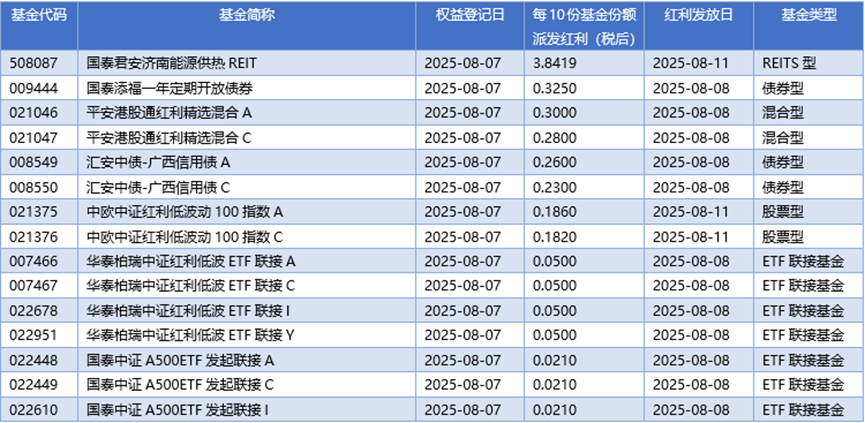
Market Overview - The A-share market has shown signs of recovery, leading to a strong rebound in actively managed equity funds, with over 90% of products seeing net value increases this year, and 1,126 funds reaching new highs since their inception [1][2] - As of August 7, the Shanghai Composite Index rose by 0.16% to 3,639.67 points, marking a new annual high, while the Shenzhen Component Index and the ChiNext Index experienced slight declines [1] Fund Performance - The year has seen significant performance divergence among actively managed equity funds, with top performers achieving returns close to 130%, while the worst performers faced declines exceeding 18% [2] - The leading sectors contributing to fund performance include innovative pharmaceuticals, hard technology, and new consumption, prompting many high-performing funds to limit purchases and new products to attract capital [2] Fund Issuance and Dividends - On August 7, 10 new funds were launched, primarily focusing on bond and equity types, with a notable fundraising target of 6 billion yuan for the CITIC Prudential Stable and Interest Rate Bond Fund [2] - A total of 15 funds declared dividends, with the highest payout being 3.8419 yuan per 10 shares from the Guotai Junan Jinan Energy Heating Closed Infrastructure Securities Investment Fund [2] Fund Registration Trends - The recovery in the A-share market has led to a surge in private securities product registrations, with 1,298 products registered in July alone, a month-on-month increase of 18%, marking a 27-month record [2] - Year-to-date, a total of 6,759 products have been registered, reflecting a year-on-year increase of 61.39%, with index-enhanced strategies seeing a 52% increase in registrations [2] Top Performing Funds - The best-performing fund on August 7 was the Qianhai Kaiyuan Hong Kong-Shenzhen Core Resource Mixed Fund C, with a daily growth rate of 5.2471%, followed closely by its counterpart A [4] - In the stock fund category, the top performer was the Huabao CSI Rare Metals Index Enhanced Fund A, with a daily growth rate of 2.3076% [5]
三年深套阴影难消,基金业绩回暖难阻“解套即赎”
Di Yi Cai Jing· 2025-08-07 12:50
Core Viewpoint - The recent recovery in the equity market has led to a significant rebound in the net value of actively managed equity funds, yet many investors are still opting to redeem their investments upon breakeven, indicating a lack of trust in fund managers despite improved performance [1][2][6]. Group 1: Fund Performance and Recovery - As of August 6, 2023, 99% of the 4,349 actively managed equity funds reported positive returns over the past year, with 40 funds achieving over 100% returns [2][3]. - Notable performers include the CITIC Securities North Exchange Select Fund, which recorded a 212.25% return, and several others exceeding 150% [2]. - The recovery trend is evident among previously underperforming funds, with over 70% of large-cap equity funds achieving returns exceeding 10% in the same period [2][3]. Group 2: Investor Behavior and Redemption Trends - Investor behavior has shown significant divergence, with some choosing to redeem their investments upon breakeven, while others wait for full recovery [5][6]. - A survey indicated that many investors are redeeming funds as they approach their cost basis, particularly when net values rise near 0.8 to 1.05 [6]. - Despite improved fund performance, actively managed equity funds experienced a net redemption of 1,076.04 million units in Q2 2023, a 56.43% increase from the previous quarter [6][7]. Group 3: Trust and Market Sentiment - The disparity between improved fund performance and investor redemption behavior suggests a lingering distrust rooted in past losses from 2022 to 2024 [7]. - Analysts emphasize that the "breakeven and redeem" behavior reflects a psychological response to historical losses rather than rational decision-making [7]. - To address the disconnect between performance and fund flows, it is crucial for fund managers to enhance their professional capabilities and for the industry ecosystem to improve [7].