
青岛银行

Search documents
25Q4基金对银行持仓点评:主动基金环比持平,被动基金增持
GUOTAI HAITONG SECURITIES· 2026-01-23 11:10
股票研究 /[Table_Date] 2026.01.23 票 研 究 主动基金环比持平,被动基金增持 [Table_Industry] 商业银行 | [姓名table_Authors] | 电话 | 邮箱 | 登记编号 | | --- | --- | --- | --- | | 马婷婷(分析师) | 021-23185608 | matingting@gtht.com | S0880525100001 | | 陈惠琴(分析师) | 021-38676666 | chenhuiqin@gtht.com | S0880525100003 | 本报告导读: 25Q4 主动基金对银行持仓比例环比持平于 1.9%,被动基金持仓比例环比+1.6pct 至 7.0%,其中宁波银行、兴业银行、中国银行、建设银行等获主动基金增配。 25Q4 基金对银行持仓点评 投资要点: [Table_Summary] 2025 年四季度基金重仓持股情况披露(主动基金包括普通股票型、 偏股混合型、灵活配置型,被动基金包括被动指数型、指数增强型): [Table_Report] 相关报告 商业银行《国有大行投放力度较大,不良压力或 企稳》20 ...





丈量地方性银行(1):江苏127家区域性银行全梳理-20260123
GF SECURITIES· 2026-01-23 11:08
Investment Rating - The industry investment rating is "Buy" [2] Core Insights - The report provides a comprehensive analysis of 127 regional banks in Jiangsu Province, highlighting their asset and liability structures, profitability, and asset quality [6][18] - Jiangsu's regional banks have shown a significant increase in asset growth, with major city commercial banks growing at 19.4%, surpassing the growth of listed city commercial banks at 14.2% [24][26] - The report indicates that the loan-to-asset ratio for city commercial banks is projected to reach 48.4% in 2024, reflecting a gradual increase in lending activities [30] - Jiangsu's regional banks exhibit better return on assets (ROA) compared to listed banks, with city commercial banks outperforming by 16 basis points and rural commercial banks by 9 basis points [6][42] - The asset quality of Jiangsu's regional banks is superior to that of listed banks, with lower non-performing loan ratios and higher provision coverage ratios [6][42] Summary by Sections 1. Economic Structure of Jiangsu Province - Jiangsu Province is focusing on new industrialization and strategic emerging industries, with significant contributions from cities like Nanjing and Suzhou [13][14] 2. Overview of 127 Regional Banks in Jiangsu - The report categorizes the banks into city commercial banks, rural commercial banks, and others, with a total of 127 banks established between 2006 and 2015 [18][20] 3. Asset/Liability Structure - The asset growth of major city commercial banks is accelerating, while rural commercial banks are experiencing a decline in growth rates [24][26] - The loan-to-asset ratio for city commercial banks is expected to increase to 48.4% by 2024, indicating a shift towards more lending [30] 4. Profitability - Jiangsu's regional banks have a higher ROA compared to listed banks, with city commercial banks showing a 16 basis point advantage [6][42] 5. Asset Quality/Capital Levels - Jiangsu's regional banks maintain a lower non-performing loan ratio compared to listed banks, with city commercial banks having a 30 basis point lower ratio [6][42]



城商行板块1月23日跌1.01%,上海银行领跌,主力资金净流入1.48亿元
Zheng Xing Xing Ye Ri Bao· 2026-01-23 09:04
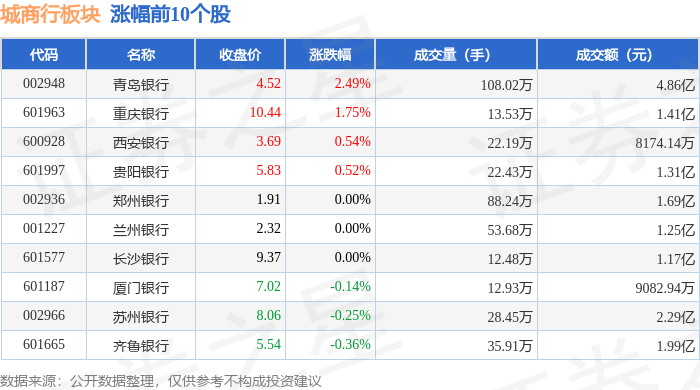
证券之星消息,1月23日城商行板块较上一交易日下跌1.01%,上海银行领跌。当日上证指数报收于 4136.16,上涨0.33%。深证成指报收于14439.66,上涨0.79%。城商行板块个股涨跌见下表: | 代码 | 名称 | 收盘价 | 涨跌幅 | 成交量(手) | 成交额(元) | | --- | --- | --- | --- | --- | --- | | 002948 | 青岛银行 | 4.52 | 2.49% | 108.02万 | 4.86亿 | | 601963 | 重庆银行 | 10.44 | 1.75% | 13.53万 | 1.41亿 | | 600928 | 西安银行 | 3.69 | 0.54% | 22.19万 | 8174.14万 | | 601997 | 豊阳银行 | 5.83 | 0.52% | 22.43万 | 1.31亿 | | 002936 | 郑州银行 | 1.91 | 0.00% | 88.24万 | 1.69亿 | | 001227 | 兰州银行 | 2.32 | 0.00% | 53.68万 | 1.25亿 | | 601577 | 长沙银行 | 9.37 | ...



机构开年密集调研中小银行:问息差、寻特色、探分化
Zheng Quan Ri Bao· 2026-01-22 16:10
本报记者 杨洁 今年以来,机构投资者密集调研上市中小银行。据《证券日报》记者梳理,截至目前,年内已有杭州银行、宁波银行、齐 鲁银行、青岛银行、青农商行、苏州银行、紫金银行等7家上市中小银行累计接待机构调研20次。 调研内容显示,信贷投放、资产质量、息差管理等话题备受关注。从各家银行答复来看,中小银行的战略路径正分化为两 大清晰主线:一是向内夯实以息差与资产质量为核心的经营基本盘,二是向外探索以区域禀赋与中间业务为突破的增长新动 能。 向内求"稳" 宁波银行方面表示,鉴于当前再融资的监管政策要求,内源性资本将为公司发展创造更大的价值。该行将一如既往地努力 提升业绩,保持内源性资本的稳健增长。 上海金融与法律研究院研究员杨海平对《证券日报》记者表示,机构投资者已不再满足于表面数据,而是深入探究银行在 战略执行、负债管理、风险抵御和资本内生等方面的真实能力。 "虽然规模增速仍重要,但业内共识已转向'盈利质量大于规模增速'。"薛洪言表示,这源于行业环境已变,单纯规模扩张 难以为继。 向外求"破" 筑牢高质量发展基石 当前,包括保险、基金、证券、信托等在内的机构投资者频频调研中小银行,在业内人士看来,其核心驱动因素在于 ...
城商行板块1月22日涨0.8%,青岛银行领涨,主力资金净流入3.96亿元
Zheng Xing Xing Ye Ri Bao· 2026-01-22 09:01
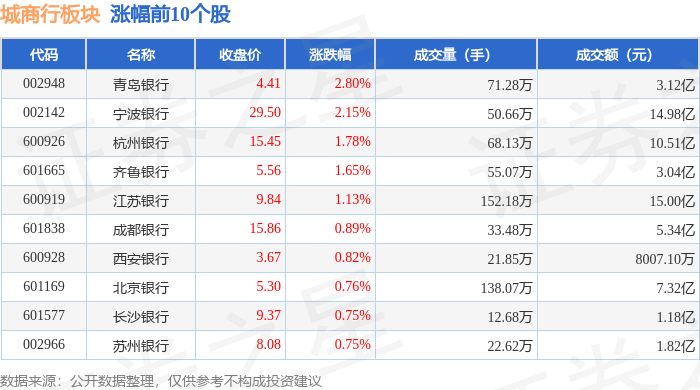
Group 1 - The city commercial bank sector increased by 0.8% on January 22, with Qingdao Bank leading the gains [1] - The Shanghai Composite Index closed at 4122.58, up 0.14%, while the Shenzhen Component Index closed at 14327.05, up 0.5% [1] - Key individual stock performances in the city commercial bank sector included Qingdao Bank at 4.41 with a rise of 2.80%, and Ningbo Bank at 29.50 with a rise of 2.15% [1] Group 2 - The city commercial bank sector saw a net inflow of 396 million yuan from main funds, while retail funds experienced a net outflow of 172 million yuan [2] - The trading volume for Qingdao Bank was 712,800 shares, with a transaction value of 312 million yuan [1][2] - The main fund inflow for Jiangsu Bank was 202 million yuan, representing 13.49% of its total trading volume [3]



银行回撤,大消费/互联网紧随其后;医疗和科技逆势小涨
Ge Long Hui· 2026-01-22 05:17
大消费冲高回落,截止午盘下跌0.23%。其中安踏体验下跌5.75%,李宁下跌4%,申洲国际/蜜雪集团/ 康方生物等股跌幅均在3%上方;同程旅行/阿里健康/药明联合等涨幅均在2%上方。 恒生科技开盘后只需拉升,随后维持在中轴上方盘整,截止午盘上涨0.13%。其中百度集团上涨 3.29%,中芯国际上涨3.15%,比亚迪股份/阿里巴巴等股涨幅均在1%上方;网易逆势下跌3.43%,小米 集团下跌2.31%。 内容只是个人观点,仅供参考,不作为投资依据!欢迎关注交流,互相学习、共同探讨! 冲高回落维持弱势,截止午盘,恒生指数小跌0.15%。银行跌幅居前,大消费/互联网等紧随其后;恒生 医疗和恒生科技等逆势小涨。 银行高开低走后一路回撤,截止午盘下跌0.29%。重庆农村商业银行下跌1.51%,大新集团下跌1.5%, 农业银行/光大银行/招商银行等股跌幅均在1%上方,青岛银行/招商银行/中国银行等股逆势小涨。 ...

数字人民币2.0:从M0到M1的质变
GF SECURITIES· 2026-01-22 05:07
Investment Rating - The report provides a "Buy" rating for all major banks analyzed, indicating a positive outlook for the banking sector [7]. Core Insights - The digital renminbi has entered its 2.0 era, transitioning from a central bank liability (M0) to a commercial bank liability (M1), allowing it to earn interest and be included in deposit insurance and reserve requirements [6][14]. - This transformation positions China as the first economy to offer interest on its central bank digital currency (CBDC), fundamentally altering its monetary attributes and creating a new financial paradigm in the digital economy [27]. - The digital renminbi's interest-bearing feature enhances user motivation to hold it, shifting its perception from a mere payment tool to a viable store of value, thus promoting its integration into everyday financial activities [27][28]. Summary by Sections 1. Digital Renminbi 2.0 Era - The digital renminbi (e-CNY) is now classified as a digital deposit currency, which can earn interest and is managed under a new regulatory framework [14]. - Major state-owned banks have begun offering interest on digital renminbi wallet balances, marking a significant shift in its utility and appeal [14][27]. 2. Development Progress and Application Status - The development of the digital renminbi began in 2014, with significant milestones including pilot tests in various cities and the establishment of a comprehensive operational framework by 2025 [32][33]. - As of November 2025, the digital renminbi has processed 34.8 billion transactions amounting to 16.7 trillion yuan, with extensive coverage across multiple provinces and cities [37]. 3. Global CBDC Development Trends - The report identifies three main trends in global CBDC development: active retail CBDC initiatives, innovation in payment systems, and cautious approaches in some countries like the U.S. [6]. - China's proactive stance in developing its CBDC positions it favorably in the global digital economy landscape, particularly in cross-border trade applications [30].

1月20日贷款财政贴息四项政策点评:“一揽子”贷款财政贴息政策影响几何?
EBSCN· 2026-01-21 11:17
Investment Rating - The report maintains a "Buy" rating for the banking industry, indicating an expected investment return exceeding the market benchmark index by more than 15% over the next 6-12 months [29] Core Insights - The "package" loan interest subsidy policies aim to stimulate consumption and investment, focusing on enhancing effective domestic demand through financial and fiscal collaboration [2][7] - The new policies are expected to significantly increase the scale of interest subsidies compared to previous measures, with a projected subsidy scale of approximately 1000 to 2000 billion yuan for 2026 [17][19] Summary by Sections Loan Subsidy Policies - The policies include four main areas: subsidies for small and micro enterprises, equipment updates, service industry operators, and personal consumption loans, with a focus on key industries such as new energy vehicles and medical equipment [4][6] - The subsidy rate for small and micro enterprise loans is set at 1.5 percentage points, with a maximum loan amount of 50 million yuan per entity, potentially providing up to 150,000 yuan in subsidies [4][6] - The equipment update loan subsidy has been increased from 1% to 1.5%, expanding the scope to include technology innovation loans and related fields [4][6] - The personal consumption loan subsidy has removed previous restrictions, allowing for broader eligibility and a maintained subsidy rate of 1% [5][6] Economic Impact - The policies are designed to alleviate financial burdens on small and micro enterprises, encouraging investment and job stability, particularly in high-tech and essential service sectors [7][8] - The expected increase in loan demand from these sectors is anticipated to support the overall credit recovery in the economy, particularly for retail and service industries [7][8] Market Outlook - The report suggests that the coordinated fiscal and monetary policies will positively impact the banking sector's loan volume and pricing, particularly benefiting banks focused on small and micro enterprises and retail finance [23] - The banking sector has seen a decline in stock performance, and the new policies are expected to act as a catalyst for recovery, especially in the context of the "opening red" period for banks [23]
城商行板块1月21日跌0.55%,重庆银行领跌,主力资金净流入5.08亿元
Zheng Xing Xing Ye Ri Bao· 2026-01-21 08:54
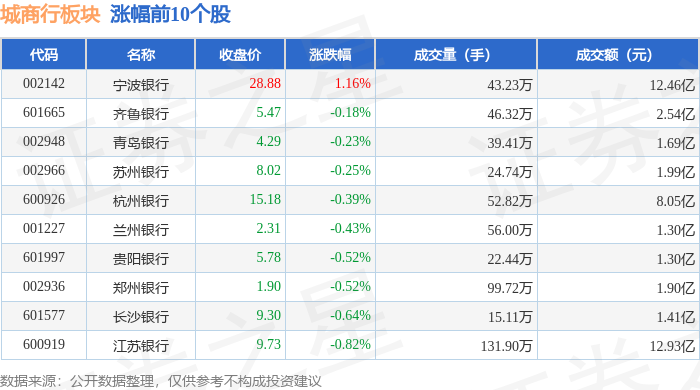
Market Overview - The city commercial bank sector experienced a decline of 0.55% on January 21, with Chongqing Bank leading the drop [1] - The Shanghai Composite Index closed at 4116.94, up 0.08%, while the Shenzhen Component Index closed at 14255.12, up 0.7% [1] Individual Stock Performance - Ningbo Bank closed at 28.88, with an increase of 1.16% and a trading volume of 432,300 shares, amounting to a transaction value of 1.246 billion [1] - Chongqing Bank closed at 10.25, down 1.82%, with a trading volume of 106,800 shares and a transaction value of 110 million [2] - Other notable performers include Xiamen Bank, which closed at 7.13, down 1.66%, and Chengdu Bank, which closed at 15.72, down 1.38% [2] Capital Flow Analysis - The city commercial bank sector saw a net inflow of 508 million from institutional investors, while retail investors experienced a net outflow of 566 million [2] - The capital flow for individual stocks indicates that Hangzhou Bank had a net inflow of 158 million from institutional investors, while it faced a net outflow of 86.5 million from retail investors [3] - Shanghai Bank also saw a net inflow of 107 million from institutional investors, with a net outflow of 121 million from retail investors [3]

A股银行年度盘点:2025告别普涨,2026拥抱分化
3 6 Ke· 2026-01-21 00:59
Core Insights - In 2025, A-share listed banks in China experienced a significant shift in development logic, moving from scale competition to value creation, focusing on core business and providing precise financial services to support high-quality economic development [1][2] Group 1: Market Performance - The A-share banking sector showed notable structural differentiation in 2025, with the Shanghai Composite Index and Shenzhen Component Index rising by 18.41% and 29.87% respectively, while the banking sector index increased by 12.04% [1] - By the end of 2025, the total market capitalization of A-share banks reached 14.65 trillion yuan, with 35 out of 42 listed banks seeing their stock prices rise, and 19 banks experiencing gains exceeding 10% [1] - In contrast to the broad market rally in 2024, where the banking sector index rose by 43.56%, 2025 marked a transition to a more selective investment environment [1] Group 2: Performance of Major Banks - Agricultural Bank of China led the sector with a stock price increase of 52.66% in 2025, while other major banks like Industrial Bank, China Construction Bank, and Bank of China saw increases of 21.54%, 12.87%, and 10.75% respectively [4] - The total market capitalization of the four major state-owned banks remains dominant, with Industrial Bank at 2.63 trillion yuan and Agricultural Bank at 2.61 trillion yuan [4] - The performance of other major banks was hindered by large capital increases, as several banks announced plans to raise a total of 520 billion yuan through stock issuance [4][5] Group 3: Performance of Joint-Stock Banks - Joint-stock banks exhibited further performance differentiation in 2025, with Shanghai Pudong Development Bank leading with a 24.56% increase, while banks like Huaxia Bank, Everbright Bank, and Minsheng Bank saw declines of 9.82%, 5.59%, and 3.09% respectively [6][7] - The decline in stock prices for these banks can be attributed to poor operating performance, with Huaxia Bank and Everbright Bank reporting revenue and profit declines [8] - Regulatory penalties also impacted these banks, with Huaxia Bank facing over 120 million yuan in fines, indicating ongoing compliance pressures [10][12] Group 4: Regional and Cooperative Banks - City and rural commercial banks showed mixed performance, with Xiamen Bank rising by 35.78%, while others like Zhengzhou Bank and Beijing Bank experienced declines [11] - Regulatory penalties for city commercial banks were significant, with Shanghai Bank and Beijing Bank facing fines exceeding 3.8 million yuan and 3.6 million yuan respectively [12] Group 5: Investment Outlook for 2026 - The investment logic for bank stocks is expected to evolve towards value reassessment, with a focus on performance growth and compliance levels becoming critical for individual stock performance [19] - The banking sector is anticipated to transition from a "growth weak cycle" to a "reform deep water zone," suggesting a dual strategy of holding stable, high-dividend large banks while selectively investing in high-potential regional banks [18][19] - The average price-to-book ratio for the banking sector was approximately 0.73, indicating a structural recovery, with Agricultural Bank exceeding 1.0, while others remained below this threshold [13]


