三生国健

Search documents
最高150亿元!复星、辉瑞 创新药大消息
Shang Hai Zheng Quan Bao· 2025-12-09 14:52
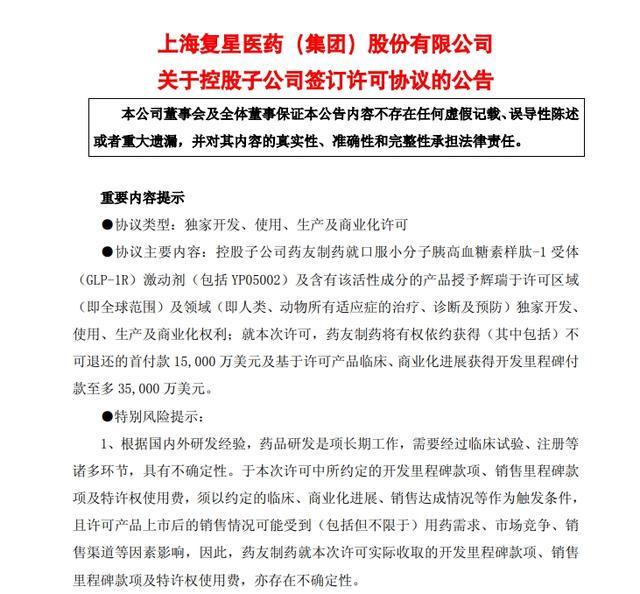
Core Viewpoint - Fosun Pharma has signed a licensing agreement with Pfizer for the exclusive global development, production, and commercialization rights of a small molecule GLP-1 receptor agonist (including YP05002) developed by its subsidiary, Yaoyou Pharmaceutical [1][5]. Group 1: Licensing Agreement Details - Yaoyou Pharmaceutical will conduct Phase I clinical trials of YP05002 in Australia and grant Pfizer exclusive rights for further global development and commercialization [1]. - Fosun Pharma will receive an upfront payment of $150 million and may earn up to $1.935 billion in milestone payments related to specific development, registration, and commercialization achievements, along with tiered royalties after product approval [1][2]. Group 2: Strategic Importance - This collaboration with Pfizer marks a significant milestone in Fosun Pharma's strategy for innovation and internationalization, aiming to address unmet clinical needs in metabolic diseases [5]. - The company has strengthened its global operational capabilities, focusing on innovation, licensing, production, and commercialization [5]. Group 3: Broader Industry Context - The licensing agreement is part of a larger trend where Chinese innovative pharmaceutical companies are increasingly engaging in international collaborations, with total licensing-out amounts exceeding $100 billion in 2025 [9]. - Other companies, such as Innovent Biologics and Hengrui Medicine, have also secured significant licensing agreements, indicating a robust growth trajectory for the Chinese pharmaceutical industry in global markets [9][11].

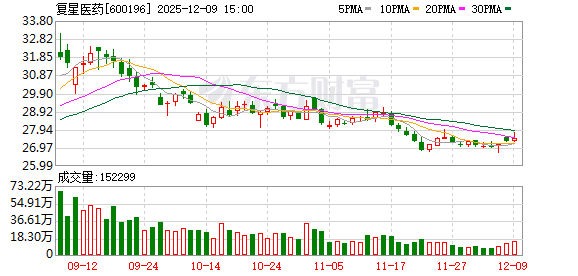
创新药又现大单,复星医药拿下10.6亿元里程碑付款!国际医药巨头辉瑞重磅押注,药品处于I期临床试验阶段
Jin Rong Jie· 2025-12-09 13:33
创新药又现大单,复星医药收获1.5亿美元里程碑付款! 12月9日晚间,复星医药公告称,公司控股子公司药友制药与辉瑞于2025年12月9日签订《许可协议》, 药友制药就口服小分子胰高血糖素样肽-1受体(GLP-1R)激动剂(包括YP05002)及含有该活性成分的 产品授予辉瑞于全球范围及领域独家开发、使用、生产及商业化权利。 在公告中,复星医药明确表示药友制药将有权获得不可退还的首付款1.5亿美元及至多3.5亿美元的开发 里程碑款项。此外,基于许可产品的年度净销售额达成情况,辉瑞将向药友制药支付至多15.85亿美元 的销售里程碑款项。该协议自2025年12月9日起生效。 值得注意的是,目前药友制药的小分子胰高血糖素样肽-1受体(GLP-1R)激动剂尚处于I期临床试验阶 段。无论最终该产品研发结果如何,复星医药都至少收获1.5亿美元(约合人民币10.6亿元)。至于此次重 磅押注,出钱的是国际医药巨头辉瑞。 公告显示,YP05002 为口服小分子胰高血糖素样肽-1受体(GLP-1R)激动剂;其主要通过激活人的GLP- 1R,促进胰腺的胰岛素分泌和降低胰高血糖素分泌,在胃肠道抑制胃排空和肠道的蠕动,并通过影响 中枢抑 ...

免疫疗法的下一波创新浪潮:全球技术趋势与行业展望
科尔尼管理咨询· 2025-12-09 03:59
Core Insights - The article discusses the trends in the development of autoimmune disease treatments, highlighting the significant growth in the global autoimmune drug market, which reached $156 billion in 2023 with a compound annual growth rate of 15% [1][2]. Group 1: Market Overview - The success of TNFα inhibitors and the emergence of IL inhibitors have marked a new era in treatment innovation [1]. - Leading products like Humira and Stelara are facing competition from biosimilars, while others like Dupixent and Skyrizi have set high efficacy standards in their respective indications [1][3]. - The market is expected to continue growing over the next three to five years, driven by the launch of JAK inhibitors and IL inhibitors across multiple disease areas [1][3]. Group 2: Competitive Landscape - Nine companies have six or more marketed products and pipeline drugs, indicating intense competition for leadership in the immunology field [3][4]. - The market is currently dominated by multi-indication blockbuster drugs, with significant ongoing clinical trials aimed at expanding indications for existing products [9][10]. Group 3: Innovation and Development Trends - Companies are increasingly focusing on new molecular entities (NMEs) and innovative treatment strategies, with 70% of pipelines dedicated to novel drug development [9][13]. - The emergence of Chinese pharmaceutical and biotech companies is notable, with firms like 3SBio and Jiangsu Hengrui actively researching innovative targets and NMEs [13][16]. - The industry is shifting towards more precise therapies, progressive innovations, and complex combination dynamics, with a focus on improving patient adherence and treatment convenience [18][23]. Group 4: Future Directions - The article emphasizes the importance of biomarker-driven patient stratification and the expansion of multi-indication models as foundational strategies in autoimmune drug development [21][22]. - The trend of "test and learn" is gaining traction, leading to increased trial activities in rare indications [21][23]. - The industry is also moving towards combination therapies and innovative drug delivery methods, such as oral formulations, to enhance patient convenience and treatment outcomes [24].


治脱发药企蔓迪国际递表港交所 销售开支攀升而研发费用收缩
Mei Ri Jing Ji Xin Wen· 2025-12-08 13:41
Core Viewpoint - The hair loss treatment market in China is rapidly growing, with over 339 million people affected, and a significant portion of this demographic being under 35 years old. The market is projected to reach a valuation of hundreds of billions [1]. Group 1: Company Overview - Mandi International, a subsidiary of 3SBio, has submitted an application for an IPO on the Hong Kong Stock Exchange, focusing on its minoxidil product line for hair loss treatment [1]. - The company was founded in 2001 and launched China's first 5% minoxidil solution, filling a gap in the market for effective hair loss treatments [2]. - Mandi's second-generation product, a 5% minoxidil foam, became a bestseller, selling over 2.5 million bottles in its first year and generating over 300 million yuan in revenue [2]. Group 2: Financial Performance - Mandi International's revenue grew from 982 million yuan in 2022 to 1.455 billion yuan in 2024, with a compound annual growth rate of 21.7%. Net profit increased from 202 million yuan to 390 million yuan during the same period [2]. - The gross profit margin remained above 80% over three years, reaching 82.7% in 2024, which is significantly higher than many pharmaceutical companies [2]. - Sales expenses rose from 476 million yuan in 2022 to 375 million yuan in the first half of 2025, exceeding 50% of revenue due to business expansion and marketing activities [3]. Group 3: Research and Development - R&D expenses increased significantly in 2024 to 92.2 million yuan but dropped to 19.5 million yuan in the first half of 2025, primarily due to the absence of certain costs incurred in the previous year [3]. Group 4: Leadership and Strategy - The company is led by Lou Jing, a second-generation pharmaceutical executive, who has a history of successful IPOs and acquisitions in the pharmaceutical sector [4][5]. - Mandi International is also expanding into the weight management market, with plans to submit a drug registration application for a semaglutide injection in 2026 [6]. - The company aims to use the funds from its IPO to enhance R&D capabilities, expand product offerings, and strengthen marketing and operational efficiency [7].

跨国巨头抄底中国创新药
2 1 Shi Ji Jing Ji Bao Dao· 2025-12-08 08:28
Core Insights - The global biopharmaceutical innovation landscape is undergoing a significant structural change, with China's innovative drug industry emerging as a key player on the global stage, transitioning from a "fast follower" to a "first mover" [2] - China's share in global clinical trials and licensing transactions has notably increased, with Chinese biotech companies' stock prices outperforming their U.S. counterparts over the past year, indicating a historic investment opportunity [2][3] - The trend of multinational corporations (MNCs) increasingly sourcing early-stage innovation pipelines from China is becoming more pronounced, driven by cost-effectiveness and superior outcomes [3] Group 1 - China's innovative drug companies can advance drug discovery from target identification to IND application 2-3 times faster than international peers, and patient recruitment in clinical development is 2-5 times quicker, with costs per patient being half of those in Europe and the U.S. [5] - The total amount of external licensing transactions for Chinese innovative drugs surpassed $100 billion in the first three quarters of 2025, highlighting the immense potential for value realization in the domestic market [5] - Significant collaborations, such as the $12.5 billion agreement between 3SBio and Pfizer, have sparked renewed interest in the capital market, leading to a 60.27% increase in the Hang Seng Innovation Drug Index in June [3][5] Group 2 - The current surge in business development (BD) activities is driven by MNCs recognizing the continuous improvement in China's innovation, research, and clinical capabilities, prompting large-scale acquisitions [6] - Investment institutions are focusing on the biopharmaceutical sector, where approximately 80% of market value is concentrated, leading to a clear investment path for capital [6][7] - The market is witnessing a shift towards more innovative collaboration models, such as the "Co-Co model" between Innovent Biologics and Takeda, with potential transaction values reaching $11.4 billion [5] Group 3 - The Chinese innovative drug sector is expected to thrive, with projections indicating a prosperous pharmaceutical industry by 2025, supported by favorable policies and recovering valuations [9] - The overall revenue of listed Chinese innovative drug companies reached 48.83 billion yuan in the first three quarters of 2025, marking a 22% year-on-year increase, with the sector achieving its first quarterly profit since its inception [9] - The Hong Kong market is experiencing a threefold increase in trading volume compared to last year, with both domestic and foreign funds actively investing in the Chinese market [9][10] Group 4 - The capital market is transitioning from a focus on narrative-driven investments to a preference for companies with solid fundamentals, emphasizing the importance of clinical data and asset quality [11][12] - The interaction between A-share and Hong Kong markets is tightening, with a trend of high-quality blue-chip assets seeking listings in Hong Kong, reflecting a more rigorous examination of companies' fundamentals [14][15] - Companies with strong fundamentals are more likely to succeed in the capital market, while those lacking solid foundations may struggle to capitalize on market opportunities [16][17]

跨国巨头抄底中国创新药
21世纪经济报道· 2025-12-08 08:17
Core Viewpoint - The global biopharmaceutical innovation landscape, traditionally dominated by multinational corporations (MNCs), is undergoing a significant structural change, with China's innovative drug industry emerging as a key player on the global stage [1][4]. Group 1: Market Dynamics - China's share in global clinical trials and licensing transactions has significantly increased, with Chinese biotech companies' stock prices outperforming their U.S. counterparts over the past year [1]. - The total market capitalization of Chinese listed biotech companies is still less than 15% of their U.S. peers, indicating a historical investment opportunity as international capital views this as a chance for growth [1]. - The collaboration between domestic companies and MNCs is intensifying, with a notable trend of MNCs increasingly sourcing early-stage innovation pipelines from China [2][4]. Group 2: Cost and Efficiency Advantages - Chinese innovative drug companies exhibit a unique dual advantage of speed and cost-effectiveness, advancing drug discovery phases 2-3 times faster than international counterparts and recruiting clinical trial patients at half the cost [6]. - The total amount of licensing transactions for Chinese innovative drugs is expected to exceed $100 billion in the first three quarters of 2025, reflecting the immense potential for value realization in the domestic market [6]. Group 3: Business Development (BD) Trends - The BD activity in the innovative drug market is thriving, with significant transactions such as the $12.5 billion upfront payment from Pfizer to 3SBio marking a record for domestic innovative drugs [4][10]. - The market is witnessing a shift towards more innovative collaboration models, such as the "Co-Co model" between Innovent Biologics and Takeda, which involves joint development and commercialization [6]. Group 4: Investment Sentiment and Market Outlook - The pharmaceutical industry is projected to experience robust growth by 2025, with the Hang Seng Index expected to double, driven by favorable policies and a rebound in industry valuations [10]. - The innovative drug sector has shown a 22% year-on-year revenue growth, with the sector achieving its first quarterly profit of 1.1 billion yuan in Q3 2025 [10]. - The market is characterized by a cautious optimism, with a significant increase in trading volume and participation from both domestic and foreign funds, indicating a healthy and sustainable market environment [10][11]. Group 5: Regulatory and Market Considerations - The interaction between A-share and Hong Kong markets is expected to tighten, with many quality blue-chip assets seeking to transition from A-shares to Hong Kong listings [15]. - The market has returned to a rational state, with investors focusing more on the fundamentals of companies rather than speculative narratives, emphasizing the importance of a clear commercialization path and sustainable profitability for successful listings [15][18].

摩根大通解密BD潮:巨头“抄底”中国创新药,下一个爆款在哪?
2 1 Shi Ji Jing Ji Bao Dao· 2025-12-08 04:50
Core Insights - The global biopharmaceutical innovation landscape, traditionally dominated by multinational corporations (MNCs), is undergoing significant structural changes, with China's innovative drug industry emerging as a key player on the global stage [1] - China's transition from a "fast follower" to a "first mover" in innovative drugs is becoming an irreversible trend, as highlighted by The Economist, indicating that Chinese innovation drugs are at a "critical point" of globalization [1] - Data shows that China's share in global clinical trials and licensing transactions is rising significantly, with Chinese biotech companies' stock prices outperforming their U.S. counterparts over the past year [1][2] - The total market capitalization of Chinese listed biotech companies is still less than 15% of their U.S. peers, presenting a "historic investment opportunity" as perceived by international capital [1] Group 1 - The cost-effectiveness and speed advantages of Chinese innovative drug companies are notable, with drug discovery phases being 2-3 times faster and patient recruitment in clinical trials being 2-5 times quicker than international counterparts [4] - The total amount of licensing transactions for Chinese innovative drugs is expected to exceed $100 billion by 2025, with significant deals already occurring, such as the $12.5 billion upfront payment from Pfizer to 3SBio [4][2] - The surge in business development (BD) activities reflects a growing interest from MNCs in China's innovative drug capabilities, particularly in advanced fields like T-cell engagers and CAR-T therapies [2][5] Group 2 - The market is witnessing a "BD frenzy," with MNCs actively engaging in acquisitions, driven by the recognition of China's improving innovation, research, and clinical capabilities [5][6] - The anticipated growth in the pharmaceutical industry is expected to lead to a significant increase in the Hang Seng Index, with projections indicating a potential doubling by 2025 [8] - The overall revenue of Chinese innovative drug companies reached 48.83 billion yuan in the first three quarters of 2025, marking a 22% year-on-year increase, with the sector achieving its first quarterly profit since inception [8] Group 3 - The shift in capital market dynamics is evident, with investors now focusing more on the "hard power" of companies rather than just their narrative or story [10][9] - The trend of companies transitioning from A-share to Hong Kong markets is gaining momentum, with a growing number of firms seeking to list in Hong Kong, reflecting a tightening scrutiny of fundamentals by investors [11][14] - The current market environment is characterized by a rational return, where investors prioritize solid fundamentals over speculative narratives, indicating a more cautious approach to investment [12][13]
摩根大通解密BD潮:巨头"抄底"中国创新药,下一个爆款在哪?
2 1 Shi Ji Jing Ji Bao Dao· 2025-12-08 04:49
Core Insights - The global biopharmaceutical innovation landscape, traditionally dominated by multinational corporations, is undergoing significant structural changes, with China's innovative drug industry emerging as a key player on the global stage [1] - China's transition from a "fast follower" to an "originator" in innovative drugs is becoming an irreversible trend, as highlighted by international media [1] - Data shows a notable increase in China's share of global clinical trials and licensing transactions, with Chinese biotech companies outperforming their U.S. counterparts in stock price growth over the past year [1][3] Group 1: Market Dynamics - Multinational corporations are increasingly inclined to source early-stage innovative pipelines from China due to cost-effectiveness, with costs in China being 30%-40% lower than in the U.S. [2] - The collaboration between domestic companies and multinationals is exemplified by the $12.5 billion upfront payment from Pfizer to 3SBio for overseas rights to a bispecific antibody, marking a record for domestic innovative drugs [2][3] - The Chinese innovative drug sector is expected to see a surge in licensing transactions, with projections indicating that total licensing amounts could exceed $100 billion in the first three quarters of 2025 [3] Group 2: Investment Trends - The biopharmaceutical sector is experiencing a business development (BD) boom, with significant transactions such as the $12 billion collaboration between Hengrui Medicine and GSK, indicating strong interest from multinational companies [3][4] - Investment institutions are focusing on the biopharmaceutical sector, with approximately 80% of the market value concentrated in biotechnology and pharmaceuticals, driving capital flow into these areas [5] - The market is witnessing a shift from "story-driven" investment decisions to a focus on the hard capabilities of companies, emphasizing the importance of clinical data and product quality [9][10] Group 3: Future Outlook - The innovative drug market is expected to thrive, with projections indicating that the Hang Seng Index could double by 2025, driven by favorable policies and a rebound in industry valuations [7] - The Chinese innovative drug sector is anticipated to recover strongly in 2025, with the overall revenue of listed companies in this sector reaching 48.83 billion yuan, a 22% year-on-year increase [7] - The market is seeing a resurgence in IPO activity, with over 20 companies currently queued for listing in Hong Kong, reflecting renewed investor interest in the biopharmaceutical sector [12][13]




摩根大通解密BD潮:巨头“抄底”中国创新药 下一个爆款在哪?
2 1 Shi Ji Jing Ji Bao Dao· 2025-12-08 04:48
Core Insights - The global biopharmaceutical innovation landscape, traditionally dominated by multinational corporations (MNCs), is undergoing significant structural changes, with China's innovative drug industry emerging as a key player on the global stage [1][3] - China's transition from a "fast follower" to a "first mover" in innovative drugs is becoming an irreversible trend, as highlighted by international media [1] - Data shows that China's share in global clinical trials and licensing transactions is increasing, with Chinese biotech companies outperforming their U.S. counterparts in stock price growth over the past year [1][2] Group 1: Market Dynamics - The cost-effectiveness and speed of Chinese innovative drug companies are becoming critical factors for MNCs to source R&D pipelines from China, with costs being 30%-40% lower than in the U.S. [2] - The year 2025 is projected to be a breakout year for China's innovative drug licensing transactions, with total amounts surpassing $100 billion in the first three quarters [4][8] - Notable collaborations include a $12.5 billion upfront payment from Pfizer to 3SBio for overseas rights to a bispecific antibody, which significantly boosted market enthusiasm [2][4] Group 2: Investment Trends - MNCs are actively engaging in acquisitions during industry downturns, recognizing the continuous improvement in China's innovation, R&D, and clinical capabilities [5] - The capital market is witnessing a shift from "story-driven" investments to a focus on the "hard strengths" of companies, emphasizing clinical data and product quality [10][11] - The interaction between A-share and Hong Kong markets is tightening, with many quality companies seeking to list in Hong Kong, reflecting a more rigorous examination of fundamentals by investors [11][12] Group 3: Future Outlook - The biopharmaceutical sector is expected to thrive, with projections indicating that the Hang Seng Index could double by 2025 due to favorable policies and recovering valuations [8] - The market is experiencing a healthy adjustment, with the innovative drug sector reporting a 22% year-on-year revenue increase, marking its first quarterly profit since inception [8][9] - The trend of companies transitioning from "fast followers" to "first movers" is gaining momentum, with 5%-10% of innovations now being true first-in-class [11]
苹果现高管离职潮;百度澄清昆仑芯上市消息丨科技风向标
2 1 Shi Ji Jing Ji Bao Dao· 2025-12-08 02:30
Group 1: SpaceX and Apple Developments - Elon Musk responded to the inaccurate valuation report of SpaceX at $800 billion, emphasizing that the company's valuation is tied to the progress of Starship and Starlink, and that NASA's contribution to revenue will be less than 5% next year [2] - Apple is experiencing significant management turnover, with four executives leaving in the past week and a push for increased recruitment and retention efforts amid concerns about CEO Tim Cook's health [2] Group 2: Technology and Product Updates - Tencent announced the release of its latest language models, Tencent HY2.0Think and Tencent HY2.0Instruct, featuring a total of 406 billion parameters and significant improvements over the previous version [5] - Nvidia released its largest update to the CUDA Toolkit in 20 years, introducing new programming models and resources for developers [10] Group 3: Market Movements and Acquisitions - PC manufacturers including Lenovo, Dell, and HP plan to raise prices by up to 20% due to rising storage costs, with Lenovo notifying customers of significant price increases effective January 1, 2026 [6] - Netflix announced a deal to acquire Warner Bros. for approximately $82.7 billion, with the transaction expected to close in Q3 2026 [8] - Guangqi Technology's subsidiary signed contracts worth 696 million yuan for the production of metamaterials, expected to impact the company's performance in 2026 [9] Group 4: Corporate Actions and Changes - Baidu clarified that it is evaluating the potential spin-off and independent listing of its subsidiary Kunlun Chip, which requires regulatory approval [14] - Jiahua Technology plans to acquire 90% of Shudun Technology through a combination of stock issuance and cash payment, aiming to enhance data security capabilities [15] - DiAo Microelectronics announced the termination of its plan to acquire 100% of Rongpai Semiconductor, following board approval [16]