
平安人寿

Search documents
险资,再举牌!
Shang Hai Zheng Quan Bao· 2025-08-08 09:13
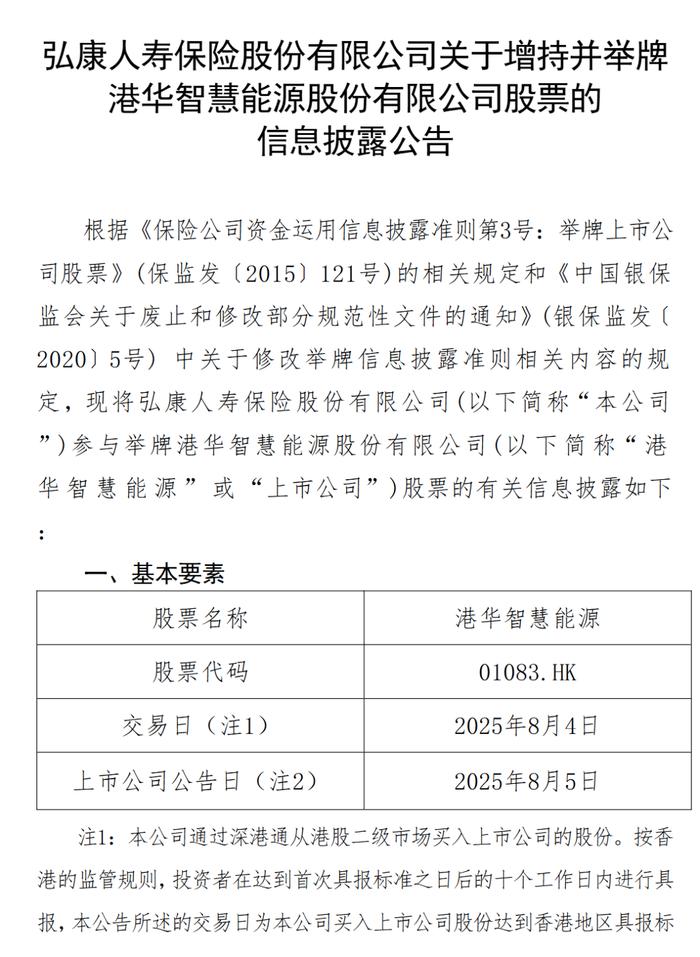
Core Viewpoint - The insurance company Hongkang Life has triggered a stake acquisition in Honghua Smart Energy by purchasing 458,000 shares, representing approximately 5.00005% of the company's H-shares, marking the first announcement of such an acquisition in 2024 [1][5]. Group 1: Insurance Capital Movements - Since the beginning of 2025, a total of 11 insurance institutions have made stake acquisitions in listed companies, surpassing the 8 institutions from the entire year of 2024 [6]. - The participating insurance institutions include Ping An Life, China Life, Taikang Life, Xinhua Life, and Lianan Life, with a total of 22 stake acquisitions recorded in 2025 after excluding related party acquisitions of the same company [6]. - The main sectors targeted by these stake acquisitions include banking, infrastructure, new energy, electricity, and pharmaceuticals [6]. Group 2: Reasons for Stake Acquisitions - The ongoing trend of stake acquisitions by insurance capital is expected to continue due to two main reasons: the pressure of "asset scarcity" from declining market interest rates, necessitating a focus on equity asset allocation for favorable investment returns [6]. - Additionally, from an accounting perspective, including stake acquisition targets in FVOCI (Fair Value Through Other Comprehensive Income) asset measurement helps mitigate the impact of stock price fluctuations on profits [6][7]. Group 3: Characteristics of Acquired Stocks - Most of the stake acquisition targets by insurance capital exhibit high dividend characteristics, with a focus on FVOCI stocks and long-term equity investments [7]. - FVOCI stocks primarily contribute dividend income to investment returns, while long-term equity investments consider multiple factors such as ROE, dividend ratio, and dividend yield [7]. - The shift in accounting standards and the strengthening of state-owned enterprise market value assessments may lead insurance capital to replicate the "insurance capital + undervalued state-owned enterprise" strategic synergy model [7].

年内险企发债金额超360亿元
Jin Rong Shi Bao· 2025-08-08 07:27
Core Insights - The speed of capital replenishment among insurance companies has significantly increased recently, with major issuances of perpetual bonds [1][2] - The total issuance of perpetual bonds by insurance companies this year has reached 457 billion yuan, surpassing the total of 359 billion yuan for the entire previous year [2] Group 1: Recent Issuances - Taiping Life successfully issued 9 billion yuan of perpetual bonds with a coupon rate of 2.40% [1] - Eight insurance companies, including Taiping Life, Ping An Life, and Taikang Life, have issued capital replenishment bonds and perpetual bonds totaling 36.6 billion yuan [1] - Among these, five companies issued perpetual bonds, amounting to a total of 32.7 billion yuan [1] Group 2: Market Trends - The issuance of perpetual bonds has been driven by higher capital adequacy requirements under the second phase of the solvency regime, prompting companies to replenish capital [2] - Current market interest rates are relatively low, allowing insurance companies to finance at a lower cost [2] - The coupon rates for perpetual bonds issued in 2023 range from 2.20% to 2.48%, while those for 2024 are between 2.20% and 2.50% [2]
新华保险拟出资不超过150亿元 认购私募证券基金
Zhong Guo Zheng Quan Bao· 2025-08-08 07:25
Core Viewpoint - The insurance giant Xinhua Insurance plans to invest up to 15 billion yuan in a private equity fund initiated by Guofeng Xinghua, responding to national policies promoting long-term capital market investments [1][2]. Group 1: Fund Details - The private equity fund, tentatively named Guofeng Xinghua Honghu Zhi Yuan Phase III, has a total size of 22.5 billion yuan, with Xinhua Insurance and China Life each committing 11.25 billion yuan [2]. - The fund's investment focus will be on large listed companies that are part of the CSI A500 index, specifically A+H shares that meet certain criteria [2][3]. - The fund aims to adopt a long-term investment strategy, emphasizing low-frequency trading and stable dividend income [2]. Group 2: Industry Trends - Multiple insurance companies are increasingly participating in long-term investment trials, with Xinhua Insurance and China Life being among the first institutions to engage in these initiatives [3]. - The total approved amount for the third batch of long-term investment trials is 40 billion yuan, with various insurance firms, including smaller ones, also participating [3]. - The acceleration of insurance capital entering the market is expected to enhance the supply structure of capital in the market, providing long-term incremental funds [4][5]. Group 3: Regulatory and Financial Implications - The trial funds primarily target the secondary stock market for long-term holding, which is beneficial for expanding "patient capital" in the capital market [4]. - The trial framework may help insurance companies mitigate the impact of equity market fluctuations on their profit statements and improve capital adequacy [5]. - The long-term stock investment trials are anticipated to increase the allocation of equity assets, addressing the mismatch between asset and liability durations for life insurance policies [5].

上半年6家保险公司获批增资
Jin Rong Shi Bao· 2025-08-08 07:24
Group 1 - The core viewpoint of the articles highlights the increasing capital needs of insurance companies in China, driven by stricter regulatory requirements and the need to support business growth [1][2][3] - As of June 20, 2023, the Beijing Regulatory Bureau approved capital increases for Zhongyou Life and China United Life, with Zhongyou Life's capital rising from 28.663 billion to 32.643 billion yuan and China United Life's from 2.9 billion to 4.1 billion yuan [1] - In 2023, insurance companies have collectively raised 69.213 billion yuan through capital increases and bond issuance, marking a 95% year-on-year increase [1] Group 2 - At least six insurance companies have been approved for capital increases this year, totaling 8.853 billion yuan, including Ping An Life and Guolian Life [1] - Twelve insurance companies have issued capital supplement bonds or perpetual bonds, with a total issuance scale of 60.36 billion yuan [1] - The second phase of the solvency regulatory framework has led to a decline in solvency adequacy ratios for many insurance companies, necessitating external capital supplementation through shareholder investments and bond issuance [2] Group 3 - New capital supplementation methods are emerging, allowing insurance companies to diversify their capital-raising strategies and enhance flexibility [3] - Regulatory adjustments, such as extending the transition period for solvency regulations and reducing risk factors for stock investments, aim to optimize capital structures for insurance companies [3] - Insurance companies, especially smaller ones, are encouraged to leverage regulatory transition policies and seek external funding while adjusting their business structures to reduce capital consumption [3]

险资年内合计举牌20次 已达去年全年水平
Zheng Quan Ri Bao· 2025-08-08 07:24
从今年举牌上市公司的险企来看,既有大型险企,也有中小险企。从举牌标的来看,高股息标的和H股 上市公司占比较高。天职国际会计师事务所保险咨询主管合伙人周瑾认为,这主要是因为这些标的与保 险资金期限长、投资风格稳健等特性高度契合,同时,H股的估值较A股呈现出一定折价,增值空间更 大,且通过港股通投资还有一定的税收优惠,因此是险资权益配置的重点。 周瑾表示,随着新会计准则即将全面实施,更多险企希望通过举牌来实现权益法核算,以减少当期损益 的波动性,这一因素也将推动险企增加举牌行为。同时,当前股票市场的估值较低,未来或有较大的升 值空间,险企需把握低估值机会增配权益资产。 具体来看,港交所披露易信息显示,弘康人寿于6月27日以每股1.2068港元增持郑州银行H股1600万股, 增持后持股比例占其H股的5.55%,根据香港市场规则,触发举牌。随后,弘康人寿于下一个交易日(6 月30日)继续增持郑州银行H股2300万股,每股价格1.1804港元。至此,弘康人寿持有郑州银行H股数 量达到1.35亿股,持股比例上升至6.68%。 《证券日报》记者根据公开信息统计,今年截至目前已有10家保险机构对16家上市公司进行举牌,举牌 ...
鸿鹄基金最新重仓股曝光 险资“长钱”加码高股息资产
Zhong Guo Zheng Quan Bao· 2025-08-08 07:19
作为首批保险资金长期股票投资试点,鸿鹄志远(上海)私募投资基金有限公司的动态备受关注。 随着A股上市公司2025年一季报陆续披露,鸿鹄基金的最新持股情况浮出水面。Wind数据显示,截至一 季度末,鸿鹄基金重仓持有中国电信、伊利股份、陕西煤业三只个股,合计持股市值超125亿元。在鸿 鹄基金一期500亿元投资落地之后,鸿鹄基金二期获批200亿元,其投资方向为中证A500指数成分股中 符合条件的大型上市公司A股、H股。 中国证券报记者调研了解到,第二批获批保险资金长期股票投资试点的机构正加快推进相关工作落 地。国家金融监督管理总局局长李云泽5月7日在国新办新闻发布会上表示,近期拟再批复600亿元,进 一步扩大保险资金长期股票投资试点范围。以此来计算,已批复和拟批复的保险资金长期股票投资试点 规模达到2220亿元。 鸿鹄基金三大重仓股 Wind数据显示,2025年一季度末,鸿鹄基金重仓持有中国电信、伊利股份、陕西煤业三只个股, 合计持股数量超10亿股,合计持股市值超125亿元。 具体来看,一季度末,鸿鹄基金分别持有中国电信、伊利股份、陕西煤业7.62亿股、1.53亿股、 1.16亿股,持股市值分别为59.80亿元、4 ...



解码险资“囤楼”经济学: 收租型物业成抗周期利器
Zhong Guo Zheng Quan Bao· 2025-08-08 07:05
Core Viewpoint - The recent acquisition of the Yumi Community in Shanghai by AIA Insurance highlights the growing interest of insurance capital in real estate investments amid declining interest rates and a scarcity of quality assets [1][2]. Investment Trends - As of July 22, 2023, four insurance companies have disclosed 13 real estate investments totaling nearly 5 billion yuan, showing a significant increase compared to the same period last year [1][2]. - Insurance companies are increasingly focusing on rental-type properties such as shopping centers, office buildings, and long-term rental apartments to secure stable rental income [1][2]. - The need for insurance capital to alleviate the pressure of asset returns not covering liability costs is driving the shift towards real estate investments [1][3]. Investment Strategies - The investment approach of insurance capital has diversified from heavily investing in real estate stocks to various methods including equity direct investment, private fund establishment, and public REITs [4][5]. - Quality real estate can provide stable cash flow and long-term appreciation potential, making it an attractive option for insurance capital seeking to optimize asset-liability matching [5][6]. Research and Development Needs - The current allocation of insurance capital to real estate is relatively low, indicating potential for growth as the policy environment improves [6]. - Investment in real estate requires enhanced research and development capabilities, as it involves complex factors such as market conditions, financial management, operations, and legal compliance [6][7]. - The limited market size and liquidity of public REITs pose challenges for large-scale insurance capital participation, necessitating adjustments to risk factors to encourage investment [6][7]. Exit Strategies - The ability to exit real estate investments is a significant consideration for insurance capital, with public REITs and bulk transactions being the primary exit channels [7]. - Recommendations include easing the entry barriers for public REITs and accelerating the development of asset securitization products to enhance exit opportunities [7].
今年险资已举牌21次上市公司 超去年全年
Jin Rong Shi Bao· 2025-08-08 07:04
Group 1 - The insurance capital market is experiencing a wave of shareholding activities, with 21 instances of insurance companies taking stakes in listed companies this year, surpassing the total of 20 for the entire year of 2024 [1][2] - Major insurance companies involved in this trend include China Post Insurance, Taikang Life, and several others, indicating a strong interest in equity investments [1][2] - The surge in shareholding activities is attributed to adjustments in asset allocation strategies by insurance companies, driven by supportive policies for long-term capital market investments [1][2] Group 2 - The companies targeted for shareholding include major banks and firms across various sectors, with bank stocks being the most frequently targeted [2] - Ping An Life has notably made 7 investments in bank stocks this year, indicating a focused strategy on this sector [2] - The regulatory environment has been favorable, with policies encouraging insurance funds to increase their equity investments, leading to a significant rise in the market value of equity holdings [2][3] Group 3 - The Ministry of Finance has adjusted the assessment methods for insurance fund performance, emphasizing long-term investment strategies [3] - This change is expected to enhance the role of insurance funds in providing long-term capital to the market, aligning asset investments with insurance liabilities [3] - Industry experts predict that the trend of insurance capital shareholding will continue in the second half of the year, supported by ongoing policy initiatives [3]


中邮人寿上半年保险业务收入近1200亿,紧逼泰康,年内两度举牌上市公司
Sou Hu Cai Jing· 2025-08-06 00:52
中邮人寿在偿付能力方面也存在一定的压力。二季度末,公司的核心偿付能力充足率和综合偿付能力充足率分别为128.57%和194.59%,与泰康人寿的 224.38%和321.20%相比,存在较大差距。 在非上市人身保险公司中,泰康人寿和中邮人寿上半年的保险业务收入已经迈入了千亿规模,远超排名第三的信泰人寿。信泰人寿、建信人寿、工银安盛、 农银人寿等公司的上半年保险业务收入规模则在300至400亿元之间。 近期,非上市保险公司的第二季度偿付能力报告陆续出炉,引起了业界的广泛关注。 7月30日,中邮人寿发布了其第二季度的偿付能力报告。数据显示,该公司在第二季度实现了379.65亿元的保险业务收入,与去年同期相比增长了19.78%。 上半年累计保险业务收入更是达到了1180.72亿元,同比增长12.07%。 在收入规模方面,中邮人寿曾在今年第一季度凭借801.07亿元的保险业务收入超越了泰康人寿,坐上了非上市人身保险公司中的"头把交椅"。然而,到了二 季度末,泰康人寿又重新夺回了榜首位置。值得注意的是,中邮人寿自2024年初开始采用了新的会计准则,而泰康人寿目前仍沿用旧准则进行统计。尽管如 此,以保险业务收入来看,中邮 ...

险资举牌热潮仍在持续,平安人寿已7次举牌银行股
Jin Rong Shi Bao· 2025-08-06 00:13
Group 1 - The insurance capital market is experiencing a wave of shareholding activities, with 21 instances of insurance companies acquiring stakes in listed companies this year, surpassing the total of 20 for the entire year of 2024 [1][2] - Major insurance companies involved in this trend include China Post Insurance, Taikang Life, and several others, indicating a strong interest in equity investments [1][2] - The surge in shareholding activities is attributed to adjustments in asset allocation strategies by insurance companies, driven by supportive policies for long-term capital market investments [1][2] Group 2 - The companies targeted for shareholding include major banks and firms across various sectors, with bank stocks being the most frequently acquired [2] - Ping An Life has notably made seven acquisitions of bank stocks this year, indicating a focused strategy on this sector [2] - The regulatory environment has been favorable, with policies encouraging insurance funds to increase their equity investments, leading to a significant rise in the market value of equity holdings [2][3] Group 3 - The Ministry of Finance has adjusted the assessment methods for insurance fund performance, emphasizing long-term investment strategies, which is expected to enhance the role of insurance capital in the market [3] - The outlook for the second half of the year suggests that the trend of insurance capital acquiring stakes will continue, supported by ongoing policy initiatives [3]