平安银行

Search documents
北京金店被挤爆,有人现场拿下近1斤金,有人卖金还房贷
21世纪经济报道· 2026-02-02 09:20
记者丨张欣 郭聪聪 编辑丨周炎炎 视频丨柳润瑛 "自上周五以来,来买卖黄金的人突然多了起来,昨天应该是人数最多的一天。" 北京市西城区 菜市口百货(以下简称"菜百") 一位 销售人员向21世纪经济报道透露,近期金 价的大幅波动,吸引了大批市民涌入金店,而人气最旺的当属四楼的投资金条销售区。 作为北京黄金消费的风向标,"菜百"成为本轮黄金热潮的缩影。 2月2日,本报记者实地探访菜百门店,刚踏入大门就被扑面而来的火热氛围包围,各个楼层的 金饰柜台、回购窗口前都挤满了人,咨询声、讨论声交织在一起。 ("菜百"黄金回购处的情景,来源:21世纪经济报道记者张欣拍摄) 一位年逾50的阿姨向21世纪经济报道记者细数手中的黄金饰品,她打算将藏品全部变现, 其 中包括1995年购入的16克左右金项链,彼时买入价仅130元/克 ,还有2018年入手的黄金饰品 及耳环,部分耳环早已送给女儿佩戴。 "近期金价合适,看到北京到处都在排队卖金,我也想趁机变现,给孩子偿还房贷。"阿姨向本 报记者说道。 与此同时,当前国际金价正在上演过山车行情。2月2日下午,国际现货黄金价格一度跌破4450 美元/盎司,创下1月8日以来的新低,较日内高点回 ...



股份制银行板块2月2日涨0.46%,中信银行领涨,主力资金净流入1.62亿元
Zheng Xing Xing Ye Ri Bao· 2026-02-02 09:15
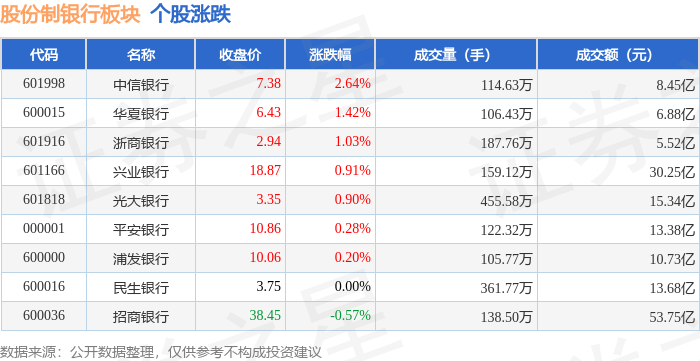
Group 1 - The banking sector saw a slight increase of 0.46% on February 2, with CITIC Bank leading the gains [1] - The Shanghai Composite Index closed at 4015.75, down 2.48%, while the Shenzhen Component Index closed at 13824.35, down 2.69% [1] - CITIC Bank's stock price rose by 2.64% to 7.38, with a trading volume of 1.1463 million shares and a transaction value of 845 million yuan [1] Group 2 - The net inflow of main funds in the banking sector was 162 million yuan, while retail funds saw a net inflow of approximately 89.95 million yuan [1] - CITIC Bank had a net inflow of 72.32 million yuan from main funds, but a net outflow of 18.99 million yuan from retail funds [1] - Minsheng Bank experienced a net inflow of 65.07 million yuan from main funds, with a net outflow of 30.58 million yuan from retail funds [1]





各银行在售高收益纯固收产品一览!合资理财子产品首次上榜
2 1 Shi Ji Jing Ji Bao Dao· 2026-02-02 09:13
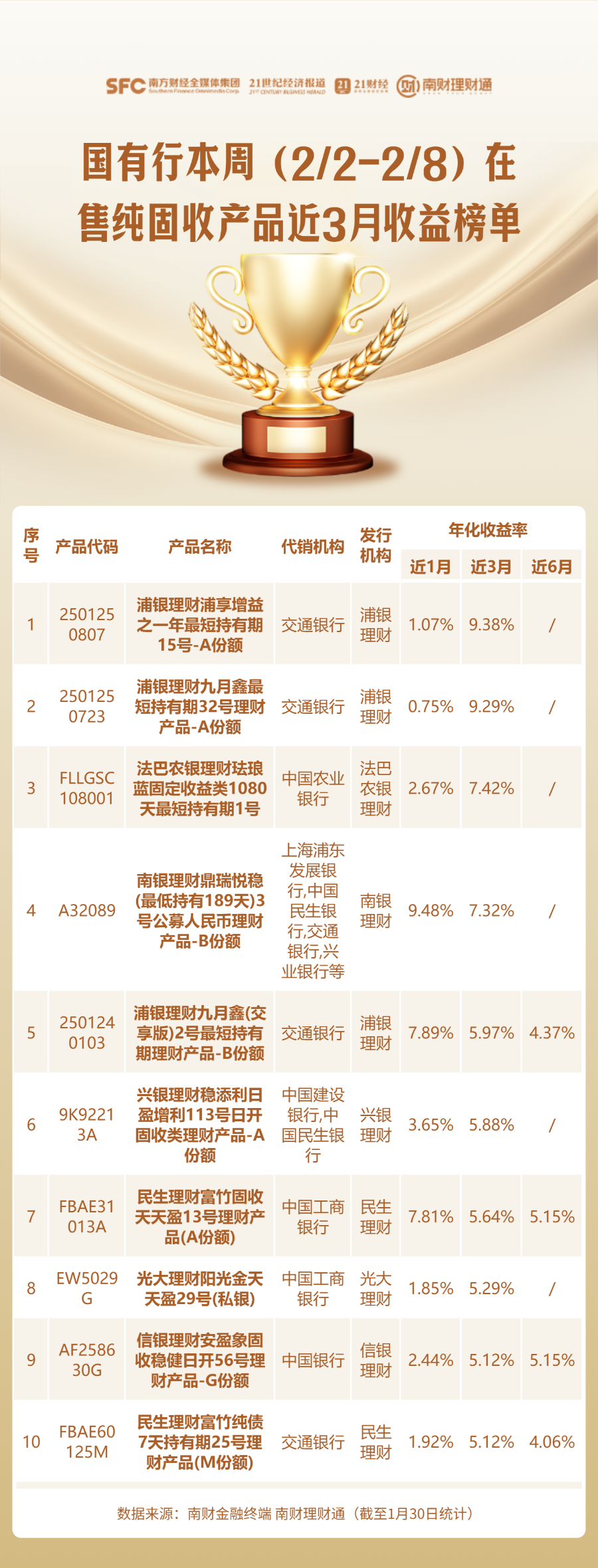
Core Insights - The report focuses on the performance of pure fixed-income products issued by wealth management companies, highlighting the best-performing products available for sale through various distribution channels [1][4] Group 1: Product Performance - The ranking of products is based on their annualized returns over the past month, three months, and six months, with a particular emphasis on the three-month annualized yield to reflect their performance amid recent market fluctuations [1] - A total of 28 distribution institutions are involved, including major banks such as Industrial and Commercial Bank of China, Bank of China, Agricultural Bank of China, and others [1] Group 2: Product Availability - The list of products is categorized as "available for sale," but actual availability may vary due to factors such as sold-out quotas or differences in product listings shown to different customers by banks [1] - Investors are advised to refer to the actual displays on the distribution bank's app for the most accurate information regarding product availability [1] Group 3: Data Source - The data presented in the report is sourced from the Nanfang Financial Terminal and Nanfang Wealth Management, with statistics as of January 30 [3][5]





卫星扎堆“上天”,银行风控卷出“新高度”
3 6 Ke· 2026-02-02 07:23
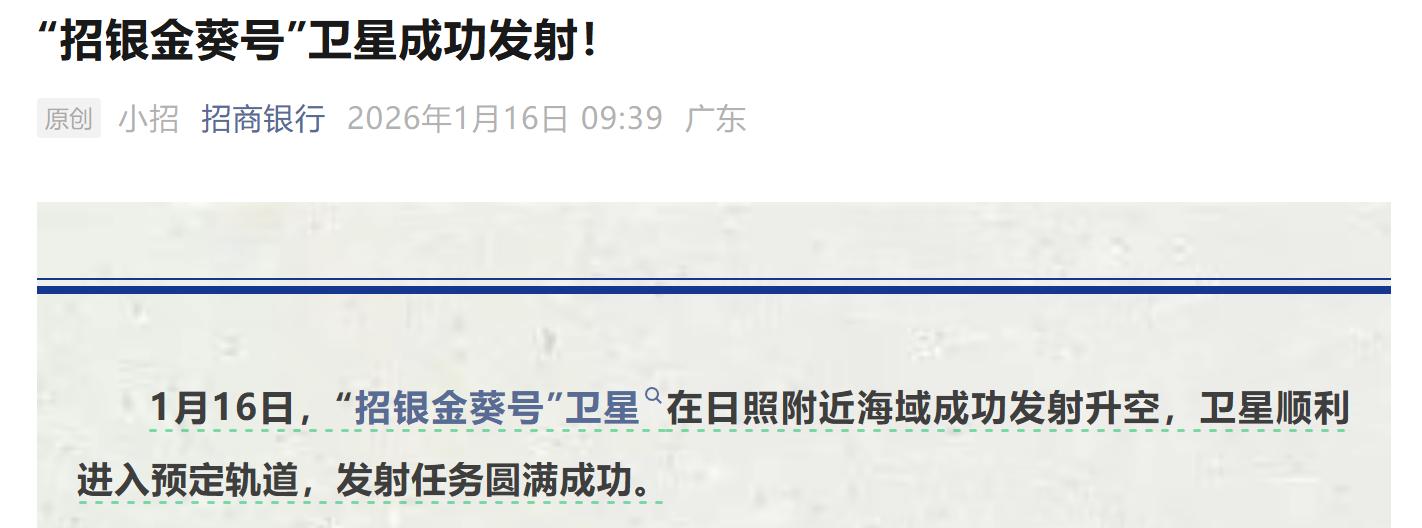
Core Viewpoint - The commercial aerospace sector is experiencing a surge in interest and investment, particularly from banks, driven by supportive policies and the potential for innovative applications of satellite technology in financial services [1][2][22]. Group 1: Policy and Industry Trends - Beijing has issued measures to promote the development and utilization of commercial satellite remote sensing data from 2026 to 2030, encouraging companies to build differentiated satellite constellations with clear commercial value and application prospects [1]. - Various industries, including traditional banking, are actively engaging in the commercial aerospace sector, with banks launching their own satellites [2][3]. Group 2: Bank Initiatives in Satellite Launches - On January 16, 2024, China Merchants Bank's "Zhaoyin Jinkui" and Shanghai Pudong Development Bank's "Pudong Digital" satellites were successfully launched [4]. - Both satellites are part of China's first global low-orbit satellite IoT constellation, "Tianqi Constellation" [5]. - The "Zhaoyin Jinkui" satellite is designed for high-precision monitoring of construction progress for first-hand mortgage properties, while the "Pudong Digital" satellite aims to enhance smart risk control and provide critical financial services during natural disasters [8]. Group 3: Evolution of Risk Control - The trend of banks launching satellites signifies a shift from traditional ground-based data reliance to a "heaven and earth collaboration" model for risk control [11][22]. - Satellite technology addresses the core pain point of information asymmetry in traditional risk management, providing banks with stable and objective data [13][14]. - For instance, the "Zhaoyin Jinkui" satellite can improve construction monitoring accuracy to over 95%, significantly enhancing post-loan inspection efficiency [14]. Group 4: Future Implications and Opportunities - The integration of satellite technology into banking operations not only enhances risk management but also opens new avenues for financing in the commercial aerospace sector, which has been traditionally challenging due to high barriers and lack of collateral [19][20]. - Banks' active participation in satellite launches may lead to deeper due diligence and value discovery in the commercial aerospace industry [20][21]. - The collective move of banks into the aerospace sector represents a critical leap in enhancing their core competitiveness and addressing inclusive finance challenges [22][23].

今年银行怎么干?12家银行年度工作会议高频词透露重要信息
Nan Fang Du Shi Bao· 2026-02-02 07:05
Core Insights - The banking industry is focusing on "digital transformation," "high-quality development," "risk prevention," and "artificial intelligence" as key themes for 2026, reflecting a shift towards more specialized and refined development paths [1][2][4] Group 1: Key Themes from Annual Meetings - "Digital transformation" and "risk prevention" are highlighted as primary focuses, with nine banks mentioning these themes in their annual meetings [4] - The term "high-quality development" appears frequently, indicating a collective industry goal towards sustainable growth [2][4] - "Cost reduction and efficiency enhancement" is emphasized by multiple banks, reflecting a strategic shift from scale expansion to more efficient operations in response to narrowing interest margins [6][7] Group 2: Specific Strategies and Initiatives - Banks are adopting "differentiated development" strategies to avoid internal competition, with seven banks mentioning this approach [6] - Several banks are actively working on reducing operational costs, with examples including the reduction of high-cost deposits and operational expenditures [7] - The concept of "investing in both tangible and human capital" is emerging, with two banks explicitly stating this in their annual meetings, indicating a shift in focus towards human capital and future value creation [8][9] Group 3: Risk Management and Performance - Banks are implementing comprehensive risk management systems, with proactive measures for early identification and handling of risks [4][5] - Some banks reported a decrease in non-performing loans, showcasing effective risk management practices [5] - Overall, banks are experiencing positive growth in revenue and net profit, indicating a recovery in performance amidst cost-cutting measures [7]

YiwealthSMI|年末市场震荡,专业陪伴内容更受青睐
Di Yi Cai Jing· 2026-02-02 05:12
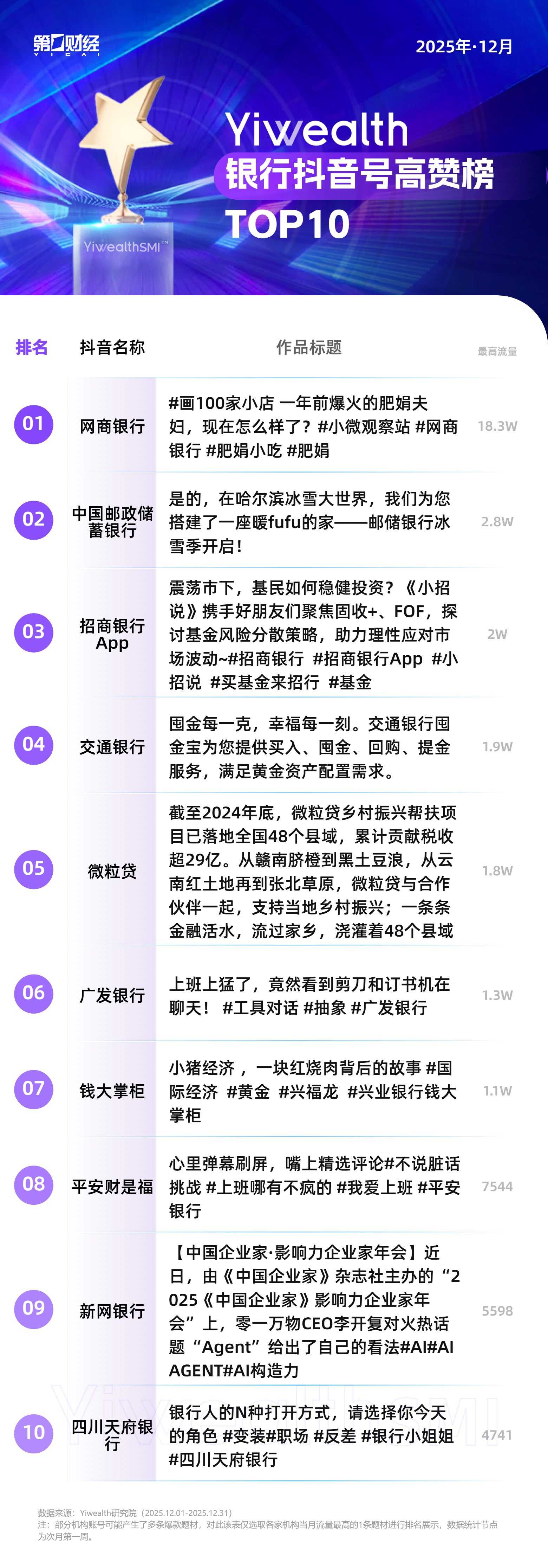
本期为银行社交媒体指数(2025年12月)。 本期为银行社交媒体指数(2025年12月)。 12月银行SMI总榜整体变化不大,仅赣州银行(11月Top19)、郑州银行(11月Top20)掉出榜单,长沙银行(Top13)和泰隆银行(Top18)上榜,名单进出 主要为运营质量较为不稳定的中小城商行。 在12月抖音高赞榜中,虽然网商银行的《画100家小店》依靠"肥娟夫妇"的暖心回访继续稳坐头把交椅,但用户的关注重心较11月已出现明显转变,专业陪 伴内容与抽象整活成为12月内容创作的核心方向。 年末市场震荡背景下,投资者情绪普遍焦虑,专业陪伴类内容顺势成为12月最大的流量黑马。招商银行App精准捕捉基民核心痛点,推出《小招说・朋友 说》系列节目,邀请基金经理与财经媒体人组局交流,以"老友对谈"的轻松形式,深度拆解基金挑选方法、固收+与FOF的核心区别等专业内容。该系列连 续更新五期,平均点赞量达到2万左右,表明在市场波动阶段,能切实缓解用户焦虑的专业干货,远比趣味段子更具传播吸引力。同样的逻辑也体现在兴业 银行钱大掌柜上,他们以"红烧肉"为引子,讲解中国生猪繁育产业从全国统一市场到"南繁北育"的格局变迁,这种让专业知 ...
金银“大跳水”下的深圳水贝市场:有档口单日卖出超200万元金条
Sou Hu Cai Jing· 2026-02-02 04:42
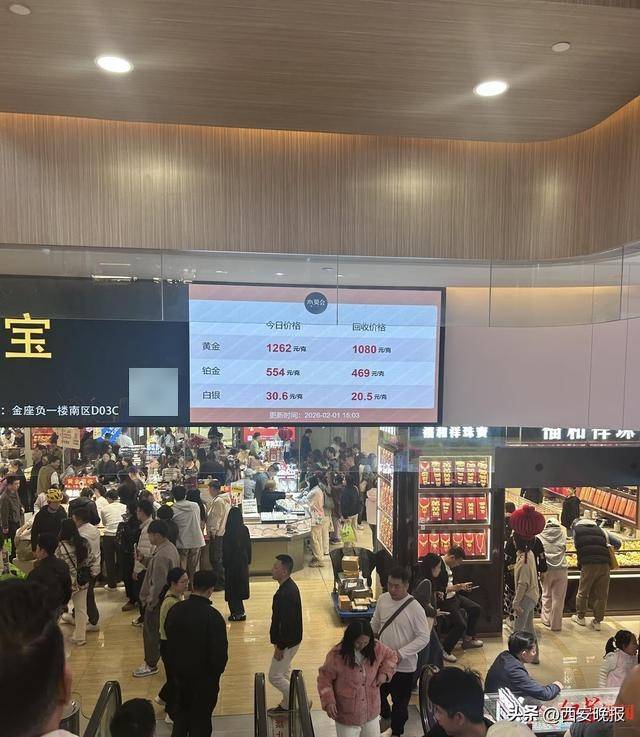
Core Viewpoint - The gold market experienced a significant drop in prices, with gold falling from 1252 CNY/g to 1142 CNY/g in a matter of minutes, marking a decline of over 9% on January 30, the largest single-day drop since 1983 [1][16]. Market Reaction - Following the price drop, many investors rushed to sell their gold holdings, with some reporting substantial profits from timely sales [1][5]. - The Shenzhen Shui Bei market saw a surge in activity, with some vendors selling gold bars worth millions in a single day, while others faced stock shortages due to high demand [3][8]. Price Trends - On February 1, gold prices were reported at 1262 CNY/g, with a recovery price of 1080 CNY/g, while silver prices were at 30.6 CNY/g, down from previous highs [5][10]. - The price of gold jewelry also saw a significant decline, with major brands reporting drops of up to 160 CNY/g within two days [14]. Investor Behavior - Some consumers opted to buy gold at lower prices, believing in its long-term value, while others were quick to sell due to market volatility [6][12]. - The market showed a mix of panic selling and opportunistic buying, with many investors expressing uncertainty about future price movements [8][10]. Institutional Response - Several banks have increased risk assessments for clients engaging in gold transactions, reflecting heightened market volatility and uncertainty [15]. - Analysts noted that the recent price drop was driven by an overheated market and external factors such as declines in the stock market, particularly following disappointing earnings reports from major companies [16].

黄金急跌!银行收紧,金条抢空
Jin Rong Jie· 2026-02-02 04:36
Group 1 - The international precious metals market experienced significant adjustments on January 30, leading major banks such as ICBC, CCB, BOC, and ABC to issue risk warnings and adjust related business rules [1] - ICBC advised investors to adopt a rational perspective on market fluctuations, control positions, and follow a principle of gradual and diversified allocation [1] - Other major banks also issued risk warnings, with CCB raising the minimum amount for personal gold accumulation to 1500 yuan, BOC advising clients to consider their risk tolerance, and ABC enhancing risk assessment requirements for gold accumulation [1][2] Group 2 - The physical gold market is experiencing high demand despite price adjustments, with popular products sold out on banking apps and limited availability of physical gold bars at branches [2] - There is a noticeable increase in inquiries about gold bars, as many view the price correction as an opportunity to accumulate for long-term holding, although supply constraints exist [2] - The interest rates for account-based gold products are being reduced to zero by major banks, indicating a weakening of their "interest property" [2]


银行股逆势上涨,中信银行涨超3%
Ge Long Hui· 2026-02-02 03:57
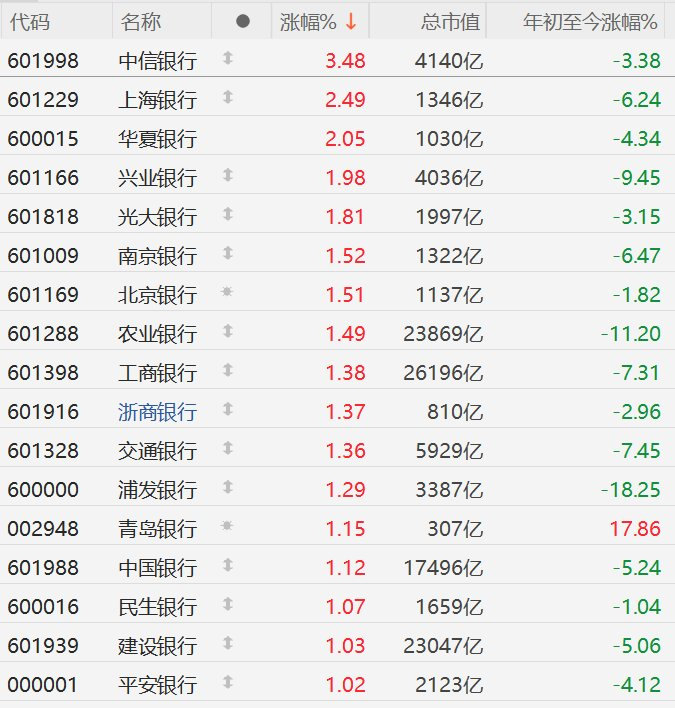
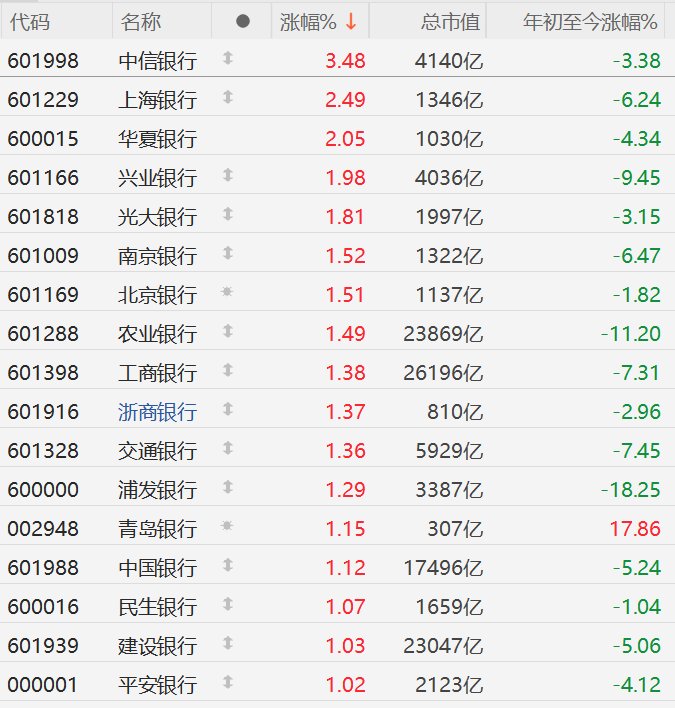
Core Viewpoint - The A-share market's banking sector experienced a counter-trend increase, with several banks showing significant gains despite overall market conditions [1]. Group 1: Stock Performance - CITIC Bank saw an increase of 3.48%, with a total market capitalization of 414 billion [2] - Shanghai Bank increased by 2.49%, with a market cap of 134.6 billion [2] - Huaxia Bank rose by 2.05%, with a market cap of 103 billion [2] - Other banks such as Industrial Bank, Everbright Bank, and Nanjing Bank also reported gains exceeding 1% [1][2] - Agricultural Bank, Industrial and Commercial Bank, and China Merchants Bank had market caps of 2386.9 billion, 2619.6 billion, and 2304.7 billion respectively, with slight increases [2] Group 2: Year-to-Date Performance - Year-to-date performance shows that most banks have negative returns, with CITIC Bank down 3.38% and Shanghai Bank down 6.24% [2] - Notably, Qingdao Bank has a positive year-to-date return of 17.86%, indicating strong performance relative to its peers [2] - Other banks like Agricultural Bank and Industrial Bank have year-to-date declines of 11.20% and 7.31% respectively [2]

A股银行股逆势上涨,中信银行涨超3%
Ge Long Hui A P P· 2026-02-02 03:54
Core Viewpoint - The A-share market has seen a rise in bank stocks, with several banks experiencing significant gains despite overall market trends [1] Group 1: Stock Performance - CITIC Bank increased by 3.48%, with a total market capitalization of 414 billion [2] - Shanghai Bank rose by 2.49%, with a market cap of 134.6 billion [2] - Huaxia Bank saw a gain of 2.05%, with a market value of 103 billion [2] - Industrial Bank increased by 1.98%, with a market cap of 403.6 billion [2] - Everbright Bank rose by 1.81%, with a total market capitalization of 199.7 billion [2] - Nanjing Bank increased by 1.52%, with a market cap of 132.2 billion [2] - Beijing Bank saw a rise of 1.51%, with a market value of 113.7 billion [2] - Agricultural Bank increased by 1.49%, with a market cap of 23,869 billion [2] - Industrial and Commercial Bank rose by 1.38%, with a market value of 26,196 billion [2] - Zhejiang Bank increased by 1.37%, with a market cap of 81 billion [2] - Bank of Communications rose by 1.36%, with a market value of 592.9 billion [2] - Shanghai Pudong Development Bank increased by 1.29%, with a market cap of 338.7 billion [2] - Qingdao Bank saw a rise of 1.15%, with a market value of 30.7 billion [2] - Bank of China increased by 1.12%, with a market cap of 17,496 billion [2] - Minsheng Bank rose by 1.07%, with a market value of 165.9 billion [2] - China Construction Bank increased by 1.03%, with a market cap of 23,047 billion [2] - Ping An Bank rose by 1.02%, with a market value of 212.3 billion [2] Group 2: Year-to-Date Performance - CITIC Bank has a year-to-date decline of 3.38% [2] - Shanghai Bank has decreased by 6.24% year-to-date [2] - Huaxia Bank has a year-to-date decline of 4.34% [2] - Industrial Bank has decreased by 9.45% year-to-date [2] - Everbright Bank has a year-to-date decline of 3.15% [2] - Nanjing Bank has decreased by 6.47% year-to-date [2] - Beijing Bank has a year-to-date decline of 1.82% [2] - Agricultural Bank has decreased by 11.20% year-to-date [2] - Industrial and Commercial Bank has a year-to-date decline of 7.31% [2] - Zhejiang Bank has decreased by 2.96% year-to-date [2] - Bank of Communications has a year-to-date decline of 7.45% [2] - Shanghai Pudong Development Bank has decreased by 18.25% year-to-date [2] - Qingdao Bank has increased by 17.86% year-to-date [2] - Bank of China has a year-to-date decline of 5.24% [2] - Minsheng Bank has decreased by 1.04% year-to-date [2] - China Construction Bank has a year-to-date decline of 5.06% [2] - Ping An Bank has decreased by 4.12% year-to-date [2]