
中国财险

Search documents
人保财险江门市分公司违规被罚 列支虚假车险手续费
Zhong Guo Jing Ji Wang· 2026-01-07 06:49
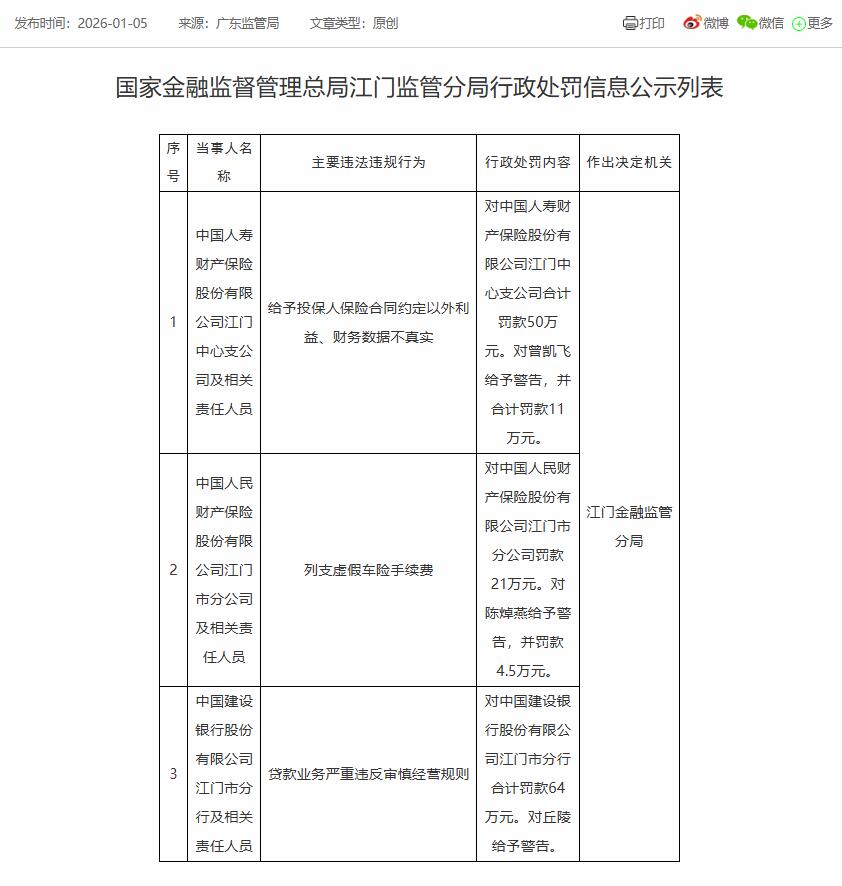
中国经济网北京1月7日讯 国家金融监督管理总局网站1月5日公布的江门监管分局行政处罚信息公示列表显示,中 国人民财产保险股份有限公司江门市分公司及相关责任人员列支虚假车险手续费。 | 序 | 当事人名 | 主要违法违规行为 | 行政处罚内容 | 作出决定机关 | | --- | --- | --- | --- | --- | | 름 | 称 | | 对中国人寿财 | | | | 股份有限 | | 心支公司合计 | | | | 中国人寿 财产保险 | | 产保险股份有 限公司江门中 | | | 1 | 公司江门 | 给予投保人保险合同约定以外利 | 罚款50万 | | | | | 益、财务数据不真实 | | | | | 中心支公 | | 元。对曾凯飞 | | | | 司及相关 | | 给予警告,并 | | | | 盖任人员 | | 合计罚款11 | | | | | | 万元。 | | | | 中国人民 | | 对中国人民财 限公司江门市 | 江门金融监管 分局 | | | | | 产保险股份有 | | | | 财产保险 | | | | | | 股份有限 | | | | | | | | 分公司罚款 | | | 2 ...

【窩輪透視】中國平安超買信號響起,窩輪槓桿效應如何把握?
Ge Long Hui· 2026-01-07 06:05
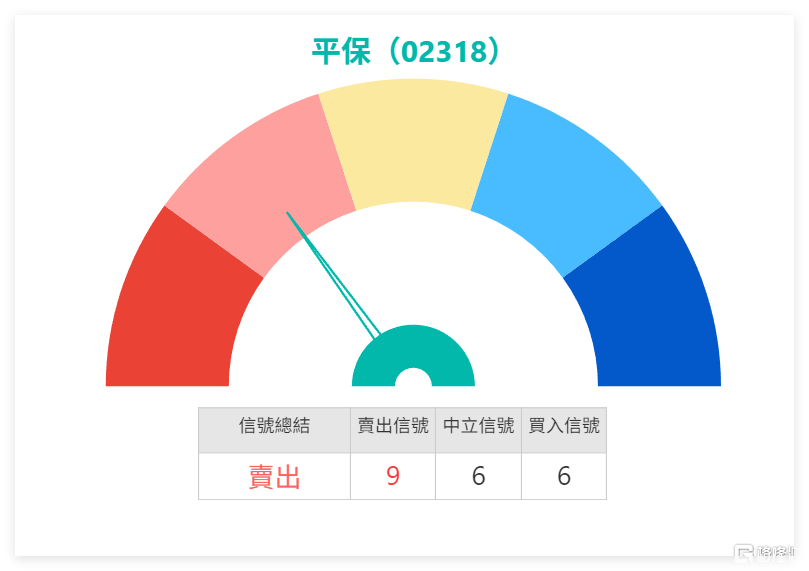
Core Viewpoint - China Ping An (02318) shows signs of overbuying, with a significant increase in trading volume and price movement, indicating potential short-term volatility and the need for caution among investors [1][3]. Technical Analysis - On January 5, 2026, China Ping An's stock closed at 68.6 HKD, up 2.69%, with a trading volume of 5.521 billion HKD. The current price is 71.25 HKD, with resistance levels at 71.9 HKD and 74 HKD, and support levels at 64.3 HKD and 60.9 HKD. The probability of further price increase is estimated at 50%, with a 5-day volatility of 7.8% [1]. - The RSI indicator is at 75, indicating an overbought condition, and the technical summary suggests a "strong sell" signal with a strength of 9, highlighting the potential for a price correction [1]. Sector Performance - On the same day, insurance stocks collectively performed well, with AIA Group (01299) closing at 83.9 HKD (up 0.72%), China Life (02628) at 29.82 HKD (up 3.40%), and China Pacific Insurance (02601) and New China Life (01336) rising by 4.03% and 5.34%, respectively. However, all these stocks also showed strong sell signals technically [1][3]. Derivative Products Analysis - The performance of related warrants has been notable, with two warrants linked to China Ping An showing a 7% increase shortly after the stock's movement, while a Morgan Stanley bull certificate rose by 8% [3]. - The leverage effect of warrants is significant, allowing investors to achieve higher returns even with minor stock price movements. The sensitivity of warrants to stock price changes is influenced by the distance between the exercise price and the current stock price [5]. Selected Products and Recommendations - Three potential products are highlighted for investors: 1. Morgan Stanley Bull Certificate (61191) with a leverage of 9.1 times and a recovery price of 61 HKD, providing a safety margin against price corrections [6]. 2. UBS Bull Certificate (61015) with the lowest premium and a leverage of 8.6 times, suitable for moderate risk investors seeking stable returns [6]. 3. Bank of China Call Warrant (21992) with a leverage of 9.6 times and an exercise price of 76.93 HKD, offering significant appreciation potential if the stock breaks through resistance [6]. Investment Strategy - Investors holding related warrants are advised to set reasonable profit-taking levels to avoid losses from potential stock corrections. New investors are recommended to avoid chasing high-priced products and instead focus on those with lower premiums and reasonable leverage [5][6].

进击的保险:不只是交易“开门红”,长债2%关口与重返1倍P/EV
Hua Er Jie Jian Wen· 2026-01-07 05:08
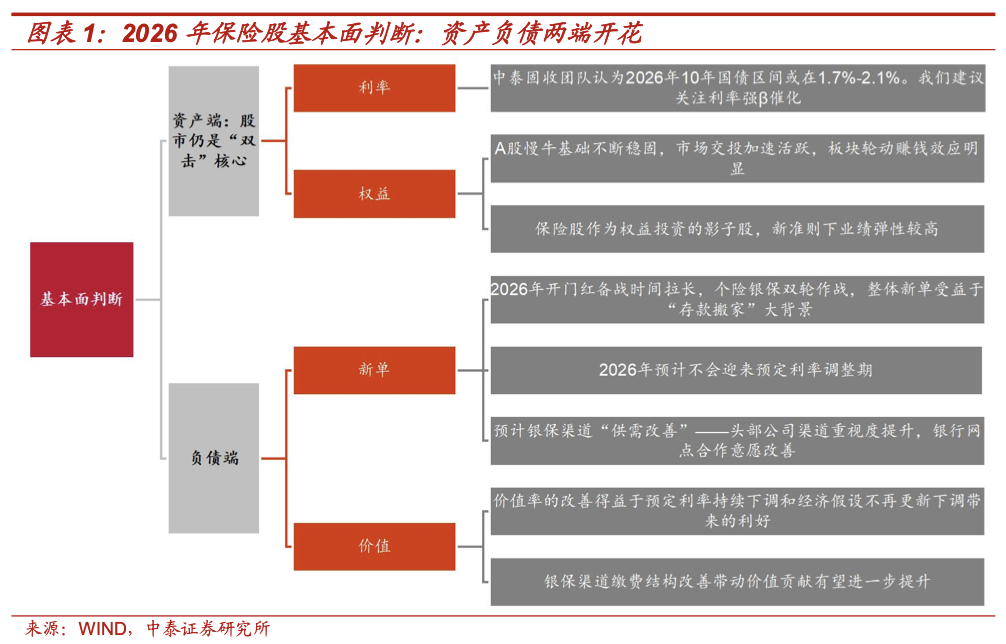
Core Viewpoint - The insurance sector experienced a significant rise of over 6% on January 5, 2026, with Xinhua Insurance and China Pacific Insurance reaching historical highs, driven by a cyclical logic of improved expectations, rising long-term interest rates, and reinforced profit elasticity since December 2025 [1] Group 1: Market Performance and Expectations - The current stock prices reflect an optimistic outlook for the "opening red" period of 2026, with Q1 2026 expected to be a peak for value and profit growth [2] - The average new business growth rate for listed insurance companies in Q1 2026 is projected to be 30%, with bancassurance and individual insurance growth rates at 50% and 20% respectively [2] - The low base from 2025 for individual insurance and the increasing focus on bancassurance channels by leading companies are expected to drive growth in new business [2] Group 2: Interest Rates and Valuation - The significance of long-term interest rates breaking the 2.0% mark is highlighted, with market expectations showing divergence on future trends [3] - If long-term rates exceed 2.0%, it could lead to a gradual approach of P/EV valuations towards 1x, benefiting insurance stock valuations [3] - The 10-year government bond yield is anticipated to range between 1.7% and 2.1% in 2026, with a favorable environment for insurance stock valuations due to improving credit spreads and term spreads [3] Group 3: Business Value and Growth Projections - The internal value (EV) credibility is gradually recovering, with expectations of a return to growth in EV for listed insurance companies from 2025 to 2027, averaging 10.6%, 10.9%, and 10.8% respectively [4] - The new business value (NBV) growth rates are projected at 34.7%, 21.7%, and 10.0% for the same period, indicating a positive outlook for the sector [4] - The insurance companies are expected to improve profitability through refined management of liability costs and benefit from upward catalysts in the asset side [4] Group 4: Strategic Recommendations - Investment in cyclical insurance stocks with strong performance support is recommended, as 2026 is expected to see growth in new business and value alongside continued management of liability costs [4] - The focus on bancassurance channels and the improvement in payment structures are likely to enhance value contributions from these channels [6]



“保险+气象+风险减量”创新模式护航长江无人机货运安全
Nan Jing Ri Bao· 2026-01-07 03:46
Core Insights - The article discusses an innovative insurance model in Nanjing that combines insurance, meteorology, and risk reduction to enhance the safety of drone logistics operations, particularly in adverse weather conditions [1][2]. Group 1: Insurance Innovation - The new insurance product, named "Drone Body and Equipment Accidental Loss Insurance," covers losses from accidents and missing drones, addressing previous limitations where compensation required physical evidence of damage [2]. - Each drone is valued at approximately 150,000 yuan, and this insurance significantly mitigates risks associated with extreme weather, facilitating the last-mile delivery in aerial logistics [2]. Group 2: Meteorological Integration - The insurance model leverages high-precision meteorological monitoring equipment to provide real-time data on wind conditions and visibility, enabling proactive risk management through flight diversion suggestions and contingency plans [2]. - This integration marks a shift in insurance services from post-incident claims to preemptive warnings and risk reduction strategies [2]. Group 3: Industry Impact - The innovative approach has received positive feedback from insurance professionals in Nanjing, highlighting it as a breakthrough in risk management for the low-altitude economy and a significant step for the insurance industry in adopting high-tech solutions [3]. - There is potential for this model to be expanded to other applications, such as urban air traffic and emergency rescue operations, indicating a broader impact on the industry [3].
上市险企新旧准则切换所得税切换测算:OCI选择权的两面性,税务追溯对现金流影响有限
ZHONGTAI SECURITIES· 2026-01-06 13:32
Investment Rating - The industry investment rating is "Increase Holding" [2] Core Viewpoints - The tax adjustment for listed insurance companies has a limited overall impact, primarily affecting cash flow rather than profit and loss statements or balance sheets [5][10] - The new accounting standards provide insurance companies with an OCI option, which reduces the impact of interest rate fluctuations on net profit [5] - The average effective tax rate for listed insurance companies has been low, with rates of 10%, 8%, -1%, -6%, 12%, and 17% from 2020 to Q3 2025, indicating a disconnect between tax burdens and actual operating performance [5][12] - The estimated taxable profit difference for listed companies under the new and old standards is projected to be 42 billion in 2023 and 93 billion in 2024, with a significant portion of this difference being attributable to insurance contracts [5][18] Summary by Relevant Sections Tax Adjustment Impact - The tax adjustment is expected to have a minimal effect on operating cash flow, with an average impact of 2.27% across listed insurance companies [5][18] - Specific companies like New China Life and China Life may experience a more significant impact, estimated at around 14% for New China Life [5][18] Financial Performance - The listed insurance companies have seen record high pre-tax profits in the first three quarters of 2025, exceeding the total profits of 2024 [11] - The actual income tax paid has not kept pace with rising profits, indicating a potential for future tax liabilities [12] Recommendations - The report suggests focusing on companies such as China Life (A/H), Ping An (A/H), China Pacific Insurance (A/H), New China Life (A/H), and China Property & Casualty Insurance (A/H) for investment opportunities [5]
港股科网股、保险股大涨
第一财经· 2026-01-06 08:39
Group 1: Technology Stocks Performance - Technology stocks experienced a broad increase, with SenseTime, Leapmotor, JD Health, and Tongcheng Travel rising over 5%, while XPeng Motors increased by more than 4% [1][2] - Notable gains were also observed in Alibaba Health, Trip.com Group, BYD Electronics, and Horizon Robotics [1] Group 2: Market Indexes - On January 6, the Hang Seng Index rose by 1.38%, and the Hang Seng Tech Index increased by 1.46% [3] Group 3: Insurance Stocks Performance - Insurance stocks showed strength, with China Ping An and Sunshine Insurance both rising nearly 5%, and China Life increasing by over 4% [4] - Other insurance companies such as China Taiping and China Pacific also saw gains [4]

“社保第六险”已覆盖近3亿人,转向全面建制
2 1 Shi Ji Jing Ji Bao Dao· 2026-01-06 03:31
Core Viewpoint - The Long-term Care Insurance (LTCI) system in China is transitioning from pilot programs to a comprehensive national framework, aiming to address the challenges of an aging population and provide essential care services for disabled individuals [2][4][6]. Group 1: LTCI System Development - The LTCI system, referred to as the "sixth social insurance," is expected to cover nearly 300 million people and benefit over 3.3 million disabled individuals by the end of 2025, with total expenditures exceeding 100 billion yuan [2]. - The pilot phase of LTCI, which began in 2016, has revealed issues such as fragmentation and varying standards across regions, necessitating a unified approach for sustainable development [4][5]. - The National Healthcare Security Administration (NHSA) plans to standardize funding, benefits, and payment policies to ensure high-quality and sustainable development of the LTCI system [6][7]. Group 2: Financial Sustainability and Challenges - The projected number of disabled individuals in China is expected to reach 34 million by 2025 and 62 million by 2050, leading to a significant increase in funding requirements for long-term care [5]. - Current funding mechanisms primarily rely on medical insurance funds and local government subsidies, which pose sustainability risks due to demographic changes [4][5]. - A multi-channel funding approach is essential to address the financial challenges associated with the nationwide implementation of LTCI [5]. Group 3: Role of Insurance Companies - Insurance companies are acting as third-party administrators for LTCI, managing funds and overseeing service quality rather than providing direct care [9]. - The current business model for insurance companies in LTCI is characterized by low profitability, with a shift towards value creation and innovation expected as the system matures [10][11]. - Companies are exploring technology-driven solutions to enhance operational efficiency and reduce costs, indicating a transition from traditional service models to integrated care solutions [10][11]. Group 4: Market Opportunities for Commercial Insurance - The LTCI system's comprehensive establishment is anticipated to create new growth opportunities for commercial insurance by addressing gaps in coverage for moderate disabilities and specialized care needs [15][16]. - Commercial insurance can develop tailored products for underrepresented groups, such as those with moderate disabilities and dementia, enhancing the overall care landscape [15][16]. - The integration of commercial insurance with high-end care services and personalized offerings is expected to meet diverse consumer demands and expand market reach [16][17].

消费者遭遇车险保费“逆向”调价
Shang Hai Zheng Quan Bao· 2026-01-06 02:18
Core Viewpoint - The recent increase in car insurance premiums, particularly for drivers with no claims, undermines the incentive structure for "good drivers" and may lead to dissatisfaction among consumers [1][5]. Group 1: Premium Increases - Many car owners, including those in regions like Hunan and Sichuan, have reported significant increases in their insurance premiums despite having no claims, breaking the previous norm where premiums would typically decrease for "good drivers" [1][2]. - For example, one car owner's comprehensive insurance premium rose by approximately 46.28%, while the coverage amount decreased from about 170,000 yuan to 150,000 yuan [2]. - The rise in premiums is attributed to regulatory requirements that limit discounting practices, leading to a return to more reasonable pricing levels [3][4]. Group 2: Industry Factors - The increase in premiums is influenced by both industry-wide and individual factors, including stricter regulations on pricing and the need for insurance companies to maintain sustainable business practices [3][4]. - Regulatory changes have eliminated hidden discounting methods, causing premiums to reflect more accurate risk assessments and operational costs [4]. - The overall combined cost ratio for the car insurance industry is approximately 97.9%, indicating that some smaller insurers are operating at a loss, which may necessitate higher premiums to ensure sustainability [4]. Group 3: Consumer Sentiment and Recommendations - The significant rise in premiums may lead consumers to reconsider their insurance purchases, with some indicating they might only opt for mandatory insurance in the future [5]. - Experts suggest that maintaining a good driving record should still yield premium discounts, and the industry should communicate transparently with consumers to avoid perceptions of unfairness [5][6]. - There is a call for the promotion of clear discount structures in insurance policies to enhance consumer trust and understanding [5][6].
长护险九年试点覆盖近3亿人 “社保第六险”转向全面建制
2 1 Shi Ji Jing Ji Bao Dao· 2026-01-05 23:05
Core Insights - The long-term care insurance (LTCI) system in China is transitioning from pilot programs to a comprehensive national framework during the 14th Five-Year Plan period, aiming to address the challenges posed by an aging population [1][2]. Group 1: LTCI System Overview - The LTCI system, referred to as the "sixth social insurance," has been piloted in 49 cities over nine years, covering nearly 300 million people and benefiting over 3.3 million disabled individuals, with total expenditures exceeding 100 billion yuan [2]. - The LTCI aims to provide essential living care and medical services for long-term disabled individuals, addressing the imbalance faced by families when one member becomes disabled [3]. Group 2: Challenges and Risks - The current fragmented pilot programs have led to significant disparities in funding mechanisms, disability assessment standards, and benefit payment scopes across different regions, raising sustainability concerns [3]. - The reliance on a single funding source, primarily the medical insurance fund, poses risks of inequity and financial pressure due to the increasing aging population [3][4]. Group 3: Need for Standardization - There is an urgent need for standardized funding and disability assessment criteria to ensure equitable access to services and to eliminate "welfare gaps" across regions [5]. - The National Healthcare Security Administration plans to implement unified standards for funding, benefits, and payment policies to support the sustainable development of the LTCI system [5]. Group 4: Role of Insurance Companies - Insurance companies are acting as third-party administrators for LTCI, managing funds and overseeing service quality, but they currently operate in a low-profit environment [7][8]. - The shift towards a comprehensive LTCI system will require insurance companies to enhance their professional capabilities and innovate product offerings to meet new regulatory standards [8][11]. Group 5: Future Opportunities - The LTCI's comprehensive establishment is expected to drive supply-side upgrades in the care industry, creating new growth opportunities for commercial insurance [12]. - The government encourages insurance companies to develop differentiated supplementary products to fill coverage gaps, particularly for moderate disability and dementia care [13][14]. Group 6: Strategic Recommendations - Insurance companies should leverage their capital and expertise to invest in care facilities, train professionals, and innovate service models to transition from mere payers to integrators of care services [15].
中国财险(02328.HK):李玲董事任职资格获金融监督管理总局核准
Ge Long Hui· 2026-01-05 12:16
格隆汇1月5日丨中国财险(02328.HK)公告,公司于近日收到国家金融监督管理总局关于李玲中国人民财 产保险股份有限公司董事任职资格的批覆。根据该批覆,国家金融监督管理总局已核准李玲担任公司董 事的任职资格。李玲担任公司职工董事及董事会审计委员会委员的任职自2026年1月4日起生效。 ...